![]()
CHAPTER 1: INTRODUCTION
1.1 Intended audience
This publication is designed for audience groups, including:
•Individuals wishing to build on their foundation-level knowledge of SIAM and achieve the SIAM Professional certification
•Customer organizations and their staff looking for guidance when managing a multi-service provider environment
•Service integrators and their staff wishing to work effectively in a SIAM ecosystem
•Internal and external service providers and their staff wishing to understand their role in a SIAM ecosystem
•Consultants in service management and other frameworks who wish to expand their knowledge in this area
1.2 The background of SIAM
SIAM developed in response to the challenges organizations face when using multiple service providers as part of their supply network, sometimes called multi-sourcing. Although multi-sourcing offers organizations the ability to choose the best service provider for each element of an end-to-end service, it may also incur significant management overhead and costs. Some organizations may not have the capabilities to manage service providers and their services.
The scope of SIAM
Although SIAM originated in the IT services arena, it is now used by an increasing number of organizations to manage business services.
This introduction provides a review of content from the SIAM Foundation BoK to aid understanding of the rest of the publication. It includes:
•SIAM Foundation BoK history
•SIAM terminology
•SIAM roadmap
Historically, organizations received IT services internally, using a simple structure of infrastructure and applications managed by an IT department. As technology use has become more complex, and business users have become more demanding, some organizations have chosen to outsource work between multiple service providers. This enables segregation of service elements, unlocks flexibility and reduces the risk of dependency on one service provider. Multi-sourcing also supports a ‘best of breed’ approach, where the organization can select services from specialized service providers.
Commissioning organizations must consider how and from where services are provided, to maximize performance of their value network within their budget. The management of multiple service providers by a single organization presents significant administrative challenges.
SIAM provides a standardized methodology for integrating and managing multiple service providers and their services. It enhances the management of the end-to-end supply chain and provides governance, management, integration, assurance and coordination to maximize the value received.
SIAM supports cross-functional, cross-process and cross-provider integration in a complex sourcing environment or ecosystem. It ensures all parties understand and are empowered to fulfil their role and responsibilities, and are held accountable for the outcomes they support.
SIAM recommends the appointment of a single logical entity with accountability for end-to-end service delivery: the service integrator. The customer organization has a management relationship with the service integrator, and the service integrator manages the relationships with service providers.
1.3 History of the SIAM Foundation BoK
SIAM evolved from many different organizations and countries. As organizations developed proprietary materials, there was little objective guidance available for practitioners.
In 2016, in response to the requirement for SIAM guidance, Scopism Limited worked with contributors from a wide range of organizations and individuals to create the SIAM Foundation BoK. This publication provides the basis for the subsequent SIAM Foundation certification scheme launched by EXIN and Scopism.2
1.4 SIAM key concepts
The following sections describe SIAM key concepts. More detail is available in the SIAM Foundation BoK3:
•SIAM layers
•SIAM structures
•Drivers for SIAM
•SIAM terminology:
oSIAM practice
oSIAM function
oSIAM roles
oSIAM structural elements
oSIAM models
•SIAM roadmap
1.5 SIAM layers
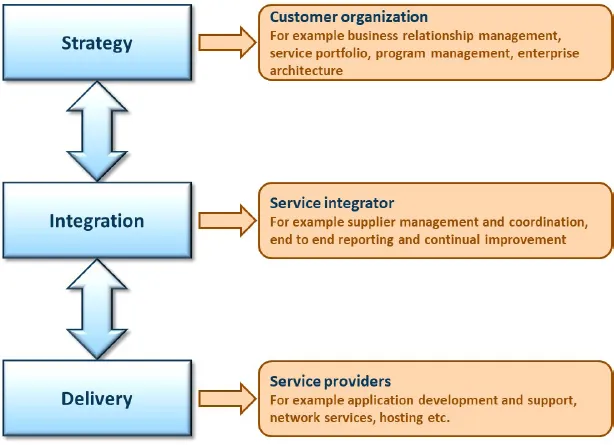
The SIAM ecosystem consists of three basic layers: the customer organization, the service integrator and service providers.
The focus, activities and responsibilities for each layer are different, as shown in Figure 1.
Figure 1: SIAM layers
An overview of each layer is provided here, with detailed information contained in the SIAM Foundation BoK.
1.5.1 Customer organization
The role of the customer organization is to commission services and provide direction based on the organization’s strategy. In a traditional multi-service provider model, the customer organization has a direct relationship with each service provider. In a SIAM model, the customer organization has a relationship with the service integrator. It retains ownership of the commercial relationship with each service provider, however, the service integrator carries out management, governance, integration, coordination and assurance activities.
The customer organization may have ‘retained capabilities’, which are skills and capabilities important for the delivery of service. Retained capabilities may sometimes be referred to as the ‘intelligent client function’.
1.5.2 Service integrator
The service integrator is responsible for managing service providers. It provides governance, management, integration, assurance and coordination across the SIAM ecosystem. It focuses on the end-to-end provision of service, ensuring that all service providers are properly engaged in service delivery and are providing value. The service integrator encourages collaboration between service providers.
The service integrator layer may be fulfilled by one or more organizations, including the customer organization. Having more than one organization in the service integrator role provides an additional challenge, so this approach must be managed carefully to ensure roles and responsibilities are clearly defined. (See section 1.6.3 Hybrid service integrator.)
1.5.3 Service provider
A SIAM ecosystem has multiple service providers delivering one or more services or service elements to the customer organization. Each service provider takes responsibility for managing its part of the contracted service, including the technology and processes that support end-to-end service delivery.
Service providers can be part of the customer organization or external to it:
•An external service provider is an organization that is not part of the customer organization. Its performance is typically managed using service level agreements (SLAs) ...