Fine-tune your leadership skills, solidify respect among your workforce, and ensure your company's lasting success with tools from a winning CEO.
When Martin G. Moore was asked to rescue a leading energy corporation from ever-increasing debt and a lack of executive accountability, he faced an uphill battle. Not only had he never before stepped into the role of CEO; he also had no experience in the rapidly evolving energy sector. Relying on the practical leadership principles he had honed throughout his thirty-three-year career, he overhauled the company's culture, redefined its leadership capability, and increased earnings by a compound annual growth rate of 125 percent.
In
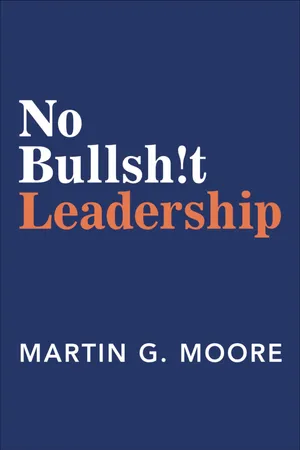
No Bullsh!t Leadership, Moore outlines these proven leadership principles in a clear, direct way. He sweeps away the mystical fog surrounding leadership today and lays out the essential steps for success. Moore combines this tangible advice with honest, real-world examples from his own career to provide a no-nonsense look at the skills a true leader possesses.
Moore's principles for no bullshit leadership focus on:
· Creating value by focusing only on the things that matter most
· Facing conflict, adversity, and ambiguity with decisiveness and confidence
· Setting uncompromising standards for behavior and performance
· Selecting and developing great people
· Making those people accountable, and empowering them to do their best
· Setting simple, value-driven goals and communicating them relentlessly
Though the steps aren't easy, they are guaranteed, if implemented, to lift your leadership—and your organization—to a higher level. Wherever you are in your career,
No Bullsh!t Leadership will help you develop the skills and form the habits needed to become a no bullshit leader.
- 288 pages
- English
- ePUB (mobile friendly)
- Available on iOS & Android
eBook - ePub
No Bullsh!t Leadership
About this book
Information

The Bullsh!t We Believe
Have you ever heard a leader say, “Our people are our greatest asset”? Maybe you’ve said it yourself. Some part of you may have even believed it.
I’m a huge fan of irony, and in these few words the irony is rich. The very comparison of people to other corporate assets—physical, financial, technical, etc.—dehumanizes them. It demonstrates precisely the lack of regard for individuals that this platitude is intended to alleviate.
If people were indeed the greatest asset of an organization, leaders would treat them very differently. In the vast majority of organizations, people are not the greatest asset, but rather the most underutilized asset.
If you value your assets, you treat them with the respect they deserve. You know how to get the most out of them. You don’t run them into the ground—you maintain them well to preserve their useful life. You figure out how to leverage them to gain competitive advantage. You understand the value that they’re capable of creating and spend deliberate effort thinking about how to capture that value.
If we’re going to compare our people to other organizational assets, then we at least need to treat them with the same level of importance, don’t we?
Imagine this scenario. You report to me as your direct manager, and you’re conducting a negotiation on behalf of the organization. One day, you walk into my office and say, without the faintest hint of embarrassment, “Martin, you know that deal I’m negotiating? Well, we’ve done a thorough analysis of the risk and value drivers and understand our counterpart’s position. We’re confident that the value of the transaction is $100 million. But I was thinking last night… It’s going to be really difficult to convince the other party of our position, and it’ll take a lot of time and effort to get the deal done. Why don’t we just settle now for $75 million and move on?”
That would be virtually unthinkable. To suggest leaving $25 million on the table, just because it looked as though capturing that value might be hard? As your boss, I’d be so shocked that I might even consider freeing you up to be successful in another organization (preferably, one of our competitors).
But often, when it comes to our people, leaving value on the table is exactly what we do. I’ve had senior executives say to me, with a straight face, “Martin, you know that vice president who’s running our Atlantic region? Well, he isn’t making the progress I expected. The culture of his team is very poor, and the results in his region aren’t improving. I know you’ve been pushing me to do something about this. But I was thinking last night… The last time we filled that role, we found it really difficult to find the right person. At least the current VP has the right industry experience. Performance management would be difficult and time consuming, and I’m not sure it will change anything. Besides, I’ve got truckloads of other important things I need to focus on, so I’m not going to take any action at the moment.”
For some strange reason, this doesn’t sound quite as ridiculous as the first example. What would be unthinkable behavior in terms of financial outcomes (where results are tangible and quantitative) often appears acceptable when it comes to people, leadership, and culture (where measuring outcomes is more difficult).
And to compound the felony, in the next breath that same executive will tell me that his own leadership performance is excellent.
Until we stop believing our own bullshit about leadership, culture, and people, we’ll never achieve the results we should. ⁄ ⁄
Why Is Leadership Hard?
I don’t know exactly when it happened, but the leadership discourse has devolved into a fluffy, abstract discussion on the aspirational qualities that great leaders should possess. Great leaders are humble; great leaders are transparent; great leaders have integrity; great leaders lead from the front.
Every year, millions of books, articles, blogs, and podcasts tell us how to be better leaders. We feel a warm glow of satisfaction when we consume this information, comforted by the impression that we’re on the road to leadership excellence. Unfortunately, for the most part this guidance serves only to motivate us with a short-term sugar hit of inspiration. The advice isn’t practical or specific enough to be of any real use.
It reminds me of an old Monty Python comedy sketch, a fictitious children’s show called How To Do It, in which they parody our tendency to oversimplify very complex subjects. Amongst other topics, they tackle how to split the atom, how to construct box girder bridges and, my favorite, how to play the flute. Their explanation? “Well, kids, you blow in one end and move your fingers up and down the outside.”
Absolutely true, but not particularly useful.
Most leadership advice is like that: true, but not useful.
Amidst the vast array of definitions of leadership, sometimes it’s easier to describe what leadership isn’t. It isn’t about making people happy. It isn’t about virtue signaling. It isn’t about making sure that everyone gets along. It isn’t about wielding the power of your position, either. It isn’t about mindlessly doing whatever your bosses instruct you to do, nor is it about pandering to their whims. It isn’t about accepting everyone unconditionally, regardless of their individual choices about how they behave and perform.
I’ve seen so many leaders over the course of my career pin their leadership credentials on one of these common fallacies. Virtue signaling is a particularly common weapon in many CEOs’ arsenals. They’re desperate to be seen as noble, benevolent leaders who have the interests of their people, and the greater good of society, as the dominant consideration driving every decision. This is some A-grade bullshit.
As you get to know them, you often find a jarringly different reality. The misalignment between how they wish to be perceived, what they truly believe, and how they ultimately act is sometimes difficult to fathom. Despite the facade of good intent, their behavior is driven almost entirely by their desire for personal rewards.
But if leadership isn’t about these things, what is it about? Well, first and foremost, leadership is about results. My biggest bugbear with today’s popular view on leadership is that it has decoupled the process of leading people from the essential need to achieve results. We seem to have lost sight of the fundamental purpose of leadership: value creation. And I don’t simply mean financial value.
No Bullsh!t Leadership re-establishes the connection between people and outcomes, with a simple, prime leadership objective: to deliver optimal results by getting the most from your people.
But to lead like this is hard. It sometimes pulls us in the opposite direction of our most primordial drives. It demands that we look at ourselves with a raw honesty that most prefer to shy away from. It parachutes us into situations that we’d rather avoid. It does nothing to build the illusion of self-assurance and confidence that we spend a lifetime trying to fabricate.
Leadership is hard because, more than anything else, it’s about people. Most of us struggle to manage ourselves: our subconscious drivers, our relationships, our emotions, our mental health, our habits. Leadership demands not only that we master ourselves, but also that we become strong enough and capable enough to help others do the same.
People are complex and unpredictable, each individual a unique package informed by their childhood trauma, significant relationships, and the many choices that have brought them to where they are today. As leaders, we aren’t necessarily equipped to deal with the myriad personalities, motivations, and expectations of our people. Besides, trying to cater to them would be futile, as the permutations are virtually limitless.
Taking on the mantle of leadership for the first time is a huge challenge. We effectively have to take a backward step. On Friday, I was an expert in my field, with deep skills in law, finance, or marketing. But now it’s Monday, and I’m a leader—a complete novice. My role has changed from being responsible only for my own results, to taking accountability for the work of others. People who, incidentally, are unlikely to be as capable as me (after all, I was the one who got the promotion, not them!).
It’s the lack of control we experience in this progression to a new type of role that’s foreign and difficult, that pushes us to work below our level. To micromanage, to rescue, to over-function for our people. All so that we can remain comfortable in the knowledge that we’re still valuable to the organization, and continue to deliver resul...
Table of contents
- Cover
- Title Page
- Copyright
- Dedication
- Contents
- Introduction
- Chapter 1: The Problem with Leadership
- Chapter 2: Deliver Value
- Chapter 3: Handle Conflict
- Chapter 4: Build Resilience
- Chapter 5: Work at the Right Level
- Chapter 6: Master Ambiguity
- Chapter 7: Make Great Decisions
- Chapter 8: Drive Accountability
- Chapter 9: Connecting the Dots
- Conclusion
- Acknowledgments
Trusted by 375,005 students
Access to over 1.5 million titles for a fair monthly price.
Study more efficiently using our study tools.
Frequently asked questions
Yes, you can cancel anytime from the Subscription tab in your account settings on the Perlego website. Your subscription will stay active until the end of your current billing period. Learn how to cancel your subscription
No, books cannot be downloaded as external files, such as PDFs, for use outside of Perlego. However, you can download books within the Perlego app for offline reading on mobile or tablet. Learn how to download books offline
Perlego offers two plans: Essential and Complete
- Essential is ideal for learners and professionals who enjoy exploring a wide range of subjects. Access the Essential Library with 800,000+ trusted titles and best-sellers across business, personal growth, and the humanities. Includes unlimited reading time and Standard Read Aloud voice.
- Complete: Perfect for advanced learners and researchers needing full, unrestricted access. Unlock 1.5M+ books across hundreds of subjects, including academic and specialized titles. The Complete Plan also includes advanced features like Premium Read Aloud and Research Assistant.
We are an online textbook subscription service, where you can get access to an entire online library for less than the price of a single book per month. With over 1.5 million books across 990+ topics, we’ve got you covered! Learn about our mission
Look out for the read-aloud symbol on your next book to see if you can listen to it. The read-aloud tool reads text aloud for you, highlighting the text as it is being read. You can pause it, speed it up and slow it down. Learn more about Read Aloud
Yes! You can use the Perlego app on both iOS and Android devices to read anytime, anywhere — even offline. Perfect for commutes or when you’re on the go.
Please note we cannot support devices running on iOS 13 and Android 7 or earlier. Learn more about using the app
Please note we cannot support devices running on iOS 13 and Android 7 or earlier. Learn more about using the app
Yes, you can access No Bullsh!t Leadership by Martin G. Moore in PDF and/or ePUB format, as well as other popular books in Business & Decision Making. We have over 1.5 million books available in our catalogue for you to explore.