"An epic history of piracy . . . Goodall explores the role of these legendary rebels and describes the fine line between piracy and privateering." —
WYPR
The story of Chesapeake pirates and patriots begins with a land dispute and ends with the untimely death of an oyster dredger at the hands of the Maryland Oyster Navy.
From the golden age of piracy to Confederate privateers and oyster pirates, the maritime communities of the Chesapeake Bay are intimately tied to a fascinating history of intrigue, plunder and illicit commerce raiding. Author Jamie L.H. Goodall introduces infamous men like Edward "Blackbeard" Teach and "Black Sam" Bellamy, as well as lesser-known local figures like Gus Price and Berkeley Muse, whose tales of piracy are legendary from the harbor of Baltimore to the shores of Cape Charles.
"Rather than an unchanging monolith, Goodall creates a narrative filled with dynamic movement and exchange between the characters, setting, conflict, and resolution of her story. Goodall positioned this narrative to be successful on different levels." —
International Social Science Review
eBook - ePub
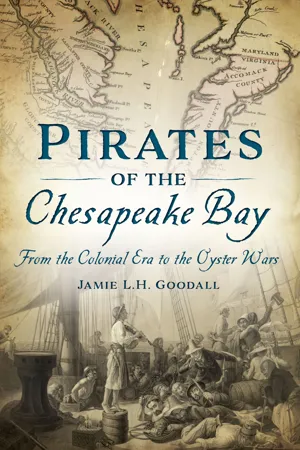
Pirates of the Chesapeake Bay
From the Colonial Era to the Oyster Wars
- 163 pages
- English
- ePUB (mobile friendly)
- Available on iOS & Android
eBook - ePub
About this book
Information
PART I
THE COLONIES, THE CROWN AND THE PIRATES
1630–1750
The Chesapeake colonies were developed as a means to an economic end: money, money and more money. The first Virginians arrived in the region in 1607; the first enslaved Africans were forcibly brought to the Chesapeake region in 1619; and in 1634, the first English colonists were sent to settle Maryland. Both Virginia and Maryland became key tobacco-producing colonies, and they reaped the profits of this industry off the backs of enslaved black laborers. But what role did pirates play in developing the economy and society of the Chesapeake? We know that William Claiborne’s piracy was born of conflict between the inhabitants of Virginia and the settlers of Maryland over territory and resources. The Chesapeake also saw a Frenchman, a tobacco trader and a shipwreck salvager turn to piracy; numerous sailors and privateers hung up their legal hats for a life of illicit commerce. These men were integral parts of the Chesapeake’s broader development.
RICHARD INGLE
Throughout the 1630s and early 1640s, Richard Ingle made it his business to transport goods and people across the Atlantic. Ingle primarily made his money in the tobacco trade and by all accounts did not start his career as a pirate. In 1641, he even ferried Thomas Cornwalleys and Leonard Calvert, the governor of Maryland, to St. Mary’s after a brief trip to England. Cornwalleys proved to be a good friend and business associate of Ingle. When the English Civil War erupted the following year, the fates of Ingle, Calvert and Cornwalleys became even more interwoven.
The war was ultimately a conflict between the Roundheads of Parliament and the Royalists who were loyal to King Charles I. Although King Charles I was an Anglican, his marriage to the Catholic French princess Henrietta Maria led many to believe that he held private Catholic sympathies. He had also been the one to grant the Calvert family their colonial charter. Governor Calvert feared what would happen to the colony of Maryland, a haven for Catholics, should Parliament win the war. Would they revoke the charter in favor of someone who supported Parliament? When the war broke out, the American colonies tried to remain neutral, but after finding it difficult to maintain a neutral status, the colonies became divided. The Chesapeake colonies remained loyal to the king and did their part to support him. After they received orders to seize ships and goods belonging to Parliament and their “traitorous companies,” Giles Brent (the acting governor in Calvert’s absence) immediately set about fulfilling them.15
Richard Ingle, on the other hand, was raised as a Protestant and found himself in favor of Parliament’s rejection of King Charles I’s absolutist rule. The first accusations levied against Ingle were done so in an act of revenge in 1643 and 1644. A man named William Hardige was angry with Ingle for taking him to court over tobacco debts—not that it was the first time Hardige had been sued over debt he’d incurred—and since he knew of Ingle’s Protestant background, Hardige accused him of high treason against King Charles I. Additionally, Hardige was summoned to give evidence against Ingle for “pyratical and treasonable offences” in the Chesapeake area. Ingle was unwittingly arrested, held without bond and had his goods and ship, the Reformation, seized. The sheriff, Edward Parker, was ordered to keep watch over Ingle. This was no easy task, since there was apparently no prison to hold him in. Parker was told that under no circumstances was Ingle to re-board his ship without express permission—in writing—from the acting governor.16 But Ingle would not be prisoner long.
Ingle’s escape was nothing short of brazen. It’s unclear whether bribery was involved, but Cornwalleys and two other councilmen came to Parker and claimed they had license to take Ingle. Parker let Ingle go under the pretense that the acting governor had issued an order for his release since three prominent officials came to retrieve him. However, he reported that he went with the men to continue his watch over Ingle. All four men took Ingle to his ship, which he boarded. Cornwalleys then ordered Parker and his men to lay down their arms and get lost. According to Parker, they really had no choice but to run since several of Ingle’s men came aboard and “beat and wounded some of the guards.” Multiple juries were convened in an attempt to arrest and convict Ingle; however, each jury came back with “insufficient evidence” to prosecute.17
Brent made one final attempt to seize Ingle; he issued a warrant for his arrest on the grounds that he had assaulted the “vessels, guns, goods and person” of a man named Bishop. When threatened with arrest, Ingle reportedly said he would destroy the homes of local residents, including that of Brent. He was officially charged with “pyracie, mutinie, trespasse, contempt and misdemeanors.” If Ingle hadn’t been a pirate before, he was certainly at that point.18 Ingle wasn’t Calvert’s only concern; the intrepid William Claiborne was back, taking advantage of the political turmoil of the time to recapture Kent Island. So, Calvert had a two-front conflict against “pirates and rogues.”
First, Ingle and his men arrived with several other armed vessels and sacked St. Mary’s. They held many members of the council prisoner, forced the governor into exile in Virginia and seized the estates of many Royalists, banishing them from the province.19 Shortly after taking control of St. Mary’s, Ingle moved on to St. Inigoes Creek, which just so happened to be in the same area as Cornwalleys’s home. It seemed that Ingle and his crew were rather indiscriminate in their devastations. Cornwalleys was in England at the time, and his lawyer, Fenwick, was overseeing the property, so Ingle made his move. He convinced several servants to ignore Fenwick’s request to retrieve his pinnace full of clothing, bedding and other goods that were valued at £250. This gave Ingle the opportunity to plunder the vessel while he sent his associates to sack and pillage the nearby homes. In the meantime, several of Ingle’s men terrorized and held Cornwalleys’s servants and Fenwick hostage.
Ingle himself got Fenwick rip-roaring drunk in the hopes of plundering Cornwalleys’s home “legally.” He convinced Fenwick that if he would just sign a note to his wife, the acting mistress of the house, permitting Ingle’s men to seize Cornwalleys’s home, arsenal and pinnace, then Ingle would let him go and promised that no harm would come to him. Worried for his own skin, Fenwick did as he was requested. But as soon as Fenwick delivered the note, Ingle ordered his men to seize him once again, and another group of men occupied Cornwalleys’s home. The home was described as being full of furnishings, linen, bedding, pewter, brass and “all manner of household stuff” worth over £1,000. Cornwalleys was also one of the richest men in Maryland, so his home was filled with fineries, including Turkish carpets, East Indian spices, “satin damask petticoats laced with gold and silver” and a large cypress chest that was valued at £130 on its own. Ingle’s men were accused of killing all the swine, goats and cattle and taking a “great store of beer, wine and ‘strong waters.’”20 According to Cornwalleys, not only did Ingle steal £200 worth of tobacco from him, but the value of goods seized from his property was more than £2,500. Ingle’s men also allegedly took four enslaved black people and twelve men and maidservants.21
Ingle, however, told a different story. In a petition to Parliament in 1645, he reminded them of a letter of marque they issued to him and his ship, the Reformation, the previous year. This letter granted him the authority to seize the goods and ships of any Royalist vessel, which technically made him a privateer. Additionally, he believed he was acting based on the oath he made to aid and assist any Protestants who were affected by “tyranicall” rule. When he voyaged back to Maryland in 1643, he found a government under “tyrannical rule.” The government of Maryland had been granted commissions from the Crown to seize goods and vessels belonging to Parliament and their supporters. He claimed that he saw his fellow Protestants being oppressed and threatened by a “tyrannicall governor and the Papists and malignants his adherents” and that he risked his life and fortune to assist them. Ingle went so far as to say that it “pleased God to enable him” to take from the “papists” their worldly possessions. He also said that these “papists” were conspiring against him with fictitious accounts of treason and piracy. Ingle encouraged Parliament to take action, as he believed that it would set a dangerous precedent to allow these people to make such false allegations against those fighting on behalf of Parliament.22
Regardless of whose version you believe, nearly two years of piracy and hardship befell Catholic Maryland in a period that later became known as the Plundering Time. There was no settled government to put a stop to piratical incursions, so Ingle wasn’t done quite yet. He made good on his promise to pillage the property of Giles Brent on Kent Island and took his pinnace, the Shotlocker, that was filled with guns, linens, clothes and account books valued at £200. Ingle also seized a pinnace called the Phoenix, which belonged to both Giles and his sister Margaret Brent and was valued at £200. Next, Ingle sacked Margaret’s house in St. Mary’s, which housed much of her brother’s goods, and Giles’s house in Kent Island. Between the two locations, he took everything, from account books and silverware to hogs, servants, tobacco, furniture and jewelry made of sapphire and diamonds.23 But Ingle’s depredations did not last forever. With the help of Virginians and Governor Berkeley, Governor Calvert assembled enough men and guns in late 1646 to retake St. Mary’s and reclaim the colony.
EDWARD DAVIS, LIONEL DELAWAFER, JOHN HINSON AND PETER CLOISE
On a hot summer day in June 1688, four men—Edward Davis, an enslaved black man named Peter Cloise, Lionel Delawafer and John Hinson—made their way down the Chesapeake in an unassuming shallop.24 The men were accompanied by a treasure-trove of goods. Davis had three bags of Spanish pieces of eight, 142 pounds of broken silver, silk stockings and expensive linens. Similarly, Delawafer had three bags of Spanish currency, thirty-seven silver plates, silver lace, 84 pounds of broken silver and an assortment of dishes. Hinson had an additional two bags of Spanish currency—including eight hundred pieces of eight—106 pounds worth of broken silver and fine linens and cloth. Altogether, the goods were valued at over £2,300.25
So, how did these men come to have such a wealth of belongings? They were former associates of South Sea buccaneer John Cook, whose exploits on the Revenge were chronicled in William Dampier’s A New Voyage Round the World. Cook first gained notoriety as quartermaster of Captain Yankes, the second-highest ranking on a ship, according to the law of privateers. Yankes held a French commission for attacking Spanish ships. After a particularly successful venture, Cook was appointed captain of a prize vessel taken from the Spanish and several of Yankes’s men, including Edward Davis. The only problem for Cook and his men, however, was that they didn’t have a true commission; this technically made all of their actions those of pirates. Some of the French commanders who had been sailing with Yankes did not appreciate having an Englishman at the helm of their prized ship. So, they rallied together and plundered the English ships, goods and arms. As for the Englishmen, most were marooned on the Isle of Vacca. Meanwhile, Cook, Davis and about eight other men were taken as prisoners to Petit Guavres, but Davis and Cook managed to escape and seized a ship to pick up all of the marooned men. During their departure, Cook and Davis seized another French ship that was laden with wine and goods. Their plan was to embark on their own South Seas adventure, but they first went to Virginia to sell the wine and refit the ships.26
Cook and his men made their way to Accomack and used their profits from the wine to buy sails, tackle and all things “necessary for so long a voyage.” Most of the men, including Dampier and Davis, remained committed to the new venture. They were also joined by new faces, including Lionel Delawafer and John Hinson. Cook’s initial crew consisted of at least seventy men, and they departed for the South Seas in August 1683. For five years, they operated under the guise of privateering and terrorized Spanish outposts, especially those in Panama. After Captain Cook’s untimely death from illness in the spring of 1684, Davis (Cook’s quartermaster and second-in-command) took over as captain. The men continued to plunder their way around the South Seas in Cook’s absence and frequently went back to the Chesapeake to refit their vessels and replenish their supplies. Their numbers continued to grow, and by the end of Davis’s piratical career, he commanded over one thousand men and an entire fleet of ships.27
After several difficult years, Davis’s men decided to retire from committing seaborne crimes and live the rest of their lives in peace and comfort. Unfortunately for them, King James had recently renewed his predecessor’s proclamation against piracy. In order to effectively eradicate the issue of piracy in the West Indies, the Crown commissioned Sir Robert Holmes to track down pirates. Holmes’s commission placed his authority above that of the English colonial governors in the Atlantic, and he was granted any of the profits he or his agents seized from pirates. Because of this, Holmes took no chances whenever he or his agents crossed paths with a vessel that was unknown to them. One of Holmes’s agents, Captain Simon Rowe, witnessed a shallop making its way down the Chesapeake and was immediately suspicious when he saw that it was carrying rather large chests. Rowe ordered the shallop to stop and, upon further inspection, seized the men and their goods and immediately shipped them to Jamestown under suspicion of piracy.28
While in Jamestown, the men were independently interrogated by members of the Council in Virginia. Both Delawafer and Hinson denied having known Davis for very long and claimed that they encountered each other in Bermuda. Delawafer and Hinson also denied being privateers or present in the South Seas. Delawafer, for example, claimed that he had spent the last several years in the West Indies and that he sometimes did trade with the Spanish and privateers. However, he claimed that all the goods in his chest had been bequeathed to him and sent by a friend in Lynnhaven. Peter Cloise’s testimony was the thing that spelled trouble for the men and undermined their denials. According to Cloise’s testimony, all of the men had been plundering together for many years.29 One has to wonder how much of Cloise’s admission was coerced. Regardless, the men began to slightly alter their stories.
They began to claim that, upon their passage between Pennsylvania and Maryland, they had secured certificates of immunity from Captain Thomas Allen of HMS Quaker and that Captain Rowe had ignored them.30 Their arguments proved to be fruitless, and the men were imprisoned in Jamestown. Fortunately for them, however, a lawyer named Micaiah Perry believed that he could get the men out of jail based on the caveat of the 1678 and 1687 proclamation: if a pirate or privateer surrendered within eighteen months of the proclamation, he would receive “full and gracious pardons.” In opposition to this argument, Governor Howard said that it was evident that the men had been pirates and that the insistence of their innocence meant that they could not receive the king’s pardon. Even if they had admitted to their wicked deeds, it would have meant forfeiture of all the goods and silver they’d acquired, so Perry convinced the men to give up their act of innocence and to apply for the pardon.31
Since the men were still concerned about their valuables, they took their lawyer’s advice, but they continued to petition for the restoration of their confiscated goods and promised to give £300 of it to the College at Virginia.32 For several years, the men languished in jail while government officials bickered over the political rulings regarding piracy, pardons and the division or return of seized goods. It ultimately took them three years and a trip to England to retrieve even a fraction of the goods that they’d started with. In the years that had passed, much of their loot had been picked over by various officials, but even still, the men were good on their word and delivered £300 to what is now the College of William and Mary.
ROGER MAKEELE
Not much was known about Roger Makeele before Richard Stevens informed local government officials about his piratical activities along the Accomack. According to Stevens, he and a couple of associates were taking a ship laden with £20,000 worth of tobacco from Choptank to Northampton County in Virginia. As night approached, the men decided to anchor at Gabr...
Table of contents
- Front Cover
- Title Page
- Copyright
- Dedication
- Contents
- Timeline of Major Conflicts
- Acknowledgements
- Introduction
- Part I. The Colonies, the Crown and the Pirates (1630–1750)
- Part II. Patriots and Loyalists: Pirates of the Revolution (1754–1783)
- Part III. Trials and Tribulations of a New Nation (The War of 1812)
- Part IV. A Nation Divided: Confederate Pirates, Raiders and Privateers (1860–1865)
- Part V. The Pearl of the Chesapeake: The Oyster Wars (1865–1959)
- Glossary
- Notes
- Bibliography
- About the Author
Trusted by 375,005 students
Access to over 1.5 million titles for a fair monthly price.
Study more efficiently using our study tools.
Frequently asked questions
Yes, you can cancel anytime from the Subscription tab in your account settings on the Perlego website. Your subscription will stay active until the end of your current billing period. Learn how to cancel your subscription
No, books cannot be downloaded as external files, such as PDFs, for use outside of Perlego. However, you can download books within the Perlego app for offline reading on mobile or tablet. Learn how to download books offline
Perlego offers two plans: Essential and Complete
- Essential is ideal for learners and professionals who enjoy exploring a wide range of subjects. Access the Essential Library with 800,000+ trusted titles and best-sellers across business, personal growth, and the humanities. Includes unlimited reading time and Standard Read Aloud voice.
- Complete: Perfect for advanced learners and researchers needing full, unrestricted access. Unlock 1.5M+ books across hundreds of subjects, including academic and specialized titles. The Complete Plan also includes advanced features like Premium Read Aloud and Research Assistant.
We are an online textbook subscription service, where you can get access to an entire online library for less than the price of a single book per month. With over 1.5 million books across 990+ topics, we’ve got you covered! Learn about our mission
Look out for the read-aloud symbol on your next book to see if you can listen to it. The read-aloud tool reads text aloud for you, highlighting the text as it is being read. You can pause it, speed it up and slow it down. Learn more about Read Aloud
Yes! You can use the Perlego app on both iOS and Android devices to read anytime, anywhere — even offline. Perfect for commutes or when you’re on the go.
Please note we cannot support devices running on iOS 13 and Android 7 or earlier. Learn more about using the app
Please note we cannot support devices running on iOS 13 and Android 7 or earlier. Learn more about using the app
Yes, you can access Pirates of the Chesapeake Bay by Jamie L.H. Goodall in PDF and/or ePUB format, as well as other popular books in History & Military & Maritime History. We have over 1.5 million books available in our catalogue for you to explore.