- 124 pages
- English
- ePUB (mobile friendly)
- Available on iOS & Android
eBook - ePub
About this book
In a material, dog-eat-dog world where pain and suffering exist and where only the fittest survive, how and why did selfless love appear? How did love become one of the most basic necessities of human life? What exactly is love anyway? Is the existence--and necessity--of selfless love evidence that we really were created in the image of a loving God?
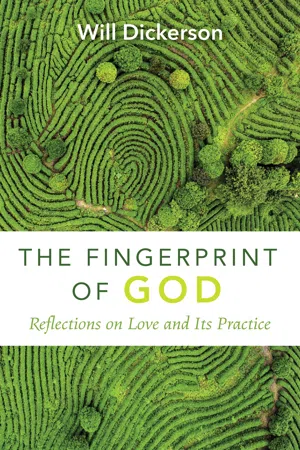
What if love was God's fingerprint on our world and in our lives?
What if love was the proof that he was here and that he made us to love and be loved?
Information
Topic
Theology & ReligionSubtopic
Self Improvement1
The Fingerprint of God
Before my first wife lost her battle with cancer, we lived in Central Europe for more than twenty years. There we made our home in a country that had languished for forty-five years on the eastern side of the Iron Curtain. During our time of residence in this beautiful country, I taught English in a public secondary school. One of the things I loved about this job was that normally I taught the same students year after year. I would get them when they entered in ninth grade and continue along with them until they graduated or completed their English studies. I got to know many of them quite well (and several continue to be numbered among my friends).
During my students’ first year, I made a great effort to get to know these young men and women. I asked a range of simple questions to find out what they were interested in. What kind of music did they listen to (or play)? What were their favorite films? What did they do in their free time? Did they participate in any sports or have favorite teams they cheered for? I then tried to find suitable material related to their interests to bring into the classroom. In this way, I hoped to make the study of English a little less tedious for them.
As the students advanced from the ninth grade through the twelfth and their knowledge of the English language improved, I tried to challenge them with questions of increasing difficulty. I moved from concrete topics to more abstract ones. For example, instead of asking them to describe their best friend, I would ask them to define friendship. I would ask my students other questions: Why do humans have a sense of humor? Why do we laugh at the things we laugh at? Why are humans so creative, and why do we put such a high value on various forms of artistic expression? Why is music so important to us? Indeed, modern neurological studies seem to show that the human brain is wired to make and appreciate music and that we actually have a musical intelligence. (That would be a most peculiar development if we were simply the product of happenstance, wouldn’t it?)
When the students were in their second year, I would ask how they would behave in a given situation—for example, what would they do if they came upon a wallet that contained a substantial amount of money, as well as an ID, address, and telephone number. Would they keep it or return it? More importantly, what would be the rationale for their behavior?
A little later, I would ask how they knew what was right and what was wrong. What was the basis for their moral and ethical decisions? This was a particularly difficult question to answer for those who held a strictly materialistic view of the universe, for there is no simple way to get around Friedrich Nietzsche’s observation that if there is no God, then there is no objective basis for morality. You may disagree with what Hitler or Stalin did, but you cannot say with any objective certainty that they were evil. Words such as good and evil, justice and injustice lose their meaning in a universe comprised of nothing but energy and matter. Moral outrage is reduced to a matter of personal preference. Yet humans do, in fact, seem to come equipped with a conscience and an innate sense of morality.
I have two children. I remember how, when they were very young, even before my wife and I had held any deep discussions with them about the impropriety of prevarication, they intuitively knew when they were lying—and they felt guilty about it. We always knew when they weren’t telling the truth because they could not look us directly in the eye when they were experiencing veracity malfunctions. Why is that? And why is it that around the globe, and across temporal, cultural, and religious boundaries, certain ethical principles are almost universally accepted as true and valid?
During my students’ final year, I would ask where humans had originally come from. Given the fact that I was teaching in a post-Communist, post-modern setting, it was not surprising that many students approached these questions from a materialistic point of view. They began with the assumption that the universe was comprised of nothing but matter and energy. So humans, like other members of the animal kingdom, were believed to be nothing more than the product of a struggle for survival. These students, therefore, would tell me that we lived in a dog-eat-dog world in which big animals ate little animals. We had fought and clawed our way to the top of the food chain and maintained our position there because we were the best at surviving and reproducing. I would nod my head, and we would move on.
Eventually, I would ask what turned out to be the most difficult question of all. I would ask them to give me a definition of love and explain what it was. At first, many of the students considered this an easy assignment. After all, a large proportion of our music, literature, art, and pop culture speaks about love. Indeed, if you turn on the radio right now, you are likely to hear some singer waxing lyrical about the power of love. And if you go to the movies tonight, there is a good chance that love will play a determinative role in driving the plot of whatever film you choose to watch. In the end, however, this question usually turned out to be the most difficult of all to answer. My students found they could not even explain love in their native tongue, much less in English. After all, you cannot hold a certain amount of love in your hand. You cannot measure its length or depth. You cannot weigh it or say what color it is. It is not easy to define such abstractions with mere words. Nevertheless, the class would try. Normally, we would spend the next several lessons trying to come up with a description of what love looked like in practice and then with a working definition of love. The students quickly agreed that the version of “love” peddled by Hollywood and by most purveyors of pop culture was not the real thing. These merchants were selling a counterfeit more akin to infatuation, physical attraction, or simple curiosity. True love was nothing so ephemeral. Rather, it was something that could stand the test of time.
Over the following weeks, students would usually wrestle their way to the conclusion that when you truly love someone, you put that person’s needs and interests before your own. They would go on to say that the greatest example of love is laying down one’s own life to save that of another. Moreover, they would tell me love was not only something very good, it was also very important—even a basic necessity of life. Love was as important to our existence as oxygen, water, and food because when someone truly believes he, or she, is alone and unloved in this world, that person often ends up the victim of suicide or a patient in a psychiatric hospital. Such a person is unable to function effectively in this world and thus is unlikely to pass along his, or her, DNA.
My students were not the first to observe that humans cannot live in the absence of love. Artists have recognized this fact for centuries—perhaps for millenia. For example, not so long ago W. H. Auden, in his poem “September 1, 1939,” spoke for poets and other writers throughout history when he proclaimed, “We must love one another or die.”
Nowadays, it is no longer just poets and other artists who speak of the necessity of love. This assertion is supported by science. Recent research in psychology and sociology has shown that loneliness and weak social connections (that is, the absence of love) have the same negative impact on the human lifespan as smoking fifteen cigarettes a day.1 Even the Harvard Business Review has taken note of this fact and in September 2017 devoted several articles to the negative impact loneliness has been shown to have in the workplace.
If we want further evidence of our dire need to be loved, we only have to look as far as the COVID-19 pandemic. If you were to do an internet search on the effects of pandemic-related isolation on people’s mental health, you would find dozens of scientific studies on the topic and in a wide array of languages. Around the world in different countries and cultures, observers noted the same phenomenon. As the pandemic dragged on and on, researchers noted a sharp rise in substance abuse, depression, suicide, and other mental health issues. As students were physically separated from their classmates, friends could not gather together socially, people were asked to work from home distant from their colleagues, travel was curtailed, and family members could not see each other on a regular basis, many people increasingly struggled to get through the day. As a species, when we do not experience the love of our friends and family on a regular basis, we generally fail to thrive.
The necessity of love, however, raises a new set of questions. If we live in a dog-eat-dog world in which the strong and powerful are the ones most likely to pass along their genetic material, how could love, which puts the needs and interests of others before its own, have ever come into existence, much less have become a requirement for our existence? Why would the experience of loneliness be just as harmful to me as smoking fifteen cigarettes a day? Other species further down the food chain seem to do just fine without the affection of others of their kind. Of course, it is not hard to see how we can benefit from the love of others, but why would it be a basic condition of our existence? And if love really is unselfish, wouldn’t such self-sacrificing behavior reduce the odds of survival of its practitioners? Why then can’t we live in the absence of a love that is willing to surrender itself for the sake of others?
This is the point where my students struggled to supply answers. In the end, they usually decided they could not explain love. It presented too much of a paradox to resolve. True love did seem to be selfless, but selflessness did not make sense in a world that consisted only of matter and energy and in a world in which the laws of self-preservation and self-propagation governed the progress of species. Love certainly seemed to be real—it even appeared to be a requisite for healthy human existence—but they could not tell me why or where it had come from.
If, in fact, we are little more than a collection of molecules arranged in a complex structure—a structure developed and refined through the process of natural selection—and if through this process we have been programmed to survive and reproduce in a most efficient manner, then the existence (to say nothing of the need) of a selfless “love” that would knowingly lay down its life for the sake of another is . . . nonsensical and confounding. After all, those who act sacrificially are much less likely to pass their genes along to the next generation than are those who put their own survival first. Self-sacrifice runs contrary to the law of survival! It is true that in the wild we may see a mother bear go on the offensive and risk her life to protect her cubs. However, we normally do not see cubs putting their lives in danger to protect the older and weaker members of their species. A majority of my students, however, insisted that they would, in fact, risk their lives to save a grandparent greatly beloved by them.
If humans have such highly developed survival skills and instincts, why would young, intelligent members of our race in the prime of their lives put their precious lives in danger to protect those who are over-the-hill and no longer capable of reproduction? Why risk our lives for someone who is old, ugly, and going to die soon anyway? This kind of behavior just does not make sense in a world that bestows its rewards on survivors.
Moreover, if I have a need to be loved, am I not in some way weaker and more vulnerable than a predator that does not have this same need? If I am feeling depressed because I am lonely and unloved, am I not more likely to serve as the main course at some predator’s feast? In fact, I might even save the predator the time and energy and end my life all by myself. Normally, we do not see this kind of self-destructive behavior in the “less-developed” species further down the food chain.
When my students reached the end of their final year, I let them turn the tables on me. During their last month or so, ...
Table of contents
- Title Page
- Acknowledgements
- Introduction: The Faith of the Atheist
- Chapter 1: The Fingerprint of God
- Chapter 2: The Pattern of the Fingerprint
- Chapter 3: The God Who Is Here
- Chapter 4: What Child Is This?
- Chapter 5: Humility: What’s Love Got to Do with It?
- Chapter 6: The Body of Christ . . . it’s complicated!
- Chapter 7: The Body of Christ: The Communion of Saints
- Chapter 8: Forgiveness: For the Love of God!
- Chapter 9: Entanglement
- Chapter 10: “Therefore”—A Small Word with Big Implications
- Chapter 11: First Love
- Chapter 12: Do You Love Me More than These?
- Chapter 13: Love and Pain
- Chapter 14: Epilogue: The Fingerprint of God
- Bibliography
Trusted by 375,005 students
Access to over 1.5 million titles for a fair monthly price.
Study more efficiently using our study tools.
Frequently asked questions
Yes, you can cancel anytime from the Subscription tab in your account settings on the Perlego website. Your subscription will stay active until the end of your current billing period. Learn how to cancel your subscription
No, books cannot be downloaded as external files, such as PDFs, for use outside of Perlego. However, you can download books within the Perlego app for offline reading on mobile or tablet. Learn how to download books offline
Perlego offers two plans: Essential and Complete
- Essential is ideal for learners and professionals who enjoy exploring a wide range of subjects. Access the Essential Library with 800,000+ trusted titles and best-sellers across business, personal growth, and the humanities. Includes unlimited reading time and Standard Read Aloud voice.
- Complete: Perfect for advanced learners and researchers needing full, unrestricted access. Unlock 1.5M+ books across hundreds of subjects, including academic and specialized titles. The Complete Plan also includes advanced features like Premium Read Aloud and Research Assistant.
We are an online textbook subscription service, where you can get access to an entire online library for less than the price of a single book per month. With over 1.5 million books across 990+ topics, we’ve got you covered! Learn about our mission
Look out for the read-aloud symbol on your next book to see if you can listen to it. The read-aloud tool reads text aloud for you, highlighting the text as it is being read. You can pause it, speed it up and slow it down. Learn more about Read Aloud
Yes! You can use the Perlego app on both iOS and Android devices to read anytime, anywhere — even offline. Perfect for commutes or when you’re on the go.
Please note we cannot support devices running on iOS 13 and Android 7 or earlier. Learn more about using the app
Please note we cannot support devices running on iOS 13 and Android 7 or earlier. Learn more about using the app
Yes, you can access The Fingerprint of God by Will Dickerson in PDF and/or ePUB format, as well as other popular books in Theology & Religion & Self Improvement. We have over 1.5 million books available in our catalogue for you to explore.