Complications in Canine Cranial Cruciate Ligament Surgery
eBook - ePub

Complications in Canine Cranial Cruciate Ligament Surgery

  1. English
  2. ePUB (mobile friendly)
  3. Available on iOS & Android
eBook - ePub

Complications in Canine Cranial Cruciate Ligament Surgery

About this book

Filling a gap in the current literature, Complications in Canine Cranial Cruciate Ligament Surgery providesrevision strategiesforcorrectingthecomplications associated with surgical repair techniques for cranial cruciate ligamentrupture, one of the most common causes of a hind limb lameness in dogs.Presentingstep-by-stepinstructionsfornumeroussurgical correction techniques, thispracticalguidecoversarticular, extra-articular and osteotomy repair techniquesas well asnon-surgical management, physical rehabilitation, clinicaldecision making, and more.

The book beginswith an overview ofcranial cruciate ligament tear, diagnosis, andtreatment goals, followed by a discussion ofmethods forminimizingsurgicalsite infectionandcomplications.Subsequent chaptersdescribethepotential complicationsof aparticular techniqueandexplainhow to identify, evaluate, and correctthe complication. Throughout the book, hundreds of high-quality clinical photographs showthe appearance of complications anddemonstrate each step of the corrective procedure. This authoritative guide:

  • Providesstep-by-step techniques for surgical corrections of common complications
  • Emphasizes surgicaldecisionmaking and specific strategies for surgical correction
  • Contains revision strategies for identification of intra-operative complications
  • Coversevaluation and identification of post-operative complications
  • Features more than 400 photographsand clinical images

Part of the state-of-the-art Advances in Veterinary Surgery series, Complications in Canine Cranial Cruciate Ligament Surgery isaninvaluable resource forsurgical residents, veterinary surgeons, and general practiceveterinariansalike.

Frequently asked questions

Yes, you can cancel anytime from the Subscription tab in your account settings on the Perlego website. Your subscription will stay active until the end of your current billing period. Learn how to cancel your subscription.
At the moment all of our mobile-responsive ePub books are available to download via the app. Most of our PDFs are also available to download and we're working on making the final remaining ones downloadable now. Learn more here.
Perlego offers two plans: Essential and Complete
  • Essential is ideal for learners and professionals who enjoy exploring a wide range of subjects. Access the Essential Library with 800,000+ trusted titles and best-sellers across business, personal growth, and the humanities. Includes unlimited reading time and Standard Read Aloud voice.
  • Complete: Perfect for advanced learners and researchers needing full, unrestricted access. Unlock 1.4M+ books across hundreds of subjects, including academic and specialized titles. The Complete Plan also includes advanced features like Premium Read Aloud and Research Assistant.
Both plans are available with monthly, semester, or annual billing cycles.
We are an online textbook subscription service, where you can get access to an entire online library for less than the price of a single book per month. With over 1 million books across 1000+ topics, we’ve got you covered! Learn more here.
Look out for the read-aloud symbol on your next book to see if you can listen to it. The read-aloud tool reads text aloud for you, highlighting the text as it is being read. You can pause it, speed it up and slow it down. Learn more here.
Yes! You can use the Perlego app on both iOS or Android devices to read anytime, anywhere — even offline. Perfect for commutes or when you’re on the go.
Please note we cannot support devices running on iOS 13 and Android 7 or earlier. Learn more about using the app.
Yes, you can access Complications in Canine Cranial Cruciate Ligament Surgery by Ron Ben-Amotz,David L. Dycus in PDF and/or ePUB format, as well as other popular books in Medicine & Veterinary Medicine. We have over one million books available in our catalogue for you to explore.

Information

Year
2021
Print ISBN
9781119654377
eBook ISBN
9781119654346
Edition
1

Section IV
Osteotomy Repair Techniques

9
Complications Associated with Cranial Closing Wedge Osteotomy

Bill Oxley

9.1 Introduction

Cranial closing wedge osteotomy (CCWO) was the first dynamic stabilization technique described for the treatment of cruciate disease by Barclay Slocum and Theresa Devine in 1984 [1]. The same authors described radial tibial plateau leveling osteotomy (TPLO) in 1993 [2], and subsequent studies of the originally reported techniques revealed radial TPLO to be associated with lower overall complication and reoperation rates [36]. However, more recently, key alterations to the original technique (including the use of locking TPLO plates and modified wedge geometry) have resulted in similar major complication rates of approximately 5–8% for both procedures [7]. Many surgeons prefer CCWO to TPLO in small dogs due to the larger size of the proximal osteotomy segment, although the procedure can be used in dogs of any size, and those with excessive tibial plateau angles (TPAs), without technical modification or adjunctive procedures [8, 9]. Additionally, CCWO can be easily adapted to concurrently manage medial patellar luxation and proximal tibial deformities.
This chapter will describe CCWO preoperative planning and surgical technique, highlighting potential pitfalls that can lead to preventable complications. The recognition and management of postoperative complications will then be reviewed.

9.2 Preoperative Planning

The importance of accurate and thorough preoperative planning cannot be overemphasized in the context of avoidance of not only intraoperative but also many postoperative complications. Good planning not only reduces the risk of surgical errors but facilitates less tangible benefits such as minimized tissue handling and reduced surgical time which are equally important in the reduction of complication rates.
Preoperative planning starts with appropriately positioned mediolateral and craniocaudal radiographs including the stifle, tibia, and talocrural joint. Criteria for optimal positioning are identical to those described in Chapter 10 for radial TPLO. The ability to accurately measure distances on the radiograph is essential and thus the use of a magnification marker and/or digital calibration is mandatory.
Images described by caption.
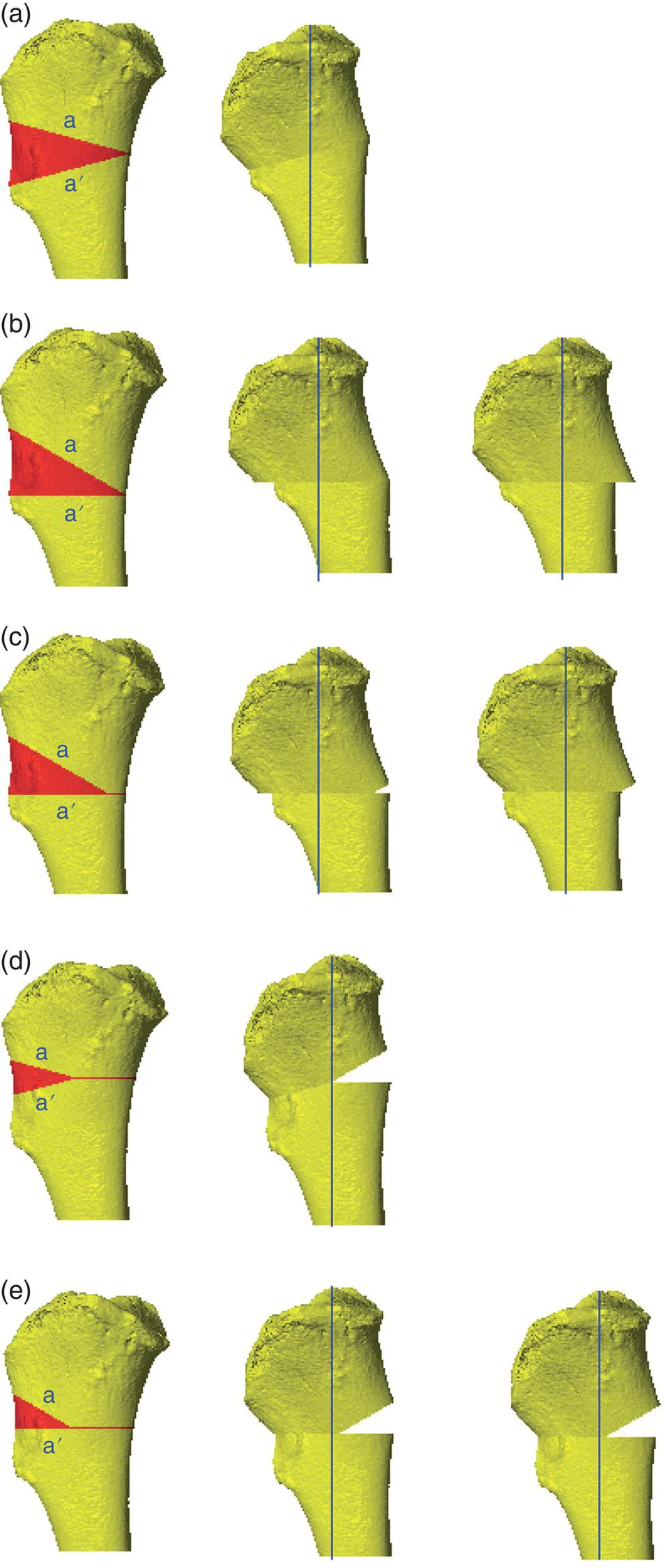
Figure 9.1 Various CCWO wedge geometries. In all cases, the wedge angle is 30°. (a) Closing symmetrical (isosceles) wedge [7]. Note that the proximal (a) and distal (a') osteotomies are the same length and meet at the caudal cortex. (b) Closing asymmetrical wedge [1, 10]. Note that a ≠ a', and that the osteotomies meet at the caudal cortex. Since the wedge is asymmetrical, the osteotomy surfaces differ in length and either the cranial or caudal cortices may be aligned. Aligning the cranial cortices shifts the long axis as indicated by the vertical blue line. Note the similar axis shift between the isosceles wedge and the asymmetrical, cranial cortical aligned geometries. (c) Neutral/closing asymmetrical wedge [8, 11, 12]. Note that a = a' but that the osteotomies meet cranial to the caudal cortex, but more caudal than the midpoint between the cortices. Again, since the wedge is asymmetrical, either the cranial or caudal cortices may be aligned. As with the original asymmetrical wedge, cranial cortical alignment with a caudal overhang is preferred to reduce long axis shift. (d) Neutral symmetrical (isosceles) wedge. Note that a = a' and the osteotomies meet at the midpoint between the cortices. (e) Neutral asymmetrical wedge. Note that a ≠ a' and the osteotomies meet at the midpoint between the cortices. Since the difference in length between a and a' is small, the difference in long axis shift between the cranial and caudal cortical alignment options is also small.
Various different CCWO osteotomy geometries have been described (Figure 9.1) [1, 7, 8,1012]. The original technique employed a closing asymmetrical wedge with its base perpendicular to the long axis of the tibia [1, 10]. Since the wedge is asymmetrical, the osteotomy surfaces differ in length, and either the cranial or caudal cortices are aligned, causing an “overhang” at the opposite cortex (Figure 9.1b). Alignment of the cranial cortices minimizes tibial long axis shift. Reported modifications include a closing symmetrical (isosceles triangle) wedge [7], and several neutral/closing asymmetrical wedge variations [8, 11, 12]. While each of these variations has specific potential advantages, none has been shown to be definitively superior in terms of indication (normal and excessive TPA), biomechanics, complication rates or functional outcome. All CCWO variations will cause relative distalization of the patella in the trochlea, although this is rarely of clinical significance. It is important to note that the degree of patella baja induced is proportional to the overall angular correction rather than the cranial wedge length as has been suggested, and is thus the same for closing, neutral, and indeed opening wedges. Given the relative similarity of the various modified techniques, it is improbable that any one technique will prove to be definitively superior, and the choice will likely remain one of surgeon preference.
A further variation on the original CCWO technique is to concurrently perform radial TPLO [13]. This technique has been rec...

Table of contents

  1. Cover
  2. Table of Contents
  3. Title Page
  4. Copyright Page
  5. Preface
  6. List of Contributors
  7. Foreword
  8. Acknowledgments
  9. Disclosures
  10. Section I: Introduction
  11. Section II: Intraarticular Repair Techniques
  12. Section III: Extraarticular Repair Techniques
  13. Section IV: Osteotomy Repair Techniques
  14. Section V: Nonsurgical Management and Physical Rehabilitation
  15. Section VI: Adjunctive Information
  16. Index
  17. End User License Agreement