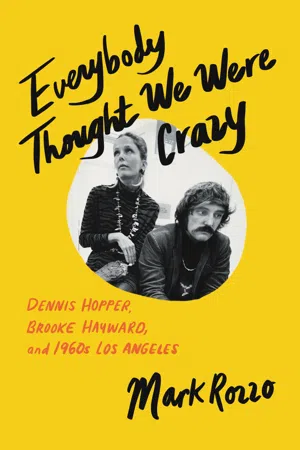
1
“Any Man Who Doesn’t Develop a Crush Has No Soul”
For Brooke Hayward, the Method, which she had learned at the feet of Lee Strasberg, was not a religion. It was merely a tool to use when needed. She still couldn’t believe that Strasberg had taken her on after she had auditioned at the Actors Studio in New York City in the fall of 1959. When Strasberg told Brooke, a young wife and mother who had rarely acted before, that she’d been accepted, she cross-examined him, ever wary of favoritism based on her parentage. Why had she, the daughter of Leland Hayward and Margaret Sullavan, gotten in when so many other actors ended up waiting years for an opening? “Your mother and father are very talented,” Strasberg explained. “The odds are that you will prove to be more gifted as an actress than most other people with experience that I interview.”
In December 1959, shortly after joining the Actors Studio, Brooke made her New York stage debut at the age of twenty-two, starring in John Whiting’s Marching Song at the Gate Theatre downtown. Peter Kass, who directed the show, told the Boston Globe, “The kid’s got one of the best raw talents I’ve ever seen.” It was only after Brooke got the part that Kass realized who her parents were. “I never asked and she never told me,” he said. He considered Brooke to be a “gift” that Margaret Sullavan had bequeathed to the theater: a few days after Marching Song opened, Brooke’s mother died at age fifty.
Walter Kerr reviewed Marching Song in the New York Herald Tribune and focused much of his attention on Brooke: “The girl is interesting.” And she was. In later years, artists would attempt to capture her mystery and idiosyncratic beauty. The art critic Barbara Rose, in describing Andy Warhol’s 1973 portrait of Brooke, wrote that Brooke “combines in actuality the dreamy distraction and worldly sophistication Warhol portrays.” Reviewing a 1970 show of Don Bachardy drawings, a writer at the Los Angeles Times observed that the artist’s rendition of Brooke “looks so soft that any man who doesn’t develop a crush has no soul.” If anything, Brooke was perhaps more conventionally beautiful than her movie star mother, of whom the director Joshua Logan once said, “She had from the very beginning that kind of incandescence, that magic, that indescribable quality that is just extremely rare. . . . She had a pulsing and husky voice which could suddenly switch, in emotional moments, to a high boy choir soprano. Her beauty was not obvious or even standard. It showed as she tilted her head, as she walked, as she laughed, and she was breathtakingly beautiful as she ran. . . . We were all in love with her.” Logan was talking about Margaret Sullavan, but he could have been describing the young Brooke Hayward.
In early 1961, through her agent, Milton Goldman at Ashley-Steiner Famous Artists, the twenty-three-year-old actress tried out for and secured the part of Blanche, an alcoholic nymphomaniac, in Jack Kirkland’s antebellum melodrama, Mandingo, set to open at the Lyceum Theatre in May. It would be Brooke’s Broadway debut. She said it was a role she might never have taken had Margaret Sullavan still been alive: “Mother was from Virginia, i.e. Southern, i.e. rather prudish, and i.e. would have quite simply choked me to death.” It was also a role that would redirect the course of her life.
Mandingo, based on a novel by Kyle Onstott, was set in 1832 on an Alabama plantation called Falconhurst, which Kirkland—who had adapted Erskine Caldwell’s Tobacco Road into one of the most successful plays in the history of Broadway—described as “not a Tara, magnificent and gracious and peopled by colonels and their ladies and their liveried black servants.” Instead, Falconhurst was nothing but “a well disciplined, middle class, successfully managed operation”—a farm whose chief crops were enslaved men and women.
In the midst of the civil rights movement and a contentious Civil War centennial, Mandingo was positioned as an excoriating indictment of the Old South and its “peculiar institution,” an answer to the Lost Cause romanticism of Gone with the Wind. Franchot Tone would lead the cast as Maxwell, the “gnarled and rheumatic” Falconhurst patriarch. The veteran actor had starred with Brooke’s mother in the 1938 film Three Comrades, from a screenplay cowritten by F. Scott Fitzgerald. A twenty-one-year-old Off-Broadway actor, James Caan, was cast as Maxwell’s sensitive son, Hammond, who marries Hayward’s Blanche, a sullen and calculating sixteen-year-old southern belle (and Maxwell’s distant cousin). Mandingo’s integrated cast featured several African American actors, including Maurishka Ferro as the slave girl Ellen and Rockne Tarkington as Mede, ostensibly the “mandingo” of the play’s title, which referred to enslaved men revered for their aptitude as warriors. The men were trained, Brooke recalled, “to fight neighboring slaves to the death, like pit bulls or fighting cocks.”
On April 17, as the Bay of Pigs invasion was underway in Cuba, the cast and crew of Mandingo assembled to begin work. “The first two weeks of rehearsal went swimmingly,” Brooke recalled. “Everybody got along with everybody else. We all memorized our parts and got the complicated physical moves down.” She thought that Caan was brilliant as Hammond, the Falconhurst scion with a Byronic limp. “He taught me one of the two most difficult things I ever had to do on stage—to crack a bull-whip,” she remembered. “The other, which luckily he had nothing to do with, required me to stand down stage alone in a chaste white ruffled gown and to have a vivid orgasm (without physically touching myself) as I imagined a rendezvous with the biggest and sexiest Mandingo.”
Unfortunately for Caan, Tone had it in for him. The man whose Broadway career stretched back to the 1920s preferred another actor to play his son: Dennis Hopper, who had appeared with James Dean in Rebel Without a Cause and Giant and, more to the point, had previously played Tone’s son in episodes of the television dramas Studio One in Hollywood and Pursuit. In 1960, Hopper had tried to book his first Broadway role, in Invitation to a March, coproduced by Leland Hayward. He hadn’t landed the part, and Brooke’s father had dropped out.
Tone managed to cut a deal with the director, Louis MacMillan, whereby Caan would be replaced after two weeks of rehearsal if Tone decided he wasn’t cutting it. When the two weeks had elapsed, the cast and crew were sitting around on their lunch break when Tone announced that Dennis Hopper was flying in from LA the next day to replace Caan, with only two more weeks to go before opening night. The cast was outraged and Caan burst into tears. Dennis never felt right about it. “It was really unfair to Jimmy Caan,” he said.
The new Hammond showed up for rehearsal the next morning. He was unshaven, unprepared, too cool for school. Brooke loathed him on sight. It was a warm spring day, with no air-conditioning, which amplified the feeling of sticky discomfort as the ensemble worked through the play with their new, not particularly welcome colleague. When they finally reached Mandingo’s last line, Dennis leaned in close to Brooke and told her, “I’m going to marry you.”
DENNIS WAS KNOWN AS a maverick and a troublemaker—eccentric, headstrong, combative. In a word, difficult. “He terrified me,” Brooke said. Mandingo’s stage manager, Pierre Epstein, a French-born Holocaust refugee who became a fine character actor, also had misgivings. “Dennis, he made me nervous,” he remembered. “He was a bit of a loudmouth.” Epstein made sure to give Dennis plenty of elbow room.
Brooke’s discomfort, even rage, was conspicuous enough that it prompted Tone to intercede. “Franchot, with whom Dennis was conveniently staying,” Brooke remembered, “immediately took matters into his own hands and insisted that for constructive purposes the three of us forthwith have breakfast, lunch, and dinner together.” As was surely the plan, Brooke’s initial revulsion gave way to fascination; Dennis radiated danger even as he mounted, with Tone’s help, a full-on charm offensive. Brooke remained convinced that Caan was the better Hammond, but she began to enjoy the adventure of working with Dennis as they engaged in the combative pas de deux of playing contentious newlyweds. “Improvisation being his favored modus operandi,” Brooke recalled, “it was impossible to predict where he might or might not be on the stage or even what he might say.”
Dennis would have mentioned to Brooke that he’d also studied with Strasberg at the Actors Studio. For Dennis, the Method, with its gospel of sense memory and being in the moment, was, in fact, a religion. It was also what connected him to his late mentor James Dean, whose legacy—Hollywood iconoclast, doomed romantic, dynamic creative force—Dennis felt compelled to honor and carry on. In emulating his sullen hero’s uncompromising approach to everything, Dennis had gotten himself virtually banished from the movie business. On the 1958 western From Hell to Texas, he’d run afoul of the director, Henry Hathaway, and hadn’t had a role in an important Hollywood film since. He had drifted into a career Sargasso. “I was influenced by Jimmy and I believe my friendship with him hurt my career,” he said. Yet he habitually turned down Dean-like roles. “The worst thing that can happen to a young actor,” he said, “is to remind his audience of someone else.”
Brooke found Dennis to be unlike anyone else she’d ever known. His profile—the long, straight nose, the sharp brow, the forceful chin—reminded her of a Greek statue. When he talked about plays, art, movies, and books or cracked goofy jokes, his voice rang with an adolescent fervor, at times a plaintive whine, and his electric blue eyes beamed with an ecstatic, otherworldly light, fierce and yearning at the same time. He ping-ponged between uproariousness and a childlike gentleness. He was, Brooke said, “a free spirit in every sense of the word.”
It became a classic case of opposites attract—“Oil and water,” Brooke said. She had been a debutante, a Vassar dropout, a Vogue cover girl, a wife, and a mother, all before she was twenty. He had been a wide-eyed boy in Kansas and suburban San Diego with a talent for dramatic monologues and trouble, arriving in Hollywood at eighteen to become a star. Their friendly flirtation stoked up into a full-blown romance in what seemed like a matter of days. Tone’s efforts to get the young Mandingo costars onto the same page had succeeded perhaps beyond his imagining. Cast member Vinie Burrows, playing the enslaved woman Tense, remembered it as a “lightning romance.”
Brooke and Dennis began exploring Manhattan together, discovering their shared ardor for visual culture—art and photography—as they roamed from gallery to gallery, museum to museum. Brooke was struck by a collection of Magrittes at the Alexander Iolas Gallery on East 55th Street. “There wasn’t a painting amongst them that I didn’t crave,” she recalled. “The most expensive was priced at $1,500, which, alas, neither of us could afford.” One afternoon, as they were walking along Madison Avenue, Dennis came to a sudden halt, formed his hands into a kind of picture frame, and invited Brooke to look through it at some graffiti on the sidewalk. Brooke liked what she saw in Dennis’s impromptu viewfinder. He shrugged and said, “I wish I could afford a camera. I know I could take good photographs.”
May 17 was Dennis’s twenty-fifth birthday. Now “madly in love,” Brooke was determined to get him a camera and called her father to get advice on buying one. Leland Hayward was an avowed camera nut who had dropped hundreds of dollars at Peerless Camera on Lexington Avenue near Grand Central Terminal, not far from his Madison Avenue office. He told Brooke to go there. She picked out a 35-millimeter Nikon F single-lens reflex camera, plunking down $351 and nearly depleting her checking account. It was a whopping gift, and it left Dennis astounded. “He never ever, ever, ever put it down,” Brooke remembered.
She was ecstatic about helping Dennis achieve his vision as a photographer. As she would later conclude, “Dennis had the greatest eye of anybody I’ve ever known.”
EVERY DAY AT REHEARSAL, Brooke and Dennis flung Mandingo’s overheated, sexualized dialogue at each other as their characters, Hammond and Blanche, clawed their way to an ugly standoff.
The slut in question is the slave girl Ellen—Hammond’s secret love, who turns out to be carrying his child. Brooke’s Blanche is a hideous caricature of a southern belle wronged, firing insults at her limping husband and working a bullwhip on Ellen. Dennis’s Hammond is unrepentant in his lo...