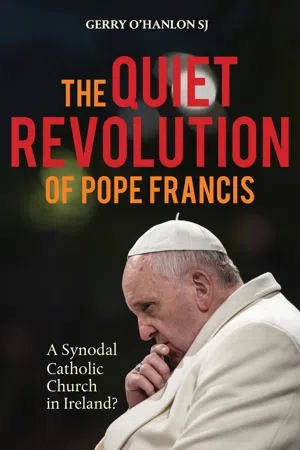
In this ground-breaking book O'Hanlon offers an Irish theology for a Church in crisis, carefully crafted in the light of his experience of having travelled the length and breadth of Ireland over the last ten years. This is not an armchair theology but one that has been chiselled out of the experience of listening to and learning from others in high and low places, engaging with diverse groups, attending to the teaching of the Second Vatican Council, and heeding the prophetic voice of the Bishop of Rome. From the Foreword by Dermot A Lane. draws on decades of reflection, by himself and by others, upon the immense challenges facing the Catholic Church in the post-Second Vatican Council period, in Ireland and beyond. We have lacked neither the vision nor the goodwill to move forward; but the institutional and organisational reforms needed to make the Second Vatican Council an embedded reality have eluded us, until now. Pope Francis, the 'gentle revolutionary', has called for a new, 'synodal' way of being church. 'Synod'means 'the path which we walk together', and it looks like the missing piece of the jigsaw. O'Hanlon's wise, critical but hopeful diagnosis offers the glimpse of a longed for sea-change for the Church. Michael Kirwan SJ. Loyola School of Theology at Trinity College, Dublin.
eBook - ePub
The Quiet Revolution of Pope Francis
A Synodal Catholic Church in Ireland Revised Edition
- 176 pages
- English
- ePUB (mobile friendly)
- Available on iOS & Android
eBook - ePub
The Quiet Revolution of Pope Francis
A Synodal Catholic Church in Ireland Revised Edition
About this book
Information
Topic
Theology & ReligionSubtopic
Christian ChurchPART ONE
Setting the Scene: Nazareth, Rome and Ireland
CHAPTER ONE
Background to the Crisis: the Roman Catholic Church
Our aim is to search for better balances without damaging vital forces. (Ladislas Orsy, Receiving the Council, 2009)
There were seven pre-conclave assemblies, known as general congregations, in the lead-up to the election of Pope Francis in 2013. In these assemblies it became clear that the Church’s maladroit handling of the scandal of clerical child sexual abuse was one of the issues uppermost in the mind of the cardinals. However, ‘… that was only part of what was seen as a dysfunctional Vatican bureaucracy in which various Curia departments were operating in an autonomous and high-handed manner, issuing instructions to bishops around the world with the authority of the Pope but without his knowledge’.2 There was evidence of financial and sexual impropriety. There was a sense of crisis, and again and again there were calls for reform, and, in particular, a return to a more collegial Church.3
Up to the Second Vatican Council
Ecclesiologists commonly note that the New Testament evidence is relatively non-prescriptive about what counts as normative for the Church in terms of institution and structures.4 Discipleship, mission, Eucharist, the promise of the ongoing presence of the Holy Spirit, the distinct identity of the Twelve with a certain pre-eminence of Peter within the group – all this is entirely compatible with a plurality of ecclesial structures. So, for example, ecclesiologist Michael Fahy, drawing on Raymond Brown, notes the diversity of churches and structures that existed in early Christianity, and identifies over ten such different types and structures. These are modelled after the different theological outlooks of the likes of Matthew, Paul and John, with both women and men playing prominent and diverse roles, and with local Churches experiencing the freedom to develop their own style of organisation in response to particular situation and needs.
It is notable that during that period there also existed a dynamic interplay between what we would now call collegial and primatial principles of authority – the burning and deeply conflictual issue of the early Church, the mission to and identity of the Gentiles, was resolved over time through the Council of Jerusalem and with key interventions from Paul and a somewhat chastened Peter (see Gal 2:11).
Over time, as the Church grew in numbers and spread geographically, a greater uniformity of structure did develop properly. Not that everything about this new uniformity was necessarily helpful or from the Holy Spirit – one thinks, for example, of the post-Constantinian quasi-identification of Church and state in which ‘… the clergy became, in effect, civil servants with all of the advantages, financial and otherwise, attached thereto’.5 Titles, honour, dress – they all date from this period and are early pointers to the ever-present temptation towards clericalism.
For the best part of the first millennium it seems that, despite growing institutionalisation and the increasing prestige of the bishop of Rome, a synodal, collegial culture flourished, at different levels – local, regional and universal (ecumenical councils). This historical reality reminds us that, apart from the relatively few normative elements from the New Testament, and those limited historical developments which have attained normative status, the Church remains free to adjust her culture and structures to best carry out the mission which has been given her – in other words, in the light of the particular situation and pastoral needs of succeeding generations and cultures. In this context the words of Michael Fahy about the Church in the second and third centuries are instructive: ‘What needs to be explained about the early church is not how a local, city-based church came to see itself as autonomous, but rather how a local church came to choose various modalities for wider fellowship. For mainline Christian churches, being autonomous never meant sterile isolation’.6 The default position, in other words, was autonomy in communion.
A shift occurred with the Gregorian Reform of the eleventh century (Pope Gregory VII, 1073–85). Often, again for very good reasons (think, for example, of the need to free the Church from political domination of various forms over the centuries, beginning with Gregory himself in his relationship with the German Emperor Henry IV), the Church became more centralised and monarchical. This trend reached its apogee in the nineteenth century with the First Vatican Council in 1870 and its definitions of papal primacy and infallibility.
Historian John O’Malley speaks of this whole period (from the French Revolution of 1789 up to the election of John XXIII as pope in 1958) as the ‘Long Nineteenth Century’.7 It is characterised not just by an entirely new ‘papalisation’ of the Catholic Church (a move from considering the Petrine office very much along the lines of ‘first among equals’, a court of last appeal, to a much more hands-on assumption of absolute, monarchical power, aided by the Roman Curia). There is also, with the exception of the emergence of Catholic social teaching in Leo XIII’s 1891 Rerum Novarum, a turn inwards by the Church away from a world which it mistrusts and sees as hostile. Bruised by the violent anti-clericalism of the French Revolution, the Church of this period rejects that cluster of developments arising from the Enlightenment, capitalism, the Industrial Revolution and democracy, which came to be known as Modernism or Liberalism. This new culture treasured the rights and freedom of the individual, and Protestantism, with its focus on the individual conscience, was more attuned to its development.
And so, despite the careful qualifiers to be found in the decrees of the First Vatican Council with respect to papal primacy and infallibility, the popular imagination and the effective operational culture of the Catholic Church assumed an unmitigated centralist, ultramontanist hue.8 The phrase ‘creeping infallibility’, attributed to Yves Congar, also extended to primacy so that, in the words of O’Malley, ‘… as a consequence, Catholics looked increasingly to “Rome” not only as a court of final appeal but for answers to all questions’.9
All this was accompanied by the relegation of laity to a very secondary role in the Church, much in contrast to New Testament and early Church times. In his Encyclical against Modernism (Pascendi, 1907) Pius X referred to ‘… that most pernicious doctrine which would make of the laity a factor of progress in the church’ and condemned Modernist positions which held that ‘… ecclesiastical government requires reformation in all its branches … [that] a share in ecclesiastical government should therefore be given to the lower ranks of the clergy and even to the laity, and authority should be decentralised … [that] the Roman Congregations, especially the Congregations of the Index and the Holy Office, are to be reformed’.10 The same pope, in an encyclical to the French Church a year earlier (Vehementer, 1906), reiterated the hierarchical structure of the Church, ‘… the Church is essentially an unequal society comprising two categories of persons, the Pastors and the flock, those who occupy a rank in the different degrees of the hierarchy and the multitude of the faithful. So distinct are these two categories that with the pastoral body only rests the necessary right and authority for promoting the end of the society and directing all its members towards that end; the one duty of the multitude is to allow themselves to be led, and, like a docile flock, to follow the Pastors’.11 The contrast with the teachings of the Second Vatican Council and Pope Francis is stark.
This is some of the background to the Second Vatican Council. There were significant exceptions to the analysis presented here – the Holy Spirit can never be entirely stifled and breaches of this rather uniform and repressive scenario were frequent, not least in the genuine piety and works of charity, mercy and justice of so many individuals and groups. One also thinks in this respect of the period between the First and Second Vatican Councils when Catholic scripture and liturgical scholarship began to flourish, when neo-Thomism became more outward looking and began to engage with secular scholarship, when the nouvelle théologie movement initiated that ressourcement movement, returning beyond Thomas and the Medievalists to patristic and biblical sources for theological nourishment. There was, in addition, as already mentioned, the emergence of that engaged corpus of Catholic social teaching, and, not least in Ireland, with Frank Duff and his Legionaries of Mary, the emergence of different lay groups which challenged the centralist assumption of lay inferiority. And, of course, there was enormous strength in the tightly knit administrative structure that enabled Rome to watch over local Churches and allowed Catholics worldwide to experience a strong sense of identity and belonging.
Despite these positive signs, it became evident, at least in retrospect, that all was not well with the Church in the lead-up to the Second Vatican Council. Canonist and theologian Ladislas Orsy speaks about the ongoing aim ‘… to search for better balances without damaging vital forces’.12 And Pope Pius XI captures this well in remarks made in 1939, just before his own death, to a group of young Canadian seminarians who were completing their studies in Rome: ‘I want you to take this message away with you. The Church, the Mystical Body of Christ, has become a monstrosity. The head is very large, but the body is shrunken. You, the priests, must rebuild the body of the Church and the only way that you can rebuild it is to mobilise the lay people.’13
The Second Vatican Council (1962–65)14
The Second Vatican Council reversed the two dominant trends that we have identified as being characteristic of the culture and structure of the Catholic Church over the ‘long nineteenth century’ and before – it displayed an openness to the world and to dialogue with it, and it proposed a collegial rather than a monarchical vision of Church.
This unforeseen outcome was, however, very much in the spirit of Pope John XXIII’s opening address in which he distanced himself from a hostile, condemnatory attitude towards the world and recommended instead the ‘medicine of mercy rather than of severity’.15 The idiom or style of the council was pastoral in an unprecedented way – persuasion rather than legal declaration was its mode of proceeding. This was not, however, a pastoral approach divorced from doctrine or even dogma – rather, as the Dogmatic Constitution on Divine Revelation makes so clear, truth in scriptural terms is always ‘saving truth’, is always sourced in the mysterious encounter with the person of Jesus Christ, and so, while not primarily a deposit of revealed propositions, does lead to the development of doctrine and dogma.
Inspired also by Pope Paul VI in his encouragement of dialogue in Ecclesiam Suam (1964) the council again and again – and not least in its Pastoral Constitution on the Church in the Modern World, Gaudium et Spes, made clear its desire to be open to the world and to other Churches and faiths. This openness was rooted in what we share in common as human beings, as was made clear from the famous opening lines of Gaudium et Spes: ‘The joys and the hopes, the griefs and the anxieties of the men and women of this age, especially those who are poor or in any way afflicted, these too are the joys and the hopes, the griefs and the anxieties of the followers of Christ’ (GS, 1). And in this dialogue of shared humanity the council declares that the Church hopes to teach and help, but also to learn from and be helped by, the world (GS, 40–45).
The other major conciliar document on the Church, The Dogmatic Constitution on the Church, Lumen Gentium, articulates the mystery of the Church in terms of the People of God, a communion mirroring the inner life of the Blessed Trinity, and a sign of hope for the world. This hope springs from the pilgrim nature of this People’s journey towards the reconciliation of unity-in-diversity, solidarity and collegiality that characterise the life of God and towards which the Holy Spirit leads both the Church and humankind in general. In this sense the Church is there not for its own sake but for the Kingdom. There is a universal call to holiness within the Church, and the language of first- and second-class ecclesial citizenship is dropped.
In particular the lay faithful, through Baptism, share in the priestly, prophetic and kingly office or role of Jesus Christ himself, both within the Church itself and in relation to the secular world. Moreover it is the People of God as a whole in whom the charism of inerrancy resides (LG, 12). It is within this subordinate context that the role of the hierarchy, including that of the papacy, is to be understood: the hierarchy exists to serve the whole People of God, not the other way around.16 And so, as Orsy puts it,17 the Church is not a military organisation where the highest in rank command and the rest obey – the notion of communio pertains to all levels of ecclesial life, based on the common baptism possessed by all, so that authority is to be exercised within the call of one mind and heart, and with respect for the inherent rights of the faithful, laity, priests, bishops and pope.
But a summary like the one just given tells only one half of the story. In fact the ...
Table of contents
- Cover
- Titlepage
- Copyright
- Contents
- Abbreviations
- Foreword
- Introduction
- Part One: Setting the Scene: Nazareth, Rome and Ireland
- Part Two: Pope Francis and the Quiet Revolution
- Part Three: Emerging Issues: Teaching and Governance
- Part Four: Ireland Revisited
- Conclusion
- Select Bibliography
- Acknowledgements
Trusted by 375,005 students
Access to over 1.5 million titles for a fair monthly price.
Study more efficiently using our study tools.
Frequently asked questions
Yes, you can cancel anytime from the Subscription tab in your account settings on the Perlego website. Your subscription will stay active until the end of your current billing period. Learn how to cancel your subscription
No, books cannot be downloaded as external files, such as PDFs, for use outside of Perlego. However, you can download books within the Perlego app for offline reading on mobile or tablet. Learn how to download books offline
Perlego offers two plans: Essential and Complete
- Essential is ideal for learners and professionals who enjoy exploring a wide range of subjects. Access the Essential Library with 800,000+ trusted titles and best-sellers across business, personal growth, and the humanities. Includes unlimited reading time and Standard Read Aloud voice.
- Complete: Perfect for advanced learners and researchers needing full, unrestricted access. Unlock 1.5M+ books across hundreds of subjects, including academic and specialized titles. The Complete Plan also includes advanced features like Premium Read Aloud and Research Assistant.
We are an online textbook subscription service, where you can get access to an entire online library for less than the price of a single book per month. With over 1.5 million books across 990+ topics, we’ve got you covered! Learn about our mission
Look out for the read-aloud symbol on your next book to see if you can listen to it. The read-aloud tool reads text aloud for you, highlighting the text as it is being read. You can pause it, speed it up and slow it down. Learn more about Read Aloud
Yes! You can use the Perlego app on both iOS and Android devices to read anytime, anywhere — even offline. Perfect for commutes or when you’re on the go.
Please note we cannot support devices running on iOS 13 and Android 7 or earlier. Learn more about using the app
Please note we cannot support devices running on iOS 13 and Android 7 or earlier. Learn more about using the app
Yes, you can access The Quiet Revolution of Pope Francis by Gerry O'Hanlon in PDF and/or ePUB format, as well as other popular books in Theology & Religion & Christian Church. We have over 1.5 million books available in our catalogue for you to explore.