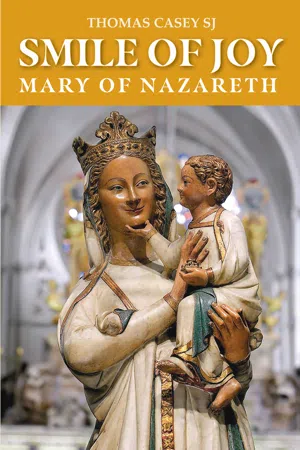
It's amazing to think that the first smile Jesus ever gave was in response to Mary's smile. It must have been an extraordinary moment: her son was smiling at her, and it was God smiling at her too. This book looks at Mary, this extraordinary woman who is "the cause of our joy" because she brought us the greatest joy of all: Jesus. She was full of joy because she was full of gratitude, gladly acknowledging the fullness of grace that God had given her. Her deep joy overflowed when she visited her cousin Elizabeth: "My soul magnifies the Lord, and my spirit exults in God my Saviour". But this Magnificat song wasn't just a once-off song of praise: the reason it came to Mary's lips so easily was because it was her usual way of praying. She constantly thanked God for the gifts he had given her. Whatever the circumstances, Mary had the deep inner conviction that "all shall be well, and all manner of thing shall be well" as Julian of Norwich was later to express it. Many of us seek joy outside of ourselves, in food and drink, or in riches and reputations. But Mary found an inner joy that came from encountering God, a joy that was immeasurably greater than any material joy. And by giving Mary a place in our hearts, we can find true joy in God as well.
- English
- ePUB (mobile friendly)
- Available on iOS & Android
eBook - ePub
About this book
Information
Topic
Theology & ReligionSubtopic
ReligionCHAPTER 1
Girl From Galilee
‘The eyes of Our Lady are… eyes of gentle compassion… and with a kind of feeling in them that cannot be described, which is beyond concepts and words, something that makes her younger than sin, younger than the race from which she sprang, and though a Mother by grace, indeed Mother of graces, yet at the same time the youngest sister of humankind.’
Georges Bernanos, The Diary of a Country Priest
In Hebrew, the sacred language of the Jewish faith, and in Aramaic, the once spoken language of Palestine, Mary’s name was Miryam. Perhaps her name is linked with the Egyptian word ‘mery’, meaning beloved or cherished, or it could be connected with the Hebrew words ‘bitter’ (mar) and ‘sea’ (yam). Indeed, a German academic once wrote a book in which he explored seventy possible meanings for Mary’s name! Although scholars offer many different explanations for her name, many saints link her name in one way or another with the ‘sea’. For the fourth-century St Jerome, God was like the sea, and Mary was a drop in this infinite ocean. St Jerome apparently called Mary Stilla Maris, or ‘drop of the sea’. But because of a copyist’s error, one single letter was changed, and as a result this phrase became Stella Maris, or ‘star of the sea’. Over time, ‘Star of the Sea’ became one of the most beloved ways of describing Mary, because so many devout people experienced her as a light guiding them through the storms and tempests of life until they could safely reach port. Saints also described her as a ‘bitter sea’, because of the immense sufferings she endured on account of her compassion for her son. Even though there is a whole ‘sea’ of meanings when it comes to Mary’s name, the Egyptian word for beloved and the Hebrew word for bitter already tell us something of Mary’s unique destiny: especially beloved by God, and yet destined to undergo the unspeakable sorrow of seeing her only son, who was also the Son of God, dying on the cross. The special place that Mary has held through the centuries in Irish hearts is shown by the fact that in the Irish language, she is the only Mary called ‘Muire’. Every other Mary is ‘Máire’.
Mary was a Jewish woman. She would have spoken Aramaic. She would have heard Hebrew as the Torah was read out in the synagogue, and most likely she would have also read the Hebrew Scriptures herself. She was a cousin of Elizabeth, the wife of the priest Zechariah, and mother of John the Baptist. Not only was Elizabeth’s own husband a priest but Elizabeth herself was ‘a descendant of Aaron’ (Lk.1:5), the first in Israel’s long line of priests, and the brother of Moses. It makes sense that Elizabeth’s cousin Mary would have been brought up in a highly religious atmosphere too. In the apocryphal gospel of James, the names of Mary’s parents are given as Joachim and Anne, and Joachim is portrayed as a wealthy and devout man who gave generously to the poor. It’s also interesting to note that Elizabeth was the name of the wife of the first high priest, Moses’ brother Aaron; and to recall that Mary shared the same name as the sister of Moses and Aaron, the name ‘Miriam’.
Mary lived in Galilee, an obscure corner of a little-known province of the Roman Empire. She didn’t live in one of the prosperous towns along the Sea of Galilee but in the simple village of Nazareth, set among its rolling hills. In fact, Nazareth was such an uneventful little place that a man called Nathanael (usually identified with the apostle Bartholomew) couldn’t imagine anything worthwhile emerging from it at all: ‘Can anything good come out of Nazareth?’ (Jn.1:46).
Mary had a happiness that wasn’t based on outward things. Just as well, because if Nathanael was correct, Nazareth hadn’t much to offer. So what gave her joy? She was convinced that she was loved infinitely by God. She knew that God was her shepherd and guide, but not a merely external guide for she also felt God’s presence deep within her. And this presence of God was an active presence: she was certain that God was at work in her heart. She was sure that God was making everything work together not only for her good but also for the good of her people, Israel. Even though life was ordinary in Nazareth, she sensed that something extraordinary was on the way. She felt that a sunrise of wonder was about to bless the life of her people, and draw them out of their tiny lives into a bigger story, the inbreaking story of the Messiah.
You have to be a child to have the lightness of heart to believe in wonder, to trust that your life is made for a big story and to have confidence in the master storyteller who is at work behind the scenes. And, in the very best sense of the word, Mary was a child: she never grew up. As the French novelist Georges Bernanos memorably wrote, this extraordinary woman stayed so young that she was ‘younger than sin’ because she was innocence itself.
Somebody might object that everyone sins, or as St Paul said, ‘all have sinned’ (Rom.3:23). But isn’t a child of three weeks or three months or three years too young to sin? Mary was that kind of innocent child, and what’s more, she retained that extraordinary childhood innocence her whole life long, which is why she is younger than sin.
But if Mary is innocence itself, how could she have said ‘my spirit rejoices in God my Saviour’ (Lk.1:47)? How could she have been saved by the Saviour if she hadn’t been lost in the first place? Here’s a way of approaching this mystery: just imagine you’re walking in a park on a summer’s day when you see a baby dove trying to fly for the first time. It lands awkwardly near a large pond of water, and you realise that since it cannot get a foothold on the slippery stones leading down to the pond, it is in danger of falling into the water. You pick up the tiny creature and save it before it falls into danger. In other words, you save it before things go wrong, and not afterwards. That’s what God did with Mary, and that’s why she was so full of joy and gratitude toward her Saviour. Another way of appreciating what God did for Mary is to take an analogy from preventive medicine. We know that doctors can successfully treat patients who are ill, and even seriously ill. However, doctors can also ‘cure’ people in advance by advising them to take preventive measures. For instance, a doctor may advise a woman to reduce her consumption of alcohol, nicotine or even sugar during pregnancy in order to save her child from being born with certain illnesses or defects. Mary too was saved in advance, in the womb, by not inheriting original sin and its consequences in the first place.
Mary always remained a child, totally dependent upon God, gladly receiving everything from God’s hands, and never wanting to be apart from him. Mary’s spirit is the spirit of childhood, a combination of utter powerlessness and immense confidence. A child is small and helpless, yet isn’t closed in on itself but delights in the world around it, full of a sense of wonder and trust. A child walks along the road of life with a spirit of astonishment, and with enough confidence to believe that God may appear at any turn. Mary looked at the path of life with the eyes of a child.
We could all gain a lot by recovering this spirit of childhood, by becoming again faithful to the children we once were. One of Pope Francis’ favourite poems puts this well. It is by Friedrich Hölderlin, and is dedicated to his grandmother. It finishes with the line; ‘May the man hold fast to what the child has promised.’ The child is filled with hope because it sees beauty everywhere, a beauty that is invisible to sceptics and cynics. Mary had that childlike spirit, that transparency and that simplicity, because she surrendered herself completely to God.
With her childlike nature, Mary was truly little and she gladly acknowledged it. She was totally dependent upon God, she gave herself fully to him and she sought to serve God as he wished to be served. It was because of this extraordinary humility that through her Christ became one of us, in the process making Mary rich in God.
Mary, I’d like to give myself more fully to God but at the same time I’m nervous about doing so. I’d like to be able to say a full ‘yes’, but all I can manage for now is something partial. Maybe we could pray this prayer of St Ignatius of Loyola together regularly, so that some of your sublime self-giving will rub off on me, and then one day I’ll be able to say it with something approaching your integrity:
‘Take Lord receive, all my liberty, My memory, my understanding, my entire will.
Give me only your love and your grace.
These are enough for me.’
CHAPTER 2
Gladness Of Grace
‘I don’t know who – or what – put the question, I don’t know when it was put. I don’t even remember answering. But at some moment I did answer “yes” to someone – or something – and from that hour I was certain that existence is meaningful and that, therefore, my life, in self-surrender, had a goal.’
Dag Hammarskjöld, Markings
Mary became engaged to a carpenter named Joseph. In that era, it was usual for Jewish girls to become engaged at the age of thirteen. At this moment in her life, when she was just a young teenager, solidly connected with a man to whom she was promised in marriage, something extraordinary unfolded. Shortly after the engagement, the angel Gabriel visited her. His first word of greeting was an invitation to joy: Gabriel said ‘Rejoice’ (Lk.1:28). He then proceeded to give Mary a new name! He called Mary ‘the one who has always been full of grace’ (Lk.1:28), which is even more striking than the familiar phrase we use: ‘full of grace’. This was the first title Mary ever received. Long before the Church started giving Mary her many titles, God, through his messenger Gabriel, had already bestowed this title upon her. Notice that the emphasis isn’t on Mary or on her virtues or merits. The phrase ‘the one who has always been full of grace’ tells us what God has done for Mary. God has poured his love into Mary’s heart, and it is this love of God that makes her worthy, not anything she has done herself. All that she is and all that she has – everything is God’s gift to her.
Grace comes into our lives when God turns toward us with his love that we don’t deserve, yet which floods our hearts, draws us toward him and makes us sharers in his divine life. That’s how it happened for Mary as well. Grace ushered Mary into a wonderful world where she could relate to God as the most intimate of friends. Grace raised her up, making it possible for her to love in a way she could never have loved by herself.
Grace and joy are closely related in life: when anyone treats us graciously or favourably, we experience joy. Grace and joy are closely connected in the New Testament as well. In fact the words look really similar in the Greek language in which the New Testament was written: ‘grace’ is charis, and ‘joy’ is chara (and by the way, the first word of the Angel Gabriel’s greeting – ‘rejoice’ – was another closely connected word: ‘chaire’). The similarity between grace and joy is in more than the spelling, because when grace enters someone’s life, joy accompanies it. Mary’s deep joy wasn’t something she produced herself; its origin was divine. This joy wasn’t dependent upon outward circumstances, because it was the fruit of the Holy Spirit. Grace didn’t bring Mary a momentary thrill but lasting joy. Grace didn’t bring Mary surface glee but inner delight.
The words of the angel Gabriel are often translated as ‘full of grace’. Impressive as the words ‘full of grace’ are, they are still not powerful enough to express what the angel Gabriel was really saying to Mary. That’s why I use the expression ‘the one who has always been full of grace’.
In the Acts of the Apostles, we’re told that Stephen, the first Christian martyr, was a man ‘full of grace’ (pleres charistos). Although this means that Stephen was filled with grace at a given moment in time, it doesn’t mean that he had always been filled with grace. The angel Gabriel used a significantly different term when he greeted Mary: the word ‘kecharitomene’. This word does not appear elsewhere in the Bible. In fact, it does not appear anywhere else in all of Greek literature. It is a once-off word for a one-of-a-kind woman. The word ‘kecharitomene’ means fully and flawlessly filled with grace. It doesn’t merely mean that someone is filled with grace just for now or only in the present moment. It means that someone, although filled with grace in the past, still continues to be filled with that same grace in the present, in such a complete way that they will most likely always be full of grace. It’s a word for someone who has permanent and perfect grace.
This wonderful word implies that Mary was full of amazing grace from the very beginning. For the rest of us, our closeness, communion and fellowship with God are given at baptism. But in Mary’s case, this gift of intimacy and communion with God was given to her from the moment her life began in the womb. And God’s grace enabled her to continue living like that her whole life through. This privilege was given by God: just as in the case of Adam and Eve, God created Mary without original sin. The word ‘kecharitomene’ already hints at the Immaculate Conception. Or to put it in a different way, this compelling Greek word is the first glimpse of what would later be clearly expressed in the belief ‘that the Blessed Virgin Mary, at the first instant of her conception, by a singular privilege and grace of the omnipotent God, in virtue of the merits of Jesus Christ, the Saviour of mankind, was preserved immaculate from all stain of original sin’ (Pope Pius IX).
The heart warming news is that we’re all invited to share in the Immaculate Conception. It’s not just Mary’s privilege – it’s a privilege open to everyone. Certainly, Mary received it in a matchless way, she was filled with the Holy Spirit from the moment of her conception. Even though our life is already well underway, we can receive this gift as well. In fact, there was someone soon after Mary who received the Holy Spirit in his mother’s womb: John the Baptist. Although we’re no longer in the womb, God can still make of us what he has always wanted us to be. This is really what St Paul is getting at in the Letter to the Ephesians (Eph.1:4), when he emphasises that even before God created the world, he had already chosen us in Christ to be holy and without fault in his sight.
Grace is not some inert thing but God himself, giving us the gift of his life and love. Even if we’ve never had this gift, we can still receive it. The Immaculate Conception means that Mary was saved, and saved in advance. However, Mary is not the only one who can be saved. We are all offered salvation. God wants to privilege each one of us, and he doesn’t want to wait until some vague point in the remote future to do so. He wants to give each of us the fullness of grace as soon as possible. Note the present tense in Mary’s description of herself to Bernadette Soubirous in the grotto of Massabielle in 1858: ‘I am the Immaculate Conception’. Mary didn’t say ‘I was immaculately conceived’. That’s because the grace of the Immaculate Conception is not just a past reality but instead something that is active and at work in the present moment. It’s something we can access in the here and now of our lives. By looking at Mary we come to realise that this marvellous gift is available to us as well: she is the reason for our hope.
The Immaculate Conception means that Mary was always in a fully healthy relationship with God. God wants to usher each of us into a right relationship with him. God wants to give us the light and the fire of the Holy Spirit. God wants to surround us with grace. God wants to save us in the most radical and generous way possible. The following words, attributed to Pedro Arrupe, the inspirational twentieth century Basque Jesuit, convey in an eloquent manner what it means to be wholly taken up by God, to become an ‘Immaculate Conception’ so to speak: ‘Nothing is more practical than finding God, than falling in love in a quite absolute, final way. What you are in love with, what seizes your imagination, will affect everything. It will decide what will get you out of bed in the morning, what you do with your evenings, how you spend your weekends, what you read, whom you know, what breaks your heart, and what amazes you with joy and gratitude. Fall in love, stay in love, and it will decide everything.’
For all the wonder of those words, the gift of the Immaculate Conception won’t wave a magic wand over our lives, suddenly exempting us from the griefs and pains that are part of the human condition. If we receive the gift of the Immaculate Conception as Mary did, the normal experiences of life will continue as before: although w...
Table of contents
- Cover
- Title
- Copyright
- Contents
- Introduction: Wavelength Of Wonder
- Chapter 1: Girl From Galilee
- Chapter 2: Gladness Of Grace
- Chapter 3: Prayer Of Praise
- Chapter 4: Born In Bethlehem
- Chapter 5: Testimony In The Temple
- Chapter 6: Leaving To Live
- Chapter 7: Tried And Tested
- Chapter 8: Symphony Of Silence
- Chapter 9: Water Into Wine
- Chapter 10: Standing And Steadfast
- Chapter 11: Praying At Pentecost
- Chapter 12: Vision Of Victory
Trusted by 375,005 students
Access to over 1.5 million titles for a fair monthly price.
Study more efficiently using our study tools.
Frequently asked questions
Yes, you can cancel anytime from the Subscription tab in your account settings on the Perlego website. Your subscription will stay active until the end of your current billing period. Learn how to cancel your subscription
No, books cannot be downloaded as external files, such as PDFs, for use outside of Perlego. However, you can download books within the Perlego app for offline reading on mobile or tablet. Learn how to download books offline
Perlego offers two plans: Essential and Complete
- Essential is ideal for learners and professionals who enjoy exploring a wide range of subjects. Access the Essential Library with 800,000+ trusted titles and best-sellers across business, personal growth, and the humanities. Includes unlimited reading time and Standard Read Aloud voice.
- Complete: Perfect for advanced learners and researchers needing full, unrestricted access. Unlock 1.5M+ books across hundreds of subjects, including academic and specialized titles. The Complete Plan also includes advanced features like Premium Read Aloud and Research Assistant.
We are an online textbook subscription service, where you can get access to an entire online library for less than the price of a single book per month. With over 1.5 million books across 990+ topics, we’ve got you covered! Learn about our mission
Look out for the read-aloud symbol on your next book to see if you can listen to it. The read-aloud tool reads text aloud for you, highlighting the text as it is being read. You can pause it, speed it up and slow it down. Learn more about Read Aloud
Yes! You can use the Perlego app on both iOS and Android devices to read anytime, anywhere — even offline. Perfect for commutes or when you’re on the go.
Please note we cannot support devices running on iOS 13 and Android 7 or earlier. Learn more about using the app
Please note we cannot support devices running on iOS 13 and Android 7 or earlier. Learn more about using the app
Yes, you can access Smile of Joy by Thomas G Casey in PDF and/or ePUB format, as well as other popular books in Theology & Religion & Religion. We have over 1.5 million books available in our catalogue for you to explore.