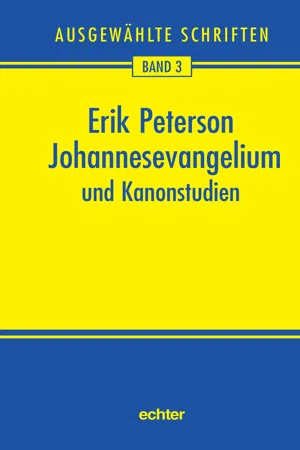
Ausgewählte Schriften, Band 3.herausgegeben von Barbara Nichtweiß unter Mitarbeit von Kurt Anglet und Klaus ScholtissekMit einem Geleitwort von Karl Kardinal LehmannDer Evangelist Johannes trägt in der östlichen Kirche seit alters den Ehrentitel "der Theologe". Sein Evangelium bietet Erik Peterson 1927/29 unzählige Anknüpfungspunkte, in die Tiefe theologischer Fra-gen vorzustoßen: Das Verhältnis des göttlichen Wortes zum Kosmos bewegt seine Auslegung ebenso wie die Frage, wie der Mensch in Gottesdienst und Sakramenten in eine neue, endzeitliche Welt einbezogen wird.Das Johanneische Schrifttum spielt für Peterson auch eine zentrale Rolle beim Werden des Neuen Tes-taments insgesamt: Das erweisen im vorliegenden Band bislang völlig unbekannte Vorträge aus Peter-sons römischer Zeit zur Entstehung des neutestamentlichen Kanons sowie zum Übergang von der mündlichen zur schriftlichen Überlieferung in der frühen Kirche.Inhalt u.a.: Johannesevangelium (Kap. 1 - 7, 30)Die Entstehung des neutestamentlichen KanonsPapias von Hierapolis"An der Kralle erkennt man den Löwen", sagt eine alte Sentenz. Sie gilt auch für die Vorlesungen Erik Petersons. Man kann aus ihnen erahnen, was diesen Historiker, Exegeten und Theologen bewegte und welche immensen Kenntnisse er hatte. Er ist ein beeindruckender Meister und Lehrer der Kirche, den es erst noch zu entdecken gilt.(Karl Kardinal Lehmann)
- 416 pages
- English
- PDF
- Available on iOS & Android
eBook - PDF
Johannesevangelium und Kanonstudien
About this book
Information
Topic
Theology & ReligionSubtopic
Christian TheologyTable of contents
- Front Cover
- Copyright
- Inhalt
- Zum Geleit
- Einführung in die Edition
- I. AUSLEGUNGEN DES JOHANNESEVANGELIUMS
- 1. Ort und Entstehung der Vorlesungen
- 2. Zur Bedeutung der exegetischen Vorlesungenf ür die Theologie Petersons
- 3. Einleitungsfragen
- 4. Zur Textgestalt und ihrer Wiedergabe
- 5. Gliederung
- 6. Quellen der Auslegung
- 7. Frühe Johannes-Fragmente
- 8. Spätere Auslegungsspuren
- II. KANONSTUDIEN
- 1. Italienische Vorlesungen der 1940er Jahre
- 2. Die Entstehung des neutestamentlichen Kanons
- 3. Texte zu den zwölf Aposteln als Traditionsträger,Papias von Hierapolis, den Quellen des Irenäus sowie Caius von Rom, die Aloger und die Kirchenväter
- DANK
- EINFÜHRUNG IN DIE JOHANNESVORLESUNG ERIK PETERSONS
- 1. EINLEITUNGSFRAGEN ZUM JOHANNESEVANGELIUM
- 2. DAS ESCHATOLOGISCHE DENKEN PETERSONSI N DER AUSLEGUNG DES JOHANNESEVANGELIUMS
- 3. BEOBACHTUNGEN ZUM KANONISCHEN ANSPRUCH DES JOHANNESEVANGELIUMS
- 4. ISRAEL UND „DIE JUDEN“ IN DER JOHANNESAUSLEGUNG ERIK PETERSONS
- 5. ZUR SCHRIFTHERMENEUTIK ERIK PETERSONS
- 5.1. Phänomenologische und johanneische Sehweise
- 5.2. Patristische und kanonische Schriftauslegung
- (a) Kanonische Schriftauslegung
- (b) Texte und ihre „Sinnkarriere“
- Teil I Auslegungen des Johannesevangeliums
- Literatur zum Johannesevangelium
- EINLEITUNG
- I. DAS VIERTE EVANGELIUM
- Symbolik des Vierevangelienkanons
- Begriff der Inspiration
- Begriff des Evangeliums
- Johannes und die Synoptiker
- Die Gattung der Aretologie
- II. KANONIZITÄT UND VERFASSERSCHAFT
- Aufnahme in den Kanon
- 1. Kirchenrecht und heiliges Recht
- 2. Die Apostolizität des Verfassers
- Identität des Verfassers
- 1. Der Presbyter Johannes
- 2. Der Sohn des Zebedäus
- Syrien
- 1. Hypothesen zur Mandäerfrage
- 2. Johannes der Täufer und Jesus
- 3. Mandäer und Judenchristentum
- Sprachcharakter
- IV. DAS JOHANNESEVANGELIUM IM KONTEXTDES URCHRISTENTUMS
- Zeugnis prophetischen Charismas
- Streitfall zwischen Rom und Ephesus
- V. DER APOSTEL JOHANNES ALS VERFASSER DES VIERTEN EVANGELIUMS
- Der Lieblingsjünger
- Das hellenistische Umfeld in Galiläa
- VI. DER INHALT IM VERGLEICH ZU DEN SYNOPTIKERN
- 1,1–18 PROLOG
- DIE BEDEUTUNG DES ANFANGS
- STIMME, MYTHOS, SPRUCH, REDE UND LOGOS
- DER LOGOS
- DER KOSMOS I
- DIE GOTTESKINDSCHAFT
- 1,19–34 DAS ZEUGNIS JOHANNESDES TÄUFERS
- 1,35–51 DIE BERUFUNGDER ERSTEN JÜNGER
- DAS „AMEN“ DES SOHNES
- 2,1–12 DIE HOCHZEIT ZU KANA
- DAS WEINWUNDER
- 2,13–22 DIE AUSTREIBUNG DER HÄNDLER AUS DEM TEMPEL
- IRDISCHER UND HIMMLISCHER LEIB CHRISTI
- 2,23–25 DIE ERSTE WIRKSAMKEIT JESU IN JERUSALEM
- DIE ERKENNTNIS DES MENSCHEN
- 3,1–15 DAS GESPRÄCH MIT NIKODEMUS
- DIE TAUFE
- FLEISCH UND GEIST
- DER MENSCHENSOHN
- ANSCHAULICHE CHRISTOLOGIE
- 3,16–21 GOTTESSOHN UND KOSMOS
- DER GLAUBE AN DEN SOHN
- LICHT UND FINSTERNIS
- 3,22–36 DIE STELLUNG DES TÄUFERS ZU JESUS
- JESUS UND JOHANNES DER TÄUFER
- 4,1–44 JESUS UND DIE SAMARITERIN
- DIE ANBETUNG IM GEIST
- DER CHRISTLICHE GOTTESDIENST
- 5,1–18 DIE HEILUNG DES GELÄHMTEN
- 5,19–47 JESU VERHÄLTNIS ZUM VATER
- DAS CHRISTLICHE SCHRIFTPRINZIP
- DIE EHRE VONEINANDER ANNEHMEN
- ZUR BEURTEILUNG DES JUDENTUMS
- 6,1–13 DIE SPEISUNG DER FÜNFTAUSEND
- 6,14–21 JESU WANDELN AUF DEM SEE
- 6,22–59 DAS BROT DES LEBENS
- TAUFE UND EUCHARISTIE
- JESUS CHRISTUS IN FLEISCH UND BLUT
- SAKRAMENTALE UND KIRCHLICHE KOMMUNION
- 6,60–66 DER ABFALL DER JÜNGER
- DAS FLEISCH DES MENSCHENSOHNES
- 6,67–71 DAS PETRUSBEKENNTNIS
- DAS PETRUSBEKENNTNIS BEI JOHANNES UND BEI DEN SYNOPTIKERN
- DIE ZWÖLF UND DIE KIRCHE
- 7,1–30 JESUS BEIM LAUBHÜTTENFEST IN JERUSALEM
- ÖFFENTLICHKEIT UND „ZEIT“ JESU
- FRÜHE AUSLEGUNGEN
- JOH 13,1
- JOH 16,12–24
- DIE GESCHICHTE DER ENTSTEHUNG DES NEUTESTAMENTLICHEN KANONS
- DIE BÜCHER UND DER KELCH DES NEUEN TESTAMENTS
- DIE SCHRIFTEN DES NEUEN TESTAMENTS
- KLEINE BIBLIOGRAPHIE
- DAS ALTE UND DAS NEUE TESTAMENT
- DIE ENTSTEHUNG DER EVANGELIEN
- HERRENWORTE BEI PAULUS
- KANNTE PAULUS EIN SCHRIFTLICHES EVANGELIUM?
- APOSTOLISCHE VERKÜNDIGUNG UND SCHRIFTLICHES EVANGELIUM
- ENTSTEHUNG DER EVANGELIEN AUS DER APOSTOLISCHEN PREDIGT
- DIE SAMMLUNG DER APOSTOLISCHEN BRIEFE
- APOSTELGESCHICHTE UND APOKALYPSE
- TRANSFORMIERUNGEN DES APOSTOLATS
- ÖFFENTLICHE VERLESUNG UND KATHOLIZITÄT APOSTOLISCHER SCHRIFTEN
- KANONISIERUNG DES NEUEN TESTAMENTS
- FOLGEN DER KANONISIERUNG DES NEUEN TESTAMENTS
- DIE ZWÖLF APOSTEL ALS TRADITIONSTRÄGER
- PAPIAS VON HIERAPOLIS
- ZUR PERSON DES PAPIAS
- „EXEGESEN“ UND „LOGIEN“
- TRADITIONEN UND IHRE UNTERSCHEIDUNG
- TRADITIONEN DER „SCHÜLER DES HERRN“
- DAS PROBLEM VON ÜBERSETZUNGEN
- DIE JOHANNEISCHE TRADITION
- JÜDISCHE TRADITIONSFORMEN UND DIE BEDEUTUNG DES PAPIAS
- KLEINASIATISCHE QUELLEN DES IRENÄUS
- CAIUS VON ROM UND DIE ALOGER
- GEIST UND LOGOS DER KIRCHENVÄTER
- Back Cover
Trusted by 375,005 students
Access to over 1.5 million titles for a fair monthly price.
Study more efficiently using our study tools.
Frequently asked questions
Yes, you can cancel anytime from the Subscription tab in your account settings on the Perlego website. Your subscription will stay active until the end of your current billing period. Learn how to cancel your subscription
No, books cannot be downloaded as external files, such as PDFs, for use outside of Perlego. However, you can download books within the Perlego app for offline reading on mobile or tablet. Learn how to download books offline
Perlego offers two plans: Essential and Complete
- Essential is ideal for learners and professionals who enjoy exploring a wide range of subjects. Access the Essential Library with 800,000+ trusted titles and best-sellers across business, personal growth, and the humanities. Includes unlimited reading time and Standard Read Aloud voice.
- Complete: Perfect for advanced learners and researchers needing full, unrestricted access. Unlock 1.5M+ books across hundreds of subjects, including academic and specialized titles. The Complete Plan also includes advanced features like Premium Read Aloud and Research Assistant.
We are an online textbook subscription service, where you can get access to an entire online library for less than the price of a single book per month. With over 1.5 million books across 990+ topics, we’ve got you covered! Learn about our mission
Look out for the read-aloud symbol on your next book to see if you can listen to it. The read-aloud tool reads text aloud for you, highlighting the text as it is being read. You can pause it, speed it up and slow it down. Learn more about Read Aloud
Yes! You can use the Perlego app on both iOS and Android devices to read anytime, anywhere — even offline. Perfect for commutes or when you’re on the go.
Please note we cannot support devices running on iOS 13 and Android 7 or earlier. Learn more about using the app
Please note we cannot support devices running on iOS 13 and Android 7 or earlier. Learn more about using the app
Yes, you can access Johannesevangelium und Kanonstudien by Erik Peterson, Barbara Nichtweiß in PDF and/or ePUB format, as well as other popular books in Theology & Religion & Christian Theology. We have over 1.5 million books available in our catalogue for you to explore.