In this companion volume to his highly successful The Fundamentals of Drawing, Barrington Barber takes the aspiring artist one step further in the quest for greater skill and competence. If you have come this far on the journey with him you will know that the more you practise the more visual surprises you are presented with and the more problems there are to be overcome. In Advanced Drawing Skills you will be shown how to find solutions to these challenges through the application of more advanced techniques and the greater awareness that comes with closer study of a subject. You will also be encouraged to develop further your perception of the visual world to enable you to express emotions and ideas in your own work and to retain information for future use.
Once you have absorbed the many techniques and approaches presented here, you will find your understanding and appreciation of the world around you opening up to reveal new possibilities.
Includes over 370 illustrations
- English
- ePUB (mobile friendly)
- Available on iOS & Android
eBook - ePub
About this book
Information
Topic
ArtSubtopic
Art TechniquesStudying Life from Nature
Throughout history artists have acquired their basic vocabulary through detailed observation of the natural world. Even if the final result in a work is abstracted or manipulated extensively, it is informed by a study of nature.
If you want to make your work convincing, look at the created world around you. Don’t view it exclusively through the mediums of photography, television or video. Personal experience will lend a power and knowledge to your work that not only informs you as the artist but also the reviewers of your work. This is very apparent when you look at the work of an artist who has actually experienced at first hand the things he draws. It is also pretty clear to the observant viewer when an artist is only working from second-hand sources, because their drawings tend to lack power.
To achieve realism in your drawings, start by observing plants in detail; even if you live in an urban environment you should be able to find a wide variety to study. You can then move on to animals and human beings. Don’t worry about posing them to begin with; just observing them will pay off if you are reasonably systematic about recording what you see so that it remains in your memory.
Observe, too, the effects of light falling on people and objects and how the effects of distance and weather create interesting changes in subject matter. Everything you see and note can be used to advantage in your work. All you need is the time and opportunity to take it all in.
PLANTS AND FLOWERS
The essential structure of a plant is not difficult to see if you study it for a time. Take a group of leaved plants: you soon notice how one type will have leaves in clusters that spring up at the points of the leaves, whereas in another the leaves will hang down around a central point. Some plants have stalks coming off the branches evenly at the same point, others have the stalks staggered alternately down the length of the stem. Once you are familiar with a plant’s characteristic shape and appearance, you will begin to notice it or similar properties in other plants. Observation will lend verisimilitude to even your most casual sketches. Look at the examples of plants on this spread, noting their similarities and differences.
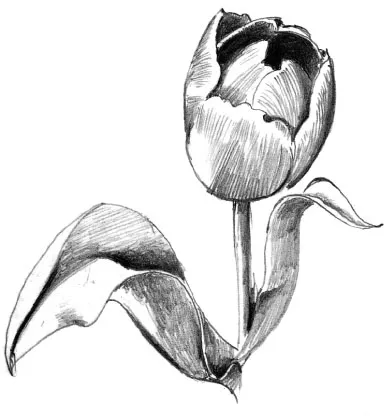
The appearance of the Tulip is very formal and upright, with its closed cup-like flower and long stiff stalk and leaves.
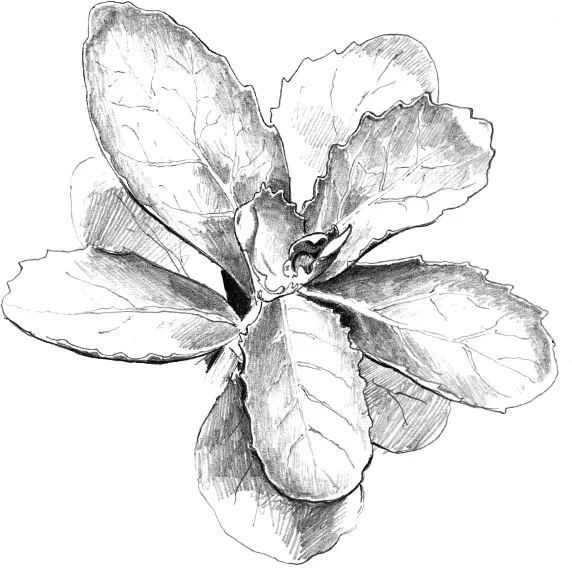
The Sedum has a beautiful spiralling arrangement of leaves that curves up into a dish-like form. Rain must fill up the hollow of the leaf and run down the stalk to water the plant’s roots.
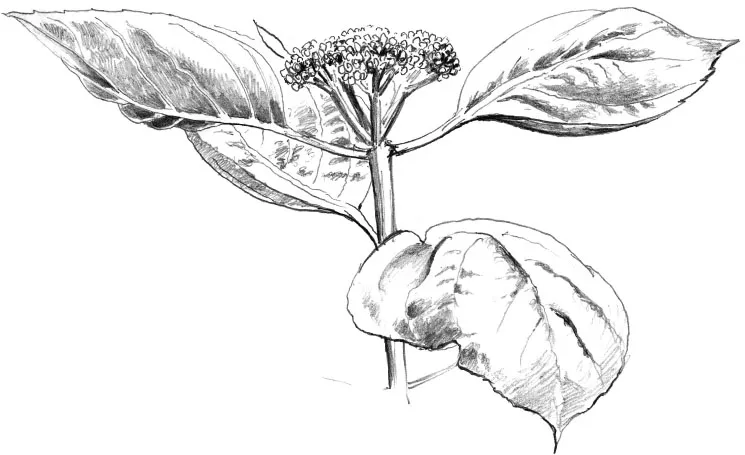
The leaves of the Hydrangea come off the stem at opposite sides to each other in a symmetrical arrangment. Notice how they curve upwards and then how the curve is reversed, with the upper surface bulging out towards the tip.
The easiest way to study plants is by sketching them as often as you can. Before you begin to draw, look at the plant closely: at the bloom (if there is one), and note how the leaves grow off the stalk. Look at it from above, to see the leaves radiating out from the centre; and from the side to see the different appearance of the leaf shapes as they project towards you, away from you and to each side as they spiral round the stem. Note the texture of the leaves, and how it compares with that of other plants.
When your subject is a flower-head, draw it from an angle, where you can see the pattern of the petals around the centre of the blossom or a profile view of them. Notice the texture of the petals and how the centre of the flower contrasts with the main part of the bloom. When you draw the flower, include a leaf or two to show the contrast in tone or texture between the leaf and the petals.
The more you draw plants, the more details you will notice and the broader your vocabulary will become. After you have been drawing plants for a while, try drawing one from memory. This type of exercise helps to sustain the image that your senses have recorded and will help you to memorize shapes and textures. You will find drawing from memory gives a simpler result than drawing from life, because you tend to leave out unnecessary details. The ability to produce a conventional shape easily without reference is a great asset. Once you have this ability, you will be able to bring a greater sense of realism to your drawings.
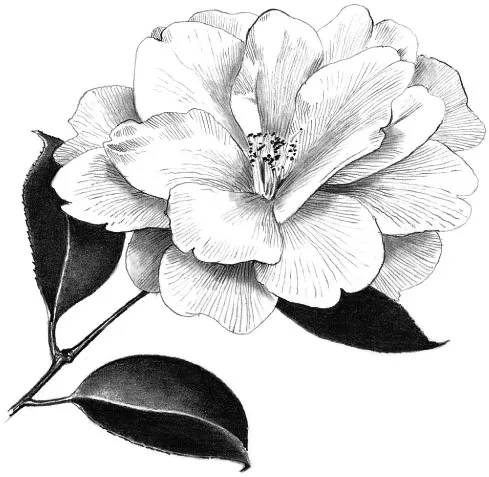
The delicate blossom of the Camellia looks so fragile. It contrasts beautifully with the solid, perfect shape of the leaves.
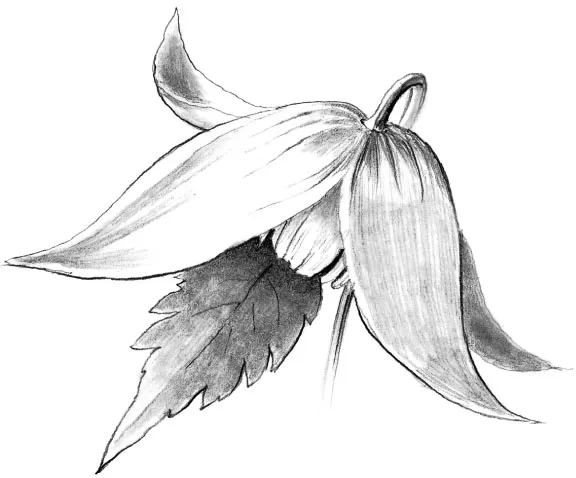
The...
Table of contents
- Cover
- Title
- Contents
- Introduction
- Drawing from the Masters
- The Experience of Drawing
- Form and Shape
- Assessing What Works
- Studying Life from Nature
- Extremes of Expression
- Styles and Techniques
- Art Appreciation
- Copyright
Trusted by 375,005 students
Access to over 1.5 million titles for a fair monthly price.
Study more efficiently using our study tools.
Frequently asked questions
Yes, you can cancel anytime from the Subscription tab in your account settings on the Perlego website. Your subscription will stay active until the end of your current billing period. Learn how to cancel your subscription
No, books cannot be downloaded as external files, such as PDFs, for use outside of Perlego. However, you can download books within the Perlego app for offline reading on mobile or tablet. Learn how to download books offline
Perlego offers two plans: Essential and Complete
- Essential is ideal for learners and professionals who enjoy exploring a wide range of subjects. Access the Essential Library with 800,000+ trusted titles and best-sellers across business, personal growth, and the humanities. Includes unlimited reading time and Standard Read Aloud voice.
- Complete: Perfect for advanced learners and researchers needing full, unrestricted access. Unlock 1.5M+ books across hundreds of subjects, including academic and specialized titles. The Complete Plan also includes advanced features like Premium Read Aloud and Research Assistant.
We are an online textbook subscription service, where you can get access to an entire online library for less than the price of a single book per month. With over 1.5 million books across 990+ topics, we’ve got you covered! Learn about our mission
Look out for the read-aloud symbol on your next book to see if you can listen to it. The read-aloud tool reads text aloud for you, highlighting the text as it is being read. You can pause it, speed it up and slow it down. Learn more about Read Aloud
Yes! You can use the Perlego app on both iOS and Android devices to read anytime, anywhere — even offline. Perfect for commutes or when you’re on the go.
Please note we cannot support devices running on iOS 13 and Android 7 or earlier. Learn more about using the app
Please note we cannot support devices running on iOS 13 and Android 7 or earlier. Learn more about using the app
Yes, you can access Advanced Drawing Skills by Barrington Barber in PDF and/or ePUB format, as well as other popular books in Art & Art Techniques. We have over 1.5 million books available in our catalogue for you to explore.