Best-selling author Barrington Barber presents a range of exciting projects, from simple still lifes and full-blown landscape compositions to individual portraits. His systematic teaching method ensures that you quickly acquire the techniques you need to complete sets of drawings that any aspiring artist would be proud of.
• Rather than teaching by rote, this book inspires readers to discover their own individual style of drawing.
• The material here works for complete beginners as well as those who are looking to improve their skills.
• Fully illustrated throughout by the author.
- English
- ePUB (mobile friendly)
- Available on iOS & Android
eBook - ePub
About this book
Information
Topic
ArtSubtopic
Art GeneralPROJECT 1: STARTING OUT WITH STILL LIFE
This part of the book starts with some straightforward drawings of mundane household objects so that you can practise your handling of shape, texture and tone. Many of the items you have around the house will have ordered, symmetrical forms and you need to be able to tackle those with confidence to make your interiors look convincing.
Once you’ve mastered the drawing of everyday objects in isolation, the next easy step is to try out your skill at putting together a composition of several objects and producing a still-life drawing. I have suggested a variety of obvious things for you to draw, but you can choose any subject that interests you.
In the later pages of this section I’ve included some larger and slightly more complex subjects so that you have something to get your teeth into if you find yourself steaming ahead in great shape. The main thing is to enjoy the process of drawing without worrying about how well or badly you’re doing initially; just try out your skills of observing and then recording what you see, and you’ll find that the more you do this the better you will get. I don’t guarantee to turn you into an artistic genius, but with a little effort and the will to persevere you’ll soon develop your abilities.
Simple still-life objects
Here we’re going to build up to drawing a simple still-life composition, starting with some practice on straightforward household objects to help you tackle the problems that you’ll discover. In these examples I’ve given you a variety of shapes, some easy and others more complex.
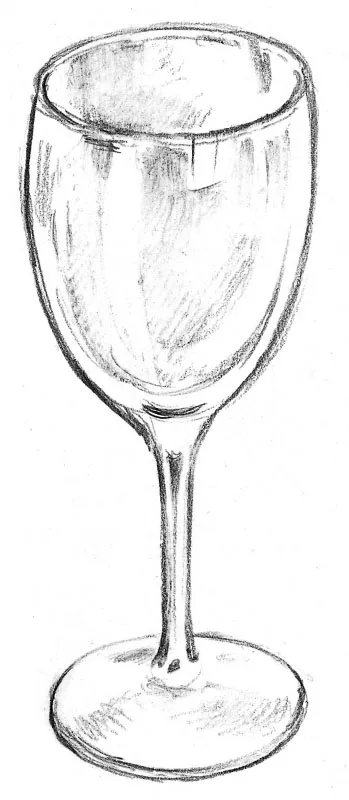
First I tried a tumbler and a wine glass, because they are easy to see through, and so you can see how the shape works. They are both centred on a central line, both sides being mirror images of each other. You could draw a vertical and draw each side of it, as I have done with the tumbler.
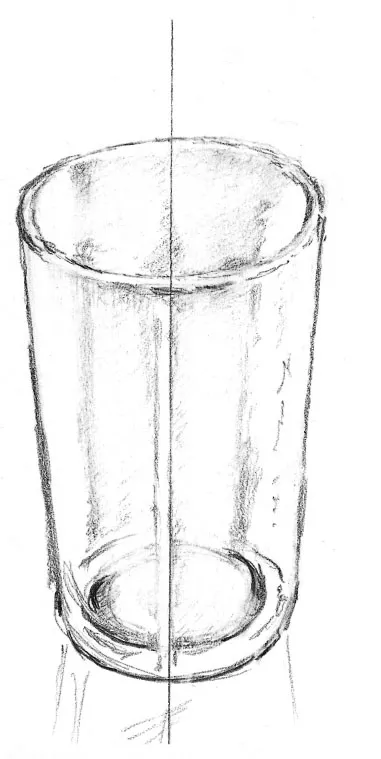
I’ve also drawn in all the tonal values, but before you embark on this do make sure that you have got the shape right.
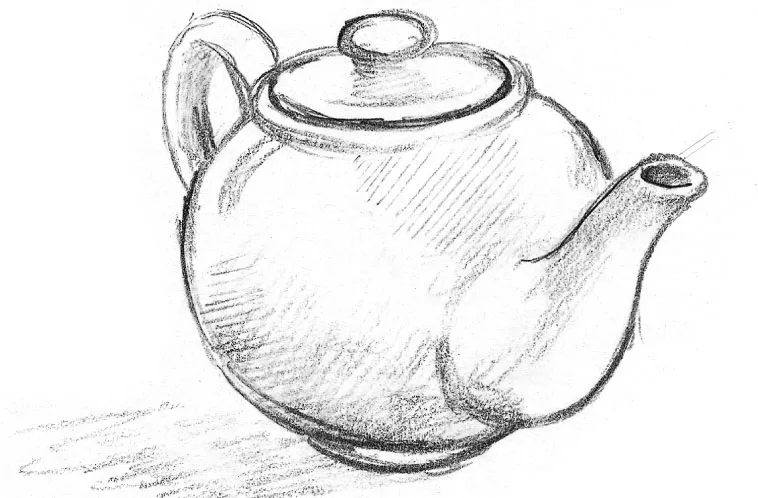
Next I moved on to two solid objects, which are a bit more complex because of the projections on them. The first is a teapot, which I have drawn with the spout turned slightly towards me. So although the middle part of the pot is based on a central line, the spout and the handle are angled projections off that more balanced shape.
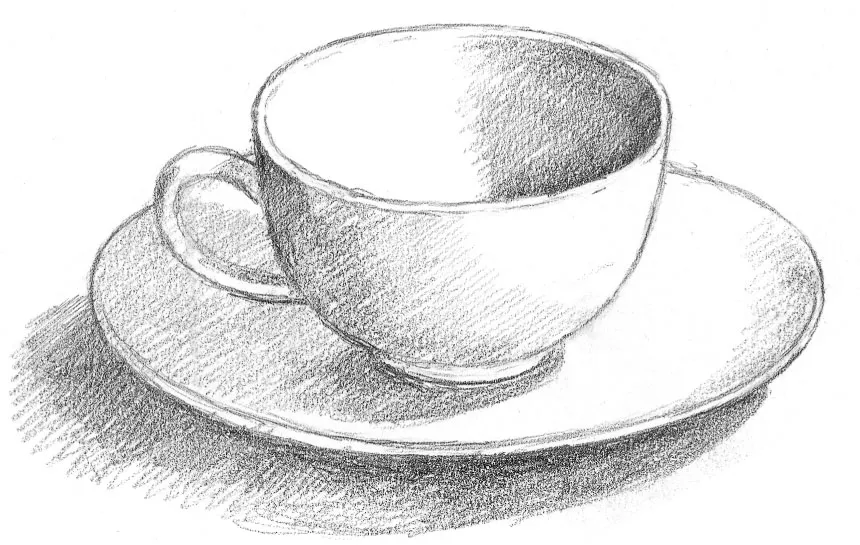
The next example is a cup and saucer, with the handle projecting to one side, and here you also have two objects that fit together to contend with. The shapes are gradually getting more complex to suit your developing skills.
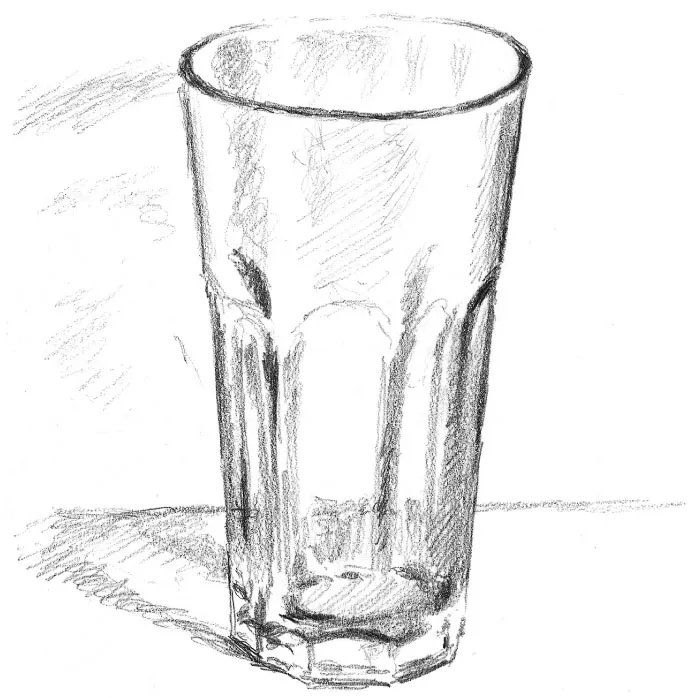
Now a return to a glass tumbler – but this one has faceted sides in the lower half, which produces a more testing shape to draw. Again, as with all of these objects, the main thing is to get the shape right and only then go ahead with the shading.
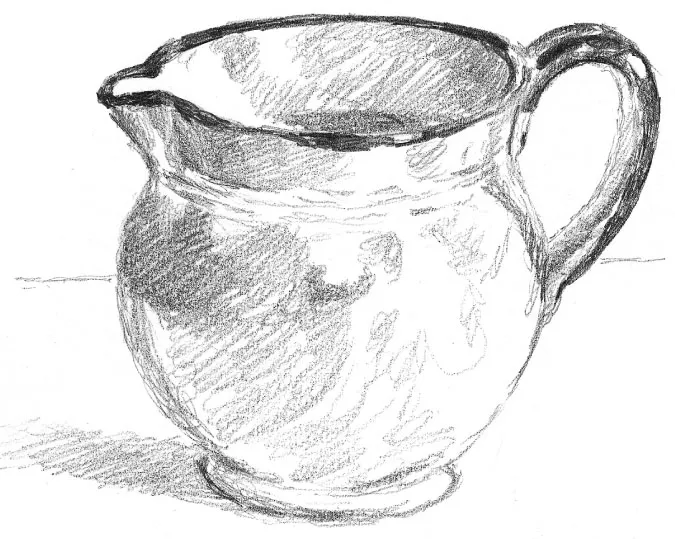
A jug is the next object, but a curved one with a painted rim and handle to make things more tricky. Work on the shape first and then add the tone as before.

This pleasingly old and battered watering can is a little more complex in construction than what has gone before. It is your accuracy of perception that is going to be tested here, so this is good practice.
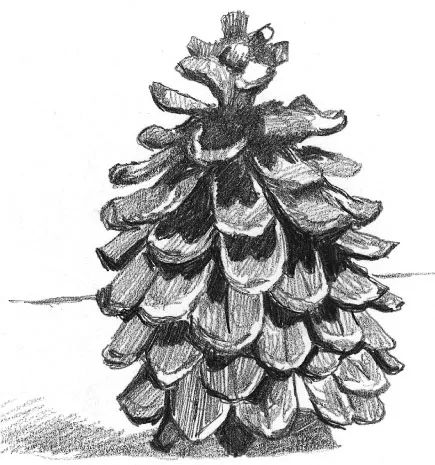
Unlike man-made goods, objects found in nature often have imperfections and unevenness in form. The trick with this pine cone is to make the tones very dark in the central shadows and lighter where the leaves don’t overlap. Because of the variety in shape you don’t have to worry if your drawing isn’t exact.
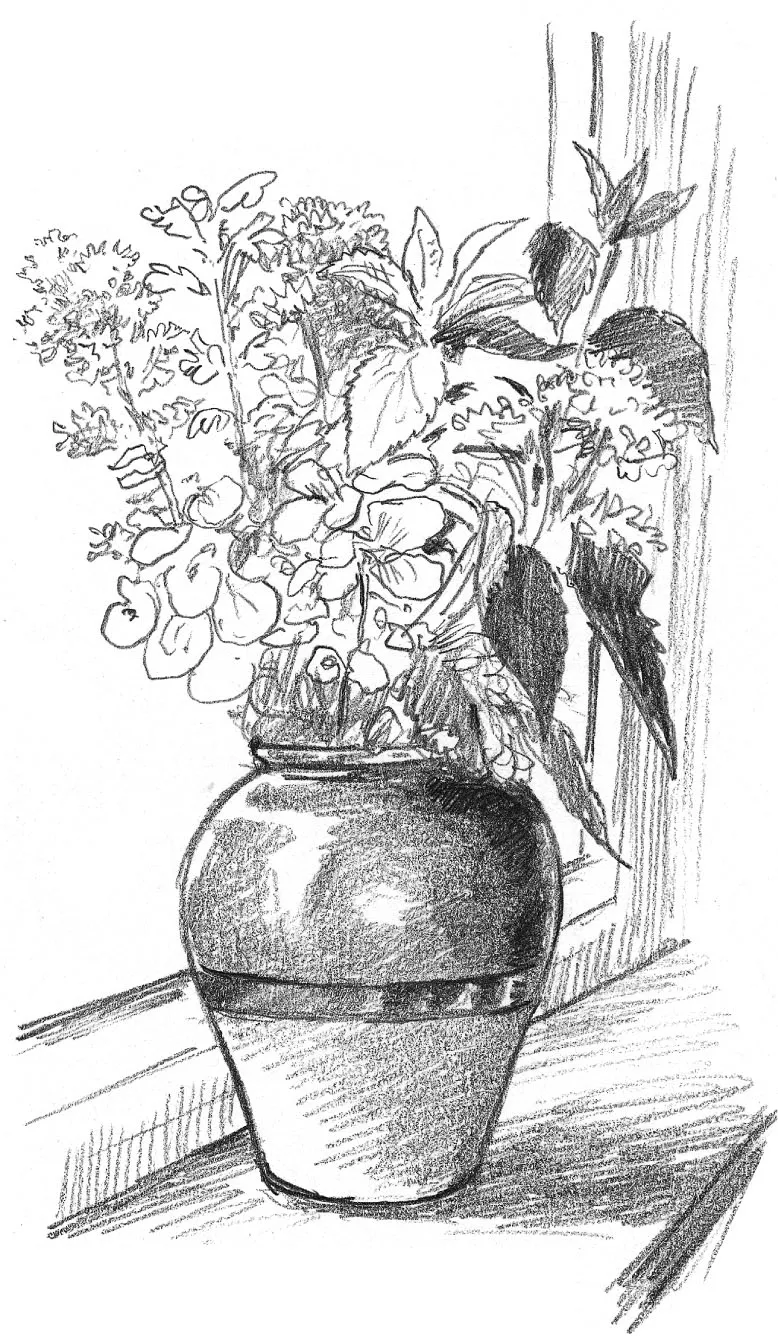
In the case of a vase of flowers, you’ll be drawing both natural and man-made things. Try to make the flowers and leaves look softer and more fragile than the vase.
Grouping objects
Now we’re going to move on to groups of objects – always trickier than single items as you have to consider their relationship to each other.
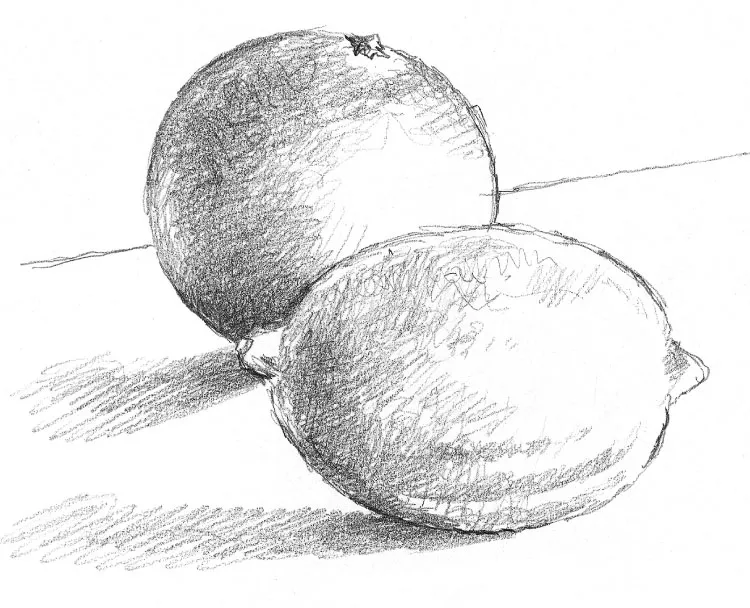
Start with an orange and lemon, placing them in such a way that one overlaps the other. This means that you have to consider the size of one compared with the other, as well as the different shapes. When you put in the tone, notice how the shading on the lower part of the orange helps to show up the shape of the lemon.

Now try three objects – two apples...
Table of contents
- Title
- Contents
- Introduction
- Project 1: Starting out with Still Life
- Project 2: Themed Still Life
- Project 3: Interiors – Around the House
- Project 4: Exteriors – Drawing a Local Scene
- Project 5: Landscape Composition
- Project 6: City Panorama
- Project 7: Individual Portrait
- Project 8: Figure Composition
- Copyright
Trusted by 375,005 students
Access to over 1.5 million titles for a fair monthly price.
Study more efficiently using our study tools.
Frequently asked questions
Yes, you can cancel anytime from the Subscription tab in your account settings on the Perlego website. Your subscription will stay active until the end of your current billing period. Learn how to cancel your subscription
No, books cannot be downloaded as external files, such as PDFs, for use outside of Perlego. However, you can download books within the Perlego app for offline reading on mobile or tablet. Learn how to download books offline
Perlego offers two plans: Essential and Complete
- Essential is ideal for learners and professionals who enjoy exploring a wide range of subjects. Access the Essential Library with 800,000+ trusted titles and best-sellers across business, personal growth, and the humanities. Includes unlimited reading time and Standard Read Aloud voice.
- Complete: Perfect for advanced learners and researchers needing full, unrestricted access. Unlock 1.5M+ books across hundreds of subjects, including academic and specialized titles. The Complete Plan also includes advanced features like Premium Read Aloud and Research Assistant.
We are an online textbook subscription service, where you can get access to an entire online library for less than the price of a single book per month. With over 1.5 million books across 990+ topics, we’ve got you covered! Learn about our mission
Look out for the read-aloud symbol on your next book to see if you can listen to it. The read-aloud tool reads text aloud for you, highlighting the text as it is being read. You can pause it, speed it up and slow it down. Learn more about Read Aloud
Yes! You can use the Perlego app on both iOS and Android devices to read anytime, anywhere — even offline. Perfect for commutes or when you’re on the go.
Please note we cannot support devices running on iOS 13 and Android 7 or earlier. Learn more about using the app
Please note we cannot support devices running on iOS 13 and Android 7 or earlier. Learn more about using the app
Yes, you can access Drawing Projects Made Easy by Barrington Barber in PDF and/or ePUB format, as well as other popular books in Art & Art General. We have over 1.5 million books available in our catalogue for you to explore.