Take an intrepid journey through the history of the Silk Roads with this brilliant reference book. Traversing snowy mountain passes, vast, forbidding deserts and stormy seas, these ancient trade routes were about much more than the movement of goods, they paved the way for an unprecedented period of cultural exchange, diplomacy and conflict creating a legacy that continues to affect global geopolitics in the 21st century.
Forged over millennia through a desire for enterprise, the Silk Roads have had an profound influence on Eurasia and beyond, connecting cultures, languages, customs and religions. And with China now working to reopen this ancient trade network, the time is right to shine a new light on its history and impact.
This edition has been updated with an expanded chapter on China's efforts to reopen this ancient trade network through the Belt and Road Initiative and the many impacts it has had along the way, from its ambitious infrastructure projects to new cities emerging along its route to the growth of a digital silk road, Geordie Torr examines the profound impacts of the revival of the world's greatest trading route.
With helpful timelines and useful information boxes, The Silk Roads gives you everything you need to master the history of this world-changing region.
- English
- ePUB (mobile friendly)
- Available on iOS & Android
eBook - ePub
About this book
Information
Topic
StoriaSubtopic
Storia dell'Asia1
ORIGINS OF THE SILK ROAD
The vast territory through which the various branches of the Silk Road and its predecessors ran includes a wide diversity of habitats, from forbidding deserts and extensive grasslands to high mountain ranges and their foothills. Chill northern forests give way to semi-arid steppe, which in turn morphs into the deserts of Central Asia: the Taklamakan, the Gobi, the Karakum, the Kyzylkum.
PHYSICAL GEOGRAPHY
Mountain ranges dissect the region: the Altai, the Pamirs, the Tian Shan, the Karakoram, the Kunlun. Rising to elevations of up to 4,000 m (13,000 ft), these formidable peaks create what were, in the early part of their human history, a series of essentially self-contained areas. Far from any ocean and its moist winds, they receive scant rainfall: standing water is generally scarce, although there are some lakes, rivers and small spring-fed oases. The lack of water for agriculture constrained settlement, as only rivers flowing from the mountains provided predictable supplies.
This combination of forbidding mountain ranges, harsh deserts and a general lack of resources, in particular water, limited the options not only for the formation of settlements in Central Asia but also for routes connecting those settlements. Diversity of landscapes and climates meant that cultural development across the continent was diverse too, in both its speed and pathways. Thus physical geography shaped the Silk Roads.
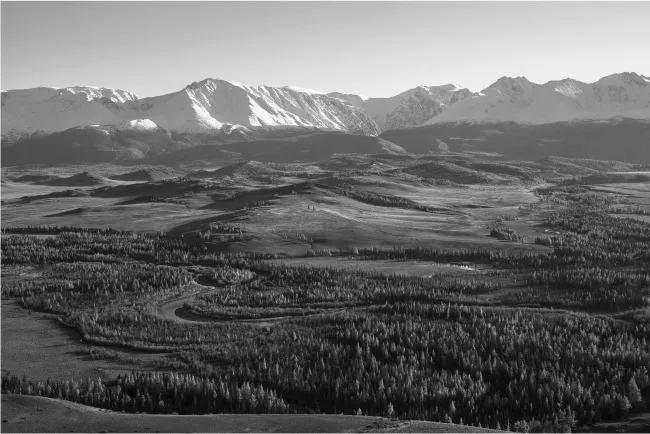
The geography of the Silk Road encompassed massive mountain ranges such as the Altai in western Siberia and northwest Mongolia.
HUMAN GEOGRAPHY
Modern humans probably began to move into Eurasia about 40,000 years ago. These early hunter-gatherers were then slowly replaced from around 9000BCE as migrants arrived from the Middle East, bringing with them knowledge of primitive farming.
However, the northern steppe regions proved inhospitable to farmers. The climatic conditions – low, unpredictable rainfall and high evaporation rates – and infertility of the soils, combined with the low levels of agricultural technology at the time, made farming difficult, if not impossible. Yet the steppe has one thing in abundance: grass. And not just any old grass, but highly nutritious grass. Thus it provided perfect conditions for the development of livestock herding. Over time, the geographical differences between the northern and southern regions meant the northern areas were mostly populated by nomadic herders, while in the south lived settled farmers, although it was by no means a clear-cut distinction.
TIMELINE
C. 4500 BCE | Beginning of the Copper Age |
C. 3500 BCE | Domestication of the horse and the Bactrian camel; horse-based pastoralism in the Eurasian steppe |
C. 3300 BCE | Beginning of the Bronze Age |
C. 3000 BCE | Wheeled transport develops |
C. 2000 BCE | Steppe Route and Nephrite and Lazurite roads in operation |
C. 1800 BCE | Settlements begin to form in the south; nomadic pastoralism develops in the north |
C. 1300 BCE | Development of horse-based warfare |
C. 1046 BCE | Start of Zhou dynasty |
C. 1000 BCE | Nomadism spreads across the steppe; horse-basedwarfare becomes more common |
C. 900 BCE | Nomads begin to attack settled farming communities |
C.600 BCE | Horseback riding spreads across the steppe |
550 BCE | Start of Persian (Achaemenid) Empire |
C. 500 BCE | Persian Royal Road completed |
C. 400 BCE | Archery and riding combined, cavalries emerge |
336 BCE | Alexander becomes king of Macedonia at the age of 20 |
330 BCE | Alexander the Great defeats the Achaemenids |
323 BCE | Alexander the Great dies |
312 BCE | Start of Seleucid Empire |
250 BCE | Start of Bactrian Kingdom |
247 BCE | Start of the Parthian Empire |
221 BCE | Qin dynasty unites China |
Those northern steppes saw one of the most significant innovations in human history, when, in around 3500BCE, steppe livestock herders (in what is now northern Kazakhstan) discovered how to domesticate the horse. From there, the knowledge spread to more settled groups in Turkmenistan over the next 500 years or so. Domestication of the Bactrian camel is thought to have taken place at around the same time, probably in what is now southern Russia. By the third to second millennium BCE, camels were widely used as draught animals. Livestock domestication brought beasts of burden for carrying agricultural products and trade goods; they could also be used for transportation, for meat and as weapons of war.
The next important innovation was wheeled transport, thought to have developed in western Asia towards the end of the fourth millennium BCE and spread into Central Asia during the first half of the third millennium BCE. Its first appearance in the steppe regions has been dated to the latter half of the third millennium BCE. In southern Turkmenistan during the Late Bronze Age, towards the end of the second millennium BCE, there was a series of further innovations, most notably the invention of the spoked wheel, and hence production of lighter vehicles, including horse-drawn chariots, which became important for warfare.
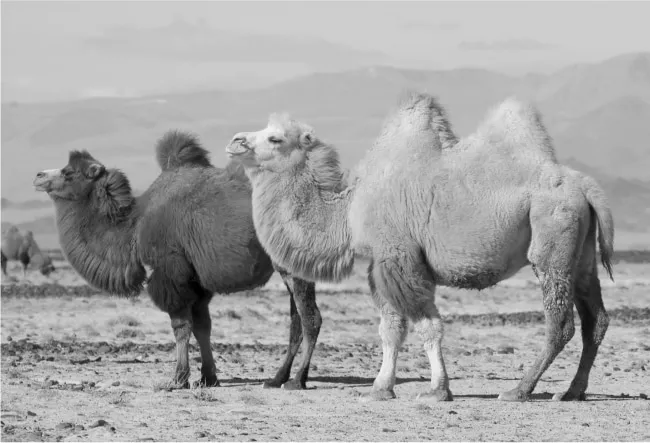
Domesticated Bactrian camels were used for transporting goods not only across inhospitable deserts but also over high mountains and cold steppes.
The use of wheeled transport significantly boosted productivity, enabling farmers to bring in crops more easily and livestock herders to follow their cattle, sheep and goats to new pastures. This in turn fostered the development of nomadic pastoralism, which would become the dominant way of life across the Eurasian steppe. Demographic pressures within agricultural societies probably also contributed to migration and the transition to a nomadic existence by forcing the more fragile groups living on the edges of farming areas to travel in search of better conditions.
Perhaps more importantly for the development of the Silk Road, wheeled transport meant, too, that people could travel greater distances, and thus came into contact with more people. This would have fostered greater cultural contact between remote regions, in turn promoting trade. Light chariots also allowed movement of significant quantities of raw materials; a text from about 1800 BCE discovered in the ancient city of Ur in southern Mesopotamia refers to a single shipment of copper that weighed 20 tonnes.
As human populations grew, so did the need for food, and hence also livestock herds. Overgrazing became a problem and communities were typically forced to move several dozen kilometres to new, ungrazed pastures every 20 years or so. The nomads also practised transhumance, moving seasonally several times a year between different pastures at different altitudes. Interestingly, many of the routes taken by Silk Road traders match those used by early nomadic livestock herders.
With the establishment of mobile livestock herding, pastoral peoples were able to make long-distance migrations. Loosely organized cultural communities formed across vast territories, interacting with each other, trading goods and occasionally attacking more settled groups in the south. Their contacts and influence extended over large areas, along with the military culture necessary to protect herds and conquer new territories.
A mobile livestock economy also meant that herd animals became commodities that could be traded, but could also be stolen. This was more than likely one of the factors that led to the construction of settlements with defensive walls. And with migration came competition, as groups began to vie for control over limited resources, and conflict became more frequent – another reason why settlements began to need defences.
Global climate undergoes irregular cycles of warming and cooling. As humans were spreading out across Eurasia, these cycles brought periods when the climate became more favourable for farming and herding, increased warmth and rainfall causing the steppe grasslands to become more verdant and crops more productive. These warmer periods often coincided with episodes of conquest, nomads banding together to invade settled areas. During cooler periods, farming and herding both became more marginal and humans were compelled either to migrate to regions where conditions were more benign or to innovate in some way.
Overall, this link between climate and human demography is a key factor in the evolution of the Silk Road. By forcing or inducing nomads to move, the changing climate created conditions for intensification of cultural contact and exchange.
Another significant innovation was the discovery of metal production. The steppe became a key centre for copper after rich deposits were discovered in the Ural Mountains. By the beginning of the third millennium BCE, copper mines were active not far from the Kargaly deposit in the southern Urals, which was among the richest known. Development of smelting techniques then made metal more common, while the creation of alloys such as bronze, brass or steel led to an increase in quality and durability of metal implements.
All this resulted in the birth of a new culture, living in fortresses and engaging in chariot warfare, probably...
Table of contents
- Title
- Contents
- Introduction
- 1. Origins of the Silk Road
- 2. The Rise of the Silk Road
- 3. The Golden Age of the Silk Road
- 4. The Maritime Silk Road
- 5. The End of the Road
- 6. Rediscovery
- 7. Trade Along the Silk Road
- 8. The Trade in Ideas
- 9. The Ecological Silk Road
- 10. Art Along the Silk Road
- 11. The Rebirth of the Silk Roads
- Bibliography
- Picture Credits
- Copyright
Trusted by 375,005 students
Access to over 1.5 million titles for a fair monthly price.
Study more efficiently using our study tools.
Frequently asked questions
Yes, you can cancel anytime from the Subscription tab in your account settings on the Perlego website. Your subscription will stay active until the end of your current billing period. Learn how to cancel your subscription
No, books cannot be downloaded as external files, such as PDFs, for use outside of Perlego. However, you can download books within the Perlego app for offline reading on mobile or tablet. Learn how to download books offline
Perlego offers two plans: Essential and Complete
- Essential is ideal for learners and professionals who enjoy exploring a wide range of subjects. Access the Essential Library with 800,000+ trusted titles and best-sellers across business, personal growth, and the humanities. Includes unlimited reading time and Standard Read Aloud voice.
- Complete: Perfect for advanced learners and researchers needing full, unrestricted access. Unlock 1.5M+ books across hundreds of subjects, including academic and specialized titles. The Complete Plan also includes advanced features like Premium Read Aloud and Research Assistant.
We are an online textbook subscription service, where you can get access to an entire online library for less than the price of a single book per month. With over 1.5 million books across 990+ topics, we’ve got you covered! Learn about our mission
Look out for the read-aloud symbol on your next book to see if you can listen to it. The read-aloud tool reads text aloud for you, highlighting the text as it is being read. You can pause it, speed it up and slow it down. Learn more about Read Aloud
Yes! You can use the Perlego app on both iOS and Android devices to read anytime, anywhere — even offline. Perfect for commutes or when you’re on the go.
Please note we cannot support devices running on iOS 13 and Android 7 or earlier. Learn more about using the app
Please note we cannot support devices running on iOS 13 and Android 7 or earlier. Learn more about using the app
Yes, you can access The Silk Roads by Geordie Torr in PDF and/or ePUB format, as well as other popular books in Storia & Storia dell'Asia. We have over 1.5 million books available in our catalogue for you to explore.