Why does E=mc2? If Einstein was right, was Newton wrong? Can we really find a theory of everything?
Think Like Einstein will answer these questions and more in this fun and fascinating book. With topics ranging from spacetime to the atomic bomb, Robert Snedden takes a look at this extraordinary man and his ground-breaking theories. This illustrated book provides an accessible introduction to this incredible theoretical physicist.
ABOUT THE SERIES: Written in an engaging Q&A format, Think Like a... series answers fundamental questions within academic subjects that come up in day-to-day life.
- English
- ePUB (mobile friendly)
- Available on iOS & Android
eBook - ePub
About this book
Trusted by 375,005 students
Access to over 1.5 million titles for a fair monthly price.
Study more efficiently using our study tools.
Information
Topic
Physical SciencesSubtopic
Science HistoryCHAPTER 1
Does the universe run like clockwork?
Since ancient times, people have puzzled over the workings of the universe.
The music of the spheres
The great Ancient Greek thinker Plato, born around 427BC, declared that the heavens were perfect and the stars and planets moved in ‘perfect curves on perfect solids’. He believed that these spheres produced music as they turned – an idea that would persist for many centuries to come.
However, the celestial spheres simply didn’t fit the evidence of the skywatchers’ eyes. A handful of stars behaved oddly, appearing to move against the background of the other ‘fixed’ stars, sometimes even looping backwards in their paths before continuing on their course. These peculiar stars were called ‘asteres planetai’ by the Greeks, meaning ‘wandering stars’. We know them as planets.
The Ancient Greeks concocted all sorts of complex schemes to explain planetary motion involving spheres moving within spheres within yet more spheres, all rotating in slightly different directions. Around AD100, the astronomer Ptolemy set out a map showing an Earth-centred universe of nested spheres – an idea that would remain largely unchallenged for 1,400 years. It lasted so long because it seemed to work. Ptolemy’s system gave accurate predictions of where the planets would be found at any given time.
Celestial revolutions
In 1543, astronomy was awakened from its Ptolemaic slumbers by the arrival of a remarkable book by Nicolaus Copernicus called De revolutionibus orbium coelestium (On the Revolutions of the Celestial Spheres). In 1507, the Polish astronomer and mathematician Copernicus had pretty much the same idea as Aristarchus 1,800 years previously: if the Sun was at the centre of the universe and the Earth and planets orbited around it, some of the puzzles of planetary motion could be explained. Mars, Jupiter and Saturn were further away from the Sun than the Earth which, moving faster in its smaller orbit, sometimes overtook them, making them look, from our point of view, as though they were travelling in reverse.
AHEAD OF HIS TIME
Around 260BC, the astronomer Aristarchus declared that the Sun, not the Earth, was the centre of the universe. This, he said, explained the movements of the planets. The stars were infinitely far away and only appeared to move because the Earth rotated beneath them. Aristarchus’ prescient notions were deemed too far-fetched by his contemporaries and were largely ignored.
Perhaps unsurprisingly, this was not a popular suggestion, particularly with the Church. No one at that time made an enemy of the Church as the consequences of doing so could be grim. Revolutions was published with an introduction (added without Copernicus’ approval) that these revolutionary ideas need not be considered as true. In 1616, Revolutions was placed on the Catholic Church’s list of banned books, where it remained until 1835.
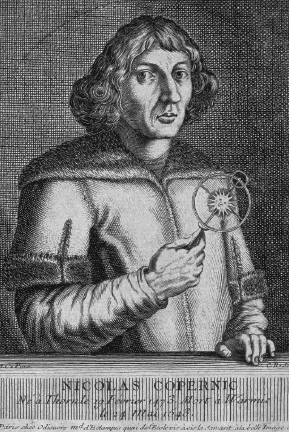
Nicolaus Copernicus
Word of the Copernican model spread slowly. Copernicus still believed the universe was formed of perfect spheres, they just no longer centred on the Earth. Then, at the beginning of the 17th century, the German astronomer Johannes Kepler’s painstaking observations led him to a sensational conclusion. The paths of the planets were not perfect circles, they were flattened circles, or ellipses. After Galileo’s discovery of the moons of Jupiter, Kepler found that these, too, moved in elliptical paths around the giant planet.
Kepler set out his three laws of planetary motion; these described how the planets moved, but not why they moved. He tried to work out what force might be responsible for the planets moving as they did. Kepler thought magnetism might be involved and that the Sun must have something to do with it, but couldn’t arrive at a satisfactory explanation. This would not emerge until 50 years later, with Isaac Newton and his ideas about gravity.
Until Einstein, our understanding of the laws that govern the movement of objects through space was founded on the work of the British scientist Isaac Newton (1643–1727). The oft-repeated story of Newton in the apple orchard is familiar to every schoolchild and perhaps has lost its impact over the years, but it took a singular mind to ask the question: ‘Why doesn’t the Moon fall to the Earth like the apple does?’ And it took real genius to conclude that the Moon is, in fact, falling.
The Universal Force
Newton knew that any theory he devised to describe the motion of both the apple and the Moon would have to explain Kepler’s findings too. In 1687, he produced what is considered by many to be one of the greatest works of science ever written. Philosophiae Naturalis Principia Mathematica (Mathematical Principles of Natural Philosophy), often referred to simply as the Principia, set out Newton’s vision of a universe in which all events take place against a backdrop of infinite space and smoothly flowing time.
Building on Galileo’s experiments carried out on moving objects and Kepler’s observations of the planets, Newton set out his three laws of motion and his theory of gravity.
NEWTON’S LAWS OF MOTION
1: An object will remain at rest or continue to move in the same direction and at the same speed unless acted on by a force.
2: A force acting on an object will cause it to move in the direction of that force. The magnitude of the change in the speed or direction of the object is dependent on the size of the force and the mass of the object.
3: For every action there is an equal and opposite reaction. If one object exerts a force on another, an equal and opposite force is exerted by the second object on the first.
Newton determined that between any two objects there is always a gravitational force which attracts them to each other. The strength of the force depends on the mass of each of the objects and on the distance between them. Gravity obeys an inverse square law, which means that the magnitude of the force decreases by the square of the distance. Therefore, if you double the distance between two objects, the force that draws them together reduces to just a quarter of what it was. At five times the distance, the force is reduced to a 25th of what it was.
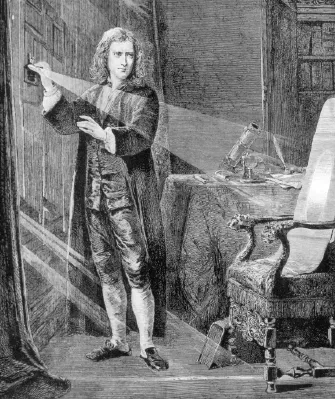
Isaac Newton examining the nature of light with the aid of a prism.
With three simple laws of motion and one law of gravity, Newton, it seemed, could explain the movement of everything in the universe. His laws provided an explanation for Kepler’s laws of planetary motion and for the fall of the apple. Newton derived his laws from three fundamental quantities which underpin all of science – time, mass and distance. By knowing the time an object takes to travel a set distance, it is possible to calculate its velocity (speed and direction). Mass tells us how much matter the object contains and therefore the amount of force required to move it. Multiplying the mass by the velocity gives the object’s momentum, which indicates how difficult it will be to stop the object once it is moving. Later, Einstein would reveal that all three of these quantities are relative.
Absolute time and space
According to Newton, time and space were absolute; they were the stage upon which the drama of the universe unfolded, remaining unchanged by events. Newton thought of our everyday measures of the passing of time – the hour, the month, the year – as simply common time. Although useful, they were not to be confused with ‘true’, or ‘absolute’, time, as Newton called it. Absolute time, he believed, was completely separate from space and independent of events. Absolute time ticked along at the same steady pace throughout the universe. One second for you should be exactly the same as one second for me, wherever we were in the universe and whatever we were doing.
Newton also believed in the idea of absolute space. He thought it should be possible to state the absolute position of an object in absolute space, almost like covering the universe in three-dimensional graph paper and plotting the positions of everything in it. But it is no more possible to say what absolute space is, as it is to define absolute time.
COSMIC CANNONBALLS
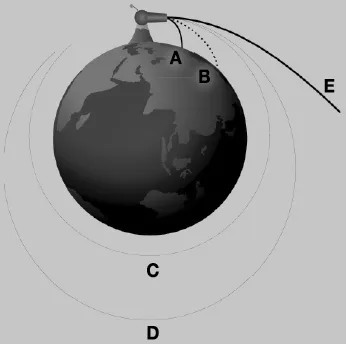
Two forces govern a cannonball’s path – gravity and the force that propelled it from the cannon. The result of those two forces acting on the cannonball is that it follows a curved path back to Earth. Imagine that the cannon produced sufficient force that the cannonball’s path matched the curvature of the Earth. It would now travel right around the Earth, always falling around the planet but never reaching the ground. (Let’s assume for the sake of the argument that there’s no air resistance to slow it down.) The cannonball is now a satellite in orbit. This is exactly the principle that puts real satellites into orbit, except with powerful rockets rather than a cannon providing the forward motion. The Moon is like a cosmic cannonball, perpetually falling around the Earth in its orbit.
Newton’s laws went unchallenged for more than 200 years. For everyday purposes, they are still an ...
Table of contents
- Cover
- Title
- Contents
- Introduction: Who was Albert Einstein?
- Chapter 1: Does the universe run like clockwork?
- Chapter 2: What is light?
- Chapter 3: How does light travel through space?
- Chapter 4: What is the quantum?
- Chapter 5: What is the photoelectric effect?
- Chapter 6: How did Einstein prove that atoms exist?
- Chapter 7: What is the theory of special relativity?
- Chapter 8: What are Einstein’s ideas about time?
- Chapter 9: What is the Lorentz-FitzGerald contraction?
- Chapter 10: What is spacetime?
- Chapter 11: Why does E = mc2?
- Chapter 12: How did Einstein fit gravity into relativity?
- Chapter 13: How does Einstein define gravity?
- Chapter 14: How did an eclipse prove Einstein was right?
- Chapter 15: If Einstein was right, was Newton wrong?
- Chapter 16: Why didn’t Einstein’s theory win the Nobel Prize?
- Chapter 17: What was Einstein’s greatest blunder?
- Chapter 18: Where does Einstein’s relativity theory break down?
- Chapter 19: How did relativity lead to a Big Bang?
- Chapter 20: Does God play dice?
- Chapter 21: Who won the argument?
- Chapter 22: Was Einstein the ‘father of the atomic bomb’?.
- Chapter 23: Can we find a theory of everything?
- Picture Credits
- Copyright
Frequently asked questions
Yes, you can cancel anytime from the Subscription tab in your account settings on the Perlego website. Your subscription will stay active until the end of your current billing period. Learn how to cancel your subscription
No, books cannot be downloaded as external files, such as PDFs, for use outside of Perlego. However, you can download books within the Perlego app for offline reading on mobile or tablet. Learn how to download books offline
Perlego offers two plans: Essential and Complete
- Essential is ideal for learners and professionals who enjoy exploring a wide range of subjects. Access the Essential Library with 800,000+ trusted titles and best-sellers across business, personal growth, and the humanities. Includes unlimited reading time and Standard Read Aloud voice.
- Complete: Perfect for advanced learners and researchers needing full, unrestricted access. Unlock 1.5M+ books across hundreds of subjects, including academic and specialized titles. The Complete Plan also includes advanced features like Premium Read Aloud and Research Assistant.
We are an online textbook subscription service, where you can get access to an entire online library for less than the price of a single book per month. With over 1.5 million books across 990+ topics, we’ve got you covered! Learn about our mission
Look out for the read-aloud symbol on your next book to see if you can listen to it. The read-aloud tool reads text aloud for you, highlighting the text as it is being read. You can pause it, speed it up and slow it down. Learn more about Read Aloud
Yes! You can use the Perlego app on both iOS and Android devices to read anytime, anywhere — even offline. Perfect for commutes or when you’re on the go.
Please note we cannot support devices running on iOS 13 and Android 7 or earlier. Learn more about using the app
Please note we cannot support devices running on iOS 13 and Android 7 or earlier. Learn more about using the app
Yes, you can access Think Like Einstein by Robert Snedden in PDF and/or ePUB format, as well as other popular books in Physical Sciences & Science History. We have over 1.5 million books available in our catalogue for you to explore.