'If I saw further than others it is because I was standing on the shoulders of giants.'
- Sir Isaac Newton
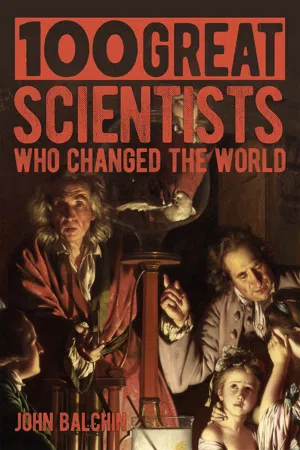
This stylish jacketed hardback introduces 100 of these giants of scientific discovery: the men and women who, often in the face of extreme skepticism or worse, have striven and succeeded in pushing back the boundaries of human knowledge. Ranging across the spectrum of scientific endeavor, from the cosmology of Copernicus and Galileo, to the medical revolutions of Hippocrates and Galen, it includes the fields of physics, biology, chemistry, and genetics.
Spanning from the ancient world to the 20th century, these figures include:
• Aristotle
• Leonardo di Vinci
• Benjamin Franklin
• Isaac Newton
• Marie Curie
• Stephen Hawking
Including brilliant illustrations, fact boxes of key information, and a chronology of important dates, 100 Great Scientists Who Changed the World provides riveting insight into the men and women who shaped the world today.
- English
- ePUB (mobile friendly)
- Available on iOS & Android
eBook - ePub
100 Great Scientists Who Changed the World
About this book
Information
NIKOLA TESLA
1856–1943

CHRONOLOGY
• 1883 Tesla invents an induction motor • 1884 Arrives penniless in the United States • 1885 Westinghouse Electric buys the rights to Tesla’s alternating current inventions • 1891 Invents the ‘Tesla coil’ • c. 1899 Discovers terrestrial stationary waves • 1917 Tesla receives the Edison Medal
Few contemporaries of Thomas Edison (1847–1931) took him on and won, but a man who could make such a claim was one of the great American inventor’s own former employees. Nikola Tesla, an eccentric electrical engineer, born in modern day Croatia but an emigrant to the U.S in 1884, was given work by Edison when he first landed in his new country. Contrasting personalities and conflicting ideas about electricity made the relationship a short one, sparking a bitter feud which would ultimately change the way the world received much of its power.
A WAY TO TRANSPORT ELECTRICITY
The story begins earlier, though, back in Europe. The brilliant, eccentric and often troubled mind of Tesla was apparent from a young age. Although he did not come from an academic family background, there was a history of inventors in his ancestry and his father worked hard on developing Tesla’s mental abilities. Despite interruptions to his childhood education due to frequent sickness and the severe trauma caused by the death of his older brother, Dane, Tesla progressed into higher education, taking up a place at the university of Graz in Austria.
The idea of the transmission of electricity without wires became a later interest for Tesla
Whilst at the university, Tesla was exposed to demonstrations of existing generators and electric motors and began to ponder better ways of creating and transporting electricity. He later came up with an idea involving a rotating magnetic field in an induction motor which would generate an ‘alternating current’ (now known as a.c.). Most electricity being created at the time for use in homes, offices and factories involved a direct current (d.c.) which had its limitations, particularly the cost of generating it, its difficulty in being transported over long distances and its need for a commutator. By contrast, Tesla would later prove his alternating current could travel safely, efficiently and cheaply over long distances. His invention of an induction motor, in line with his earlier ideas in 1883 was the first big step on that road. His next move was to sell it.
AC OR DC?
Telsa decided to emigrate to America, arriving penniless but soon finding work by making use of his electrical engineering skills. Edison employed him, Edison fell out with him and Edison got rid of him within a year. But Edison’s rival, George Westinghouse, wooed Tesla. In 1885 his company, Westinghouse Electric, bought the rights to Tesla’s alternating current inventions and a war of electricity began. Edison and others believed in and, probably more importantly, had a financial interest in, direct current and wanted to make it a success. It was already the standard way of generating and supplying electricity. Westinghouse and Tesla believed their method was ultimately more adapted to the job and fought hard to promote it. In spite of Edison’s attempts at damaging the reputation of alternating current by claiming it was unsafe (which Tesla would later refute by grand demonstrations lighting lamps using only his body, by allowing his a.c. current to flow through it), the greater benefits of alternating current were soon realised. With the subsequent invention of better transformers in its transportation, alternating current became the standard, with d.c. increasingly confined to only specialist applications. The trend continues to this day.
THE TESLA COIL
In 1891, Tesla built on his knowledge to invent the ‘Tesla coil’ which was even more efficient at producing high frequency alternating current. It had many applications and still today is widely used in radio, television and electrical machinery. Using this and his turn of the century discovery of ‘terrestrial stationary waves’, which basically meant the planet earth could be employed as an electrical conductor, he produced some spectacular demonstrations. Tesla generated self-made ‘lightning-strikes’ over a hundred feet long, and he once lit 200 lamps, unconnected by wires, stretched over 25 miles. Indeed, the idea of the widespread transmission of electricity without wires became a particular area of interest for Tesla in his latter years. The ‘tesla’, the SI unit of magnetic flux density, is named in honour of him.
FURTHER ACHIEVEMENTS
Tesla was also a prolific inventor. His inventions include: the telephone repeater, the rotating magnetic field principle, the polyphase alternating-current system, the induction motor, alternating-current power transmission, the Tesla coil transformer, wireless communication, radio, fluorescent lights, and more than 700 other patents.
SIR JOSEPH JOHN THOMSON
1856–1940

CHRONOLOGY
• 1860 Thomson enters Manchester University, aged 14 • April 1897 Announces his discovery of electrons • 1906 Receives the Nobel Prize for Physics • 1908 Thomson is knighted
Towards the turn of the twentieth century, a time when many physicists believed most of the important discoveries in their subject had already been made, the Englishman Joseph John Thomson arrived and blew any such notions away.
Along with other scientific issues the nineteenth century had cleared up much of the confusion in atomic theory. Scientists believed, for example, that they now largely understood the properties and sizes of the atoms contained within elements; without question hydrogen was the smallest of all. So when ‘J.J.’ Thomson announced the discovery of a particle one thousandth of the mass of the hydrogen atom, he rocked the scientific world.
THE CATHODE RAY DEBATE
An early starter, Thomson attended classes in theoretical physics – a new subject at the time and one not on offer at all universities – at the University of Manchester when he was only fourteen. His most important discovery came while he held the chair of the now famous Cavendish Laboratory at Cambridge, a post he had taken over in 1884 and held until 1919. He had decided to investigate the properties of cathode rays, now known to be a simple stream of electrons, but at the time the cause of widespread debate among scientists. The rays were visible, like normal light, but were quite clearly not normal light. Were they perhaps some form of X-ray? Most thought almost certainly not. To clear up the argument Thomson devised a series of experiments which would apply measurements to these cathode rays and clarify their nature.
Instead of ‘corpuscle’, the tiny negatively charged particles were renamed ‘electrons’
MEASURING THE MASS OF PARTICLES
The rays were created by passing an electric charge through an airless or gasless tube. By improving the vacuum in the tube Thomson quickly demonstrated that the rays could be deflected by electric and magnetic fields, a result which had not been observed before.
From this he concluded that the rays were made up of particles, not waves. Thomson then saw that the properties of the rays were negative in charge and didn’t seem to be specific to any element; indeed, they were the same regardless of the gas used to transport the electric discharge, or the metal used at the cathode. Thomson devised a way of measuring the mass of the particles and found them to be consistently about a thousandth of the weight of the hydrogen atom. From these findings he concluded that cathode rays were simply made up of a jet of ‘corpuscles’, and, more importantly, that these corpuscles were present in all elements. He announced his discovery of the sub-atomic particle in April 1897 and in the process opened up a whole new branch of scientific research.
Thomson’s conclusions were soon widely accepted but his terminology was not. Instead of the word ‘corpuscle’, the tiny negatively charged particles were renamed ‘electrons’ and have been a fundamental part of the understanding of atomic science ever since.
THE CAVENDISH LABORATORY
Thomson’s position within the Cavendish Laboratory meant he also became involved in a range of other important physics projects, most notably involving the discovery of certain isotopes and aiding the development of the mass spectrograph. He was a superb teacher and leader, playing a vital part in the development of the reputation the Laboratory would gain as the world’s leading authority in physics. Seven of his pupils went on to gain Nobel Prizes and, indeed, Thomson himself received the award for physics in 1906, as well as a knighthood in 1908: all from a man who had originally intended to go into engineering! Thomson had studied the sciences instead because he could not afford the fee to become an engineer’s apprentice – his father had died in 1872. It was a strange quirk of fate for which physics would always be grateful.
FURTHER ACHIEVEMENTS
Although there are many claimants to the title of Father of modern physics, Joseph John Thomson’s is probably as justified as anybody’s. It was Thomson’s discovery of the electron in 1897 which opened up a whole new way of looking at the world. Not only was matter composed of particles not even visible with a modern electron microscope (as scientists from Democritus to Dalton had predicted) but it also appeared that those particles were composed of even smaller components themselves. Following Thomson, the discovery of these particles raised questions about the structure of matter that remain unanswered today.
SIGMUND FREUD
1856–1939

CHRONOLOGY
• 1886 Freud sets up his private clinic in Vienna • 1895 Studies in Hysteria published • 1896 Coins the phrase ‘psychoanalysis’ • 1899 The Interpretation of Dreams published • 1905 Three Essays on the Theory of Sexuality published • 1923 The Ego and the ID published
Sigmund Freud’...
Table of contents
- Title
- Contents
- Acknowledgements
- Foreword
- The Ancients
- The First Millennium
- The Fifteenth Century
- The Sixteenth Century
- The Seventeenth Century
- The Eighteenth Century
- The Nineteenth Century
- The Twentieth Century
- Scientists A–Z
- Picture Credits
- Copyright
Trusted by 375,005 students
Access to over 1.5 million titles for a fair monthly price.
Study more efficiently using our study tools.
Frequently asked questions
Yes, you can cancel anytime from the Subscription tab in your account settings on the Perlego website. Your subscription will stay active until the end of your current billing period. Learn how to cancel your subscription
No, books cannot be downloaded as external files, such as PDFs, for use outside of Perlego. However, you can download books within the Perlego app for offline reading on mobile or tablet. Learn how to download books offline
Perlego offers two plans: Essential and Complete
- Essential is ideal for learners and professionals who enjoy exploring a wide range of subjects. Access the Essential Library with 800,000+ trusted titles and best-sellers across business, personal growth, and the humanities. Includes unlimited reading time and Standard Read Aloud voice.
- Complete: Perfect for advanced learners and researchers needing full, unrestricted access. Unlock 1.5M+ books across hundreds of subjects, including academic and specialized titles. The Complete Plan also includes advanced features like Premium Read Aloud and Research Assistant.
We are an online textbook subscription service, where you can get access to an entire online library for less than the price of a single book per month. With over 1.5 million books across 990+ topics, we’ve got you covered! Learn about our mission
Look out for the read-aloud symbol on your next book to see if you can listen to it. The read-aloud tool reads text aloud for you, highlighting the text as it is being read. You can pause it, speed it up and slow it down. Learn more about Read Aloud
Yes! You can use the Perlego app on both iOS and Android devices to read anytime, anywhere — even offline. Perfect for commutes or when you’re on the go.
Please note we cannot support devices running on iOS 13 and Android 7 or earlier. Learn more about using the app
Please note we cannot support devices running on iOS 13 and Android 7 or earlier. Learn more about using the app
Yes, you can access 100 Great Scientists Who Changed the World by Jon Balchin in PDF and/or ePUB format, as well as other popular books in History & Science & Technology Biographies. We have over 1.5 million books available in our catalogue for you to explore.