"This eye-opening journey through centuries of medical care on the battlefield is a fascinating read. The research is impressive, the writing style relaxed but what makes this book stand out is the personal stories of women and men who risked their lives to save others." - ANNE MACMILLAN, HISTORIAN, JOURNALIST AND AUTHOR OF WAR STORIES
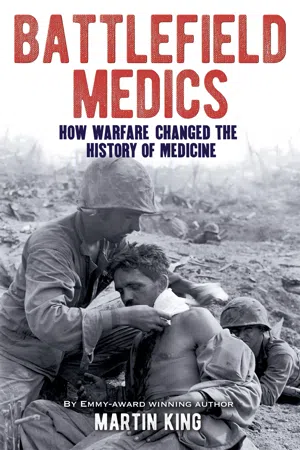
Double Emmy award-winning author Martin King takes you on an enthralling journey through the history of medicine on the battlefield, covering the battles of Ancient Rome, both World Wars, Vietnam and many more. Hear true stories of the brave men and women who risked their lives to save others in the chaos of conflict, including:
• Tillie Pierce, the 16-year-old girl who tended soldiers from both sides during the American Civil War
• Mary Seacole a black nurse who ran her own medical center during the Crimean War
• Nellie Spindler, a staff nurse in World War I who was tragically killed in the Battle of Passchendaele
• John Bradmore, the man who saved Prince Henry in the War of the Roses
Battlefield Medics includes first-hand accounts from veterans of various wars and conflicts, as well as a foreword by Colonel Robert Campbell of the 101st Airborne Division of the US Army.
Told with King's usual flair for engaging narrative and eye for historical detail, this illustrated account provides a testament to these remarkable medics and the vital part they played in history.
- English
- ePUB (mobile friendly)
- Available on iOS & Android
eBook - ePub
About this book
Information
Topic
MedicinePART ONE
THOSE HEALING HANDS
CHAPTER ONE
WHERE IT ALL BEGAN
The Egyptians believed that the application of successful wound treatments demanded prescribing both observable and supernatural elements. For this purpose, they would inevitably respect practical physical remedies but be prepared to throw in the odd magic spell or spontaneous dance routine for added efficacy. Their medicine also relied on the combined power of incantations along with herbal concoctions to hopefully achieve a desired result. The right words could invalidate or deflect malicious forces, and the use of amulets or materials that had been in contact with powerful talismans were also expected to render a salutary effect. This was often to the detriment of the afflicted soldier whose primary considerations rarely exceeded, ‘Do something quick, this stings you know?’
As Egyptian troops ventured forth into battle they often wore an amulet for protection that depicted the gruesome image of the Egyptian god Bes. This was thought to deter malevolent gods or the hostile spirits of the dead. In the event of Bes being preoccupied with other matters the image was augmented with a massive shield and a pair of sturdy legs that, as the situation evolved, could switch direction at any given moment. Ancient Egyptians didn’t rely entirely on supernatural remedies when coping with physical traumas. One papyrus written during a period of internecine struggle and warfare refers to a physician actively treating battle casualties.
It describes in detail the types of weapon that would have inflicted the wounds that were used by both Egyptian soldiers and their enemies in combat. The physical treatments and prescriptions involved a compendium of substances compiled over the course of millennia. Surgery was exceedingly rare, and dissection was definitely not considered a feasible option. Physicians of the day employed a vast pharmacopoeia of natural substances such as honey and pomegranate juice, a powerful astringent. The water lily plant that was applied to wounds and abrasions has been proven to contain analgesic properties and may also have been ingested on occasion for that purpose. Residues discovered in distinctive tall-necked vessels that may have been imported from Asia Minor suggest that Egyptian physicians were acquainted with the anaesthetic properties of opium. All physicians were meticulously trained and required to become skilled practitioners of physical and supernatural medicine. Some centuries later the Greeks would also invoke their gods for numerous purposes, but tended to rely on more practical solutions when treating the wounded.
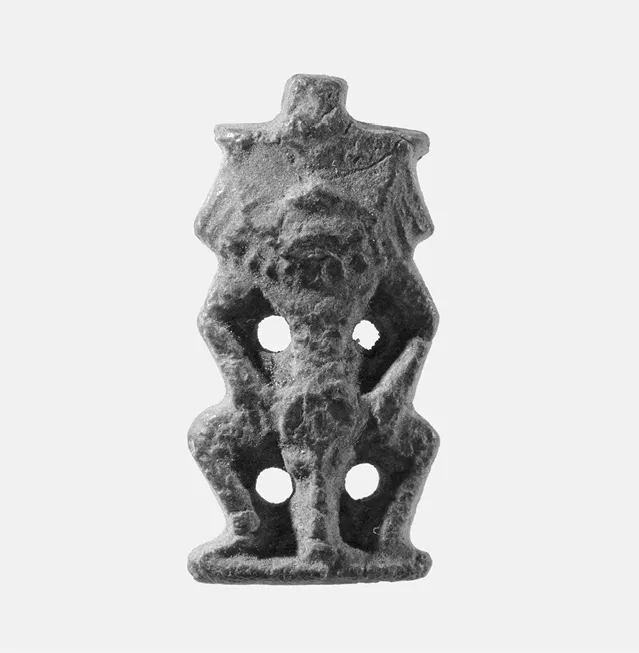
Amulet of Egyptian god Bes, c.1550–1295bc. One of the many gods the ancient Egyptians invoked to cure their wounded.
Hippocrates, the renowned Greek physician of the Age of Pericles, is credited with the famous oath, ‘He who desires to practise surgery must go to war.’ What he implied was that only during warfare could a physician truly learn his art, closing wounds, treating infection, and learning the intricacies of human anatomy. One passage from Homer’s Iliad states: ‘A physician is worth more than several other men put together, for he can cut out arrows and spread healing herbs.’ This takes into account of course that most wounds would have resulted from the implementation of the hacking, stabbing or slashing practices employed by ancient armies. Although their anaesthetic value may have been questionable some of the ‘healing herbs’ applied to the afflicted areas could indeed be quite efficacious.
The ancient Greek term for the person who cared for the wounded was ‘iatros’, apparently derived from an old Ionian word meaning ‘extractor of arrows’. The Greeks effectively cleansed wounds with a concoction assembled from wine and vinegar. Greek wine contained polyphones, which are bactericides 33 times more powerful than the phenols Joseph Lister used in 1865.
It’s generally known that Alexander the Great’s army used tourniquets made of brass and leather to staunch wounds. However, they didn’t have the knowledge to permanently arrest the bleeding once a tourniquet was removed. Alexander openly acknowledged the benefits of having trained physicians to accompany his armies and they operated in situations not completely alien to contemporary medical staff. He only had seven overworked physicians to tend an army of around 40,000. His experience would inspire the Roman Army to incorporate a highly organized and efficient military medical service as a standard addition to all its conquering legions.
When the Roman armies began expanding to support the imperial ambitions of their emperor, they developed something that resembled a distinct system of military medicine. Once the Roman Army had defeated the Greeks and forced them to renounce their independence, the Roman medical service improved on the Greek version by incorporating trained physicians and establishing field hospitals to tend their wounded. Plato had been correct when he wrote, ‘all the good things of the conquered pass into the hands of the conquerors’.
The Roman author Vegetius wrote that the Roman Army should be ‘preserved’ by providing ‘a good, clean water supply, taking seasonal considerations into account, the use of medicine, and exercise for the troops’. He emphasized that commanders should not march the troops in baking sun or in freezing weather, and that clean drinking water was an imperative at all times. He was among the first to state categorically that sick soldiers should be ‘brought back to health by suitable food and cured by the skills of doctors’. Each doctor attached to the army would be required to successfully pass through the appropriate school before being allowed to unleash his talent on the legionaries. Battlefield medicine was exclusively a male domain at that time and its application in the Roman Army was remarkably advanced even by contemporary standards. It far exceeded the medical knowledge of the medieval period.
A Roman medical officer was known as the medicus. This trained doctor was usually in charge of Greek, or Greek-trained medical personnel known as the ‘medici’. The exact rank and hierarchic position of the medici within the army has never been conclusively ascertained. They were usually employed in the service of Rome after being captured as prisoners of war.
Wounded Roman soldiers would receive initial treatment by medics called capasarii, who carried boxes of bandages. Later Roman Army surgeons were usually given the rank of magister or ‘master’. Records show that medical supplies and carriages for bearing the wounded were strategically placed in the middle of marching columns.
Archaeological discoveries in the town of Xanten (known as Vetera to the Romans) in Germany unearthed what is assumed by many to be a Roman hospital (Valetudinarium) complete with wards, rooms full of medical instruments, surgical suites, convalescence rooms, and possibly mortuaries. These hospitals were originally built to serve the military.
Under the auspices of the Roman general and statesman Gaius Marius, the Roman Army became the best trained and most disciplined force the known world had ever witnessed, and their military medical services became the envy of all opposing armies.
In the seventh book of Pliny’s Natural History, published in ad77, the author refers to Marcus Sergius Silus Ferrous, Roman general and politician who lived from c.240–187bc and fought during the Punic and Epirote Wars. According to Pliny, this Roman general was one of the first soldiers to wear a prosthetic limb, his right hand having been sliced off in a sword fight. Not only did the general live to tell the tale, he actively participated in many ensuing battles – whereupon he sustained a further 23 separate injuries to his extremities.
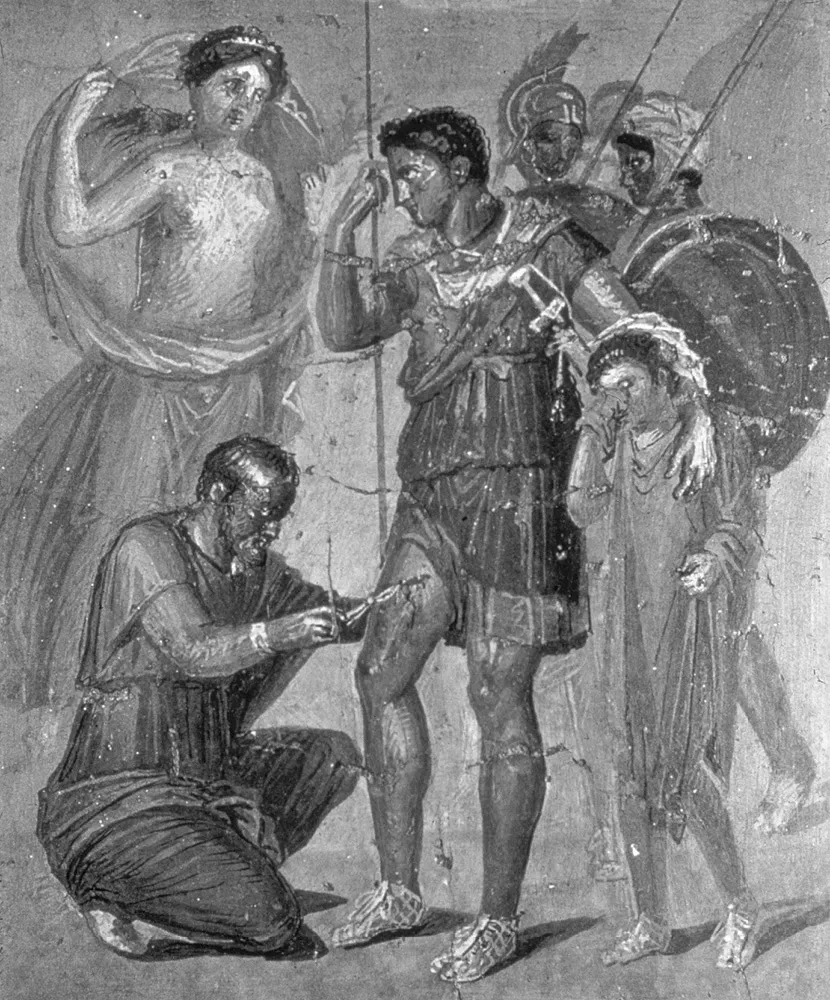
A Roman fresco of a medicus treating the battlefield wounds sustained by Aeneas, the legendary Trojan hero.
He managed to maintain his prowess in battle by fashioning a prosthetic iron hand capable of holding a shield and splitting enemy skulls with remarkable dexterity. His enemies were frequently reduced to awestruck silence as he stabbed, gouged and slashed away to great effect. Twice taken prisoner by Hannibal’s Carthaginians, he managed to escape on both occasions. After military service he ventured into politics, where he served as a Roman praetor. A number of his colleagues attempted to prevent the former general from participating in public ceremonies because of his perceived ‘deformity’. Nevertheless, Sergius confounded his detractors, which to some extent made him the world’s first advocate for the rights of veteran amputees.
In the Roman Army the person who would have initially tended the general would have been the medicus, using the instruments at their disposal for the treatment of wounds. Their primary use would have been for the extraction of arrowheads and small stones fired by slings, but there were various other instruments that were remarkably similar to those employed by surgeons of the nineteenth and early twentieth centuries. Roman surgeons used forceps, scalpels, tourniquets, ear scoops, catheters and even arterial clamps. They wouldn’t have had any knowledge of bacterial infections, but had some concept of hygiene because they usually took the precaution of boiling instruments before and after every procedure.
The medicus also had sedatives and painkillers at their disposal to enhance their bedside manner, including opium and henbane seeds, which contained scopolamine, also known as hyoscine, which is used to treat motion sickness and post-operative nausea and vomiting.
Wounded Roman soldiers were treated with acetum, a concoction made from vinegar which proved a feasible antiseptic but which was by all accounts excruciatingly painful when applied to wounds. It took four or five capasarii to restrain a patient when it was used, but as an antiseptic it was known to prevent some infections and even prevent superficial wounds from becoming fatal.
Sadly, many of these Greek and Roman remedies were lost by the Middle Ages, only to be recovered in the modern era.
Historians agree that the quality and effectiveness of Roman military medicine was not surpassed until at least the seventeenth and eighteenth centuries. The care given to a Roman soldier was in fact almost equivalent to that received by a soldier in World War I.
The word ‘nurse’ is derived from the Latin word nutrire, meaning to suckle, and originally may have referred to a maternity nurse. It wasn’t until the late sixteenth century that the word ‘nurse’ obtained its contemporary meaning as someone who provides care and comfort for the infirm.
It’s said that the world’s first nursing school was founded in India about 250bc. Writings from the time indicate that only men were considered ‘pure’ enough to become nurses. This was also the case in ancient Rome, where the ‘nosocomi’ were men who provided nursing care. The term ‘nosocomial’, meaning ‘hospital acquired’, stems from the late Latin word for hospital, nosocomium. Women were overlooked again in ad300, when another group of men known as the Parabolani started a hospital providing voluntary nursing care and funeral services during a plague epidemic in Alexandria, during the episcopate of Dionysius the Great. The name Parabolani is derived from the Latin meaning ‘to disregard’, as the men of this fraternal organization deliberately exposed themselves to contagious diseases. When the Roman Empire became the Byzantine Empire, further medical innovations occurred with the establishment of two hospitals within the great city of Constantinople, housing both male and female nurses. They were known as ‘hypourgoi’ and helped to advance nursing on a global scale.
However, it’s important to note that nursing only became much more common in Europe during the Middle Ages, due primarily to its spread by the all-powerful Catholic Church.
It was St Benedict, born around 480 in Norcia, in modern Italy, who founded the Benedictine monks’ nursing order, and here the parameters become slightly blurred because his twin sister St Scholastica went on to establish a similar monastic-based community of women. What little we know about St Benedict was written about a generation later in the Dialogues of Gregory the Great, by Pope Gregory I, the man who established the medieval papacy.
When Charlemagne became Holy Roman Emperor in 800 he undertook to restore and equip the hospitals of his domain with all of the latest medical equipment. He also demanded that hospitals be attached to every cathedral and monastery within Europe, which helped to stimulate demand for more nurses. Monasteries began siting hospitals within their premises, as well as building separate infirmaries, with the stipulation that their services were only available to the genuinely pious. Heathens and worshippers of other religions were not welcome.
Military, religious and lay orders of men including the Knights Hospitallers, the Teutonic Knights, the Knights of St Lazarus and the Hospital Brothers of St Anthony provided nursing care during the Middle Ages. Then there were the Alexians, informal groups of laymen who provided nursing care for the poor in the twelfth century.
CHAPTER TWO
the painful middle ages
After the fall of the Roman Empire, western Europe receded dramatically from the well-ordered structure and discipline of the Classical Era and replaced it with what became known as feudalism. The onset of the feudal period began around the ninth century in western and central Europe. In time it disseminated to other parts of the Continent, finally grinding to a stuttering halt in the fifteenth century in western Europe, although elements of feudalism continued for considerably longer in eastern Europe.
This system of enforced subjugation was based on strict hierarchies with each group having obligations and expectations from the groups above and below them. Under this despised system, everyone but the king had a ruling lord above him to whom he owed loyalty, fealty and service in exchange for land and protection. A few peasants retained their liberty, but they were in the minority because most became serfs, slaves to the lord of the manor. They were required to stay on the land and pay extortionately high rents to the lord. Adding insult to injury, in times of war or armed conflict the menfolk were expected to bear arms and serve the feudal lord unquestioningly. Existing records offer extensive accounts of the often-nefarious means feudal kings used to raise their armies. Detailed inventories of feudal obligations were maintained to calculate the total number of knights that might be pressed into service when required.
There is little reference in these records concerning the treatment of wounded soldiers. The general assumption is that it depended largely on the generosity or parsimony of the respective feudal lord to care for the knights and foot soldiers in his service and, more often than not, it fell to the monasteries to care for disabled soldiers who had signed on to fight for wages. The only hope for these unfortunate peasants depended solely on their obedient adherence to devout Christianity and the conviction, imposed or otherwise, that life in heaven would be considerably better than life on Earth.
While resident on the manor most people endured a desultory existence, usually centred around the castle, church, village and surrounding farmland. These manors were usually quite isolated, and only rarely enlivened by visits from peddlers, pilgrims on their way to the Holy Land, or soldiers from other fiefdoms. The care a soldier received at this troubled time depended entirely on the status of that individual. Even though many feudal lords were ignorant of the values of genuine altruism, they cared for their knights, while monasteries were encumbered with looking after the fiscally challenged ordinary foot soldier, or pitchfork-wielding peasant.
During medieval times, treatment of wounded soldiers on and off the battlefield often fell to the clergy, where the imposition of stringent religious doctrine frequently impeded the quality of care received. The sharp division of the medical profession into physicians and surgeons can be traced back to the twelfth century, when the Catholic Church officially forbade the clergy to shed b...
Table of contents
- Title Page
- Contents
- Foreword
- Preface
- Introduction
- Part One: Those Healing Hands
- Part Two: Healing hearts and minds
- Bibliography
- Picture Credits
- Copyright
Trusted by 375,005 students
Access to over 1.5 million titles for a fair monthly price.
Study more efficiently using our study tools.
Frequently asked questions
Yes, you can cancel anytime from the Subscription tab in your account settings on the Perlego website. Your subscription will stay active until the end of your current billing period. Learn how to cancel your subscription
No, books cannot be downloaded as external files, such as PDFs, for use outside of Perlego. However, you can download books within the Perlego app for offline reading on mobile or tablet. Learn how to download books offline
Perlego offers two plans: Essential and Complete
- Essential is ideal for learners and professionals who enjoy exploring a wide range of subjects. Access the Essential Library with 800,000+ trusted titles and best-sellers across business, personal growth, and the humanities. Includes unlimited reading time and Standard Read Aloud voice.
- Complete: Perfect for advanced learners and researchers needing full, unrestricted access. Unlock 1.5M+ books across hundreds of subjects, including academic and specialized titles. The Complete Plan also includes advanced features like Premium Read Aloud and Research Assistant.
We are an online textbook subscription service, where you can get access to an entire online library for less than the price of a single book per month. With over 1.5 million books across 990+ topics, we’ve got you covered! Learn about our mission
Look out for the read-aloud symbol on your next book to see if you can listen to it. The read-aloud tool reads text aloud for you, highlighting the text as it is being read. You can pause it, speed it up and slow it down. Learn more about Read Aloud
Yes! You can use the Perlego app on both iOS and Android devices to read anytime, anywhere — even offline. Perfect for commutes or when you’re on the go.
Please note we cannot support devices running on iOS 13 and Android 7 or earlier. Learn more about using the app
Please note we cannot support devices running on iOS 13 and Android 7 or earlier. Learn more about using the app
Yes, you can access Battlefield Medics by Martin King in PDF and/or ePUB format, as well as other popular books in Medicine & Medical Theory, Practice & Reference. We have over 1.5 million books available in our catalogue for you to explore.