From the early barter system, through the Industrial Revolution, to the emergence of globalization, economics has defined our lives. Think Like an Economist is a fun introduction to the main ideas of economics, untangling its intricacies and revealing the ways in which individuals, societies and nations allocate resources. Using a Q&A format, the book delves into questions such as:
• Why don't we just print more money?
• Is cash on the way out?
• How does the stock market work?
• Is the whole world capitalist now?
Written in an amusing and easy-to-understand style, Anne Rooney investigates how economics can be used to improve living standards and make the world a better place.
- English
- ePUB (mobile friendly)
- Available on iOS & Android
eBook - ePub
About this book
Information
CHAPTER 1
What is money anyway?
Trade, or commerce, is a fundamental part of economics, and money is at its heart. So what does money really represent?
Money is any token, physical or virtual, that can be used in trade. It might have intrinsic value, such as a disc of gold, or it might have only a symbolic value, like a printed slip of paper with a fancy design. It might have no physical existence, like the virtual currency bitcoin – a digital currency that operates independently of the main banking system. Of course, even the ‘intrinsic’ value of a gold coin is culturally determined. Gold is of limited use outside jewellery and commerce. It is now used in electronics, but that use emerged long after gold was first considered valuable. It’s easier to make crowns and jewellery from gold than other metals because it’s soft and non-corrosive – but you could say the same of plastic. Crowns and jewellery are not essential to survival – they are not ‘needs’.
Bartering doesn’t go well
Try to imagine a world in which there is no form of money. If you want something that you can’t find or make yourself, you need to persuade someone who has it to give it to you. They will probably be unwilling to give it for free, but might swap it for something you have. This is called bartering. If you have a mammoth skin and want some watermelons, it might take a long time to find someone with watermelons who wants a mammoth skin. If the person with watermelons wants a clay bowl, you might have to trade a mammoth skin for a clay bowl, then trade the bowl for watermelons (if you can find someone with watermelons who wants a clay bowl). You can see how bartering quickly becomes a complex, time-consuming and often frustrating endeavour. This problem, called the coincidence of wants, or double coincidence of wants, makes such systems unwieldy and inefficient.
Instead, most societies have developed some form of exchange mechanism. This works on the basis that everyone agrees some token (cowrie shells, perhaps) represents value.
GOLDEN CHAINS
The 16th-century philosopher Sir Thomas More satirized humankind’s greed for gold in his book Utopia. More’s Utopians see gold as corrupting, so put it to unglamorous use: ‘Their chamber-pots and close-stools are made of gold and silver… . Of the same metals they also make chains and fetters for their slaves; on some of whom, as a badge of infamy, they hang an ear-ring of gold, and make others wear a chain or a coronet of the same metal. And thus they take care, by all possible means, to render gold and silver of no esteem. Hence it is that, while other countries part with these metals as though one tore out their bowels, the Utopians would look upon giving-in all they had of them, when occasion required, as parting only with a trifle, or as we should esteem the loss of a penny.
‘They find pearls on their coast, and diamonds and carbuncles on their rocks. They seek them not, but if they find them by chance, they polish them and give them to their children for ornaments, who delight in them during their childhood. But when they come to years of discretion, and see that none but children use such baubles, they lay them aside of their own accord; and would be as much ashamed to use them afterward, as grown children among us would be of their toys.’
Sir Thomas More, Utopia, Book 2 (1516)

The value can be transferred between people and exchanged for goods and services. This makes it easy to trade a mammoth skin for cowrie shells then take the shells to someone who has watermelons. The watermelon farmer can use the shells to buy a chair or a boat or a chicken – whatever he or she needs. As everyone in the community accepts that cowrie shells have value, they become a means of exchange – or money.
The four functions of money
In 1875, British economist William Jevons set out the four functions of money in his book Money and the Mechanism of Exchange. Money, he said, is a medium of exchange, a common measure of value, a standard of value and a store of value. Some economists have argued that storing money means you can’t spend (exchange) it, and spending it means you can’t save (store) it, so the two are mutually exclusive. But money can serve both functions at different times.
A modern approach often lists three functions for money:
• a medium of exchange
• a store of value
• a unit of account
It is called a medium of exchange as it facilitates the exchange (swapping) of goods and services, acting as an intermediary between disparate items such as mammoth skins and watermelons. As a store of value, it’s important that whatever is chosen as the means of exchange does not readily deteriorate or decay. This is one reason for choosing gold. It would not be sensible to choose, say, fresh fruit as a medium of exchange because it would soon rot.
Economists recognize two types of value: the utility (usefulness) of a particular good or service, and the power of a good or service when exchanged to acquire other goods and services. Anything used as money has exchange value. It can also have utility value, as we shall see.
The last function, a unit of account, means there must be a consistent way of measuring or counting money and that it provides the unit for pricing other items. This is served by currency: we count money in dollars, pounds, euro, yuan, yen, pesos and so on.
WHEN MONEY GOES WRONG
When an economy fails, prices may rise beyond all sensible measure and each unit of currency will then buy less and less – its exchange value falls. In this case, money itself is no longer a good store of value. The classic example of this is the period in the 1920s when the German currency, the mark, became virtually worthless. Something that cost one mark in 1918 cost three billion marks in 1923. As a result, some people in Germany began to use other currencies or media of exchange in preference to the mark (see Chapter 14).
Commodity money
Physical items used as money are called commodity money. The item itself must have recognized intrinsic value. Items that have been used as commodity money include:
• Buckskins and beaver pelts in North America. Hudson Bay had an official exchange rate for beaver pelts. One beaver pelt could be exchanged for two pairs of scissors, five pounds of sugar, 20 fish-hooks or a pair of shoes. Twelve beaver pelts would buy you a gun.
• Decorative items such as shells, mirrors, beads and decorated belts. Part of the payment that Dutch traders made to Native Americans when they bought Manhattan Island in 1626 was in beads.
• Food items which are slow to perish, such as salt, peppercorns, barley, rice, dried fish and cattle.
• Tobacco and cigarettes. Cigarettes have often been used by soldiers and prisoners as currency. A full economy based on cigarettes grew up in some prisoner-of-war camps in World War II.
THE ISLAND OF STONE MONEY
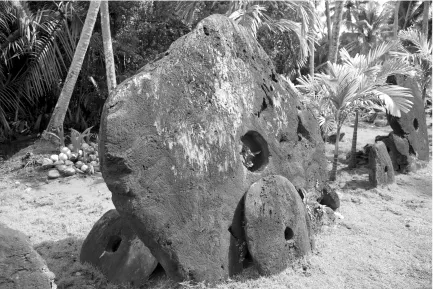
On the Pacific island of Yap, wheel-shaped stones have been used as money for centuries. Some are small, but others very large – up to 3.6m (12 ft) across and weighing over 4,000 kg (4 tons). Made of limestone mined and carved in Palau, they were moved by bamboo canoe to Yap.
The agreed value of a stone depends on its size, craftsmanship and history. The most valuable stones, paradoxically, are those that killed no one in transit and those that killed most people in transit. The largest stones are rarely moved; trade consists only of recording a change in ownership. One stone even fell into the sea during transport to Yap and was still traded because access to it was not important. Everyone knew where it was and who owned it. Ownership of a stone that can’t be retrieved from the ocean is an early example of virtual money.
THREE HEADS FOR THAT DRAGON JAR
Some of the Penan people in Borneo used the severed heads of their enemies as tributes to the spirits that had power over rice. Heads were offered to make the rice grow, but also became an item of value in their own right, because of their efficacy as spirit-bribes. There was no physical trade in heads, though, as trading them was considered unlucky. Instead, a head was equivalent to a living slave or captive, which could be traded. Some items had a value as ‘virtual heads’. A dragon jar – a large receptacle with a green glaze and dragon motif, imported from China – was valued at three heads. If someone killed a person, requiring a tribute to the bereaved family of three heads, the debt could be discharged by the transfer of a dragon jar.
Modern money
For most of us, money is counted in units of a specific currency – dollars, pounds, euros, yen, yuan, lire, dinar and so on. This is called fiat money – the items exchanged have no intrinsic value, but they are agreed to have value for the sake of running the economy.
We are used to fiat money in the form of coins and notes, but increasingly also in virtual form. In the developed world today, people are less likely to be paid in cash. Their salary is usually deposited in their bank as a figure that increases their balance, and is often spent by using a card that authorizes a business to reduce the balance, or by setting up a direct debit or standing order that lets creditors take away some of the balance on a regular basis. We might sometimes withdraw some cash – but for most of us today cash is not really the dominant form of money (see Chapter 17).
Increasingly, money has become dissociated from the real, physical world. Money is now largely theoretical and there is nowhere near as much cash in existence as there is ...
Table of contents
- Cover
- Title
- Contents
- Introduction: What is economics about?
- Chapter 1: What is money anyway?
- Chapter 2: What goes into making things?
- Chapter 3: How do supply and demand work?
- Chapter 4: Does cost reflect value?
- Chapter 5: How do we know if a country is rich or poor?
- Chapter 6: How did we get here?
- Chapter 7: Is the whole world capitalist now?
- Chapter 8: Why do we pay taxes?
- Chapter 9: Why don’t we just print more money?
- Chapter 10: Don’t we still have to make things?
- Chapter 11: What are you paying for?
- Chapter 12: Why can’t I get a job?
- Chapter 13: What should the state own?
- Chapter 14: Is inflation good or bad?
- Chapter 15: If we are the 99 per cent, who are the 1 per cent?
- Chapter 16: Why does the EU pay farmers not to grow crops?
- Chapter 17: Is cash on the way out?
- Chapter 18: How do economic crashes happen?
- Chapter 19: Does austerity work?
- Chapter 20: How long will the shops stay open?
- Chapter 21: How does the stock market work?
- Chapter 22: Does aid help or hinder?
- Chapter 23: How do we benefit from international trade?
- Chapter 24: How do multinationals escape paying tax?
- Copyright
Trusted by 375,005 students
Access to over 1.5 million titles for a fair monthly price.
Study more efficiently using our study tools.
Frequently asked questions
Yes, you can cancel anytime from the Subscription tab in your account settings on the Perlego website. Your subscription will stay active until the end of your current billing period. Learn how to cancel your subscription
No, books cannot be downloaded as external files, such as PDFs, for use outside of Perlego. However, you can download books within the Perlego app for offline reading on mobile or tablet. Learn how to download books offline
Perlego offers two plans: Essential and Complete
- Essential is ideal for learners and professionals who enjoy exploring a wide range of subjects. Access the Essential Library with 800,000+ trusted titles and best-sellers across business, personal growth, and the humanities. Includes unlimited reading time and Standard Read Aloud voice.
- Complete: Perfect for advanced learners and researchers needing full, unrestricted access. Unlock 1.5M+ books across hundreds of subjects, including academic and specialized titles. The Complete Plan also includes advanced features like Premium Read Aloud and Research Assistant.
We are an online textbook subscription service, where you can get access to an entire online library for less than the price of a single book per month. With over 1.5 million books across 990+ topics, we’ve got you covered! Learn about our mission
Look out for the read-aloud symbol on your next book to see if you can listen to it. The read-aloud tool reads text aloud for you, highlighting the text as it is being read. You can pause it, speed it up and slow it down. Learn more about Read Aloud
Yes! You can use the Perlego app on both iOS and Android devices to read anytime, anywhere — even offline. Perfect for commutes or when you’re on the go.
Please note we cannot support devices running on iOS 13 and Android 7 or earlier. Learn more about using the app
Please note we cannot support devices running on iOS 13 and Android 7 or earlier. Learn more about using the app
Yes, you can access Think Like an Economist by Anne Rooney in PDF and/or ePUB format, as well as other popular books in Economics & Economic Theory. We have over 1.5 million books available in our catalogue for you to explore.