In order to understand the universe you must know the language in which it is written. And that language is mathematics.
- Galileo (1564-1642)
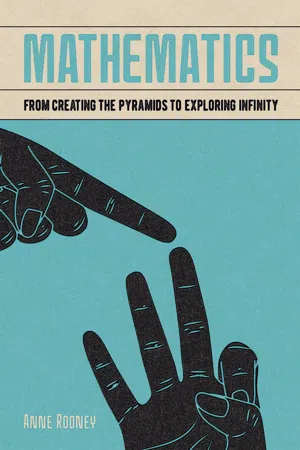
People have always sought order in the apparent chaos of the universe. Mathematics has been our most valuable tool in that search, uncovering the patterns and rules that govern our world and beyond. This book traces humankind's greatest achievements, plotting a journey through the mathematical intellects of the last 4,000 years to where we stand today.
It features the giants of mathematics, from Euclid and Pythagoras, through Napier and Newton, to Leibniz, Riemann, Russell, and many more.
Topics include:
• Counting and measuring from the earliest times
• The Ancient Egyptians and geometry
• The movements of planets
• Measuring and mapping the world
• Fuzzy logic and set theory
• The death of numbers
ABOUT THE SERIES: Arcturus Fundamentals Series explains fascinating and far-reaching topics in simple terms. Designed with rustic, tactile covers and filled with dynamic illustrations and fact boxes, these books will help you quickly get to grips with complex topics that affect our day-to-day living.
- English
- ePUB (mobile friendly)
- Available on iOS & Android
eBook - ePub
About this book
Information
CHAPTER 1
Starting with numbers
Before we could have mathematics, we needed numbers. Philosophers have argued for years about the status of numbers, about whether they have any real existence outside human culture, just as they argue about whether mathematics is invented or discovered. For example, is there a sense in which the area of a rectangle ‘is’ the multiple of two sides, which is true independent of the activity of mathematicians? Or is the whole a construct, useful in making sense of the world as we experience it, but not ‘true’ in any wider sense? The German mathematician Leopold Kronecker (1823–91) made many enemies when he wrote, ‘God made the integers; all else is the work of man.’ Whichever opinion we incline towards individually, it is with the positive integers – the whole numbers above zero – that humankind’s mathematical journey began.
Where do numbers come from?
Numbers are so much a part of our everyday lives that we take them for granted. They’re probably the first thing you see in the morning as you glance at the clock, and we all face a barrage of numbers throughout the day. But there was a time before number systems and counting. The discovery – or invention – of numbers was one of the crucial steps in the cultural and civil development of humankind. It enabled ownership, trade, science and art, as well as the development of social structures and hierarchies – and, of course, games, puzzles, sports, gambling, insurance and even birthday parties!
FOUR MAMMOTHS OR MORE MAMMOTHS?
Imagine an early human looking at a herd of potential lunch – buffalo, perhaps, or woolly mammoths. There are a lot; the hunter has no number system and can’t count them. He or she has a sense of whether it is a large herd or a small herd, recognizes that a single mammoth makes easier prey, and knows that if there are more hunters the task of hunting is both easier and safer. There is a clear difference between one and ‘more-than-one’, and between many and few. But this is not counting.
At some point, it becomes useful to quantify the extra mammoths in some way – or the extra people needed to hunt them. Precise numbers are still not absolutely essential, unless the hunters want to compare their prowess.
CAN ANIMALS COUNT?
Could the mammoths count their attackers? Some animals can apparently count small numbers. Pigeons, magpies, rats and monkeys have all been shown to be able to count small quantities and distinguish approximately between larger quantities. Many animals can recognize if one of their young is missing, too.
TALLY-HO!
Moving on, and the mammoth hunters settle to herding their own animals. As soon as people started to keep animals, they needed a way to keep track of them, to check whether all the sheep/goats/yaks/pigs were safely in the pen. The easiest way to do this is to match each animal to a mark or a stone, using a tally.
It isn’t necessary to count to know whether a set of objects is complete. We can glance at a table with 100 places set and see instantly whether there are any places without diners. One-to-one correspondence is learned early by children, who play games matching pegs to holes, toy bears to beds, and so on, and was learned early by humankind. This is the basis of set theory – that one group of objects can be compared with another. We can deal simply with sets like this without a concept of number. Similarly, the early farmer could move pebbles from one pile to another without counting them.
The need to record quantities of objects led to the first mark-making, the precursor of writing. A wolf bone found in the Czech Republic carved with notches more than 30,000 years ago apparently represents a tally and is the oldest known mathematical object.
FROM TWO TO TWO-NESS
A tally stick (or pile of pebbles) that has been developed for counting sheep can be put to other uses. If there are 30 sheep-tokens, they can also be used for tallying 30 goats or 30 fish or 30 days. It’s likely that tallies were used early on to count time – moons or days until the birth of a baby, for example, or from planting to cropping. The realization that ‘30’ is a transferable idea and has some kind of independence of the concrete objects counted heralds a concept of number. Besides seeing that four apples can be shared out as two apples for each of two people, people discovered that four of anything can always be divided into two groups of two and, indeed, four ‘is’ two twos.
At this point, counting became more than tallying and numbers needed names.
BODY COUNTING
Many cultures developed methods of counting by using parts of the body. They indicated different numbers by pointing at body parts or distances on the body following an established sequence. Eventually, the names of the body parts probably came to stand for the numbers and ‘from nose to big toe’ would mean (say) 34. The body part could be used to denote 34 sheep, or 34 trees, or 34 of anything else.
TOWARDS A NUMBER SYSTEM
Making a single mark for a single counted object on a stick, slate or cave wall is all very well for a small number of objects, but it quickly becomes unmanageable. Before humankind could use numbers in any more complex way than simply tallying or counting, we needed methods of recording them that were easier to apprehend at a glance than a row of strokes or dots. While we can only surmise from observing non-industrialized people as to how verbal counting systems may have developed, there is physical evidence in the form of artefacts and records for the development of written number systems.
The earliest number systems were related to tallies in that they began with a series of marks corresponding one-to-one to counted objects, so ‘III’ or ‘…’ might represent 3. By 3400BC, the Ancient Egyptians had developed a system of symbols (or hieroglyphs) for powers of ten, so that they used a stroke for each unit and a symbol for 10, then a different symbol for 100, another for 1,000 and so on up to 1,000,000. Within each group, the symbol was repeated up to nine times, grouped in a c...
Table of contents
- Cover
- Title
- Contents
- Introduction: The magic of numbers
- Chapter 1: Starting with numbers
- Chapter 2: Numbers put to work
- Chapter 3: The shape of things
- Chapter 4: In the round
- Chapter 5: The magic formula
- Chapter 6: Grasping the infinite
- Chapter 7: Numbers at work and play
- Chapter 8: The death of numbers
- Chapter 9: Proving it
- Glossary
- Copyright
Trusted by 375,005 students
Access to over 1.5 million titles for a fair monthly price.
Study more efficiently using our study tools.
Frequently asked questions
Yes, you can cancel anytime from the Subscription tab in your account settings on the Perlego website. Your subscription will stay active until the end of your current billing period. Learn how to cancel your subscription
No, books cannot be downloaded as external files, such as PDFs, for use outside of Perlego. However, you can download books within the Perlego app for offline reading on mobile or tablet. Learn how to download books offline
Perlego offers two plans: Essential and Complete
- Essential is ideal for learners and professionals who enjoy exploring a wide range of subjects. Access the Essential Library with 800,000+ trusted titles and best-sellers across business, personal growth, and the humanities. Includes unlimited reading time and Standard Read Aloud voice.
- Complete: Perfect for advanced learners and researchers needing full, unrestricted access. Unlock 1.5M+ books across hundreds of subjects, including academic and specialized titles. The Complete Plan also includes advanced features like Premium Read Aloud and Research Assistant.
We are an online textbook subscription service, where you can get access to an entire online library for less than the price of a single book per month. With over 1.5 million books across 990+ topics, we’ve got you covered! Learn about our mission
Look out for the read-aloud symbol on your next book to see if you can listen to it. The read-aloud tool reads text aloud for you, highlighting the text as it is being read. You can pause it, speed it up and slow it down. Learn more about Read Aloud
Yes! You can use the Perlego app on both iOS and Android devices to read anytime, anywhere — even offline. Perfect for commutes or when you’re on the go.
Please note we cannot support devices running on iOS 13 and Android 7 or earlier. Learn more about using the app
Please note we cannot support devices running on iOS 13 and Android 7 or earlier. Learn more about using the app
Yes, you can access Mathematics by Anne Rooney in PDF and/or ePUB format, as well as other popular books in Mathematics & History & Philosophy of Mathematics. We have over 1.5 million books available in our catalogue for you to explore.