"The mind is like an iceberg, it floats with one-seventh of its bulk above water"
- Sigmund Freud
From Socrates to Carl Jung and Descartes to Daniel Dennett, this illustrated book brings together the threads that have made up psychology, from the musings of the Ancient Greeks to the findings of functional MRI scanning. Explained in a concise and easy-to-understand manner, it explores various key approaches, including structuralist, functionalist, behaviourist, psychodynamic, humanist, cognitive, and biological. It is a narrative of how we have tried to approach the very core of our being - of what makes us ourselves.
Topics include:
• The ghost in the machine - the search for the mind and how it relates to the body
• Models of madness - attempts to categorize and treat mental illness
• Artificial intelligence
• Mind and matter - how modern neurology sheds new light on the workings of the mind
• Psychoanalysis
ABOUT THE SERIES: Arcturus Fundamentals Series explains fascinating and far-reaching topics in simple terms. Designed with rustic, tactile covers and filled with dynamic illustrations and fact boxes, these books will help you quickly get to grips with complex topics that affect our day-to-day living.
- English
- ePUB (mobile friendly)
- Available on iOS & Android
eBook - ePub
About this book
Information
Topic
PsychologieCHAPTER 1
What and where is the mind?
‘For it is the same thing to think and to be.’
Parmenides (born c.515BC)
Where and what is the thing we identify as ‘I’? The question is as old as culture itself, and central to psychology. Is ‘I’ just a physical body? If so, what makes one person so very different in character from another? Many people believe that the mind, or perhaps something called the soul, makes us what we are. Some believe that only biochemical processes mark the differences between individuals.
Mind and matter
The way in which humans use language suggests that the mind is not the same as the physical body. Phrases such as ‘I felt myself do . . . ’ and ‘I can’t bring myself to . . . ’ suggest a split between the mind and body. This ‘dualist’ position supposes that there are two different entities involved in an individual’s makeup. One is the physical matter that makes up flesh and bones; the other is an inspiring spirit, energy, consciousness – or soul.
If the mind and the body are separate, in what way are they related and how do they interact? This question underscores many of the issues discussed in psychology and its therapeutic applications in psychiatry and psychotherapy, and even in other aspects of medicine. Some philosophers take the ‘monist’ view – that things can be explained in terms of a single reality or substance. The ‘materialistic monist’ position holds that there is only the physics and chemistry of our bodies, and everything we consider to be a mental event is produced by physical impulses. Radical behaviourist psychologists such as Burrhus Frederick (‘B. F.’) Skinner (1904–90) held that the mind does not exist; they assert that humans are simply their bodies, and everything they do can be described in terms of behaviour.
The ‘idealist monist’ position states that human actions are psychological events and the physical counts for nothing at all and might not even exist. A psychologist taking this position explains everything in terms of consciousness and psychological acts. The 18th-century Anglo–Irish philosopher Bishop George Berkeley (1685–1753) was an idealist monist: he claimed that the external world doesn’t exist except insofar as it is perceived by human consciousness.
In Ancient Greece, before the time of Socrates, the soul was seen as something which distinguished a living person from a corpse. It was the ‘spirit of life’ and that was its only role – it wasn’t held responsible for behaviour, thought, emotions, intellect or any of the other attributes of the mind. Initially only humans were believed to have a soul. The soul didn’t go anywhere after death or have any supernatural connotations; it was simply the state of a living person to be ‘ensouled’ and of a dead person to be lacking one. Slowly, the meaning of ‘soul’ changed and it came to be applied to any living thing. In the 5th century BC, it was associated with virtues such as courage, and with some actions of the mind – principally, higher motives such as a love of learning. The Greek philosopher Socrates (c.470– 399BC) believed that the body was responsible for desires, fears, beliefs and pleasures. The soul was responsible for keeping the body in check and policing its baser instincts. In this sense, it served much the same purpose as the faculty of reason.
Three in one
Plato (c.425–c.348BC) proposed a three-part soul. The ‘appetitive’ soul is concerned with satisfying physical appetites – the body’s desire for food, drink, sex, sensation. The ‘courageous’ soul is concerned with the emotions – love, hate, fear, courage and so on. The ‘rational’ soul seeks knowledge and keeps the other two parts in check, with varying degrees of success. In Phaedo, Plato uses the allegory of the charioteer to explain the relationship between the three aspects of the soul. The charioteer is the rational soul trying to steer his carriage pulled by two horses, one black and one white. The black horse is the appetitive soul, and the white horse is the courageous soul. The black horse is trying to pull the chariot towards fine dinners and whore-houses while the white horse is pulling in the direction of acts of valour and benevolence. The charioteer tries to control the two vying parts of the soul and tries to negotiate the best course of action.
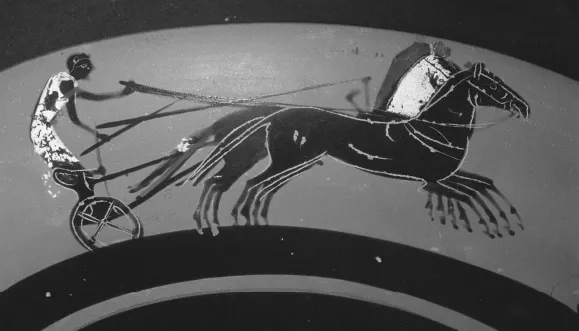
Plato’s allegory of the charioteer steering two horses explains the idea of the three-part soul.
‘What is it that, when present in a body, makes it living? — A soul.’
Plato’s Phaedo (‘On the Soul’)
Plato’s pupil Aristotle (384–322BC) proposed a different trio of souls. He believed that each animate thing, from plant to human being, has a soul suited to its function, with capabilities and duties appropriate to the organism. This might include abilities such as growth (in a plant), locomotion (in an animal) and abstract reasoning (in a human). With this theory, Aristotle touched on concepts regarding the function of the brain which we consider to be exclusively modern. The brain does regulate voluntary and involuntary activities such as breathing and moving; but it is also the site of non-physical activities such as contemplation, desire and reasoning. Unlike Plato, Aristotle didn’t believe that the soul could survive the body or have any existence independent of it. In this, too, the Aristotelian soul is closer to the modern concept of ‘mind’ than that of a semi-mystical spirit.
In two minds
In Epicurean tradition, based on the teachings of the Ancient Greek philosopher Epicurus (341–270BC), the soul has two parts – one rational, and the other non-rational. The rational part, called animus (mind), produces emotions and impulses, applies concepts, shapes beliefs, assesses evidence, interprets sensory perceptions, and so on. The non-rational part receives sense-impressions – sights, sounds, smells and so on. (Any errors arise later on, when the rational part of the soul is interpreting these stimuli.) The non-rational part also transmits impulses which originate in the rational part, and carries out non-reasoning tasks such as seeing and breathing. These practical tasks carried out by the brain are also achieved by animals we would not always assume to have a soul or conscious thought processes, such as hedgehogs and prawns.
HEART AND SOUL
While it’s obvious to us that the brain is the part of the body that does the thinking, feeling, dreaming, believing and so on, until recently there was no anatomical evidence for this and earlier generations didn’t necessarily consider it as the locus for thought. The Ancient Egyptians believed the heart was the centre of emotions, reason and thought. They discarded the brain when they mummified their dead, even though they carefully preserved all the other organs in Coptic jars for burial. Plato suggested that the brain was the site of thought, but Aristotle rejected this idea, plumping for the heart once again.
The Stoics took the crucial step towards suggesting something like the prevailing modern view of the mind. They believed there were three types of pneuma, or inspiring spirit (pneuma means ‘breath’). The first was thought to hold solid matter together and was present even in rocks; today we would ascribe this to the laws of physics and the behaviour of atoms and molecules. The second was believed to provide the vital functions of plant life (growth, respiration and so on). The third, the soul, was thought to provide the mental and psychological functions of animals and humans. It varied in its capabilities according to the animal, so in a human included reason, belief, intellect and desire as well as basic mental processes such as sensory perception.
The Stoic conception of the soul is not as an animating spirit, the breath of life, or the difference between being alive or dead. It’s a conglomeration of mental processes that provide awareness, understanding, thought, consciousness and meaningful interaction with the world.
THE STOICS
Stoicism was a school of philosophy started by Zeno of Citium (334–262BC) in Athens in the early 3rd century BC. The Stoics thought that destructive emotions such as hatred and envy occur through errors of judgement, and maintained that only a wise man can be truly happy. Later Stoics included the Roman philosopher Seneca the Younger (4BC–AD65) and the Greek sage, Epictetus (c.AD55–135).
Soul-grabbers
With the rise of monotheistic religions, the soul was hijacked in the service of God and became a shard of divinity resident in each human body, reflecting or struggling towards a godhead.
The Neoplatonists, such as the Jewish philosopher Philo of Alexandria (c.25BC–AD50) and the Roman thinker Plotinus (204–270), adopted the mystical aspects of Plato’s thinking and adapted it to religion. Philo melded Plato’s division between sensory and rational aspects of the human with Hebrew religious teaching, taking as his starting point the Jewish model of the physical body imbued with a soul that is a fragment of the divine being. Unlike Plato, he didn’t believe that introspection and reason would lead to knowledge; he thought that wisdom could come only from God, by divine inspiration. To prepare the soul for the gift of knowledge, Philo considered it necessary to eschew bodily impulses by way of meditation and distancing oneself from base appetites. He believed that inspiration could also strike in dreams and trances, as these distance the soul from the physical world. Plotinus thought the soul reflected the spirit, which was itself an image of ‘the One’. This gave a three-part hierarchy, with the One at the top, imperfectly imaged in the spirit, and the spirit imperfectly imaged in the Soul. He taught that, in entering a body, the spirit merged with something inferior.
The Platonic and Neoplatonic model of the soul struggling to master the bodily impulses appealed to Christian theology. It required only a minor reworking to have the noble soul striving towards godliness while the imperfect body tries to drag it down to frolic in wayward pleasures. This tweaking was accomplished by the early Christian philosopher Augustine of Hippo (345–430). Eight hundred years later, the Italian priest Thomas Aquinas (1225–74) did the same tweaking and accommodation for Aristotelian theory. In the main, though, the period following the fall of the Roman Empire was a fruitless one for the development of psychological thought in Europe. The soul/mind was in thrall to God and any interpretation of its workings was therefore theological. Instead it was the Arab world that kept the flame of learning alive.
In the footsteps of the prophet
After the death of Mohamet in 632, Islam spread rapidly throughout the Arab and Persian world. Middle Eastern thinkers read the works of the Ancient Greeks, particularly Aristotle, and wrote translations and commentaries on them, and Aristotle’s writings resurfaced in Europe in the Middle Ages. For a period of around 400 years, Middle Eastern culture made great strides in all branches of science – until Islam took a more intellectually conservative, curiosity-stifling turn in the 12th century.
One of the most important Islamic scholars was the 11thcentury Persian polymath Ibn Sina, known as Avicenna in the West. His work was firmly rooted in Aristotle. In psychology, Ibn Sina is most famous for his ‘floating man’ thought experiment. Imagine you have suddenly been created, from nothing, suspended in mid-air and without any sensory input from the environment or a body. Ibn Sina claimed that because it is possible to conceive of this existence and to be thinking and conscious in this state and not doubt one’s existence, it is clear that the mind i...
Table of contents
- Title
- Contents
- Introduction: The study of humanity
- Chapter 1: What and where is the mind?
- Chapter 2: Measuring the mind
- Chapter 3: How and why do we think?
- Chapter 4: Is knowledge innate or acquired?
- Chapter 5: The building blocks of the psyche
- Chapter 6: Defining the self
- Chapter 7: The self and society
- Chapter 8: Approaches to abnormal psychology
- Conclusion: The riddle of the mind
- Copyright
Trusted by 375,005 students
Access to over 1.5 million titles for a fair monthly price.
Study more efficiently using our study tools.
Frequently asked questions
Yes, you can cancel anytime from the Subscription tab in your account settings on the Perlego website. Your subscription will stay active until the end of your current billing period. Learn how to cancel your subscription
No, books cannot be downloaded as external files, such as PDFs, for use outside of Perlego. However, you can download books within the Perlego app for offline reading on mobile or tablet. Learn how to download books offline
Perlego offers two plans: Essential and Complete
- Essential is ideal for learners and professionals who enjoy exploring a wide range of subjects. Access the Essential Library with 800,000+ trusted titles and best-sellers across business, personal growth, and the humanities. Includes unlimited reading time and Standard Read Aloud voice.
- Complete: Perfect for advanced learners and researchers needing full, unrestricted access. Unlock 1.5M+ books across hundreds of subjects, including academic and specialized titles. The Complete Plan also includes advanced features like Premium Read Aloud and Research Assistant.
We are an online textbook subscription service, where you can get access to an entire online library for less than the price of a single book per month. With over 1.5 million books across 990+ topics, we’ve got you covered! Learn about our mission
Look out for the read-aloud symbol on your next book to see if you can listen to it. The read-aloud tool reads text aloud for you, highlighting the text as it is being read. You can pause it, speed it up and slow it down. Learn more about Read Aloud
Yes! You can use the Perlego app on both iOS and Android devices to read anytime, anywhere — even offline. Perfect for commutes or when you’re on the go.
Please note we cannot support devices running on iOS 13 and Android 7 or earlier. Learn more about using the app
Please note we cannot support devices running on iOS 13 and Android 7 or earlier. Learn more about using the app
Yes, you can access Psychology by Anne Rooney in PDF and/or ePUB format, as well as other popular books in Psychologie & Geschichte & Theorie in der Psychologie. We have over 1.5 million books available in our catalogue for you to explore.