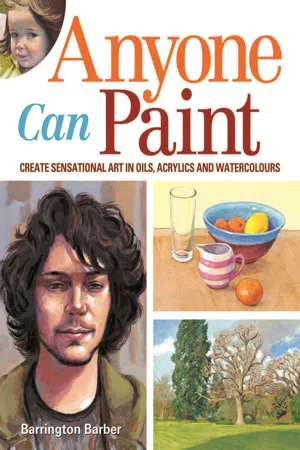
It's true - anyone can paint! Even if you have seldom done so before, it's never too late to pick up a brush and have a go. In this book, professional artist and inspirational teacher Barrington Barber demonstrates step-by-step methods of painting in watercolours, acrylics and oils. He explores the use of colour and shows how the different techniques and effects of each medium can be applied to a range of subjects, including still lifes, landscapes, portraits and buildings.
Finished artworks in each medium give an idea of the results that can be achieved, and examples of composition, technique and style show how famous artists have evolved their own painting methods.
Through practice, and by following the guidance in this book, you will hopefully discover the enjoyment and fulfilment that can be found in learning how to paint.
• step-by-step tuition
• beautiful examples
• suitable for beginners and improving artists
eBook - ePub
Anyone Can Paint
Create sensational art in oils, acrylics, and watercolours
- English
- ePUB (mobile friendly)
- Available on iOS & Android
eBook - ePub
About this book
Information
Topic
ArtSubtopic
Art Techniques
1 Watercolours
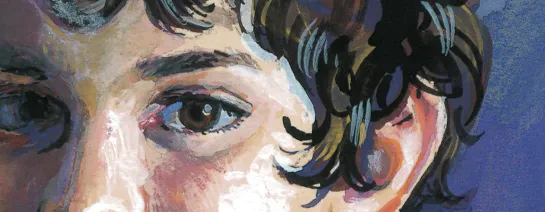
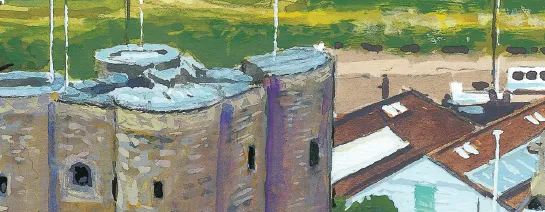
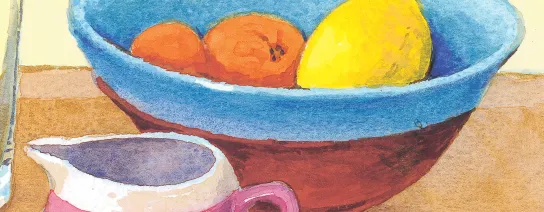
In this chapter we shall look at watercolours. These are the most simple and ancient method of painting as they are simply pigment mixed with water in varying quantities to get the colours and tones required. Also included here are gouache paints, which are watercolours with a higher density of pigment and an added white pigment such as chalk, making them opaque. This means that you can paint over other colours easily, something that isn’t possible with traditional watercolour.
Preparation and equipment
One of the advantages of watercolour is that the materials and equipment you need are very straightforward. The basics are easily found in any art supplies shop and, although you can buy various mediums to add to watercolour to give different effects, they aren’t necessary to make a painting; a jar of tap water will see you through.
Choosing your watercolours
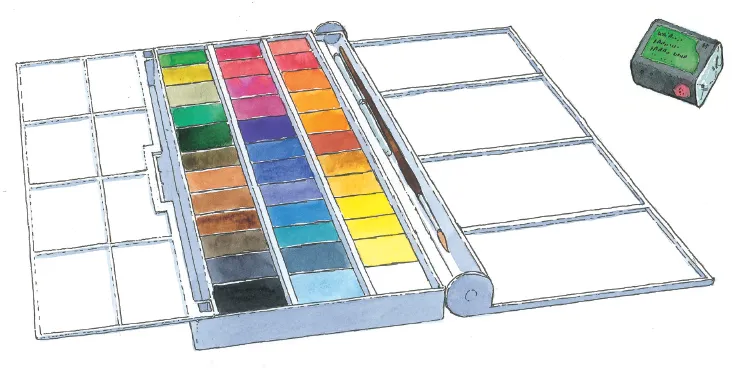
If you just want to find out whether you might enjoy painting in watercolour or not, your best plan is to buy a small box with a few colours to get you started – they won’t go to waste if you want to take it more seriously. However, if you know from the outset that watercolour painting is for you, a large box of paints such as the one shown here is ideal. As you can see, it not only has the palettes in the lid, but also a second range of palettes which slot into the opposite side of the box. This is useful when you are painting for any length of time and want to mix a number of colours. The palettes clip back over the paint pans like an extra lid when the box is closed.
My favourite watercolour box is the St Petersburg White Nights set, which has 36 colours, all of them very intense. I find this quality avoids me having to pile on the paint, which in this medium is not ideal since you always need to let the white of the paper shine through the colour to give the liveliness that will enhance your work. However, most reputable manufacturers of art materials produce good standard boxes. Always go for the range described as artists’ quality, since the cheaper ranges have less pigment in proportion to binders and fillers and produce an inferior result.
When you have exhausted a colour in your paintbox you can buy a replacement tablet, known as a pan, or half pan, depending on the size. All you need to do is unwrap it and slot it into place. Pans vary in price, since some pigments are more expensive than others because of the rarity of the material from which they are made.
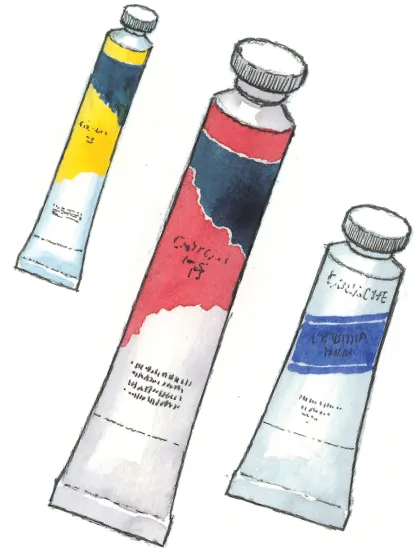
Watercolour tubes
Watercolour paints are also sold in tubes, which you may find especially useful for colours you use in large quantities. You can squeeze out the exact amount you want and dilute it. Tubes have the advantage that there’s less likelihood of mixing too little for a wash, which is often the case with pans in inexperienced hands.
There are two sizes of tube – a regular one of about 8ml (0.27 US fl oz) which will be sufficient for most of your needs, and a larger tube of 21ml (0.71 US fl oz).
Gouache, also known as body colour, is a more substantial water-based paint that has greater covering power, making it useful when you want to obscure one colour with another. It can be used with traditional watercolour in various ways (see page 32).
Colours
The vast amount of colours available can be confusing for a beginner. As you become more experienced you’ll discover which are most suitable for your own style and subject, but to start you off here’s a range of colours that will allow you to paint most subjects. It is always good to start working with a limited palette until you are more familiar with the medium.
Yellows


Reds and oranges


Colours
Blues


Greens


Browns

Table of contents
- Cover
- Title
- Contents
- Introduction
- 1 Watercolours
- 2 Acrylics
- 3 Oils
- 4 Composition, Technique & Style
- Copyright
Trusted by 375,005 students
Access to over 1.5 million titles for a fair monthly price.
Study more efficiently using our study tools.
Frequently asked questions
Yes, you can cancel anytime from the Subscription tab in your account settings on the Perlego website. Your subscription will stay active until the end of your current billing period. Learn how to cancel your subscription
No, books cannot be downloaded as external files, such as PDFs, for use outside of Perlego. However, you can download books within the Perlego app for offline reading on mobile or tablet. Learn how to download books offline
Perlego offers two plans: Essential and Complete
- Essential is ideal for learners and professionals who enjoy exploring a wide range of subjects. Access the Essential Library with 800,000+ trusted titles and best-sellers across business, personal growth, and the humanities. Includes unlimited reading time and Standard Read Aloud voice.
- Complete: Perfect for advanced learners and researchers needing full, unrestricted access. Unlock 1.5M+ books across hundreds of subjects, including academic and specialized titles. The Complete Plan also includes advanced features like Premium Read Aloud and Research Assistant.
We are an online textbook subscription service, where you can get access to an entire online library for less than the price of a single book per month. With over 1.5 million books across 990+ topics, we’ve got you covered! Learn about our mission
Look out for the read-aloud symbol on your next book to see if you can listen to it. The read-aloud tool reads text aloud for you, highlighting the text as it is being read. You can pause it, speed it up and slow it down. Learn more about Read Aloud
Yes! You can use the Perlego app on both iOS and Android devices to read anytime, anywhere — even offline. Perfect for commutes or when you’re on the go.
Please note we cannot support devices running on iOS 13 and Android 7 or earlier. Learn more about using the app
Please note we cannot support devices running on iOS 13 and Android 7 or earlier. Learn more about using the app
Yes, you can access Anyone Can Paint by Barrington Barber in PDF and/or ePUB format, as well as other popular books in Art & Art Techniques. We have over 1.5 million books available in our catalogue for you to explore.