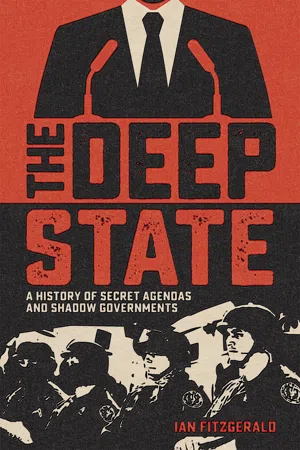
Beneath the outward appearance of legitimate government and accountable officials there lurk hidden agendas, shadowy personalities and special interest groups seeking to seize control of the nation for their own ends. These 'states within a state', unfettered by legal norms and unworried by public opinion, are known as 'deep states'.
In this fascinating account, Ian Fitzgerald examines what a deep state really is and how they have emerged in various places across the world and throughout history. Ranging from the police state of East Germany in the 1950s to the narco states of Latin America in the 1970s to the institutional corruption of 21st century Nigeria, he explores the many ways people have sought to seize the apparatus of power for themselves while remaining out of sight.
Now the subject of modern conspiracy theories the world over as a worrying trend toward unelected power emerges, this book is more timely than ever, and helps separate fact from fiction.
Looks at deep state conspiracies around the world, including:
• the narco-states of Colombia and Mexico - where legitimate institutions have been corrupted by the power and wealth of the illegal drug trade
• the illicit tax haven of Panama and the 2016 "Panama Papers", history's biggest data leak
• the United Fruit Company's involvement in the 1954 coup d'état in Guatemala
• the robber barons of the late 19th- and early 20th- century America
• the role of intelligence services such as the CIA, FBI and NSA in the US deep state, at home and abroad
• the extent to which social media sites such as Facebook influence voters
- English
- ePUB (mobile friendly)
- Available on iOS & Android
eBook - ePub
About this book
Information
Chapter 1
Historical deep states
It’s tempting to think of the deep state as a relatively modern phenomenon, but a look back through history reveals examples in every place and in every time. The deep state’s aim has always been consistent, too: to further its own interests against those of the ruling authority.
In this chapter we’ll look at how the various types of deep state have been established over the millennia. There’s the oligarchic deep state of traditional elites, which arose in the very first democratic city-state, Ancient Athens, and then in republican Rome. Then there is the military deep state, embodied in the Praetorian Guard and in the legions of the Roman Empire, and later in the General Staff in Imperial Japan. The Ottoman Empire of the 19th century best exemplifies an early example of the bureaucratic deep state, where concerned (and self-interested) civil servants and government officials work behind the scenes to control regimes whose activities they disagree with. Finally, we shall explore how ideological deep states in France and Germany acted in the aftermath of the Franco-Prussian War of 1870–71, and how their host states reacted in return.
The oligarchy of Ancient Athens
In 508 bce, the Athenian lawgiver Cleisthenes introduced a programme of political reform that he called demokratia (‘rule by the people’). In ‘inventing’ democracy, Cleisthenes’ aim had been to ameliorate rising tensions between the traditional oligarchic elites that had dominated Athenian politics since time immemorial and the growing ‘middle class’ of merchants and citizens who wanted a say in how the city-state was run. However, from its inception, democracy was susceptible to interference and manipulation by groups looking to prioritize their interests over the greater good. In Ancient Athens, this meant the formation of an oligarchic deep state to steal back the power that democracy had forced it to share with the lower orders.
The oligarchs fight back
While Cleisthenes and his successors made the new machinery of government as tamper-proof as possible, the oligarchs nevertheless found a way in. The Assembly is probably Athens’ most famous example of the democratic process at work, a ‘parliament’ open to all of the city-state’s 40,000 male citizens. But a more important organ of government from a deep-state point of view was the Boule. This was the office that did most of the day-to-day work of civic life. Crucially, it controlled the political agenda by deciding which legislation was put before the Assembly. Membership of the Boule was decided by the drawing of lots and this should have made it immune to corruption – but historical records show a higher than normal proportion of oligarchic citizens served on it, although how they managed to rig the lottery is not known.
Our rosy view of Athenian democracy certainly needs revisiting. As the classicist Claire Taylor has pointed out, ‘Every level of Athenian politics was riddled with corruption, from the most important orators to the smallest deme election.’ Between 6 and 10 per cent of senior public officials were tried on charges of bribery during Athens’ golden age, with around half of them convicted. Much of this was fairly low-level corruption and favour-trading, but underlying it all was the constant chipping away by Athens’ richest, most prominent and often competing families at the edifice of popular rule. There is even an argument to say that Cleisthenes introduced democracy partly to protect his own influential oligarchic family, the Alcmaeonidae, against a powerful rival clan, the Peisistratids. From 546 to 510 bce, the Peisistratid family had ruled Athens as tyrants and had exiled Cleisthenes’ Alcmaeonidae kin from the city. After helping to oust the Peisistratids in 510 bce, Cleisthenes saw that continuing the cycle of rule by one family after another was unproductive and that a new approach to government was needed. In that sense, it could be said that while democracy grew out of good intentions the motivations behind it were self-interested as much as pragmatic. It’s one of the great ‘what ifs’ of history to ponder whether democracy would even have been invented if the Peisistratids and the Alcmaeonidae had got on better.
This tension between democratic intent and oligarchic motivation mounted following the outbreak in 431 bce of the Peloponnesian War, Athens’ long-running conflict with its main regional rival, Sparta – an authoritarian, militaristic city-state much admired by those of an oligarchic cast of mind. As the war progressed, with periodic victories and defeats on both sides, Athens’ oligarchic deep state began the process of undermining their home state’s democracy once and for all. They were galvanized by works of propaganda, such as a widely circulated pamphlet called The Athenian Constitution. Its anonymous author was credited as the Old Oligarch, and the piece served as a rallying call for the ‘best and most qualified’ to impose their rule over ‘the vulgar people’.
The end of an era
The war came to a head in 411 bce, when Athens suffered a militarily devastating and financially catastrophic defeat by Sparta in Sicily. As a wave of popular unrest broke out in Athens, the oligarchs encouraged and funded attacks on public buildings and even on public officials. A group of aristocrats, led by the statesman Antiphon and the rogue Athenian general Alcibiades (an Alcmaeonidae, no less, who had been exiled from the city and had defected to Sparta), seized power and installed a government of prominent oligarchs known as the Four Hundred.
Within a year the coup had been overturned, but the damage to Athens’ democracy had been done. The war with Sparta limped on for several more years, but when it finally ended in 404 bce with Athens’ total defeat a Spartan-imposed dictatorship of the Thirty Tyrants assumed control. Democracy was restored once more in 403 bce, but was ended for good when Philip of Macedon conquered Greece in 338 bce.
Fortunately, democracy did not disappear with the Athenian city-state. It survived and grew and evolved in Europe and then around the world, but so did the deep state virus that attached itself to the body politic and which remains to this day, dormant in many cases but very active in others.
Republican and Imperial RoME
Ancient Roman history divides into two eras: the republic, which traditionally began in 509 bce, and the empire, initiated by the rule of Augustus from 27 bce. In deep-state terms, this translates to an oligarchic secret network interfering in the republican period, exemplified in the fate of the reforming Gracchi brothers, while for the Imperial epoch it is represented by the creeping influence of a military shadow government that ultimately tired of acting behind the scenes and took power for itself.
Defeating the Gracchi
Legend has it that Rome was founded in 753 bce, on 21 April to be exact, by the brothers Romulus and Remus. It became a republic in 509 bce when the last king was expelled from the city, and from that time onwards Romans were fiercely protective of their royalty-free government. But, as in Ancient Athens, the form of government Romans opted for was one dominated by the oligarchy, the old, aristocratic families of the patrician class, as opposed to the plebeian class of commoners. Patricians saw themselves as descendants of the first 100 men chosen by Romulus as Rome’s original senators. As well as holding political power in the Senate, Rome’s parliament, the patricians dominated economic life, too, through their ownership of vast and extremely profitable estates and plantations. If anything was guaranteed to anger Rome’s landowning aristocracy, it was the suggestion they might redistribute some of their holdings among their fellow countrymen.
This is exactly what the tribune Tiberius Gracchus did in 134 bce. Like Cleisthenes in Athens, he was a high-born aristocrat. He was also a leading light of the reformist Populares faction in the Senate. The Populares were concerned about the growing social inequalities in Rome, with the patricians, represented in the Senate by the Optimates, accumulating more and more wealth at the expense of their low-born plebeian countrymen. Tiberius Gracchus’ land reform proposals involved Rome’s aristocratic country squires handing over large swathes of their estates to the peasantry. The effect was to inflame the simmering resentment of an aristocracy that did not want to share anything – land, wealth, political power – with a population they despised as an uncouth mass.
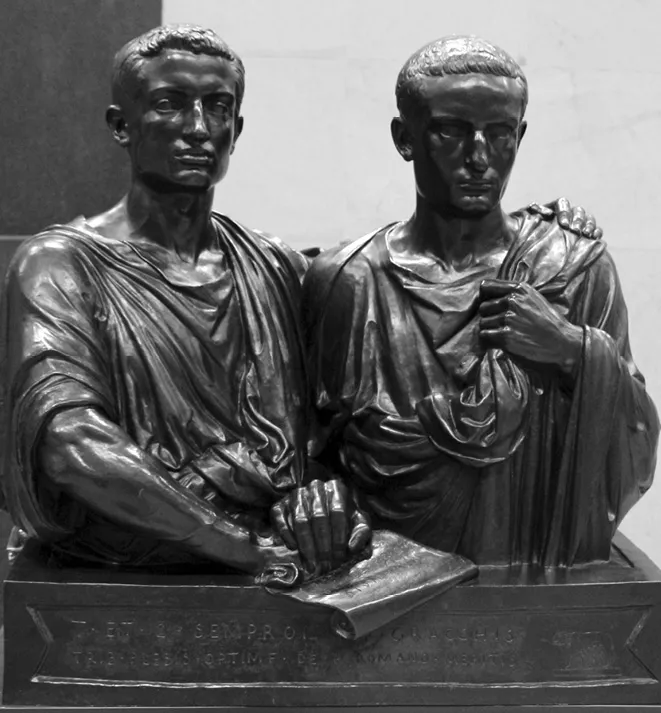
Tiberius and Gaius Gracchus, brothers and populist politicians who fell foul of Rome’s oligarchic deep state.
The parallels with Athens’ experiment with democracy are striking. In both cases a progressive oligarch had the foresight to see that social and economic changes were making their existing forms of government unsustainable, but where Cleisthenes succeeded, Tiberius Gracchus failed. Cleisthenes persuaded enough of his fellow oligarchs it was in their interests to follow his lead; Tiberius Gracchus, on the other hand, was more confrontational. He courted popular support among the plebeians against his fellow oligarchs, and the fiery rhetoric he deployed in the Forum gave the Optimates the excuse they needed to bring him down. Under the guise of saving Rome from a burgeoning tyrant, in 133 bce Rome’s aristocrats, senators and a hired mob of enforcers confronted Tiberius Gracchus and, in the ensuing fight, beat him to death along with 300 of his followers.
In the aftermath of this massacre the Senate actually passed Tiberius Gracchus’ reforms – public opinion had swung too far behind the issue to ignore it – but implementation of the act was slow and heavily compromised. In the end, Tiberius Gracchus’ radical proposals suffered death by a thousand cuts.
Ten years later this scenario was played out again when Tiberius Gracchus’ brother Gaius, also a tribune, tried to force the state to subsidize grain prices in Rome to make it affordable to ordinary citizens. The republic’s large landowner and agribusiness deep state disdained this policy. In the inevitable violence that followed, Gaius Gracchus took his own life when cornered by a gang sent by the oligarchs to murder him.
The empire strikes back
What happened to the Gracchi was symptomatic of the state of Roman politics in the waning years of the republic. Before long, the oligarch-dominated Senate would become little more than a talking shop as a cadre of military strongmen emerged that favoured a more direct approach to the exercise of power.
All the offices of state continued as before – senators were appointed, consuls, tribunes and quaestors elected – but they increasingly became proxies for rogue generals pushing their personal agendas. These included Pompey the Great and Julius Caesar, whose bitter power struggle helped to hasten the end of the republic and opened the way for the age of emperors that followed. Both men prioritized military success over politics, so as Rome transitioned from a republic into an empire its deep state morphed from an oligarchic cabal into a military junta.
Augustus, the first emperor, had come to power in 27 bce on the back of military success. This, and the imperial expansion and influx of wealth that accumulated during his 40-year reign, made his position unassailable. Those who followed were not so fortunate. Augustus’ successor, Tiberius, a disillusioned and dissolute old man by the end of his 22-year reign in 37 ce, was supposedly helped on his way to the afterlife by the commander of the Praetorian Guard, Naevius Sutorius Macro. The Praetorian Guard had been established by Augustus as the emperor’s personal security detail. Given its proximity to ultimate power, it quickly became a deep-state kingmaker, removing and installing emperors at will. It arranged the assassination of Tiberius’ successor Caligula in 41 ce, for example, and murdered 13 Roman emperors in total over the course of its history. By the end of Nero’s unhappy reign in 68 ce, Rome’s military deep state abandoned all pretence of impartiality and went to war with itself. The year 69 ce saw no fewer than four emperors, all of them military generals. The last of these was Vespasian, commander of Rome’s eastern legions, who re-established peace and security.
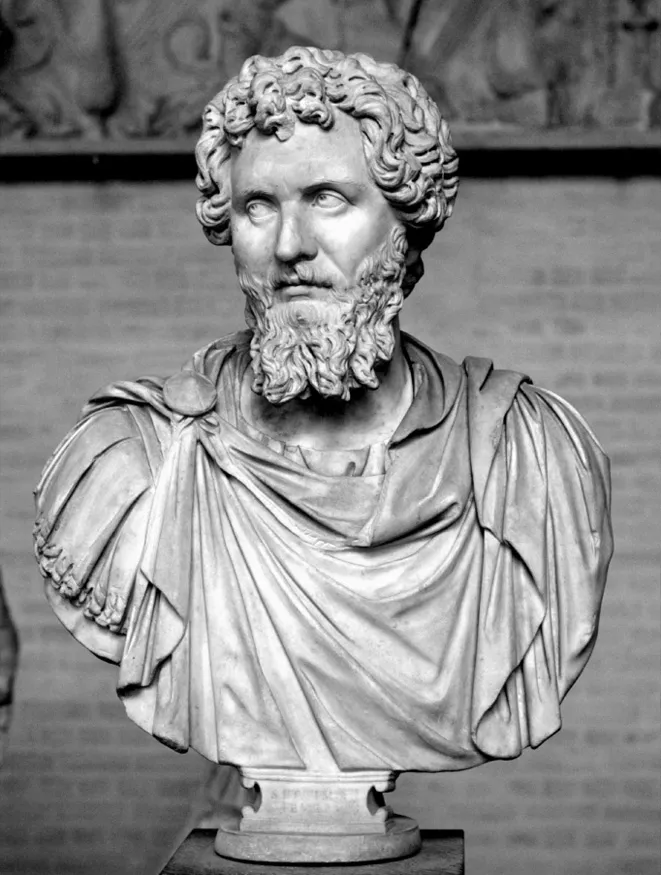
Septimius Severus, (r. 193–211 ce), one of Rome’s more long-lasting military leaders-turned emperor.
For the next 400 years, until the final fall of Rome in 476 ce, the majority of the empire’s rulers were drawn from the military – but not all of them. When the emperor Commodus (r. 177–92 ce) became violently unhinged towards the end of his rule he was strangled in his bath and replaced by the soldier-politician Pertinax. His two-month reign as emperor ended when he tried to introduce legislation limiting the power of the Praetorian Guard. It reacted by having him assassinated and sold the emperorship off to the highest bidder. The winner, Didius Julianus, was emperor for 65 days before he too was murdered in favour of another military leader, Septimius Severus.
During the so-called ‘Imperial Crisis’ of 235–284 ce, a period of intense political instability beginning with the rule of Maximinus Thrax, there were 27 different rulers in 49 years. They were known as the ‘Barracks Emperors’ as most were drawn from the Roman legions. From a supporting role at the inception of the empire, being the tools of ambitious statesmen such as Pompey, Caesar and Augustus, Rome’s army quickly became at first the power behind the throne and then the power on the throne – a deep state no longer but the state itself.
It is ironic, perhaps, that the institutions the military deep state subverted so successfully and for so long outlasted the men that corrupted it. When Rome fell in 476 ce its armies had long since been decimated by successive waves of barbarian invaders. But the Senate remained, and did so until at least 603, when the last recorded mention of it appears.
Imperial Japan
For a country where respect for authority is embedded in the culture, Japan has a surprisingly long history of deep-state dissent – emanating, even more surprisingly, from the armed forces. It goes back to 1853, when an American armed fleet arrived in Tokyo Bay and forced the hitherto closed country to open up to international trade. The USA and UK in particul...
Table of contents
- Title Page
- Dedication
- Introduction
- Chapter 1: Historical Deep States
- Chapter 2: European Deep State
- Chapter 3: The Middle East
- Chapter 4: Asia
- Chapter 5: Africa
- Chapter 6: Central and South America
- Chapter 7: American Deep States to 1939
- Chapter 8: Post-war American Deep States
- Chapter 9: Digital Deep States
- List of Illustrations
- Copyright
Trusted by 375,005 students
Access to over 1.5 million titles for a fair monthly price.
Study more efficiently using our study tools.
Frequently asked questions
Yes, you can cancel anytime from the Subscription tab in your account settings on the Perlego website. Your subscription will stay active until the end of your current billing period. Learn how to cancel your subscription
No, books cannot be downloaded as external files, such as PDFs, for use outside of Perlego. However, you can download books within the Perlego app for offline reading on mobile or tablet. Learn how to download books offline
Perlego offers two plans: Essential and Complete
- Essential is ideal for learners and professionals who enjoy exploring a wide range of subjects. Access the Essential Library with 800,000+ trusted titles and best-sellers across business, personal growth, and the humanities. Includes unlimited reading time and Standard Read Aloud voice.
- Complete: Perfect for advanced learners and researchers needing full, unrestricted access. Unlock 1.5M+ books across hundreds of subjects, including academic and specialized titles. The Complete Plan also includes advanced features like Premium Read Aloud and Research Assistant.
We are an online textbook subscription service, where you can get access to an entire online library for less than the price of a single book per month. With over 1.5 million books across 990+ topics, we’ve got you covered! Learn about our mission
Look out for the read-aloud symbol on your next book to see if you can listen to it. The read-aloud tool reads text aloud for you, highlighting the text as it is being read. You can pause it, speed it up and slow it down. Learn more about Read Aloud
Yes! You can use the Perlego app on both iOS and Android devices to read anytime, anywhere — even offline. Perfect for commutes or when you’re on the go.
Please note we cannot support devices running on iOS 13 and Android 7 or earlier. Learn more about using the app
Please note we cannot support devices running on iOS 13 and Android 7 or earlier. Learn more about using the app
Yes, you can access The Deep State by Ian Fitzgerald in PDF and/or ePUB format, as well as other popular books in Social Sciences & Political Institutions & Public Administration. We have over 1.5 million books available in our catalogue for you to explore.