The Nazis and the Supernatural is a gripping account of the magical thinking that dominated Nazi beliefs leading up to and including the Second World War.
This book explores the Nazi obsession with the occult and symbols of arcane power, shedding new light on the most hated political movement in history, and revealing how occultism not only helped the Nazis but also hindered them, as opposition movements utilized its techniques. Particularly intriguing sections include the Vril Society, the New Teutonic Knights, Black Camelot, the Nazi 'Occult Bureau', Atlantis and Aryan science.
Illustrated throughout with informative photographs, and featuring a wealth of new facts and conclusions, The Nazis and the Supernatural is a fascinating account of this hidden history.
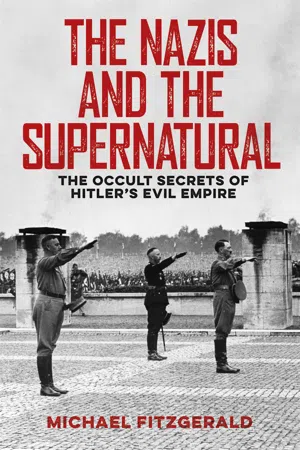
eBook - ePub
The Nazis and the Supernatural
The Occult Secrets of Hitler's Evil Empire
- English
- ePUB (mobile friendly)
- Available on iOS & Android
eBook - ePub
About this book
Information
Chapter One
Dark Initiates
The twelve years during which the Nazi Party ruled Germany and much of Europe were so fundamentally governed by irrational and even magical thinking that the whole period has sometimes been referred to as the ‘occult Reich’. Hitler, Hess, Goering, Himmler, Bormann, Goebbels and Rosenberg were simply the most prominent believers in a way of thought that was entirely at odds with the secular thinking that had come to prevail in Europe. When the Third Reich was no more than a smouldering ruin, the Allied conquerors took a number of statements from Nazi Party members and discovered many documents about the way in which a range of occult notions had come to dominate the thinking of the most powerful leaders within Germany. They were so astonished by what they discovered that the evidence was deliberately suppressed at the Nuremberg Trials for fear that it would allow the defence lawyers to plead insanity on behalf of their clients.
How did it come about that Germany, a nation more closely identified than most with the spirit of rationality and enlightenment, had fallen under the control of a group of people who utterly rejected these views, preferring instead to follow the promptings of occultists and to espouse pseudo-scientific theories of race, superhuman beings and the virtue of genocide as a means of purifying Germany and eventually the world of the ‘corruption’ of ‘inferior races’?
Hitler’s introduction to the occult
The trail begins six years before the commencement of the First World War. When the young Hitler was living in poverty in Vienna, he made friends with another dweller at the hostel for the homeless, Joseph Greiner. He introduced Hitler to a number of magical practices and showed him how to develop the power to control people and events. Hitler saw the new vistas that Greiner had shown him as offering the opportunity to escape from his present situation and translate his grandiose visions and ideas into reality through using the methods he had learned from his friend.
Hitler began studying hypnotism, yoga and other disciplines that he believed would help to strengthen his willpower. He attempted to move objects from a distance by focusing his will upon the exercise, and dowsed for water in the woods around Vienna. Hitler studied astrology, learning to draw up and cast a horoscope. He also learned numerology, graphology – assessing character from handwriting – and physiognomy – the art of judging people by their face and body language. Hitler sometimes tried to test the strength of his willpower by holding his hand under a burning gas jet. The fact that Greiner introduced Hitler to a number of occult practices is confirmed by others who knew him at the time, particularly Reinhold Hanisch who, like Greiner, shared a friendship with him at various doss-houses in Vienna.
Lanz and Aryan heroes
In 1909, at the age of 20, Hitler met with Adolf Lanz, the head of an occult group based in Vienna. Lanz also published a newsletter called Ostara. Hitler regularly bought this paper from a local tobacconist’s shop and met Lanz on a number of occasions, where he received further occult training. Lanz’s newspaper and pamphlets first awakened Hitler’s anti-Semitic prejudices, though they did not become fully formed until around 1920.
Lanz began his career as a Cistercian monk but was expelled from his monastery at the age of twenty-five for ‘carnal and worldly thoughts’. He immediately became an ardent German nationalist and a fierce anti-Semite who also attacked the Jesuits. Lanz also discarded the plain Herr Adolf Lanz to which he was entitled and began styling himself as Baron Jörg Lanz von Liebenfels. His occult group, the Order of the New Templars, was consciously modelled upon the Catholic Church.
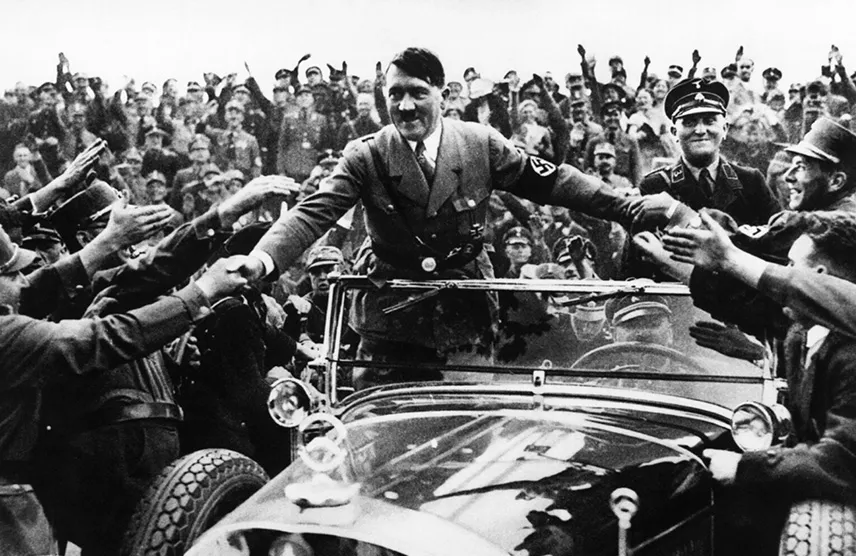
Hitler was presented to the German people as a man of mystical, supernatural power, able to reach out to them.
Lanz set up centres for his Aryan heroes in various castles that he acquired for his order. By the 1920s they owned four castles, a house in Salzburg and a ‘cell’ in Hungary. He declared that ‘the Aryan hero is on this planet the most complete incarnation of God and the spirit’. Unfortunately he had a bitter enemy known as the Tschandala, the underman. The Tschandala promoted democracy, capitalism and materialism. It was because the Aryan heroes had mixed their blood with apes that their race had degenerated. The Age of Aquarius would see the triumph of the newly racially purified Aryan over the sin of mingling his blood with that of lesser races.
The order laid down strict racial criteria for membership, including not simply blond hair and blue eyes but large heads, small hands and small feet. All those who joined his New Templars had to promise to marry racially pure women. Lanz claimed that ‘through woman, sin came into the world, and it is so over and over again because woman is especially susceptible to the love artifices of her animal-like inferiors’.
The rather unedifying slogan of his order was ‘race war until the castration knife’.
Lanz was also an obsessional advocate of nudism and devoted several issues of Ostara to the subject. He believed in a lost paradise where nude Aryans consorted in racially pure liaisons with Aryan women. The Fall came about through Aryan females breeding with ‘the Dark Races’ and Jesus (whom Lanz called Frauja) came to save them by issuing a new commandment ‘love thy neighbour as thyself if he is a member of your own race’. He also denounced what he called ‘inter-racial sexual relationships’ and demanded forced labour and a starvation diet as punishment for these offences, calling for ‘the extirpation of the animal-man and the propagation of the higher New Man’ through selective breeding, sterilization, forced labour, transportation to ‘the ape jungle’ and even murder.
Lanz called his bizarre system of racial mythology Ariosophy and it involved a number of eccentric beliefs centred on the idea that when the Bible spoke of angels it meant ‘Aryan heroes’. In his fantasies subhuman races emerged in the days of Atlantis and Lemuria. Lanz rejected the idea that humans had evolved from apes; his theories regarded apes as fallen men. Jews, Czechs and Slovenes were the three ethnic groups for whom he harboured particular hatred and in his eyes they had evolved through ‘intermixing blood’ between Aryans and apes. His Aryans were destined to be the Master Race and would lord it over inferior ethnic groups.
It is not for nothing that in 1932 Lanz wrote in a private letter to one of his students that ‘Hitler is one of our pupils’. In 1934 he proudly claimed that his order was ‘the first manifestation of National Socialism’ and as late as 1951 he was still claiming to be the man who had inspired Hitler to adopt the Final Solution.
The cosmic circle of Munich
Hitler was certainly influenced by Lanz’s ideas but it was to be another six years or so before he began to formulate anything approaching a coherent ideology. When he moved to Munich in 1913, Hitler settled in the Schwabing area, the Bohemian quarter of the city. As well as mixing with other artists, he also discovered the ideas of Alfred Schuler and Ludwig Derleth. Schuler was convinced of the importance of what he called ‘pure blood’ and was strongly anti-Semitic. Both men belonged to a group that aspired to turn Munich into the centre of ‘cosmic consciousness’. Their goal was to replace the existing political, social and religious structure of the world with ‘the Urheimat [original home] of the soul’. They favoured instinctive rather than rational thinking, advocated following the promptings of the unconscious mind and tried to bring about a return to a more ‘natural’ and ‘primitive’ society.
Schuler revered the Roman Empire and blamed the Jews and Christians for its collapse. He engaged in séances, healing rituals and ‘astral travel’. Schuler stressed the ‘sacredness’ of ‘pure blood’ and adopted the swastika as his personal symbol. Hitler heard Schuler lecture in Vienna and, as his friend Greiner related, developed an admiration for ancient Rome as a result. Schuler also led Hitler to become fascinated by the swastika symbol. He may have been a comparatively minor influence on the young Hitler but he reinforced his racial obsessions and gave him the most potent emblem of Nazism, the swastika.
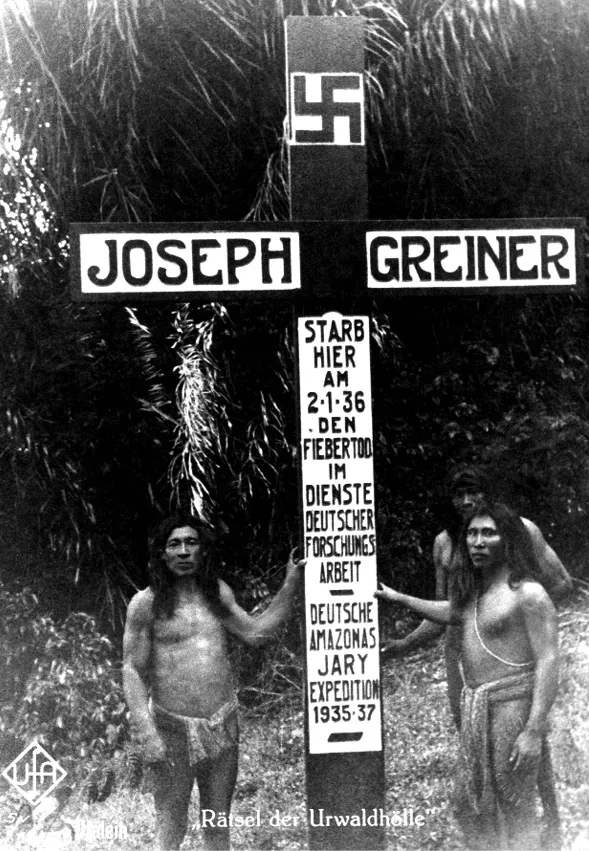
Researching the Amazon’s potential as a future German colony, Joseph Greiner visited the rainforest in 1935 but succumbed a year later to fever and was buried there.
Derleth subscribed to an even more bizarre belief system than Schuler. He was convinced that Schuler’s séances were ‘black magic rituals’ and his own megalomania soon led to his notorious Proclamations, in which he declared the imminent arrival of ‘Christus Imperator Maximus’. This coming saviour of the world wanted ‘death-hardened troops for the conquest of the globe’. The last sentence of the Proclamations became notorious: ‘soldiers, I deliver unto you for plundering – the world!’ His ‘Reich of Christ the king’ found few disciples but his ideas were widely publicized in Munich and were mentioned favourably by the Schwabinger Beobachter, the newspaper of the local Bohemian community.
Hitler was aware of Derleth’s Proclamations and of his project for the establishment of the Rosenburg, his vision of an ideal city. The Rosenburg, though never more than a dream, was favourably commented upon by Lanz and other thinkers who influenced the young Hitler. It was also an ideal that Himmler found attractive when he came to consider his own vision of the Utopian state over which he imagined his SS (Schutzstaffel) ruling in the event of final German victory. Derleth’s fascination with alchemy, organic farming, living in harmony with nature, vegetarianism, ‘spiritual development’ and an ‘order’ that created and ruled a ‘golden society’ were decisive influences upon Himmler’s conception of the world.
Three men who changed the course of Hitler’s life
In 1919 Hitler met three men in Munich who, more than any others, profoundly shaped his thought and laid the foundations of his political career. All three were deeply involved in occult practices. The influence of Gottfried Feder, Dietrich Eckart and Alfred Rosenberg proved decisive in transforming him into the future leader of Germany.
It began when Hitler attended a talk at the German Workers’ Party on 12 September 1919. The speaker was Feder and the subject of his talk was capitalism and its evils. There were only fifty-four members of the party, few of them present that evening. Hitler listened to Feder’s talk with fascination and was strongly attracted to the new economic ideas that he put forward. During the questions that followed the speaker’s lecture, a member of the audience demanded that the state of Bavaria should secede from the rest of Germany and restore its former monarchy.
Hitler stood up angrily and engaged in a passionate defence of a Greater Germany that included not only the states that already belonged to it but also Austria, Danzig and all of the German-speaking peoples. Having made his statement he was about to make a rapid exit when the party leader, Anton Drexler, rushed after him and managed to get his address. He left the meeting but received a membership card in the post the following day.
Drexler and Feder were both deeply impressed with Hitler’s charisma, speaking ability and strength of conviction. As Drexler remarked after hearing Hitler speak, ‘My God, he’s got the gift of the gab, hasn’t he? We could use him.’
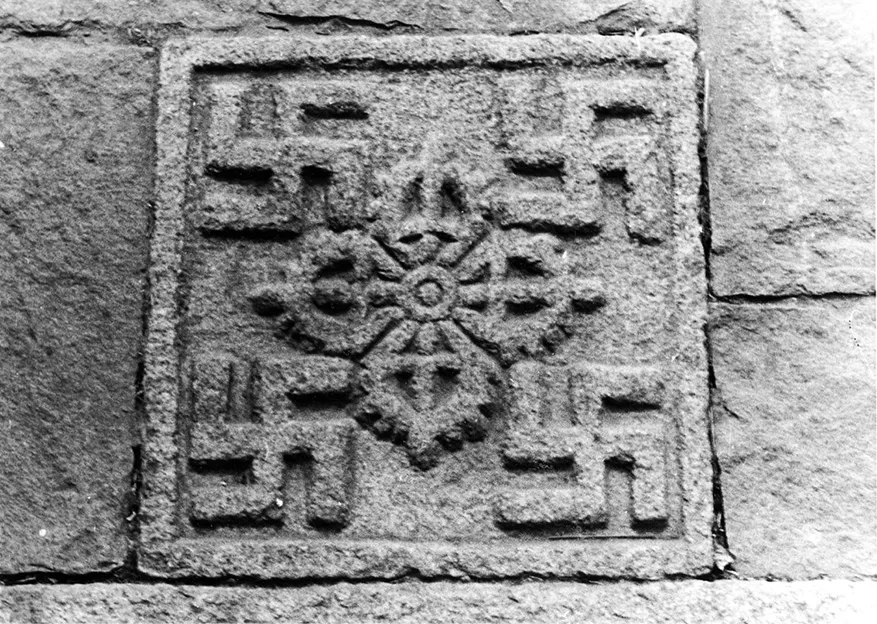
The swastika was an auspicious symbol in Tibet. This photo was taken by Ernst Schäfer in Lhasa, 1938/9
As a result of the meeting Hitler became the fifty-fifth member of the German Workers’ Party and the seventh member of its committee, given special responsibility for propaganda. Before long it had been renamed the National Socialist German Workers’ Party and Hitler became its leader. He was to transform it into a mass movement, using to a considerable extent the occult training he had received from the dark initiates of the Thule Group and the Vril Society.
Very few of the ideas that the future Chancellor of Germany put forward during his political career were original. His economic policies were almost entirely derived from Feder and his anti-Semitism, still a relatively vague and incoherent prejudice before he met them, hardened into dogma as he swallowed the occult-based racial theories of Eckart and Rosenberg. Unlike Hitler all three men came from wealthy middle-class families and they decisively changed the direction of Hitler’s life and as a result the future history of the world through their ability to provide a more sophisticated ‘justification’ for prejudices that however deeply felt had perhaps not been clearly formulated before.
Dietrich Eckart – Hitler’s spiritual father
Eckart knew that the German Workers’ Party, even though he shared its beliefs, was incapable of ever becoming a mass movement without the right sort of person as its leader. He said in the spring of 1919 before he had met Hitler, ‘we need a man at the head who can stand the sound of a machine gun. The best man for the job would be a worker who kno...
Table of contents
- Title Page
- Contents
- Introduction
- Chapter One: Dark Initiates
- Chapter Two: The Vril Society
- Chapter Three: A New Religion for Germany
- Chapter Four: The New Teutonic Knights
- Chapter Five: The Nazi Grail Castle
- Chapter Six: Occult Reich
- Chapter Seven: In Search of Atlantis
- Chapter Eight: The Real Raiders of the Lost Ark
- Chapter Nine: ‘Aryan Science’ in the Third Reich
- Chapter Ten: Occultism at war
- Conclusion
- Bibliography
- Picture Credits
- Copyright
Trusted by 375,005 students
Access to over 1.5 million titles for a fair monthly price.
Study more efficiently using our study tools.
Frequently asked questions
Yes, you can cancel anytime from the Subscription tab in your account settings on the Perlego website. Your subscription will stay active until the end of your current billing period. Learn how to cancel your subscription
No, books cannot be downloaded as external files, such as PDFs, for use outside of Perlego. However, you can download books within the Perlego app for offline reading on mobile or tablet. Learn how to download books offline
Perlego offers two plans: Essential and Complete
- Essential is ideal for learners and professionals who enjoy exploring a wide range of subjects. Access the Essential Library with 800,000+ trusted titles and best-sellers across business, personal growth, and the humanities. Includes unlimited reading time and Standard Read Aloud voice.
- Complete: Perfect for advanced learners and researchers needing full, unrestricted access. Unlock 1.5M+ books across hundreds of subjects, including academic and specialized titles. The Complete Plan also includes advanced features like Premium Read Aloud and Research Assistant.
We are an online textbook subscription service, where you can get access to an entire online library for less than the price of a single book per month. With over 1.5 million books across 990+ topics, we’ve got you covered! Learn about our mission
Look out for the read-aloud symbol on your next book to see if you can listen to it. The read-aloud tool reads text aloud for you, highlighting the text as it is being read. You can pause it, speed it up and slow it down. Learn more about Read Aloud
Yes! You can use the Perlego app on both iOS and Android devices to read anytime, anywhere — even offline. Perfect for commutes or when you’re on the go.
Please note we cannot support devices running on iOS 13 and Android 7 or earlier. Learn more about using the app
Please note we cannot support devices running on iOS 13 and Android 7 or earlier. Learn more about using the app
Yes, you can access The Nazis and the Supernatural by Michael FitzGerald in PDF and/or ePUB format, as well as other popular books in History & German History. We have over 1.5 million books available in our catalogue for you to explore.