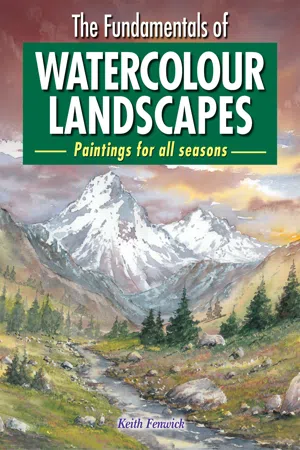
Learning to paint is fun, and it's easier than you think. This book will save you many years of learning, by providing a simplified approach to painting watercolours. All the techniques you'll need are explained and demonstrated by inspirational teacher Keith Fenwick, who takes you through the processes in easy stages.
The comprehensive content includes:
• Easy to follow stage-by-stage demonstrations
• Watercolour painting techniques
• Key points accompanying each demonstration
• Comprehensive colour-mixing combinations
• Invaluable advice and helpful tips
• Specially created artworks
- English
- ePUB (mobile friendly)
- Available on iOS & Android
eBook - ePub
About this book
Information
Topic
ArtSubtopic
Art GeneralSPRING
The Spring comes in with all hues and smells
In freshness, breathing over hills and dells
O’er woods where May her gorgeous drapery flings
And meads washed fragrant by their laughing springs
Fresh are new open’d flowers, untouched and free
From the bold rifling of the amorous bee
The happy time of singing birds is come
And love’s lone pilgrimage now finds a home;
Among the mossy oaks now coos the dove
And hoarse crow finds softer notes for love.
John Clare
In Spring the earth seems to be reborn; new shoots push through as soon as the ice and snow have melted. Fresh green grass appears and dormant buds grow fatter, waiting to burst into leaf at the first opportunity. Lambs play in the fields, while the rooks gather in the treetops and daffodils sway in the breeze.
The birds are beginning to build their nests and the dawn chorus reaches a crescendo each morning as the days begin to lengthen. Everything appears clean and fresh. Frequent showers and warmer temperatures stimulate new growth, and the air smells sweet. Spring, one of my favourite times of year, marks the beginning of the artist’s year.
SPRING SNOW – PROJECT
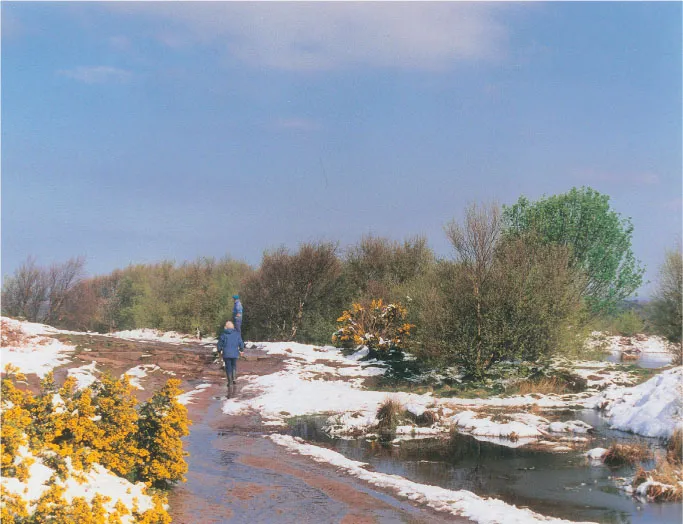
The photograph below was taken on Thurstaston Hill, a few miles from my home in north-west England. The area is a popular beauty spot overlooking the Dee Estuary, and is one of my favourite places to walk. It is riddled with woodland paths and is famous for its red sandstone rocks which are characteristic of this region.
It is said that the great artist JMW Turner visited Thurstaston to capture in paint the wonderful sunsets that can be seen here. The views from the Hill are breathtaking in all directions. The photograph makes a pleasing composition, although the painting was in fact completed a little earlier, before the fall of snow began to melt.
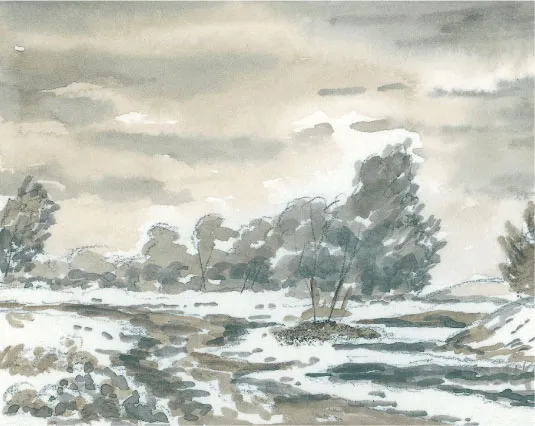
The tonal study became the plan for the painting. Although such a study can be produced in only a few minutes, it provides thinking time to establish one’s approach to the final painting.
WHAT YOU WILL NEED
PAPER:
Winsor & Newton 640 gsm/300 lb Rough
BRUSHES:
Winsor & Newton Sceptre Gold II Series size 14 round, size 3 rigger, 38 mm/1½ in hake, 13 mm/½ in round hog hair brush

COLOURS:
Payne’s Grey, Cerulean Blue, Alizarin Crimson, Raw Sienna, Burnt Sienna, Burnt Umber, Sap Green, Cadmium Yellow Deep
SUPPORTIVE:
Masking fluid, white acrylic paint, tissues (toilet roll), dark brown water-soluble crayon

STAGE 1:
DRAWING AND MASKING
DRAWING AND MASKING
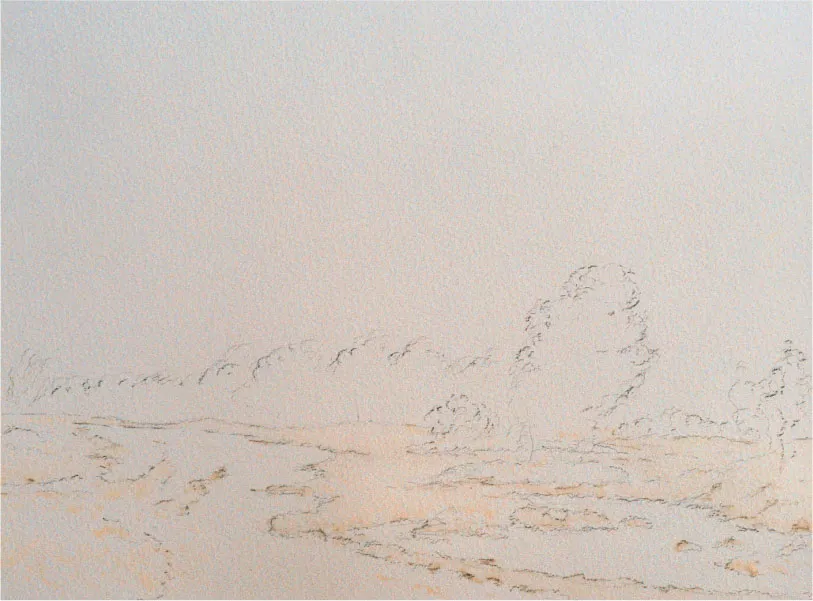
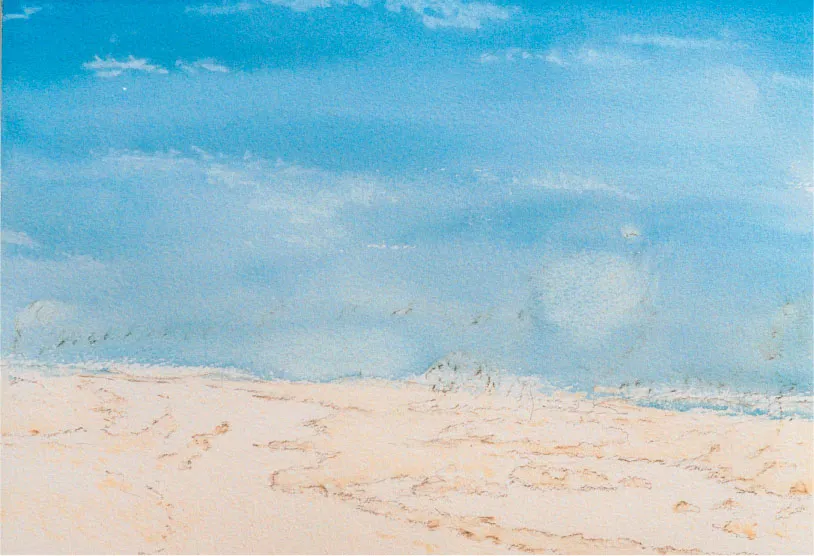
A rough outline drawing was completed using a dark brown water-soluble crayon. The areas to be reserved to represent snow were masked.
STAGE 2:
SKY
SKY
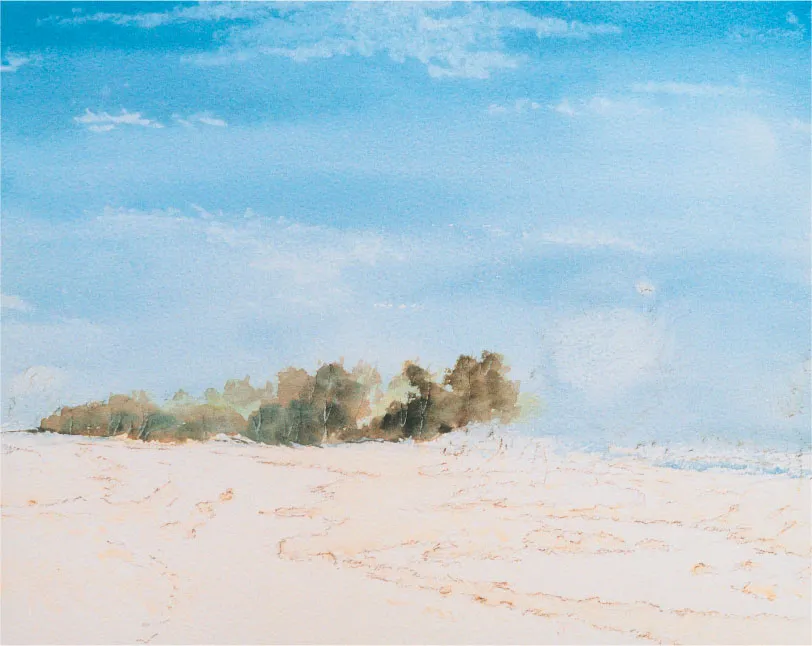
The sky was a soft Cerulean Blue, applied with the hake brush over a Raw Sienna underpainting applied to wet the paper. A very small quantity of Payne’s Grey was added to the Cerulean Blue to produce slightly darker values of blue at the top of the sky and in selected areas. A tissue was used to remove colour by dabbing to create white clouds.
STAGE 3:
DISTANT BUSHES
DISTANT BUSHES
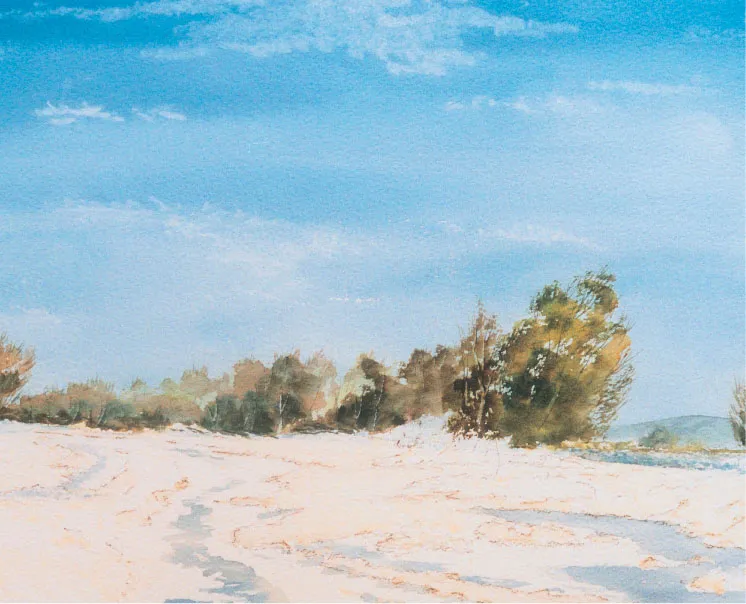
The side of the size 14 round brush was used to twitch downwards from the top of the bushes to establish their mass. Raw Sienna and Payne’s Grey were used to produce various tonal values. A quick twitch of the brush combined with a light touch is what is needed.
STAGE 4:
DISTANT TREES AND PATHS
DISTANT TREES AND PATHS
Using the same technique and colour combinations described in Stage 3, the large trees w...
Table of contents
- Cover
- Title
- Contents
- Introduction
- Materials and Equipment
- Watercolour Techniques
- Design Principles
- The Importance of Tonal Studies
- Spring
- Summer
- Autumn
- Winter
- Copyright
Trusted by 375,005 students
Access to over 1.5 million titles for a fair monthly price.
Study more efficiently using our study tools.
Frequently asked questions
Yes, you can cancel anytime from the Subscription tab in your account settings on the Perlego website. Your subscription will stay active until the end of your current billing period. Learn how to cancel your subscription
No, books cannot be downloaded as external files, such as PDFs, for use outside of Perlego. However, you can download books within the Perlego app for offline reading on mobile or tablet. Learn how to download books offline
Perlego offers two plans: Essential and Complete
- Essential is ideal for learners and professionals who enjoy exploring a wide range of subjects. Access the Essential Library with 800,000+ trusted titles and best-sellers across business, personal growth, and the humanities. Includes unlimited reading time and Standard Read Aloud voice.
- Complete: Perfect for advanced learners and researchers needing full, unrestricted access. Unlock 1.5M+ books across hundreds of subjects, including academic and specialized titles. The Complete Plan also includes advanced features like Premium Read Aloud and Research Assistant.
We are an online textbook subscription service, where you can get access to an entire online library for less than the price of a single book per month. With over 1.5 million books across 990+ topics, we’ve got you covered! Learn about our mission
Look out for the read-aloud symbol on your next book to see if you can listen to it. The read-aloud tool reads text aloud for you, highlighting the text as it is being read. You can pause it, speed it up and slow it down. Learn more about Read Aloud
Yes! You can use the Perlego app on both iOS and Android devices to read anytime, anywhere — even offline. Perfect for commutes or when you’re on the go.
Please note we cannot support devices running on iOS 13 and Android 7 or earlier. Learn more about using the app
Please note we cannot support devices running on iOS 13 and Android 7 or earlier. Learn more about using the app
Yes, you can access The Fundamentals of Watercolour Landscapes by Keith Fenwick in PDF and/or ePUB format, as well as other popular books in Art & Art General. We have over 1.5 million books available in our catalogue for you to explore.