eBook - ePub
The Complete Book of Drawing Techniques
A Professional Guide For The Artist
- English
- ePUB (mobile friendly)
- Available on iOS & Android
eBook - ePub
About this book
The Complete Book of Drawing Techniques is intended for artists who are looking to expand their knowledge and understanding of materials and the wide range of available media. It will teach them about the characteristics of these media and materials and how to use them to get the required effect. With a unique combination of instruction and practice the book provides examples of the type of mark-making each medium produces. A range of projects then demonstrates effective ways of working with them. By the end of the book every budding artist will have enough knowledge and confidence to utilize the techniques they have learnt in a broad range of compositions of their own choosing.
Information
Topic
ArtSubtopic
Art TechniquesPart One
THE PENCIL
The different types of pencil, graphite, erasers.

INTRODUCTION
A pencil is a rod of graphite encased in a soft wood such as cedar, about six or seven inches long and exposed at one end. Crude forms of graphite pencils were first used as early as the 17th century. Before this, rods of lead or silver (known as silver point) were used as implements for making drawings. The modern form of lead or graphite pencil with its wooden encasement first came into use about the beginning of the 19th century.
The pencil fundamentally works by pushing or pulling the lead end across the surface fibres of the paper, which act as graters, breaking up into small flakes. Pressure on the pencil pushes the flakes of lead into the fibres of the paper to leave a mark or trace.
Graphite, a form of carbon, also known as mineral black or plumbago, is the major constituent of the modern pencil. The softness or hardness of a pencil varies depending on the amount of clay mixed with the carbon. The softest varieties of pencil contain little or no clay. Artists and designers will use a range of pencils, varying their choice according to the effect they are trying to achieve.
As the graphite is worn away by use, it can be repeatedly exposed. This is done by the action of sharpening the pencil using a purpose-made sharpener or blade. Sharpening and exposing the graphite should be regarded as an important act, because how it is done changes the type of mark you make with it. There are many ways of sharpening. A particular point produces a particular result. The artist should experiment to discover what is possible and how to make each type of pencil meet his particular needs at any given time.
The pencil can be used for a variety of purposes and, as with any material you use, you must be fully aware of its potentials and its limitations - different pencils and types are designed for particular uses. In the ensuing chapter some of these practices will be revealed with particular relevance to the appropriate pencil or graphite material.
The marks shown over the following few pages give some idea of the wide range of mark making possible. When you have looked at them, take each of the pencils in turn and see what marks you can make. Apart from being very stimulating and a way of opening your mind to new possibilities with your drawing, you will find it increases your ‘feel’ for the pencil itself. As artists, what we feel through the materials we use has an affect on what we produce, and familiarity with those materials is vital to a good outcome.
Materials and examples of marks

HARD PENCIL
Hard pencil marks have very little variation in the range of mark making. They only usually vary through a linear progression. Tone is usually made from a build up of crosshatch effects. Hard pencils are denoted by the letter H. As with soft pencils, they come in a range, comprising HB, H, 2H, 3H, 4H, 5H, 6H, 7H, 8H and 9H (the hardest).
These pencils are mainly for use by designers, architects and people who produce precise technical diagrammatic drawings for which a fine, accurate line is essential, such as perspective or other projection drawings. Although the marks made with hard pencil show very little variation it can be used in an expressive manner. As with soft pencil, tone can be built using a cross-hatching system, although the result is much finer and more formal, the cross-hatching emerging out of a series of linear progressions.
SYSTEMS FOR HARD PENCILS
Hard pencils are mostly appropriate for drawings requiring accuracy. As we have pointed out previously, such drawings are usually done by engineers, industrial designers, graphic designers and architects. The final drawings they produce have to be to scale and precise so that other people, such as craftsmen, can follow the instructions to construct or make the designed object. These drawings come in a number of different types of perspective, or parallel projection systems, ranging from flat orthographic plan or elevation drawings to 3D perspective illustrations.
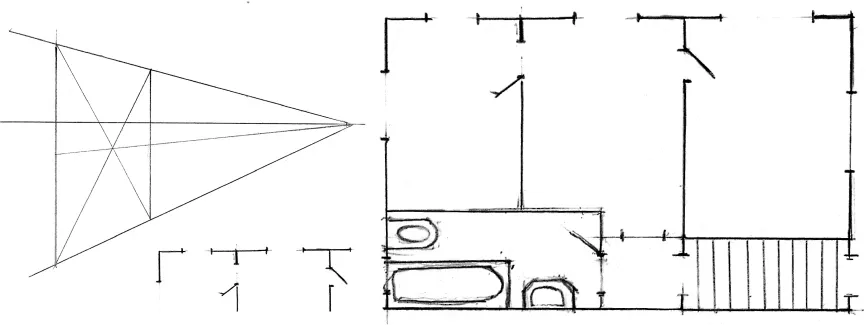
HARD PENCIL MARKS
NB: I have not given you examples of mark making with HB or 7H to 9H pencils.
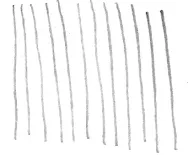
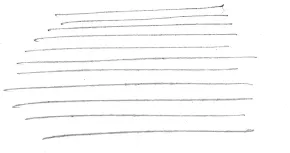
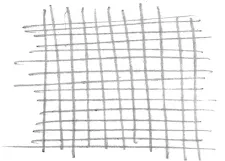
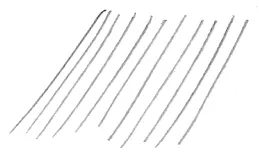
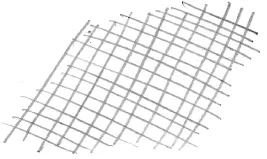
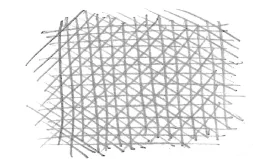
Table of contents
- Cover
- Title
- Contents
- Introduction
- Part One: The Pencil
- Part Two: Charcoal
- Part Three: Pens, Inks, Brushes and Paper
- Conclusion
- Copyright
Trusted by 375,005 students
Access to over 1.5 million titles for a fair monthly price.
Study more efficiently using our study tools.
Frequently asked questions
Yes, you can cancel anytime from the Subscription tab in your account settings on the Perlego website. Your subscription will stay active until the end of your current billing period. Learn how to cancel your subscription
No, books cannot be downloaded as external files, such as PDFs, for use outside of Perlego. However, you can download books within the Perlego app for offline reading on mobile or tablet. Learn how to download books offline
Perlego offers two plans: Essential and Complete
- Essential is ideal for learners and professionals who enjoy exploring a wide range of subjects. Access the Essential Library with 800,000+ trusted titles and best-sellers across business, personal growth, and the humanities. Includes unlimited reading time and Standard Read Aloud voice.
- Complete: Perfect for advanced learners and researchers needing full, unrestricted access. Unlock 1.5M+ books across hundreds of subjects, including academic and specialized titles. The Complete Plan also includes advanced features like Premium Read Aloud and Research Assistant.
We are an online textbook subscription service, where you can get access to an entire online library for less than the price of a single book per month. With over 1.5 million books across 990+ topics, we’ve got you covered! Learn about our mission
Look out for the read-aloud symbol on your next book to see if you can listen to it. The read-aloud tool reads text aloud for you, highlighting the text as it is being read. You can pause it, speed it up and slow it down. Learn more about Read Aloud
Yes! You can use the Perlego app on both iOS and Android devices to read anytime, anywhere — even offline. Perfect for commutes or when you’re on the go.
Please note we cannot support devices running on iOS 13 and Android 7 or earlier. Learn more about using the app
Please note we cannot support devices running on iOS 13 and Android 7 or earlier. Learn more about using the app
Yes, you can access The Complete Book of Drawing Techniques by Peter Stanyer in PDF and/or ePUB format, as well as other popular books in Art & Art Techniques. We have over 1.5 million books available in our catalogue for you to explore.