Learning to paint is fun, and it's easier than you think. The Fundamentals of Watercolour Painting aims to enhance your enjoyment of painting as well as broaden your repertoire of skills.
This book will save you many years of learning by providing a simplified approach to painting watercolours. All the techniques you'll need are explained and demonstrated by well-known teacher Keith Fenwick, who leads you through the painting process in easy stages. To help you develop your natural ability the author has included many helpful hints, tips and short-cuts which he has developed over 30 years of painting.
Used as a constant companion and reference source, this beautifully designed book will enable users to capture the magical characteristics of every landscape.

eBook - ePub
The Fundamentals of Watercolour Painting
A Complete Course in Techniques, Subjects and Styles
- English
- ePUB (mobile friendly)
- Available on iOS & Android
eBook - ePub
The Fundamentals of Watercolour Painting
A Complete Course in Techniques, Subjects and Styles
About this book
Information
Topic
KunstSubtopic
KunsttechnikenPainting Buildings • Introduction
Vary the distance between the centre of interest in your painting and the four edges of the paper.
The subject of buildings covers a very wide field. Because they come in a variety of shapes and forms, buildings offer the watercolourist an exciting range of opportunities. In this book, I have attempted to reflect this range by showing you my approach to painting many different types of building, from old farmsteads to medieval castles.
I am fascinated by the structure of buildings and the textures you find in them. An interesting window, an old door with rusty hinges, a stairway or an element in a street scene with people, all are worthwhile subjects. You don’t have to paint a complete landscape to get a rewarding watercolour.
To paint buildings well, it’s important to be able to sketch and draw reasonably accurately to represent the scene effectively. I felt it was necessary, therefore, to include in the text some basic instruction on how to draw. Drawing isn’t difficult, just common sense, but there’s an approach to drawing that I follow, which I will explain in the following pages.
Perspective plays an important part in the drawing of buildings. Some people find perspective easy to understand, others don’t. If you are one of the latter, don’t worry – you will find perspective simplified for you on pages 104–5.
Paintings don’t just happen, they need to be designed, and if you learn how to do this your end result won’t be just a matter of luck. You will discover that you must establish a plan using your imagination, asking yourself what the main features in your chosen picture are and how you can emphasize them. Tonal values, colour, texture and contrast all play a part in this.
In the exercises and demonstrations in this section, I will be describing and showing how all this is done.


Practice
• Study the examples in this book and practise painting wet-into-wet skies to represent the various light situations.
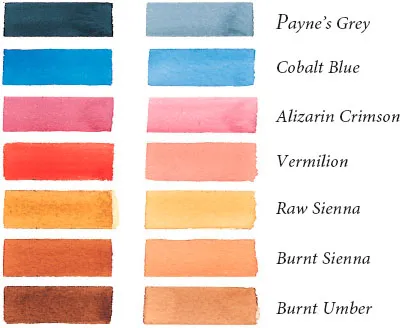
• Practise colour mixing, using the colours specified in the text.
• Practise using an eraser to remove colour, creating shafts of light as in a woodland glade or an atmospheric sky.
Painting Buildings • Sketching on location
The camera records, artists express themselves.
There’s no substitute for sketching and drawing. No matter how good you are at applying paint, if your initial drawing is out of scale and your perspective is wrong the end result will be a failure. Draw, draw, and draw again is the answer.
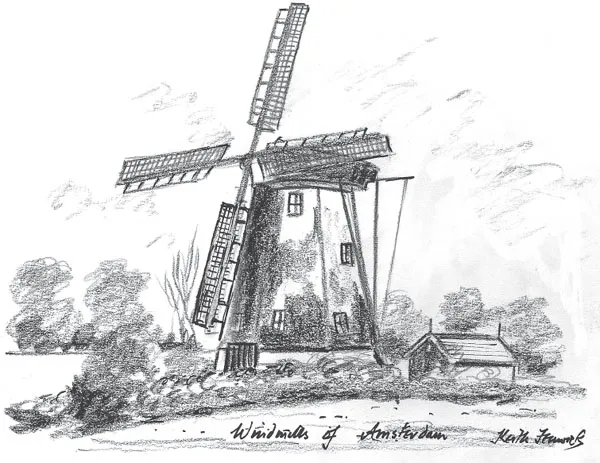
The sketches I produce when on location are not intended to be masterclass drawings but quick doodles to act as a record of my visit to an area or as a simple outline direct on to watercolour paper ready for applying paint at a later date. The amount of detail you include in your sketches or outline drawings and the techniques you use to create texture will depend on the particular subject, the time available for drawing or the intended use of the finished work. Knowing when to stop will come with experience.
Sketching and drawing is a pleasant and relaxing experience which forces you to think about your subject and observe it very closely. When you have been sketching and drawing for some time you will no longer think about your style but concentrate on the statement you are trying to make.
Drawing materials
How you interpret your subject is personal, whether you use pencil, crayon, charcoal, conté crayon, felt tip pen or drawing pen and ink. My personal choice includes 4B and 6B pencils, water-soluble crayons and drawing pens (sizes 0.5 and 0.7mm). For both pencil and pen work, I like to use 2 ply Bristol board, which has a bright white surface. When using water-soluble crayons, I find the fine texture of an oil or acrylic painting pad is perfect for creating shading and textures speedily.
Approaches to sketching
I find that many of my students just want to paint without first spending time observing their subject, simplifying the scene and studying the relationships of darks and lights, the direction of light and shadows and the scale of the various elements in the scene. Consequently, they go on to waste a perfectly good piece of watercolour paper.
Beginning with a drawing instead provides you with thinking time and the opportunity to produce several sketches that will help you to discover the viewing point you should choose for the best composition. Try to spend three minutes observi...
Table of contents
- Title
- Contents
- Introduction
- Materials and equipment
- Painting Skies
- Painting Mountains
- Painting Lake Scenes
- Painting Trees
- Painting Rocks
- Painting Water
- Trees, Rocks & Running Water
- Light
- Atmosphere & Mood
- Atmosphere, Mood & Light
- Painting Buildings
- Painting Bridges & Walls
- Portrait of the artist
- Copyright
Trusted by 375,005 students
Access to over 1.5 million titles for a fair monthly price.
Study more efficiently using our study tools.
Frequently asked questions
Yes, you can cancel anytime from the Subscription tab in your account settings on the Perlego website. Your subscription will stay active until the end of your current billing period. Learn how to cancel your subscription
No, books cannot be downloaded as external files, such as PDFs, for use outside of Perlego. However, you can download books within the Perlego app for offline reading on mobile or tablet. Learn how to download books offline
Perlego offers two plans: Essential and Complete
- Essential is ideal for learners and professionals who enjoy exploring a wide range of subjects. Access the Essential Library with 800,000+ trusted titles and best-sellers across business, personal growth, and the humanities. Includes unlimited reading time and Standard Read Aloud voice.
- Complete: Perfect for advanced learners and researchers needing full, unrestricted access. Unlock 1.5M+ books across hundreds of subjects, including academic and specialized titles. The Complete Plan also includes advanced features like Premium Read Aloud and Research Assistant.
We are an online textbook subscription service, where you can get access to an entire online library for less than the price of a single book per month. With over 1.5 million books across 990+ topics, we’ve got you covered! Learn about our mission
Look out for the read-aloud symbol on your next book to see if you can listen to it. The read-aloud tool reads text aloud for you, highlighting the text as it is being read. You can pause it, speed it up and slow it down. Learn more about Read Aloud
Yes! You can use the Perlego app on both iOS and Android devices to read anytime, anywhere — even offline. Perfect for commutes or when you’re on the go.
Please note we cannot support devices running on iOS 13 and Android 7 or earlier. Learn more about using the app
Please note we cannot support devices running on iOS 13 and Android 7 or earlier. Learn more about using the app
Yes, you can access The Fundamentals of Watercolour Painting by Keith Fenwick in PDF and/or ePUB format, as well as other popular books in Kunst & Kunsttechniken. We have over 1.5 million books available in our catalogue for you to explore.