Mark-making is a basic human instinct, and it's something that we take to with joyous unselfconsciousness long before we reach school and formal learning. As we grow older, however, we become more conscious of what we can't do and the whole business of art can begin to seem beyond our reach.
In An Introduction to Drawing, artist and teacher Robin Hazlewood restores that lost confidence by his belief that most of us can draw as long as we learn to see objects as they are in reality. As adults, when we look at a subject we invest it with everything our experience tells us about it and attempt to convey that in our drawing - and that is where we encounter unnecessary complications and find ourselves with an unsatisfactory result.
This book discusses basic techniques and gives exercises to provide you with plenty of practice in coordinating hand and eye. Most importantly, it helps you to find a new way of looking and to develop a fresh vision of the world around you.
- English
- ePUB (mobile friendly)
- Available on iOS & Android
eBook - ePub
About this book
Information
Topic
ArtSubtopic
Art TechniquesSECTION 10
Portraits
In the making of a portrait, the aim is to capture not only the likeness but also something of the character of an individual, or group of individuals. Although it can take in the whole figure, in the main a portrait concentrates on the face. Most artists have drawn or painted self-portraits, most notably Rembrandt and, more recently, Francis Bacon.
The basic proportions
You will probably know from your early experience of drawing that the head is basically egg-shaped when looked at from the front, and you will have some idea of what the skull looks like.
What often surprises people, on looking more closely, is the relationship between the parts of the head. For instance, the eyes are midway between the top of the head and the chin. Most people think they are much higher on the head and draw them so.
The tops of the ears are level with the eyes and the bottom with the mouth – and the side view of the head fits approximately into a square. These simple relationships and proportions are worth remembering as we mostly tend to draw heads from the side view, three-quarters view or full face.
However, if we look at the head from an unusual angle – from above or below, for example – these proportional relationships change because of foreshortening. This is why you should treat all the objects you draw as a collection of shapes before you start thinking of them as particular objects. The moment we are conscious of what an object is, we endow it with the qualities we know from previous experience. From then on, the way we see it is often distorted by our preconceived ideas.
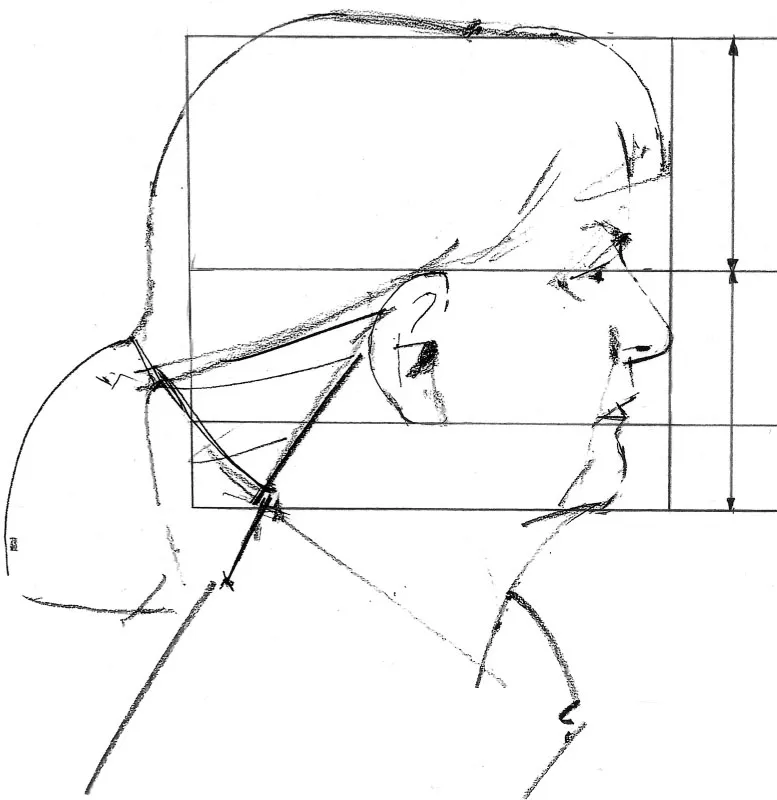
Seen in profile, the head fits approximately into a square. It is important to get the basic shape of the head right and to register how it fits on to the neck before going into too much detail. With a side view, you will need to plot the shape of the forehead, nose, mouth and chin as part of the basic shape.
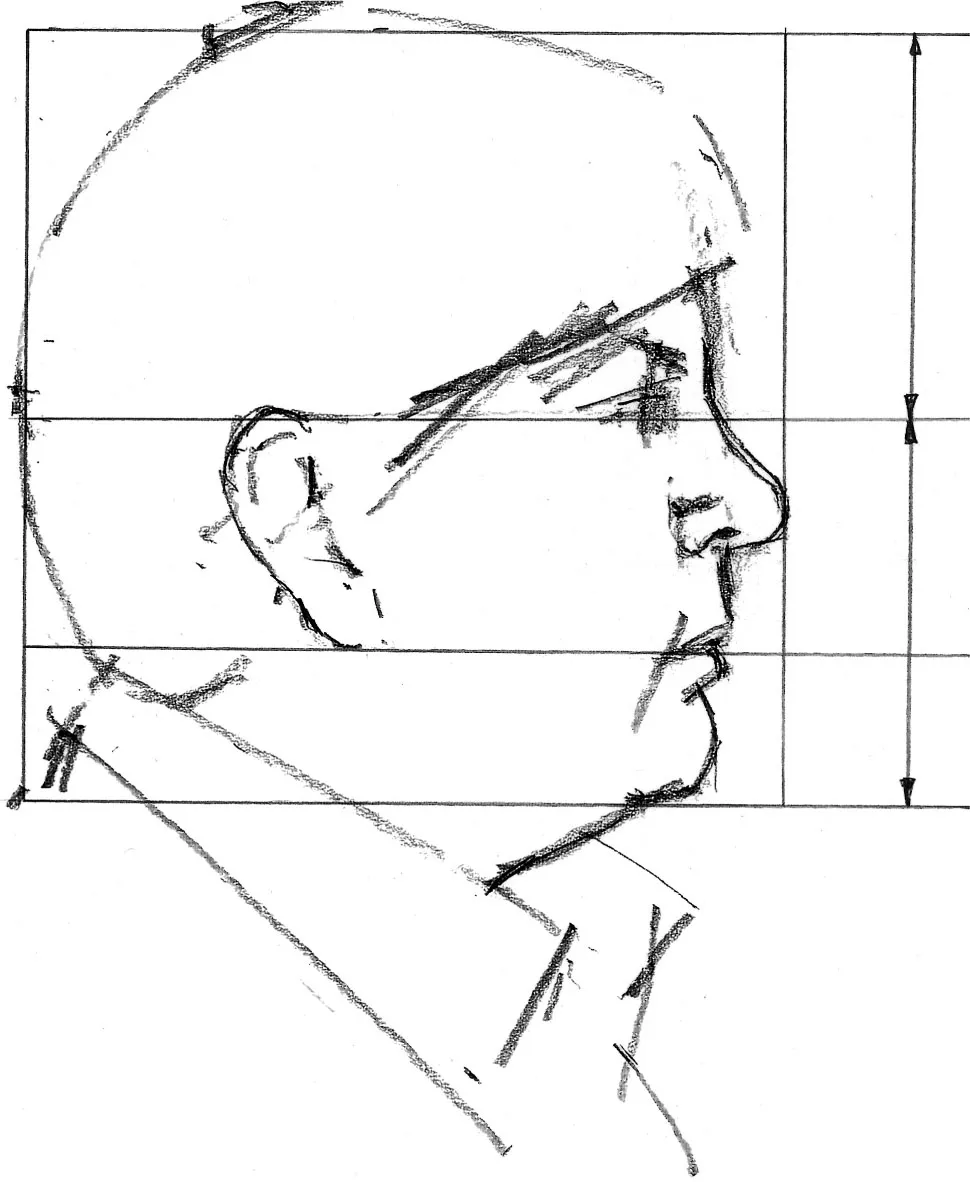
Although the shape of heads may vary, because of such factors as race, age or gender, they still have the same basic proportions. In drawing this side view of a man it is important to make sure you have the overall shape, including the way the shape of the hair fits the head, before you go into too much detail. Most of the general character lies in these first few lines.
DON’T FORGET TO…
• Sit comfortably and hold the same position throughout your drawing.
• Keep your arm outstretched when measuring.
• Double check a measurement before using it as the basis for another.
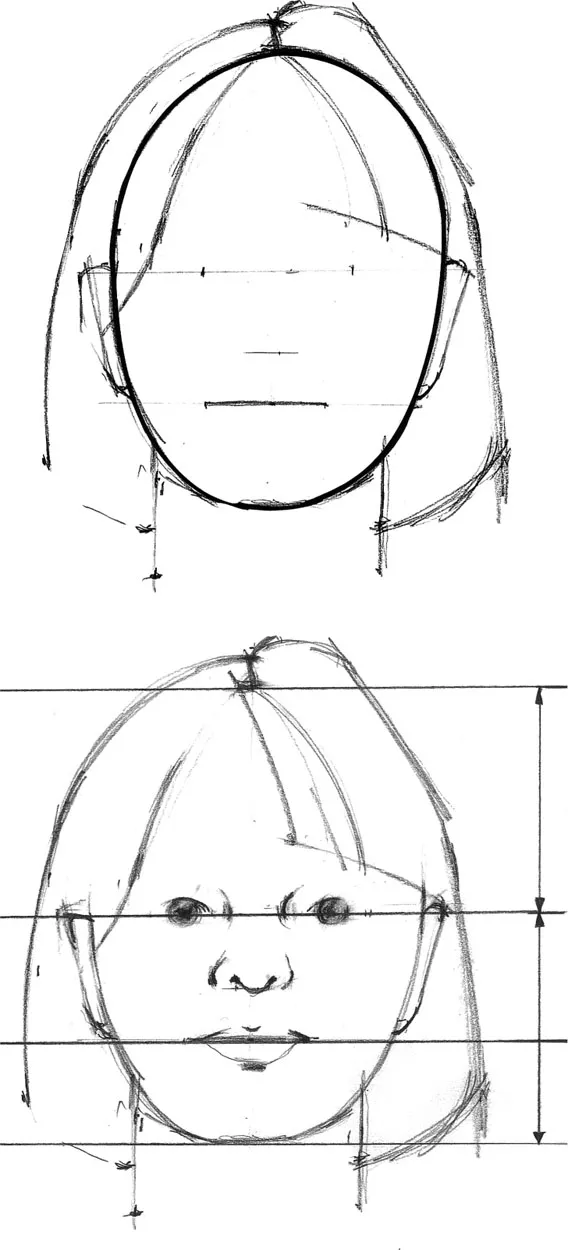
Heads seen from the front are basically egg-shaped. The eyes are midway between the top of the head and the chin. The ears are placed between the eyes and the mouth. However, if the head is tilted, there may be a small amount of foreshortening. For this reason it is best to measure and plot the shapes each time to be sure of their position.
Drawing a head
When you are drawing a head, the same practical rules apply as when you are drawing a figure: make sure that both you and your model are comfortably seated and that you have made a note of both the lighting conditions and the respective positions of both artist and model. If you think the drawing might take more than one session you will also need to note exactly what the model is wearing.
The next step is to decide upon the basic composition of the picture – whether you are going to draw the head and shoulders or take in more of the figure, and whether your view will be full face, profile or three-quarter face. You will find it useful at this stage to use a viewfinder and perhaps make one or two quick sketches to decide which of the many choices of composition you are going to go for.
Once this is resolved, start in the manner in which you have been shown in this book, measuring and plotting all the basic shapes with your pencil held at arm’s length as a guide. The four steps shown here take you through the whole drawing process.
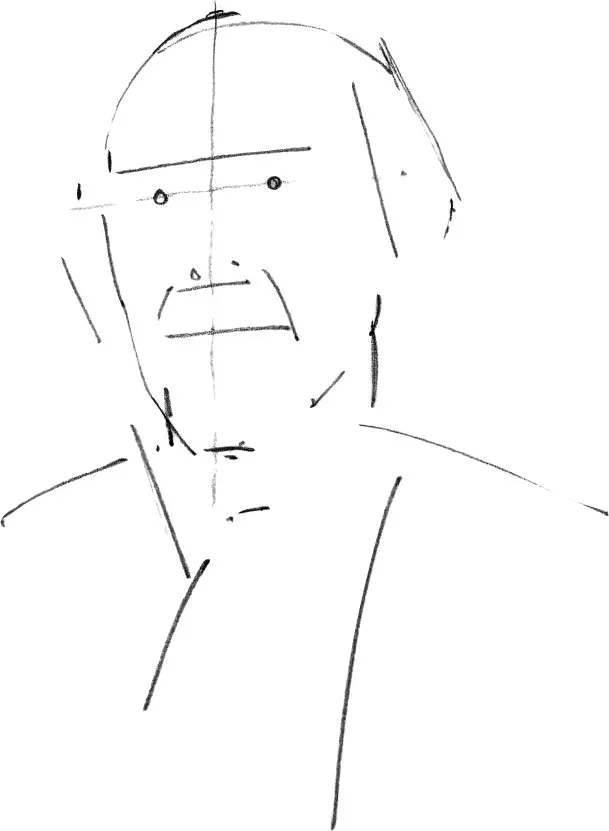
STEP 1
First, measure and plot the overall shapes. In this portrait the figure has a small beard which should be seen as part of the overall shape of the head. I have also put in a guideline running down the centre of the head from the forehead to the chin to help with plotting the eyes, nostrils and mouth and calculating the width of the head. Most people, when sitting still, will incline their head one way or another, and it is vitally important to draw the angle accura...
First, measure and plot the overall shapes. In this portrait the figure has a small beard which should be seen as part of the overall shape of the head. I have also put in a guideline running down the centre of the head from the forehead to the chin to help with plotting the eyes, nostrils and mouth and calculating the width of the head. Most people, when sitting still, will incline their head one way or another, and it is vitally important to draw the angle accura...
Table of contents
- Cover
- Title
- Contents
- Preface
- Introduction
- Drawing objects
- Tone and form
- Figures
- Perspective
- Foreshortening
- Composition
- Landscape
- Sketching
- Portraits
- Using photographs
- Tools and material
- Copyright
Trusted by 375,005 students
Access to over 1.5 million titles for a fair monthly price.
Study more efficiently using our study tools.
Frequently asked questions
Yes, you can cancel anytime from the Subscription tab in your account settings on the Perlego website. Your subscription will stay active until the end of your current billing period. Learn how to cancel your subscription
No, books cannot be downloaded as external files, such as PDFs, for use outside of Perlego. However, you can download books within the Perlego app for offline reading on mobile or tablet. Learn how to download books offline
Perlego offers two plans: Essential and Complete
- Essential is ideal for learners and professionals who enjoy exploring a wide range of subjects. Access the Essential Library with 800,000+ trusted titles and best-sellers across business, personal growth, and the humanities. Includes unlimited reading time and Standard Read Aloud voice.
- Complete: Perfect for advanced learners and researchers needing full, unrestricted access. Unlock 1.5M+ books across hundreds of subjects, including academic and specialized titles. The Complete Plan also includes advanced features like Premium Read Aloud and Research Assistant.
We are an online textbook subscription service, where you can get access to an entire online library for less than the price of a single book per month. With over 1.5 million books across 990+ topics, we’ve got you covered! Learn about our mission
Look out for the read-aloud symbol on your next book to see if you can listen to it. The read-aloud tool reads text aloud for you, highlighting the text as it is being read. You can pause it, speed it up and slow it down. Learn more about Read Aloud
Yes! You can use the Perlego app on both iOS and Android devices to read anytime, anywhere — even offline. Perfect for commutes or when you’re on the go.
Please note we cannot support devices running on iOS 13 and Android 7 or earlier. Learn more about using the app
Please note we cannot support devices running on iOS 13 and Android 7 or earlier. Learn more about using the app
Yes, you can access An Introduction to Drawing by Robin Hazlewood in PDF and/or ePUB format, as well as other popular books in Art & Art Techniques. We have over 1.5 million books available in our catalogue for you to explore.