eBook - ePub
The Fundamentals of Oil Painting
A Complete Course in Techniques, Subjects and Styles
- English
- ePUB (mobile friendly)
- Available on iOS & Android
eBook - ePub
The Fundamentals of Oil Painting
A Complete Course in Techniques, Subjects and Styles
About this book
Versatile and expressive, oils are the most popular media for artists who want to learn to paint. Professional artist and inspirational teacher Barrington Barber works with their strengths in The Fundamentals of Oil Painting. The perfect guide to an absorbing activity, the book covers everything you need to know, from investing in the right equipment and making those first marks on canvas to developing the range of subject matter available to you. In addition, Barrington Barber shows how paintings can be broken down into simple steps, whether the subject is a still life, a landscape or a human portrait. His engaging style and inspiring examples will encourage you to take up your brush and experiment for yourself.
Information
Topic
ArtSubtopic
Art TechniquesCHAPTER 1
MATERIALS AND COLOURS
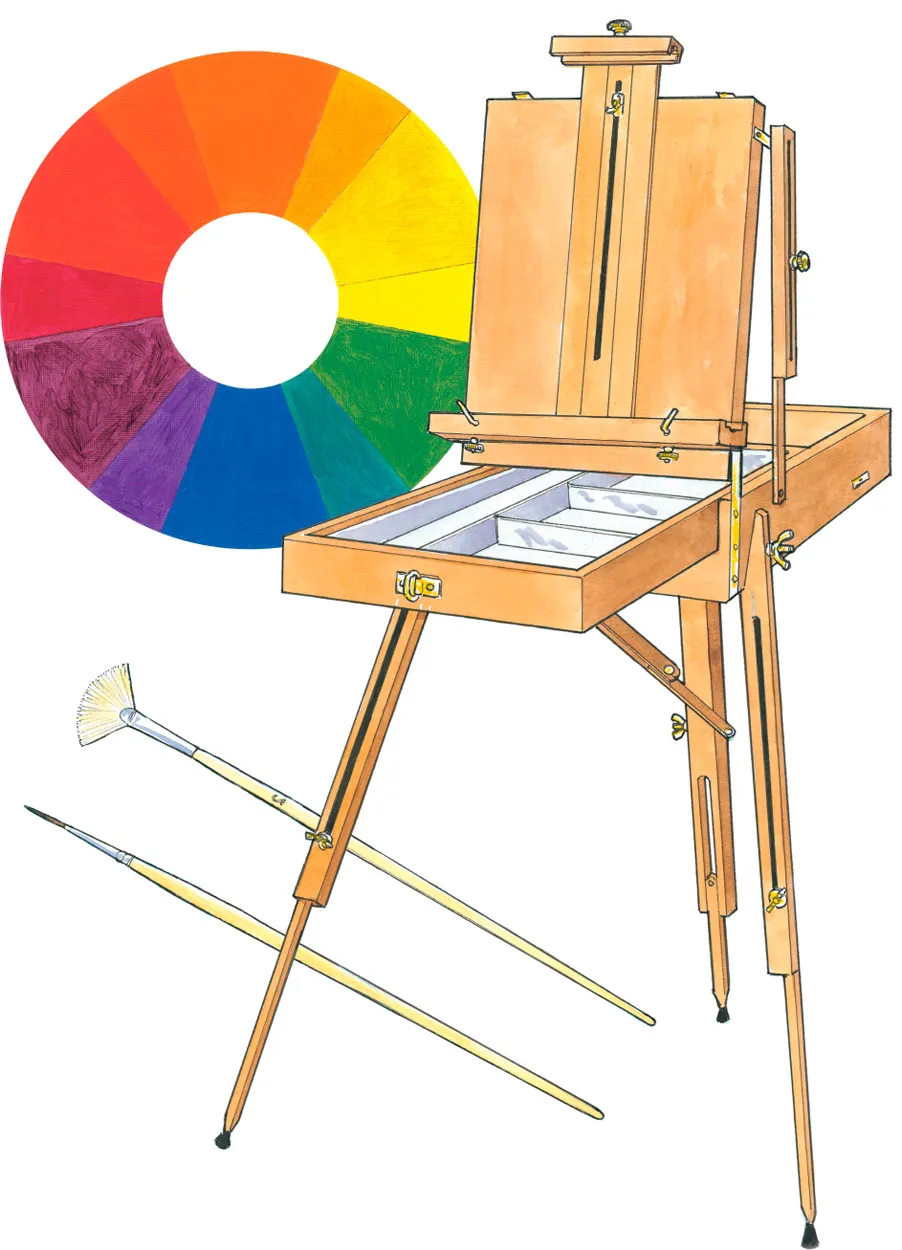
In this section we’ll look at everything you will require to make a start in oil painting, including brushes, supports, easels and of course colours and an understanding of their relationships with each other.
The multifarious things that may be found in an artist’s studio are so extensive in range that you could spend enormous amounts of money acquiring them all, only to discover that you use just a few of them. Here I have described items that you will need at once, and only when you know a bit more about what you are doing should you extend your range of materials.
You can paint with very little, so long as you have pigments, brushes and a surface on which to paint. Even an easel is not entirely necessary, although if you take up oil painting seriously you will probably want one. The most important things are worth spending some money on, because the better materials last longer and feel better to use than the very cheapest. However, if you do buy the cheapest you will find you can still paint quite well – although you may have to replace them more often, making them not as economical as they seemed at first.
A little knowledge of colour values and how they work in painting is not difficult to master, and your handling of colour will become more subtle as you progress. Eventually mixing colours becomes almost automatic and you will surprise yourself with how effective your use of them has become.
BRUSHES
While oil paintings can be done entirely with bristle brushes, it’s useful to have softer brushes too for detail or for subtle areas where you want to reduce brushmarks. You’ll need quite a few brushes if you really get into painting, but you can build them up over time.
Buying cheaper brushes can be a false economy as the better types tend to last much longer, so it’s best to get good-quality ones from the outset if possible and look after them carefully (see box). Here is my basic list of brushes, which will be more than enough to get you started.
Bristle Brushes
These are usually made from hog’s hair, though synthetic ones, which are normally softer, are also available. They come in a range of styles, each with its own purpose.
Flats
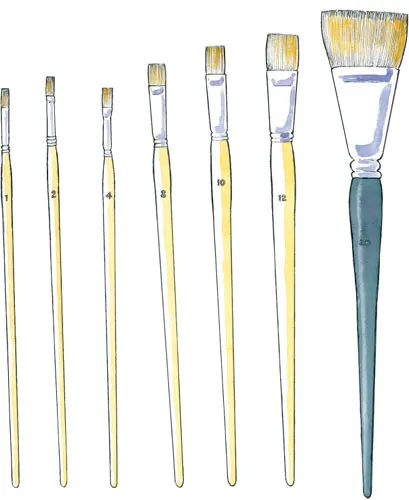
Flat brushes have a flattened set of bristles, rather like a refined version of a decorator’s brush. They are the brushes you’ll use most of the time, as they hold the paint well and you can apply it to your support with both the wide surface and the edge to get varying brush marks. The following sizes are a useful range: 20 (probably the largest you will need unless you wish to paint murals), 12, 10, 8, 4, 2 and 1.
Cleaning Brushes
To clean brushes, first wipe off excess paint with a kitchen towel or rag, squeezing them from the ferrule downwards but taking care not to pull on the bristles. Rinse them in white spirit first to get the paint out of the hairs – you can push hog’s hair brushes about in the spirit, but you need to be much gentler with sables or they will lose their point. Wash them in soap and cold water to clean out the white spirit and any remaining paint then, once you’re sure they are clean, give them a final rinse in water. Reshape the brushes gently with your fingers and leave to dry. Never stand them up resting on their bristles as this will destroy the shape.
Filberts
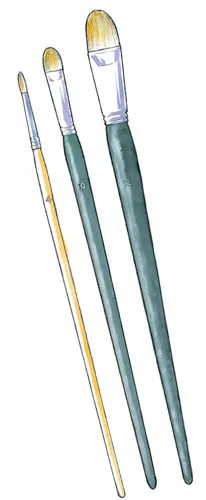
These brushes are similar to flats but have a rounded end so that you can make softer marks with them. Of these, three will probably be enough...
Table of contents
- Cover
- Title
- Contents
- Introduction
- Chapter 1: Materials and Colours
- Chapter 2: Methods of Work
- Chapter 3: Still Life
- Chapter 4: Landscape Painting
- Chapter 5: Portraits and Figures
- Chapter 6: Styles and Composition
- Copyright
Trusted by 375,005 students
Access to over 1.5 million titles for a fair monthly price.
Study more efficiently using our study tools.
Frequently asked questions
Yes, you can cancel anytime from the Subscription tab in your account settings on the Perlego website. Your subscription will stay active until the end of your current billing period. Learn how to cancel your subscription
No, books cannot be downloaded as external files, such as PDFs, for use outside of Perlego. However, you can download books within the Perlego app for offline reading on mobile or tablet. Learn how to download books offline
Perlego offers two plans: Essential and Complete
- Essential is ideal for learners and professionals who enjoy exploring a wide range of subjects. Access the Essential Library with 800,000+ trusted titles and best-sellers across business, personal growth, and the humanities. Includes unlimited reading time and Standard Read Aloud voice.
- Complete: Perfect for advanced learners and researchers needing full, unrestricted access. Unlock 1.5M+ books across hundreds of subjects, including academic and specialized titles. The Complete Plan also includes advanced features like Premium Read Aloud and Research Assistant.
We are an online textbook subscription service, where you can get access to an entire online library for less than the price of a single book per month. With over 1.5 million books across 990+ topics, we’ve got you covered! Learn about our mission
Look out for the read-aloud symbol on your next book to see if you can listen to it. The read-aloud tool reads text aloud for you, highlighting the text as it is being read. You can pause it, speed it up and slow it down. Learn more about Read Aloud
Yes! You can use the Perlego app on both iOS and Android devices to read anytime, anywhere — even offline. Perfect for commutes or when you’re on the go.
Please note we cannot support devices running on iOS 13 and Android 7 or earlier. Learn more about using the app
Please note we cannot support devices running on iOS 13 and Android 7 or earlier. Learn more about using the app
Yes, you can access The Fundamentals of Oil Painting by Barrington Barber in PDF and/or ePUB format, as well as other popular books in Art & Art Techniques. We have over 1.5 million books available in our catalogue for you to explore.