This accessible and entertaining guide introduces Sigmund Freud's life and ideas, from dream analysis to the superego.
Sigmund Freud's theories on the unconscious revolutionised the way we approach human behaviour. This essential introduction explores his theories and the implications they had for understanding an array of psychological issues, including trauma, repressed memory, childhood development and more.
It also explores Freud's life as a scientist - the conflicts and controversies he faced when proposing his new ideas to his contemporaries - and the ways in which his theories have influenced psychology today.
Sections include:
• Freud's early life
• Psychoanalysis
• Free association
• The unconscious
• Interpreting dreams
• The Oedipus complex
• Case histories
• Modern evaluations of Freud
Images and diagrams are included, as well as bullet pointed summaries at the end of each chapter to pick out key concepts.
Perfect for students on anyone wanting to get to grip with Freud's ideas, this book is the perfect introduction to the great psychoanalyst and his ground-breaking concepts.
ABOUT THE SERIES: The critically-acclaimed Knowledge in a Nutshell series provides accessible and engaging introductions to wide-ranging topics, written by experts in their fields.
eBook - ePub
Knowledge in a Nutshell: Sigmund Freud
The complete guide to the great psychologist, including dreams, hypnosis and psychoanalysis
- English
- ePUB (mobile friendly)
- Available on iOS & Android
eBook - ePub
Knowledge in a Nutshell: Sigmund Freud
The complete guide to the great psychologist, including dreams, hypnosis and psychoanalysis
About this book
Information
Chapter I
Mind, madness and psychiatry Before Freud
Over the course of his career, Freud was to invent psychoanalysis as both an all-encompassing account of the human mind and as an institution that regulated the training of professional analysts. His work was to influence academic fields including psychology, philosophy, sociology and literary theory and professional and applied fields such as psychiatry, psychotherapy and counselling. When Freud enrolled in medical school in 1873, these fields either already existed or were in the process of being formed. Freud’s theories and techniques were developed in this context, and to understand where they were distinctive and where he borrowed from previous thinkers it is necessary to briefly sketch out the basic features of the scientific landscape that he was entering. The particular areas on which I shall concentrate are German Scientific Medicine, which was led by Freud’s teachers; philosophical debates on the role of consciousness as a foundation for knowledge; and the rapidly changing social and medical understandings of how mental illness was to be conceptualized and treated.
The influence of Johannes Müller
By the middle of the 19th century, medicine was going through a period of rapid change. Diagnoses and treatments that had been in place for centuries were being re-examined and there was a growing tendency to use the findings of new disciplines such as physiology and biochemistry along with technologies drawn from the fields of chemistry, microscopy, physics and statistics to understand the causes of illness and devise new treatments. German science was at the heart of this movement, and Handbuch der Physiologie des Menschen für Vorlesungen (Handbook of Physiology) by Johannes Müller (1801–58), published in 1838, was a key text that was to influence a whole generation of biologists and medical researchers by providing them with a comprehensive and cutting-edge overview of the relationship between morphology (the study of biological structures) and physiology (the study of biological functions).
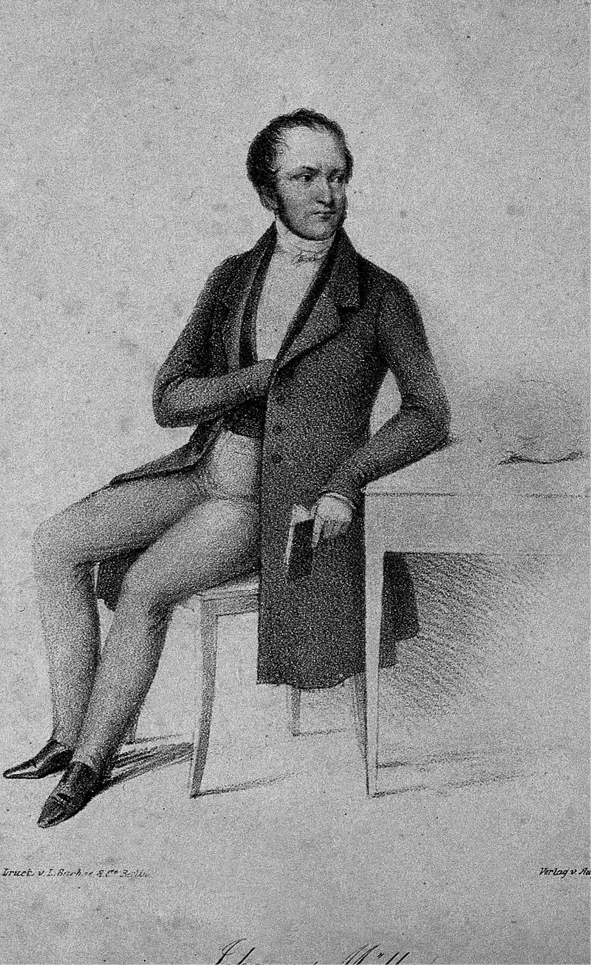
Johannes Müller was a German physiologist who had a great influence on Freud.
Müller surrounded himself with some of the brightest students of their generation. They included Herman Helmholtz (1821–94), Emil du Bois-Reymond (1818–96), Carl Ludwig (1816–95) and Ernst Brücke (1819–92), all of whom went on to make significant contributions to the sciences of biology and physiology. Helmholtz became one of the most renowned German scientists of the 19th century, contributing to the science of thermodynamics and formulating the principle of the conservation of force, known today as the principle of the conservation of energy. The principle states that energy cannot be created or destroyed but can only be transformed from one form to another (for example, when we switch on a lamp, electrical energy is transformed to heat and light energy).
Helmholtz also contributed to neurology by measuring the speed of nerve conduction – he measured nerve impulses travelling in frog nerves at around 27 m (88 ft) per second – and to ophthalmology, inventing the ophthalmoscope that allowed doctors to examine the interior of the eye and proposing a new theory of colour vision. Du Bois-Reymond went on to investigate the electrophysiology of nerves and muscles and Ludwig invented the kymograph, which is a device that allows physiological data such as blood pressure to be recorded over time. Brücke researched speech, the structure of skeletal muscle and plant physiology.
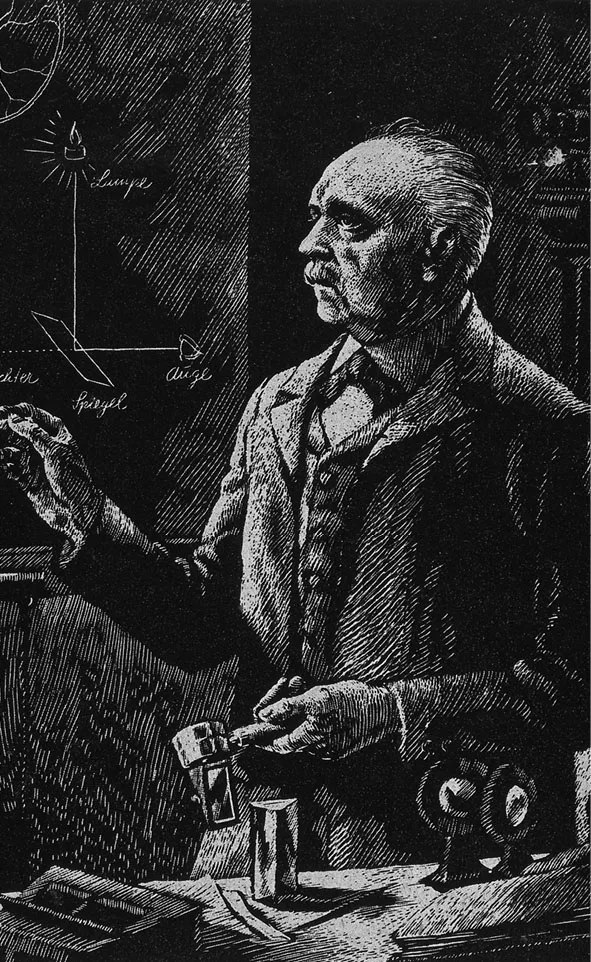
Hermann von Helmholtz was a physicist who made a number of discoveries in optics, physiology, electrodynamics and many other fields.
Clearly Johanne s Müller was an innovative and original scientist who drove the agenda of scientific medicine forward. He was also a convinced vitalist, believing that the difference between a live and a dead organism was the presence or absence of a ‘life energy’ or, as it was sometimes called, a vital spark or élan vital. This vital principle was understood as a unifying force that somehow inhabited living things and left them at death. It could not be understood in terms of current physics and chemistry and, despite its description in quasi-scientific terms, was according to its critics the equivalent of the concept of ‘soul’ that was found in various religious traditions. Helmholtz’s formulation of the principle of the conservation of energy was a direct challenge to Müller’s vitalism and, although they clearly loved and respected their teacher, most of Müller’s former students rejected vitalism and embraced a thorough-going materialism and reductionism, which aimed to understand the phenomena of life in terms of chemistry and physics. In 1845 Brücke, du Bois-Reymond and four other young physicists founded the Deutsche Physikalische Gesellschaft (German Physical Society) to promote their approach, and later that year met together to swear a solemn oath that in their research and teaching they would explain physiological phenomena only in terms of forces that were known in, or consistent with, the laws of physics and chemistry. Brücke went on to take up appointments at Berlin and Königsberg before being appointed professor of physiology at the University of Vienna in 1849. There he kept to his oath and taught physiology as a sub-discipline of physics.
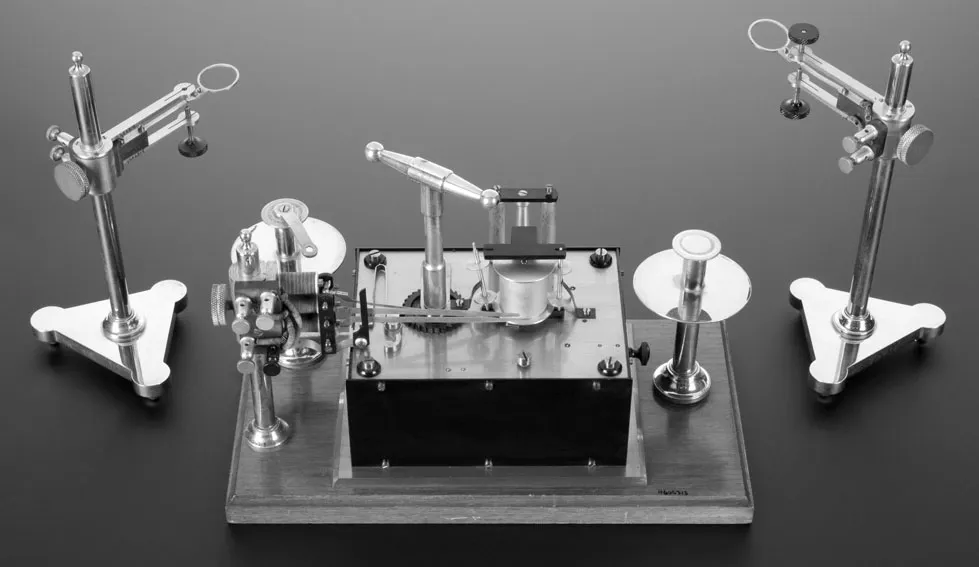
The kymograph was invented by Carl Ludwig in 1847 and was first used to measure blood pressure.
As we shall see in Chapter 2, Brücke became an important mentor to Freud, and in Chapter 3 we shall explore how Freud tried to keep to the spirit of the materialism of his teacher when he attempted to square clinical observations and neurology with the principles of the conservation of energy and force. In 1895 Freud attempted to write this up as ‘A Psychology for Neurologists’ but abandoned the project as speculative, deciding instead to treat psychology, neurology and physics, in the short term at least, as separate and autonomous fields that could not as yet be connected. This work was eventually published as Project for a Scientific Psychology in 1950. Despite his abandonment of his reductionist programme, Freud’s use of the concepts of force and energy were still to play a role in psychoanalytic thinking (see Chapter 6).
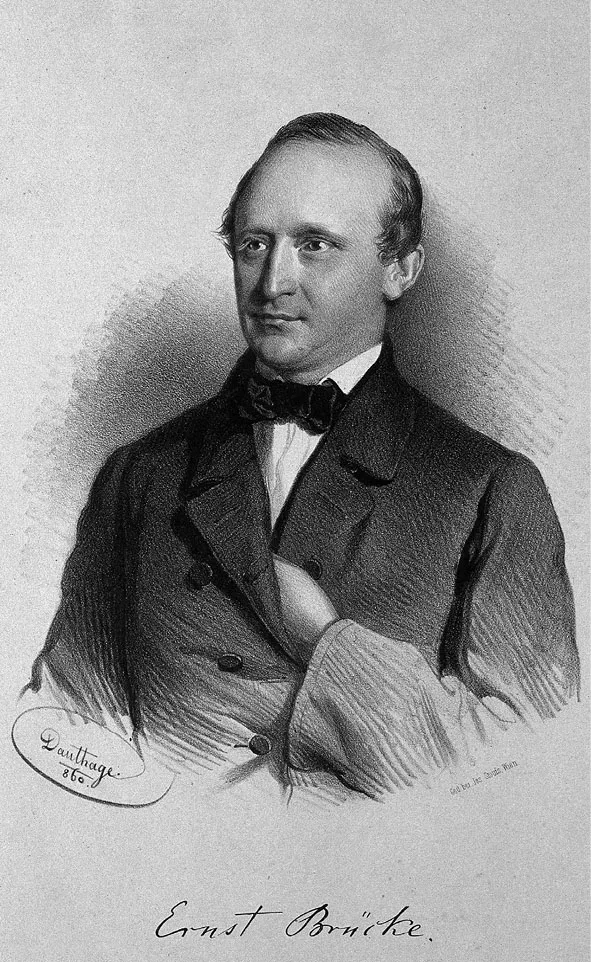
Ernest Wilhelm von Brücke was one of Müller’s most successful students, who introduced techniques from physics and chemistry into medical research.
The privileging of consciousness
In Freud’s published work there are few references to philosophy and its practitioners. However, at the University of Vienna, Freud attended lectures by Franz Clemens Brentano (1838–1917). Brentano was to influence the philosophical movement known as phenomenology, which took experience as the starting point of philosophizing rather than trying to identify the concepts that made experience possible. For Brentano the key observation when we consider our experience is that all mental acts (thinking, believing, hoping) all point beyond themselves. I might think that the sky is blue, believe that the capital of France is Paris and want a piece of cheese. These thoughts, beliefs and wants are about something and it is not so much the objects (blue skies, French seat of government and dairy products) but their very ‘aboutness’ that Brentano finds significant. He argues that this points to the basic difference between the mental and the physical. Mental acts all share an aboutness which is a kind of intrinsic pointing to real or imaginary targets. In contrast, purely physical things have no capacity to go beyond themselves. A rock is a rock and it is not about anything else. Brentano called this aboutness ‘intentionality’ and he identifies it as the mark of the mental.
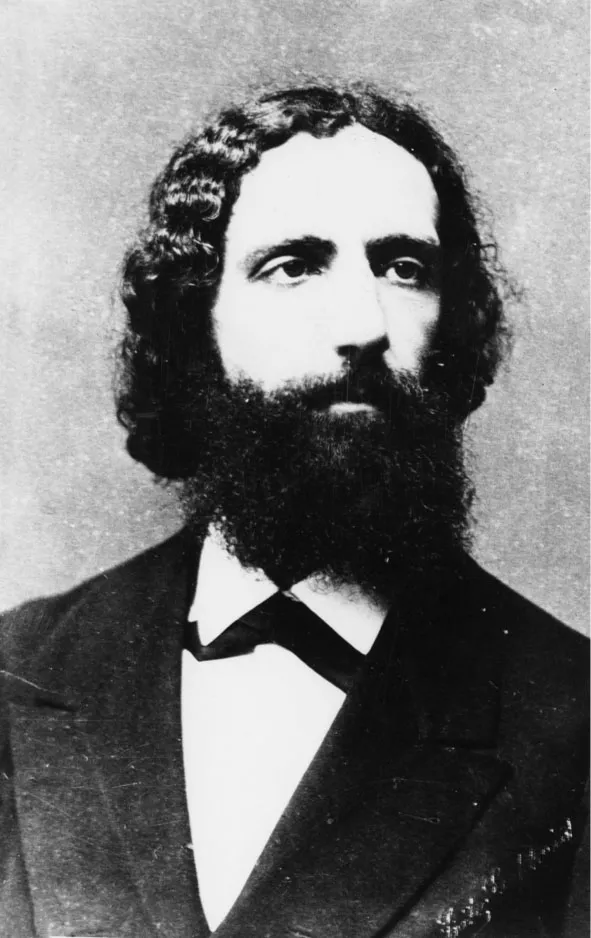
Franz Brentano was a leading 19th-century philosopher who brought the idea of intentionality to the modern philosophical concepts of phenomenology.
In 1874 Brentano published Psychology from an Empirical Standpoint, in which he argued that psychology was to be the scientific study of mental phenomena and the methodology for investigating mental phenomena was introspection – that is, turning the mind on itself. This was possible because, for example, when we are looking at a rock we are aware of the rock but we are also aware that we are having a thought about rock. For Brentano we can never think about the world without being aware that we are doing so. While this argument may seem rather arcane, the consequence of making the awareness of the intentionality of our mental acts the defining difference of the mental and the physical is that all mental acts are conscious acts (although the intensity of our consciousness may be very low – I may be walking along and kicking rocks from the path in front of me, but this is never a fully automatic act and at some level I am conscious that I intend to kick rocks away) and that unconscious mental acts are logically impossible. For Brentano there can be no unconscious thoughts, beliefs, feeling or hopes.
Brentano drew the distinction between the mental and the physical in terms of intentionality, but making a fundamental distinction between the mental and the physical has a much longer history. The French philosopher René Descartes (1596–1650) was highly influential in popularizing a dualist understanding of our place in the world when, more than 250 years earlier, he had attempted to put science once and for all on a solid footing by subjecting all that he knew to a process of radical doubt. His conclusion was that his only certain knowledge that was clear and distinct to his mind was the existence of his own cognitive activity of doubting. This led him to his famous statement cogito ergo sum – ‘I think, therefore I am’, which appeared in his 1644 Principles of Philosophy. The implications of this statement were that the very essence of a human was to be a mind – that is, a thinking, conscious being – and this knowledge of ourselves as minds was given to us with absolute certainty. Our existence as a body, along with the rest of the world, was something that could be inferred, but the starting point was our minds and there is nothing we know better than our own minds. Descartes’ method of radical doubt had introduced a dualism between mind and matter – and, since our bodies are made up of matter, between mind and brain also. Descartes believed that to be a mind was to be conscious at all times, even when our bodies are in a state of sleep or when our mechanical brains are not functioning after, say, a blow to the head. In these states our minds ‘withdraw’ from our bodies, to return when they are in full working order. We cannot remember the conscious activity we were engaged in during these episodes of sleep or unconsciousness because no new bodily or material memories were laid down in our brains.
The upshot of Descartes’ thinking is that mind is defined in terms of consciousness and that consciousness is the criterion of the mental. Just as importantly, examining our minds carefully and rejecting that which is confused or vague is th...
Table of contents
- Title page
- Contents
- Introduction
- Chapter I • Mind, madness and psychiatry before Freud
- Chapter 2 • Freud as zoologist, neurologist and physician
- Chapter 3 • Freud the neurologist
- Chapter 4 • The birth of psychoanalysis
- Chapter 5 • The case histories
- Chapter 6 • The methodology of psychoanalysis
- Chapter 7 • Key psychoanalytic concepts
- Chapter 8 • The early growth of the psychoanalytic Movement
- Chapter 9 • Conflicts and controversies
- Chapter 10 • Freud outside the clinic
- Chapter 11 • Current evaluations of Freud and psychoanalysis
- Glossary
- Picture credits
- Copyright
Trusted by 375,005 students
Access to over 1.5 million titles for a fair monthly price.
Study more efficiently using our study tools.
Frequently asked questions
Yes, you can cancel anytime from the Subscription tab in your account settings on the Perlego website. Your subscription will stay active until the end of your current billing period. Learn how to cancel your subscription
No, books cannot be downloaded as external files, such as PDFs, for use outside of Perlego. However, you can download books within the Perlego app for offline reading on mobile or tablet. Learn how to download books offline
Perlego offers two plans: Essential and Complete
- Essential is ideal for learners and professionals who enjoy exploring a wide range of subjects. Access the Essential Library with 800,000+ trusted titles and best-sellers across business, personal growth, and the humanities. Includes unlimited reading time and Standard Read Aloud voice.
- Complete: Perfect for advanced learners and researchers needing full, unrestricted access. Unlock 1.5M+ books across hundreds of subjects, including academic and specialized titles. The Complete Plan also includes advanced features like Premium Read Aloud and Research Assistant.
We are an online textbook subscription service, where you can get access to an entire online library for less than the price of a single book per month. With over 1.5 million books across 990+ topics, we’ve got you covered! Learn about our mission
Look out for the read-aloud symbol on your next book to see if you can listen to it. The read-aloud tool reads text aloud for you, highlighting the text as it is being read. You can pause it, speed it up and slow it down. Learn more about Read Aloud
Yes! You can use the Perlego app on both iOS and Android devices to read anytime, anywhere — even offline. Perfect for commutes or when you’re on the go.
Please note we cannot support devices running on iOS 13 and Android 7 or earlier. Learn more about using the app
Please note we cannot support devices running on iOS 13 and Android 7 or earlier. Learn more about using the app
Yes, you can access Knowledge in a Nutshell: Sigmund Freud by Alan Porter in PDF and/or ePUB format, as well as other popular books in Psychology & History & Theory in Psychology. We have over 1.5 million books available in our catalogue for you to explore.