"...there is nothing elementary about O'Grady's primer. She pulls off the feat of writing a reliable and accessible introduction to modern philosophy that is also a meaningful contribution to the subject." - Times Literary Supplement
From Descartes' famous line 'I think therefore I am' to Kant's fascinating discussions of morality, the thinkers of the Enlightenment have helped to shape the modern world. Addressing such important subjects as the foundations of knowledge and the role of ethics, the theories of these philosophers continue to have great relevance to our lives.
Ranging across Enlightenment thinking from Berkeley to Rousseau, Enlightenment Philosophy in a Nutshell explains important ideas such as Locke's ideas of primary and secondary qualities, Kant's moral rationalism, and Hume's inductive reasoning.
Filled with helpful diagrams and simple summaries of complex theories, this essential introduction brings the great ideas of the past to everyone.
ABOUT THE SERIES: The 'Knowledge in a Nutshell' series by Arcturus Publishing provides engaging introductions to many fields of knowledge, including philosophy, psychology and physics, and the ways in which human kind has sought to make sense of our world.
eBook - ePub
Knowledge in a Nutshell: Enlightenment Philosophy
The complete guide to the great revolutionary philosophers, including René Descartes, Jean-Jacques Rousseau, Immanuel Kant, and David Hume
- English
- ePUB (mobile friendly)
- Available on iOS & Android
eBook - ePub
Knowledge in a Nutshell: Enlightenment Philosophy
The complete guide to the great revolutionary philosophers, including René Descartes, Jean-Jacques Rousseau, Immanuel Kant, and David Hume
About this book
Information
Topic
PhilosophyChapter 1
The Road to Enlightenment
In about 600bce, the Greek citizen Thales asked: ‘What is the One underlying the Many?’ Until then, human ingenuity had tended to manipulate the world piecemeal – in maths and technology – and to try to explain it as a whole only in terms of myth. Thales’ question sprang from the (then) odd and original idea that there must be a single principle (arché) informing and animating the gallimaufry of things in the world, and it made the key distinction that spurs all philosophical and scientific enquiry – the distinction between what things merely seem and how they actually are.
Soon those who practised what they called philos sophia (love of wisdom) began to turn the spotlight on themselves. They realized that what they investigated was investigated by them through the medium of their thought, and of human eyes, skin, ears and other specific sense organs. Philosophy, like science, has always wanted to know what everything is, irrespective of how it seems, but that requires asking ‘what or who does everything seem to?’ We can’t winkle ourselves out of our knowing. We have to judge how far, or even if, what we perceive is as we perceive it, and what we believe is true. In the third century bce, the Skeptikoi (enquirers) questioned whether we can know anything at all – extreme, perhaps, but scepticism is essential to all philosophizing.
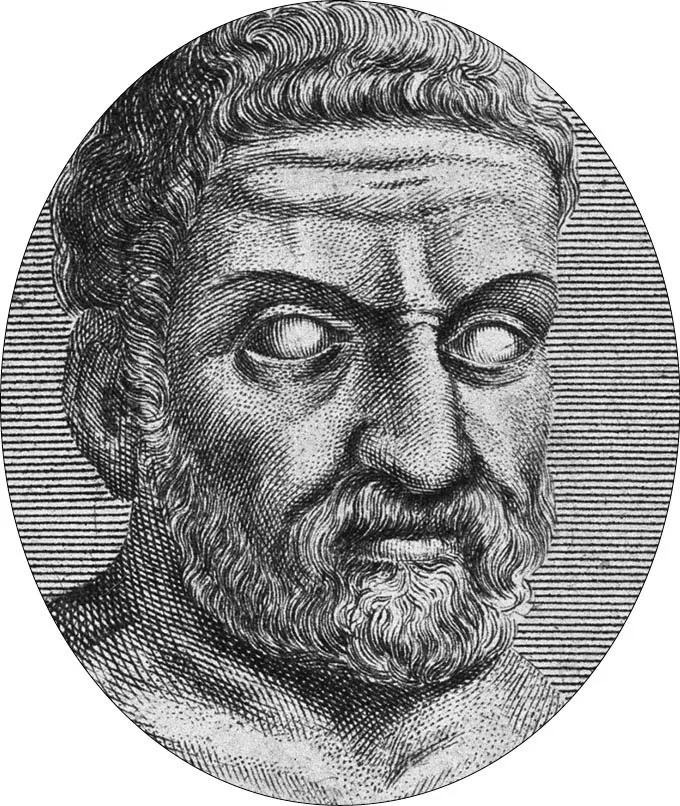
Thales, the first recorded philosopher, asked ‘What is the One underlying the Many?’
What distinguishes philosophy is not its subject matter but its technique – a perilous mixture of flexible open-endedness and meticulous precision as the philosopher walks a narrow tightrope over undifferentiated chaos, trying to transfix, demarcate and gather it into meaningful concepts, and to make sense also of existing categories and models. A philosopher’s tool-kit is him- or herself. Our own intuitions (a technical term in philosophy) provide a tuning fork for testing the soundness of what it makes sense to think or say about anything. Yet, while relying on intuitions, philosophy requires us to query all the presuppositions and seeming certainties on which our reasoning is based.
Philosophy is also a conversation, answering, contradicting, building on what other philosophers have said or are saying, and also demolishing it. Indicatively, Descartes, with whom this book begins, and Kant, with whom it ends, both lament how deplorable the current state of philosophy is (in 1641 and 1781 respectively). The appearance/reality distinction had become more puzzling than ever.
The Cradle of All Subjects
Philosophy was the cradle of all subjects before any subjects or disciplines had even been identified and differentiated, but gradually the fields of knowledge split off from it as each crystallized round a different basis, perspective, method and topic. The philosophy core that remained split into:
• metaphysics (the study of the nature and structure of reality);
• epistemology (the study of whether, how, and what we know);
• logic;
• aesthetics (the study of art and of what is beautiful);
• ethics; political philosophy and more.
The centuries between Aristotle and Descartes
In 380ce, after philosophy’s heyday in Athens – and alongside Greek and Roman Stoicism and the neo-Platonists – an initially tiny sect, Christianity, was made the dominant religion of the Roman Empire and was soon the only authorized one. For the next thousand years, religious authority was the bond that united people’s thought and action, but also shackled it. Thinking, or its expression, had to be squared with Christian orthodoxy in Europe, and, after 700ce, with Islam in the Middle East and part of Spain.
Of course this is very broad-brush. It is sometimes argued that Christianity itself contained the germ of the Enlightenment. The Christ of the Gospels focuses on what is truly felt and thought as opposed to what is only enacted and said; early Christianity overturned the ancient world’s prioritizing of family, nationality, state, hierarchy and convention by insisting on individual conscience. ‘There is neither Jew nor Gentile, slave nor free, male nor female, for you are all one in Christ,’ said Paul. But Christian ‘innerness’ and category-transcendence was vitiated by power and rigmarole. ‘The Catholic, apostolic and Roman religion is, in all its ceremonies and in all its dogma, the reverse of the religion of Jesus,’ Voltaire wrote in the 18th century. The rebirth of pre-Christian Greek and Roman culture in the European Renaissance of the 13th to 16th centuries, Galileo’s discovery of the sun being at the universe’s centre, Pierre Bayle’s provocative Historical and Critical Dictionary (dubbed ‘the arsenal of the Enlightenment’), the freer pursuit of knowledge, its wider dispersal by means of printing, and the translation of the Bible, were all fiercely suppressed by the Church. Luther’s 16th-century Reformation, which was intended to reform it from within, effected a schism, and Catholics fought Protestants in the Holy Roman Empire during a Thirty Years’ War in which an estimated eight million people died. In 1648 the Peace of Westphalia drew up a series of treaties stipulating that from now on each region would adopt the religion of its ruler, though with members of minority religions having the right to practise their faith. It was futile for Pope Innocent X to pronounce the treaties ‘null, void, invalid, iniquitous, unjust, damnable, reprobate, inane, empty of meaning and effect for all time’. Protestant factions had been officially recognized, and any chance for the Catholic reconquest of Europe obliterated.
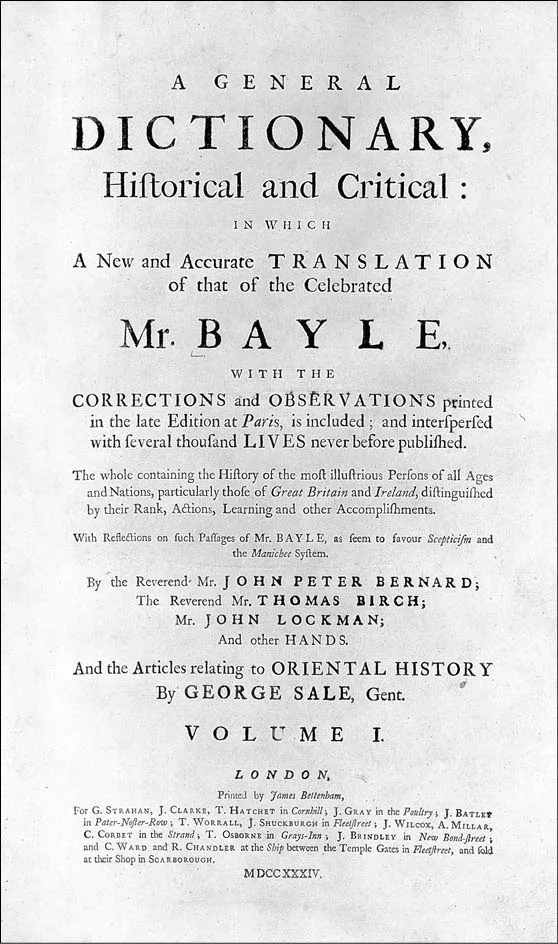
The Historical and Critical Dictionary was dubbed ‘the arsenal of the Enlightenment’.
Why – and what?
Fragmentation of the religious monolith, weariness at fatuous bloodshed over minute religious distinctions, revelatory scientific discoveries, social factors such as capitalism and greater class flexibility – these were some of the factors that led to scepticism of authority and an upsurge of new ideas. Protestantism of all sorts demanded a direct relationship between human and God, rejecting the priest as essential middleman. If reason was, as Augustine had called it in the fourth century, ‘the inner light of God’, then why should priests, religious strictures, tradition, or even the Bible, be final arbiters of thought? Surely you should side-step them and rely on reason alone. ‘Enlightenment is man’s emergence from his self-imposed immaturity,’ is the first sentence of Kant’s essay on Enlightenment – ‘self-imposed’ because of what Kant considers our ‘laziness and cowardice’ in failing to think for ourselves without being guided by others. ‘If I have a book to understand for me, a pastor to serve as my conscience, a doctor to decide my diet, and so on, I need not exert myself at all. I need not think, if I can only pay.’
Enlightenment thinkers were trying to do what the Ancient Greeks had done: think from first principles, and persuade everyone else to do so too. They urged criticism of all beliefs and ideas, including their own, and the promulgation of new ones. The multi-volume Encyclopedia, edited by Diderot and d’Alembert, had gathered free-thinking experts in different fields to collectively summarize all extant knowledge, thereby counteracting the orthodoxies of church and state.
Of course the Encyclopedia was censored and shut down, just as Galileo had felt forced to recant his theories in front of the Inquisition, Descartes had needed to suppress his Treatise of the World; and books by Enlightenment thinkers were constantly banned and burned, their authors imprisoned or banished from their cities or countries. But ‘a lively fermentation of minds’, as d’Alembert put it, was ‘spreading through nature in all directions like a river that has burst its dams’, and it ‘swept with a sort of violence everything along with it which stood in its way’.
Whatever else, the Enlightenment can never be seen as one of those movements that was named and concocted retrospectively. It was triumphantly self-conscious. ‘Aufklarung’ and ‘Siecle des lumières’ were names current in the 18th century (‘Enlightenment’ wasn’t used until the 19th), and they signalled the namers’ determination to pursue science, philosophy and political improvement in the light of reason. Enlightenment thinkers unanimously saw themselves as throwing off the shackles of religious and state authority. Even revisionists who insist that the ‘Dark Ages’ had their own sort of light would admit that great thinkers such as Augustine, Abelard and Aquinas had been constrained by the need to examine religious questions and not exceed prescribed Christian boundaries, and that for the thousand years preceding Enlightenment, philosophy had been the handmaiden to theology.
It was life in this world, rather than in the questionable next, that was now, in the 17th century, the focus of thought, the criterion for change. Spinoza, Locke, Rousseau and others, all in very different ways, urged religious tolerance, free speech and political freedom. Montesquieu’s Spirit of the Laws advocated a freedom-enhancing separation between the state’s legislative, executive and judicial powers. Locke, Hobbes and Rousseau, in their different ways, contended that any state’s legitimacy could only be based on a social contract, which ensured the rational consent of the ruled. So much for the Divine Right of Kings.
And why harp on humanity’s fallenness, our natural propensity to evil? Hutcheson, Shaftesbury, Hume and Adam Smith all variously argued that humans possess an instinctive sympathy towards one another, which alone serves as the foundation of morality, thus dispensing with any appeal to divine command. ‘Our hopes for the future condition of the human race may be summed up in three important points’, wrote the political scientist the Marquis de Condorcet, ‘the elimination of the inequality between nations; progress in equality within each nation; and the true perfection of mankind.’ The Enlightenment was (and still should be) a project. ‘If we are asked, “Do you now live in an enlightened age?”’ wrote Kant, ‘the answer is, “No, but we do live in an age of enlightenment.”’
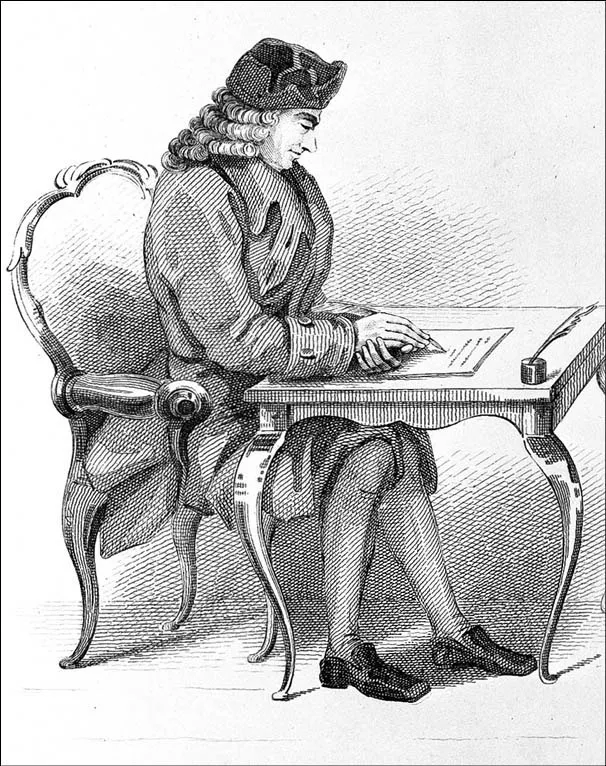
Voltaire, like many Enlightenment thinkers, was a Deist and practised natural religion.
How secular, pagan and anti-clerical was the Enlightenment?
Probably more Enlightenment thinkers than admitted to it were atheist or agnostic. Even Hume thought it prudent to prevaricate, although heretically declaring that ‘the Christian religion not only was at first attended with miracles, but even at this day cannot be believed by any reasonable person without one’. Spinoza anticipated Strauss and other 19th-century scholars by scrutinizing the Bible’s authenticity. Voltaire, with his famous signature exhortation ‘Écrasez l’infâme!’ (‘Crush the vileness!’), fought the injustices of the Catholic Church, and Diderot endorsed the wish attributed to Jean Meslier, a secretly atheist priest: ‘Let us strangle the last king with the guts of the last priest.’
But many Enlightenment thinkers, including Voltaire, were Deists and believed in natural (as opposed to revealed) religion. And while Spinoza’s ‘God’ was everything (therefore possibly nothing), Descartes, Berkeley and Leibniz continued to profess some form of Christianity – indeed God was an essential part of their metaphysics. Leibniz, a strange mixture of the old and new, argued that God is the ‘sufficient or final reason’ for everything existing, from whose ‘supreme perfection’ the best of all possible worlds must (of moral necessity) proceed. He coined the term ‘theodicy’ (‘justifying God’), and in his essay of this title tackled the problem of how a good God can allow metaphysical and moral evil.
Deism
Deism is a set of views which hold that, although God exists and has created the world, He is not a personal intercessor in human life. Deists disavow divine revelation, prophets and sacred texts.
For many, belief in God was shaken by the Lisbon earthquake of 1755, which could hardly be blamed on sinners as it mainly hit worshippers in the cathedral, sparing the seedy prostitute-frequented areas of the city. Voltaire wrote a poetic lament. Rousseau answered it with a letter sneering at such facile pessimism. Voltaire’s response to both Rousseau and Leibniz was his famous novel Candide, in which the protagonists undergo the most excruciating sufferings, throughout which the eponymous hero’s tutor, Dr Pangloss, always insists that this is the best of all possible worlds, even after he has been almost burned, and then hung, to death, semi-dissected, lashed and made a galley-slave.
‘If God did not exist, it would be necessary to invent him’ is a famous quotation from Voltaire; but he thought that even though God did exist, He needed to be invented all the same, because unknowable. ‘If God has made us in his image, we have returned him the favour.’
The legacy of the Enlightenment
At the time and for long afterwards, the Enlightenment was glorified by progressive thinkers and ...
Table of contents
- Title Page
- Acknowledgements
- Contents
- Introduction
- Chapter 1 • The Road to Enlightenment
- Chapter 2 • René Descartes (1596–1650)
- Chapter 3 • John Locke (1632–1704)
- Chapter 4 • Benedict de Spinoza (1632–77)
- Chapter 5 • George Berkeley (1685–1753)
- Chapter 6 • David Hume (1711–76): Epistemology
- Chapter 7 • David Hume (1711–76): Moral Philosophy
- Chapter 8 • Jean-Jacques Rousseau (1712–78)
- Chapter 9 • Immanuel Kant (1724–1804): Epistemology and Metaphysics
- Chapter 10 • Immanuel Kant (1724–1804): Moral Philosophy
- Glossary
- Enlightenment Figures
- Picture Credits
- Copyright
Trusted by 375,005 students
Access to over 1.5 million titles for a fair monthly price.
Study more efficiently using our study tools.
Frequently asked questions
Yes, you can cancel anytime from the Subscription tab in your account settings on the Perlego website. Your subscription will stay active until the end of your current billing period. Learn how to cancel your subscription
No, books cannot be downloaded as external files, such as PDFs, for use outside of Perlego. However, you can download books within the Perlego app for offline reading on mobile or tablet. Learn how to download books offline
We are an online textbook subscription service, where you can get access to an entire online library for less than the price of a single book per month. With over 1.5 million books across 990+ topics, we’ve got you covered! Learn about our mission
Look out for the read-aloud symbol on your next book to see if you can listen to it. The read-aloud tool reads text aloud for you, highlighting the text as it is being read. You can pause it, speed it up and slow it down. Learn more about Read Aloud
Yes! You can use the Perlego app on both iOS and Android devices to read anytime, anywhere — even offline. Perfect for commutes or when you’re on the go.
Please note we cannot support devices running on iOS 13 and Android 7 or earlier. Learn more about using the app
Please note we cannot support devices running on iOS 13 and Android 7 or earlier. Learn more about using the app
Yes, you can access Knowledge in a Nutshell: Enlightenment Philosophy by Jane O'Grady in PDF and/or ePUB format, as well as other popular books in Philosophy & Medieval & Renaissance Philosophy. We have over 1.5 million books available in our catalogue for you to explore.