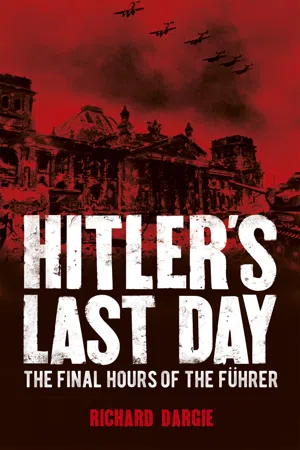
Have you ever wondered what was going on in Adolf Hitler's mind during his final hours in the Führerbunker?
What were his thoughts as radio contact with the outside world grew faint, Soviet explosions became louder and louder, and he began to feel his unassailable power ebbing away?
Did Hitler repent of his crimes against humanity or was he obsessed with thoughts of his imminent defeat and suicide?
With an inimitable cast of doomed characters, from Hitler himself to his mistress Eva Braun, mass-murderer Heinrich Himmler, cunning chief of Nazi propaganda Joseph Goebbels, and the manipulative Martin Bormann, this book captures all the drama and dread in the bunker as the Red Army remorselessly advanced into the heart of Berlin, and Hitler and his Thousand-Year Reich vanished into history.
- English
- ePUB (mobile friendly)
- Available on iOS & Android
eBook - ePub
About this book
Information
Chapter 1
Last Will and Testament,
29 April, 12.10 a.m.
At about ten minutes after midnight on 29 April 1945, Hitler asked his secretary, Gertraud ‘Traudl’ Junge, to sit with him: he had decided to kill himself and was ready to dictate his Last Will and Political Testament. Traudl was the youngest of his four private secretaries and although she was only 25 years old she had worked closely with Hitler for three years: in the Reich Chancellery in Berlin, at Wolfsschanze or Wolf’s Lair, his military command post in East Prussia, and at his Bavarian summer home, the Berghof, in Obersalzberg. Now she found herself fated to share Hitler’s last days in the Führerbunker. She was an excellent secretary and she was also devoted to Hitler, who had always treated her in a kind, fatherly manner. After the war she confessed to a deep sense of guilt at having been fond of a man who was responsible for so much mass murder and horror.
Hitler quietly informed her that he was going to dictate two documents. The first was a private will with instructions for the disposal of his personal assets after his death. The second document, however, by far the more important of the two as far as Hitler was concerned, was his political testament, which would deal with his historic legacy and would contain his last commands regarding the government of what remained of the Third Reich. While he carefully dictated the testament he referred to his written notes and Traudl rightly supposed that this was the text she had seen Hitler and Joseph Goebbels discussing privately over the previous few days.
All hope gone
With all of the false lingering hopes finally extinguished, Hitler now accepted that the war was irredeemably lost. He had entered the Berlin bunker on 16 January 1945, just after the events of the Battle of the Bulge had fully exposed Germany’s incapacity to halt the Allied offensive. He had stayed on in Berlin to keep the faith with those remaining German troops holding out against a vastly superior opponent and to maintain civilian morale. Or perhaps his acceptance of defeat was brought about by deep despair and his declining physical condition. But by refusing to desert Berlin he also had one eye on history: he would not be remembered as a coward fleeing from his last crumbling fortress.
By April all hope of avoiding total defeat and unconditional surrender had gone. There would be no miracle. No relief column breaking through the Red Army lines that encircled Berlin. No new wonder weapon that would clear the Allied planes from the skies above Germany. And to make defeat more bitter, some of his closest, longest Party allies had betrayed him. There was bad news too from Italy: his ally Mussolini had been captured and his own troops there were now surrendering. The limited German command structure that survived was focussed around dwindling enclaves near the Baltic coast, where Admiral Dönitz and Himmler still commanded remnants of the Wehrmacht and the Waffen SS.
It was only a matter of time before Russian troops stormed the Reich Chancellery, only a few hundred metres away. Most of the bunker personnel had left, many of them ushered to safety in Bavaria at his own command on some of the last flights out of Berlin. Others had quietly disappeared to take their chances among the burning rubble of the city.
The communications room in the bunker was now virtually silent: few messages for the Führer were coming in from the field. Local commanders were making their own decisions to preserve what remained of their units and the lives of their men. In any case, German signals capability was almost defunct. Radio contact was intermittent: frantic messages from the Führerbunker to the troops still fighting in the streets above were now scribbled on paper and carried by volunteer runners from the Hitler Youth. Hitler realized that he no longer mattered. If the Nazi Reich was to continue in some form, Hitler now accepted that he had no part in its future.
Hitler draws into himself
In the last week or so of his life, since his explosion of impotent rage on 22 April, Hitler had drawn into himself, taking increasingly little interest in the events unfolding above in the burning streets of Berlin, saying little even when picking at his daily lunch with his secretaries. Much of his time was now spent with his German shepherd Blondi and her pups. When he spoke at lunch, he said little about the war but preferred to ramble on about the principles of caring for dogs and training them well. Now, with the realization that there was very little time left, he was concentrating on tidying up his personal affairs and on the important task of leaving a justification of his ideas and deeds for posterity. And he had just enough time to settle a few private scores.
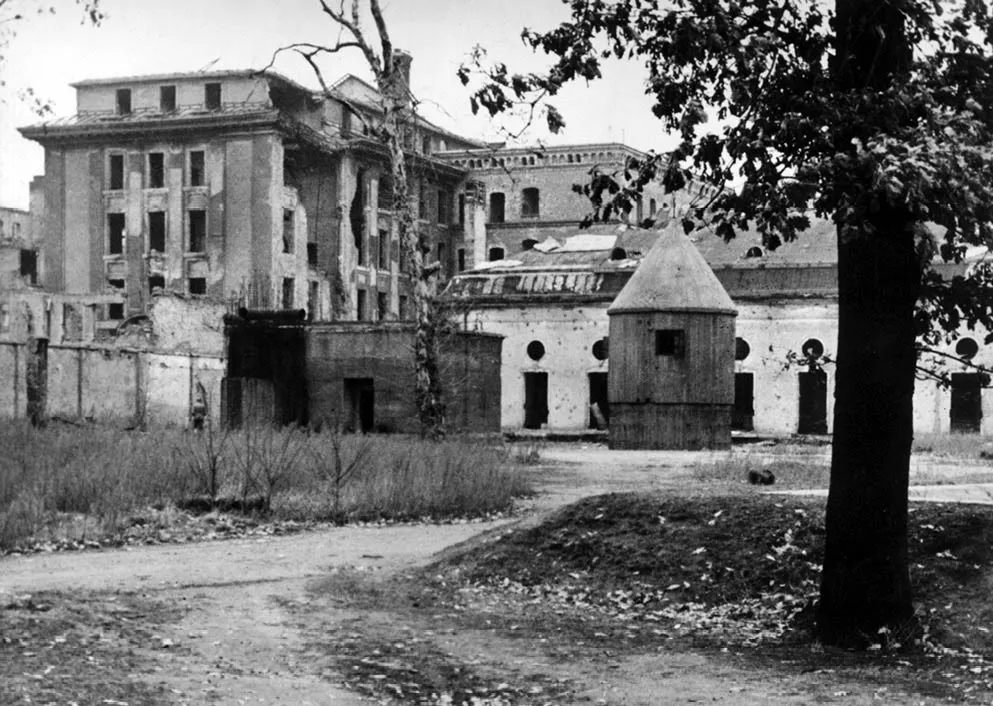
The ruins of the German Chancellery, with the entrance to the bunker and the turret from which the SS men kept watch, Berlin 1945.
Private will
Hitler’s private will was brief. Other than books and a few pieces of art that had sentimental value, Hitler had never much bothered about owning material possessions. He was inspired by ideas and history, rather than things and the fleeting pleasures of the world. While some Nazi leaders such as Göring and Himmler sacked museums and art galleries across Europe to amass their treasure, Hitler’s art collection had been acquired for a specific purpose. As a boy he had spent his formative years in the city of Linz in Upper Austria and had always looked upon it as his home town. He had long dreamed of transforming Linz into the cultural capital of the Greater Germany that would, he thought, dominate the future of European civilization.
In 1941, when the entire continent seemed to be in his grasp, he commissioned the architect Hermann Giesler to begin the task of planning and building this new Führerstadt. However, other more pressing wartime tasks had consumed Giesler’s time and energy and it was only in February 1945 that he finally completed his model of the Linz of the future and delivered it to the New Reich Chancellery.
There, while his real capital city collapsed around him, a distracted and entranced Hitler spent hours examining and discussing every aspect of Giesler’s grand vision of a city that would never be built. Hitler had always planned to retire to Linz once his political mission was complete, but now he accepted that he was going to die in Berlin. All he could do was bequeath his pictures to his home town on the Danube.
Bormann’s rise to power
In his will, Hitler appointed Martin Bormann to act as the sole executor of his estate. Since 1943, Bormann had held the title of Personal Secretary to the Führer and as a result he exercised immense power and influence over all ranks of the Nazi Party, including the Führer himself. He had joined the Party relatively late, in 1927, but by then he had already built a reputation in extreme right-wing circles as a sound, reliable fellow. His credentials included his vigorous membership of the paramilitary Freikorps in the early 1920s; his deeply held hatred of the Jews; his friendship with Rudolf Höss, later Kommandant at Auschwitz; and his involvement in at least one brutal political murder.
Martin Bormann was a squat, lumbering man who knew that he lacked the swaggering demeanour required of a leading National Socialist. He was, however, a dedicated, tireless and cunning bureaucrat who was willing to take on and master all of the dull, difficult legal and administrative duties that others avoided. By 1933 he was on the edge of the Nazi Party’s ruling elite, serving as personal secretary to the Deputy Führer, Rudolf Hess, until his dramatic flight to Scotland in 1941.
Transforming the Berghof
Bormann was by then also serving Hitler in a direct capacity. In 1935 he was given the job of supervising the transformation of the Führer’s small chalet in the Alps, Haus Wachenfeld, into a fully equipped governmental hub where Hitler could relax with friends and members of the Nazi elite, or host and impress foreign dignitaries. At the Berghof, as the chalet was now called, Bormann already acted as Hitler’s personal secretary, a post that gave him continual access to the Führer and the opportunity to control the access of others. In time Hitler became heavily dependent on Bormann, who was now the spider at the heart of the Nazi web, controlling information, rumours, decisions, squabbles and appointments. His influence over Hitler made him many enemies but also gave him immense power, which he exercised quietly, effectively and ruthlessly.
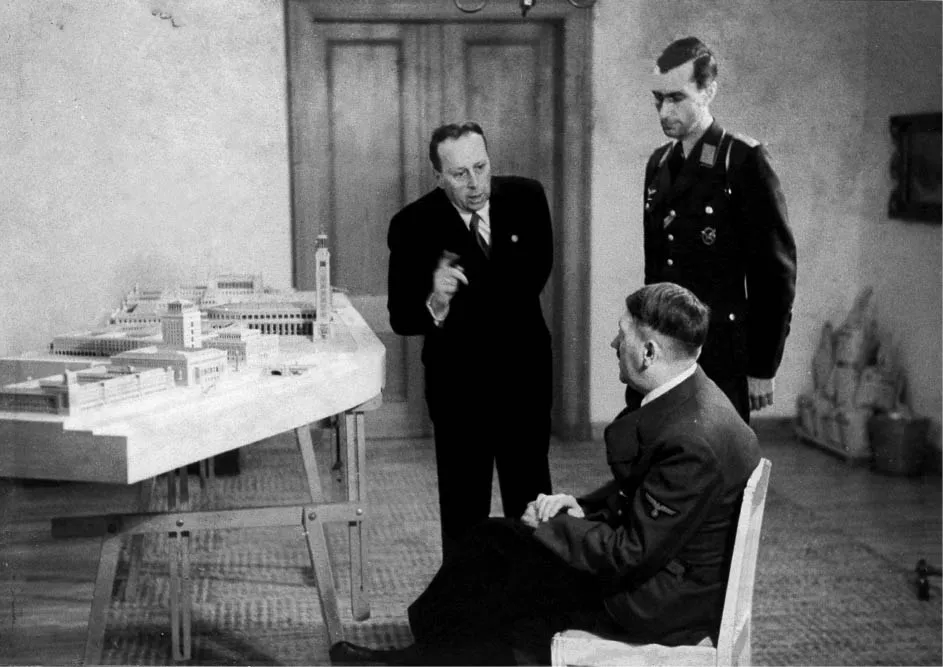
Architect Hermann Giesler shows Hitler his plans for Linz.
Takes over from Hess
In 1941, Bormann assumed Rudolf Hess’s role as Head of the Party Chancellery, giving him control over most German domestic affairs. Moreover, he soon exercised increasing influence over the civilian government of the conquered territories in the East. It was Bormann who signed the decrees that established the extermination camps which would facilitate ‘the final solution to the Jewish Problem’ and which gave Adolf Eichmann the authority to start organizing the detailed destruction of European Jewry.
Bormann was much less well-known to the German people, and to foreign observers, than the high-profile trio of Himmler, Göring and Goebbels, who had very publicly accompanied Hitler throughout the Nazi Party’s rise to power in the 1930s. Yet by 1942 Bormann held such a concentration of state and Party power in his hands that he could quite rightly regard himself as a very likely contender to succeed Hitler as Führer.
Bequests to family members
Hitler trusted Martin Bormann completely. In his will, he gave Bormann full power to decide how much of his estate should be left to his family, only stipulating that each member should receive enough for ‘the maintenance of a modest simple life’. Hitler had loved his mother Klara very deeply and her early death in 1907 from breast cancer devastated him. However, his feelings for most of his other relatives were cool and his contact with them was only ever sporadic and limited.
Adolf was never particularly close to his younger sister Paula, who saw very little of him until his emergence as a major national figure in the early 1930s. He supported her financially to some extent, but seldom met her in the flesh. Nevertheless, in the last weeks of the war he did order Bormann to make sure that he got her out of Berlin and off to the safety of his mountain retreat at Berchtesgaden in the Bavarian Alps. Hitler saw more of his half-sister Angela, who acted as his housekeeper at the Berghof in Obersalzberg from 1928 to 1936. The Führer was, however, not particularly upset when she left his household that year in protest at the growing influence of his mistress, Eva Braun.
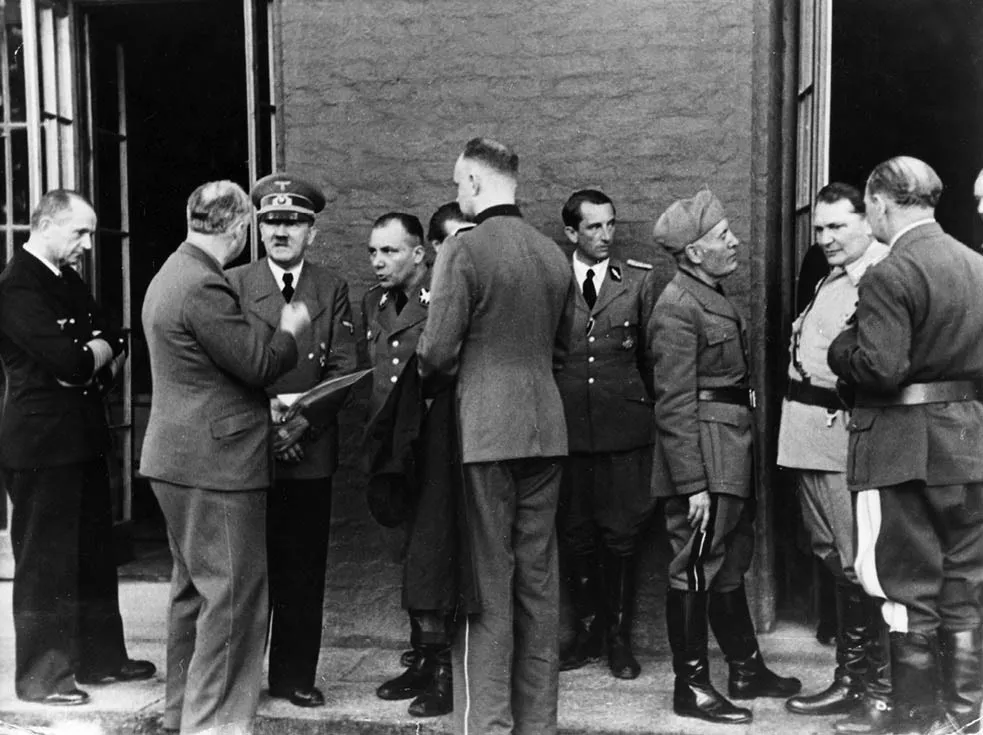
Martin Bormann lends an attentive ear to his master Adolf Hitler in conversation with von Ribbentrop. Admiral Dönitz is isolated on the far left and the tall man (back to us) in the foreground is Hitler’s valet Heinz Linge. Behind them, a trim Mussolini chats with a bulky Hermann Göring at the Wolf’s Lair, 1944.
Hitler’s nephews
Hitler also still had two living nephews in 1945. Angela’s son Leo was in Soviet hands, captured two years earlier at Stalingrad while serving as a flight engineer in the Luftwaffe. Although Hitler was fond of Leo, at the height of the battle and with the German forces surrounded, he pointedly refused to fly him out of the closing Soviet trap, fearing accusations of favouritism. He did later consider exchanging Leo for Stalin’s son Yakov, who had been taken prisoner by the Wehrmacht in 1941 in the first month of the ‘Barbarossa’ campaign against Russia, but the response from the Kremlin to this suggestion was not encouraging. Leo languished in Soviet captivity until 1955.
His other living nephew, the part-German, part-Irish William Patrick Hitler, had grown up in Liverpool and only visited Germany briefly in 1933 and 1938, hoping to see what his famous uncle could do to help him progress in life. Hitler is said to have called William ‘loathsome’ and probably never accepted him as a real member of his family.
He had been much fonder of his third nephew, Heinz, an enthusiastic National Socialist who had studied at an elite military academy before joining the Wehrmacht as a signals officer in 1941. Posted to the Eastern Front, he disappeared in January 1942 after making his way to a forward position to retrieve radio equipment. It isn’t clear if Hitler ever knew whether his favourite nephew had been killed or captured. In the event, Heinz ended up in the old Tsarist prison of Butyrka in central Moscow. In Soviet times, it often housed ‘distinguished’ political and military prisoners. After several days of interrogation and torture, he died in Butyrka in late February 1942, aged 21.
After making provision for his surviving relatives, Hitler specifically indicated that Eva’s mother, Franziska ‘Fanny’ Braun, should receive a distribution from his estate.
Co-workers remembered
Also remembered were the ‘faithful co-workers’ who had formed the intimate team around him, both in Berlin and at the Berghof. Only one member of this group, Frau Winter, the housekeeper of his apartment in Munich, was actually named in the document, but Bormann knew exactly who Hitler meant when he expressed his thanks to those ‘who have for many years aided me by their work’.
Hitler disliked change in his immediate household staff and preferred to be surrounded by familiar faces who understood how he liked to live and work. Many of these co-workers had served under him throughout the years of Nazi rule and they had come to form almost a substitute family. All of them were devoted to him and never escaped from the magic spell that he cast upon those around him, even in his final, weakened days.
His longest-serving secretary, Johanna Wolf, had been with him since 1929 and was typical of the deeply loyal staff around him. It was only with the very greate...
Table of contents
- Title Page
- Contents
- Prologue • Final Dawn
- Chapter 1 • Last Will and Testament
- Chapter 2 • The Wedding
- Chapter 3 • Disintegration
- Chapter 4 • Terror and Revenge
- Chapter 5 • Fading Hopes
- Chapter 6 • Death of a Warmonger
- Chapter 7 • Aftermath
- Epilogue • Misinformation and Myths
- Further Reading: Eyewitness Accounts
- Glossary
- Copyright
Trusted by 375,005 students
Access to over 1.5 million titles for a fair monthly price.
Study more efficiently using our study tools.
Frequently asked questions
Yes, you can cancel anytime from the Subscription tab in your account settings on the Perlego website. Your subscription will stay active until the end of your current billing period. Learn how to cancel your subscription
No, books cannot be downloaded as external files, such as PDFs, for use outside of Perlego. However, you can download books within the Perlego app for offline reading on mobile or tablet. Learn how to download books offline
Perlego offers two plans: Essential and Complete
- Essential is ideal for learners and professionals who enjoy exploring a wide range of subjects. Access the Essential Library with 800,000+ trusted titles and best-sellers across business, personal growth, and the humanities. Includes unlimited reading time and Standard Read Aloud voice.
- Complete: Perfect for advanced learners and researchers needing full, unrestricted access. Unlock 1.5M+ books across hundreds of subjects, including academic and specialized titles. The Complete Plan also includes advanced features like Premium Read Aloud and Research Assistant.
We are an online textbook subscription service, where you can get access to an entire online library for less than the price of a single book per month. With over 1.5 million books across 990+ topics, we’ve got you covered! Learn about our mission
Look out for the read-aloud symbol on your next book to see if you can listen to it. The read-aloud tool reads text aloud for you, highlighting the text as it is being read. You can pause it, speed it up and slow it down. Learn more about Read Aloud
Yes! You can use the Perlego app on both iOS and Android devices to read anytime, anywhere — even offline. Perfect for commutes or when you’re on the go.
Please note we cannot support devices running on iOS 13 and Android 7 or earlier. Learn more about using the app
Please note we cannot support devices running on iOS 13 and Android 7 or earlier. Learn more about using the app
Yes, you can access Hitler's Last Day by Richard Dargie in PDF and/or ePUB format, as well as other popular books in History & German History. We have over 1.5 million books available in our catalogue for you to explore.