If you have always wanted to excel at drawing, then The Complete Guide to Drawing & Illustration is for you. All you need is a pencil, a bit of blank paper and the expert guidance you will find within these pages. This book is designed to systematically teach you the essentials of drawing and lays the groundwork for you to develop your own personal drawing style.
• Hands-on course in drawing and illustration, suitable for beginners and improvers alike
• Practical, step-by-step, easy-to-follow exercises and demonstrations
• From simple object drawing, move on to tackle all aspects of our environment, people and animals
• Sketching and observation, materials and theory, tips and techniques - everything you need to know to create original artworks, cartoons and illustrations
• More than 1,000 illustrations
eBook - ePub
The Complete Guide to Drawing & Illustration
A Practical and Inspirational Course for Artists of All Abilities
- English
- ePUB (mobile friendly)
- Available on iOS & Android
eBook - ePub
The Complete Guide to Drawing & Illustration
A Practical and Inspirational Course for Artists of All Abilities
About this book
Information
Topic
ArtSubtopic
Art GeneralTHE HUMAN FIGURE
Drawing human bodies, or ‘figures’, as artists call them, requires a bit more technical understanding than heads and faces, which don’t have the complexity of structure, movement and gesture of the body as a whole.
There is a lot to take on, but it need not be too painful. The days of painstaking academic figure drawing have passed in favour of a more expressive and playful approach. Some preliminary explanations of the more important elements of theory cannot be avoided, but I’ve included only as much as you need to get started.
You may wonder why it is that artists seem obsessed with drawing nudes. There are very sound reasons: you will not get to understand how the motorcar works without lifting the bonnet and likewise, the artist must learn to draw the body, its knobbles, joints, muscles, sinews and fat, without the coverings of clothing. But we must look deeper still, beyond the skin and flesh to the skeleton, the key to proportion and articulation. Our investigation will be conducted from the inside out.

The skeleton
The skeleton provides the rigid framework for the musculature and it allows us to bend in the right places. Though the bones can’t be seen in a drawing of a person, the proportions and articulation of the skeleton govern every pose. A basic working knowledge of the skeleton is therefore essential for successful figure drawing.

Made up of dozens of bones, the skeleton is a confusion of sticks and knobbles. For advanced academic figure drawing it would be important to know the individual bones, but for most drawing purposes such detailed knowledge is not necessary.
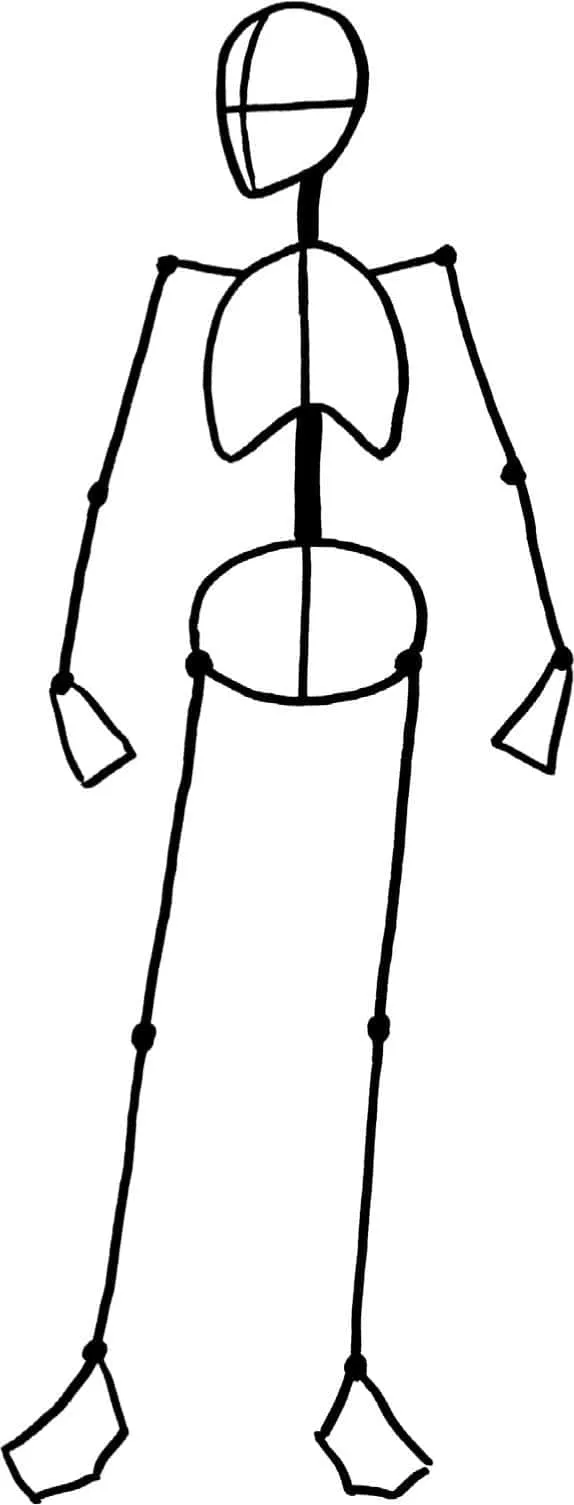
This is the skeletal framework that artists employ as the basis for drawing figures. Here we see all the important information: the relative sizes of head, chest and hips (and the spaces in between), the lengths of the limbs and the major joints and points of flexibility. Hands and feet are treated as general masses.

As well as the proportions, the basic skeleton establishes a figure’s pose and posture. The skeleton on the left demonstrates a common misconception: that we stand bolt upright. Working from this model would result in a stiff and odd-looking figure.

This is a more natural posture. The differences are subtle, but important. The neck slopes forward, the back curves and the arms do not hang straight down, but are relaxed and supple. The vertical line in this diagram makes clear these divergences from the upright.
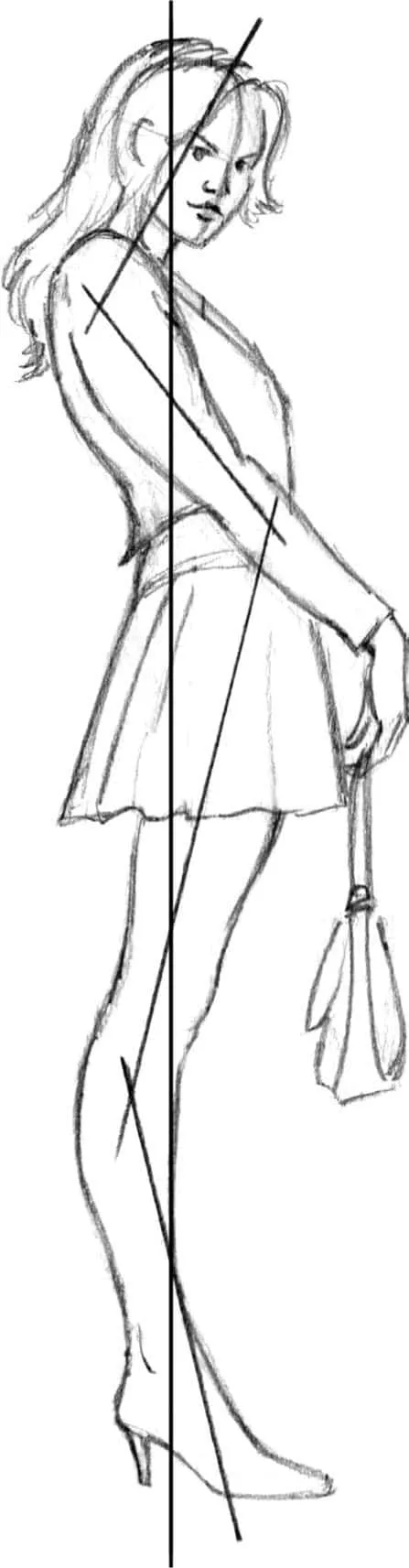
This fashion model’s pose and her high-heeled shoes exaggerate the natural curves and angles of the standing posture.
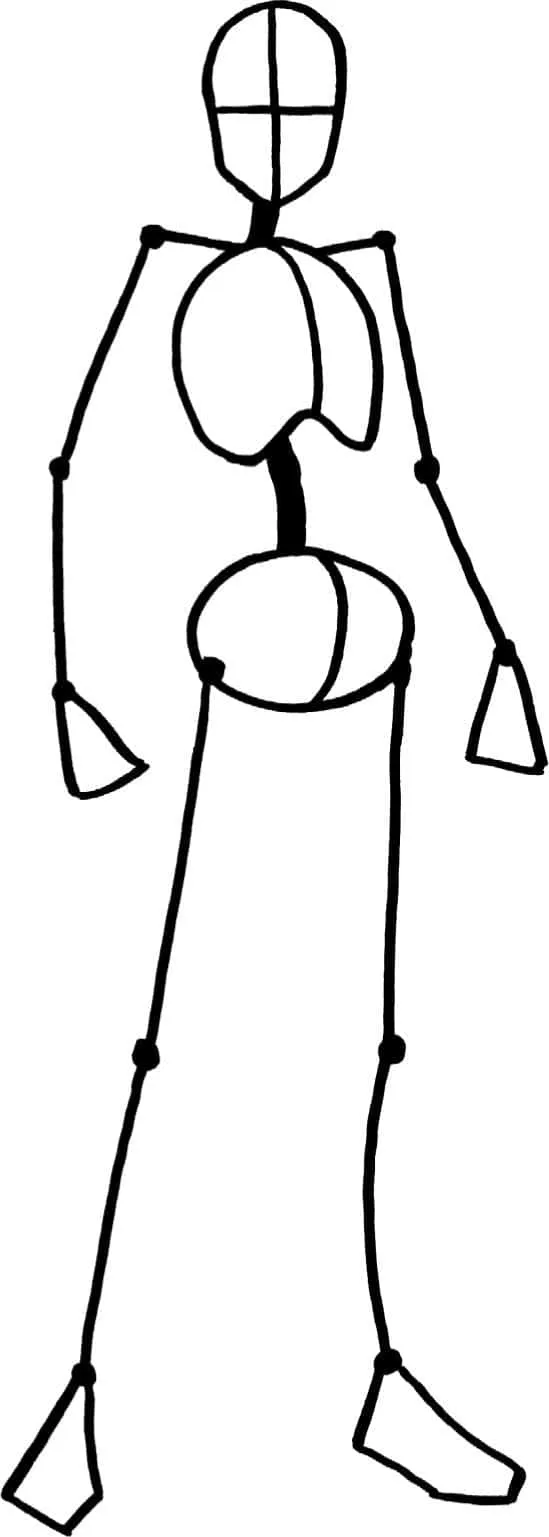
Seen from a three-quarter angle, the curve of the spine, the mass of the chest and hips and the general thrust of weight in the posture are clear in what is really little more than a stick man.
The musculature
Although the skeleton can be simplified for drawing, things are not quite so easy with muscles. They are responsible for the general contours of the body and so their relative shapes and sizes are more apparent under the skin’s surface. The drawings below will help you to make sense of the confusing undulations of the body. They will be particularly useful when you come to draw figures without a model.
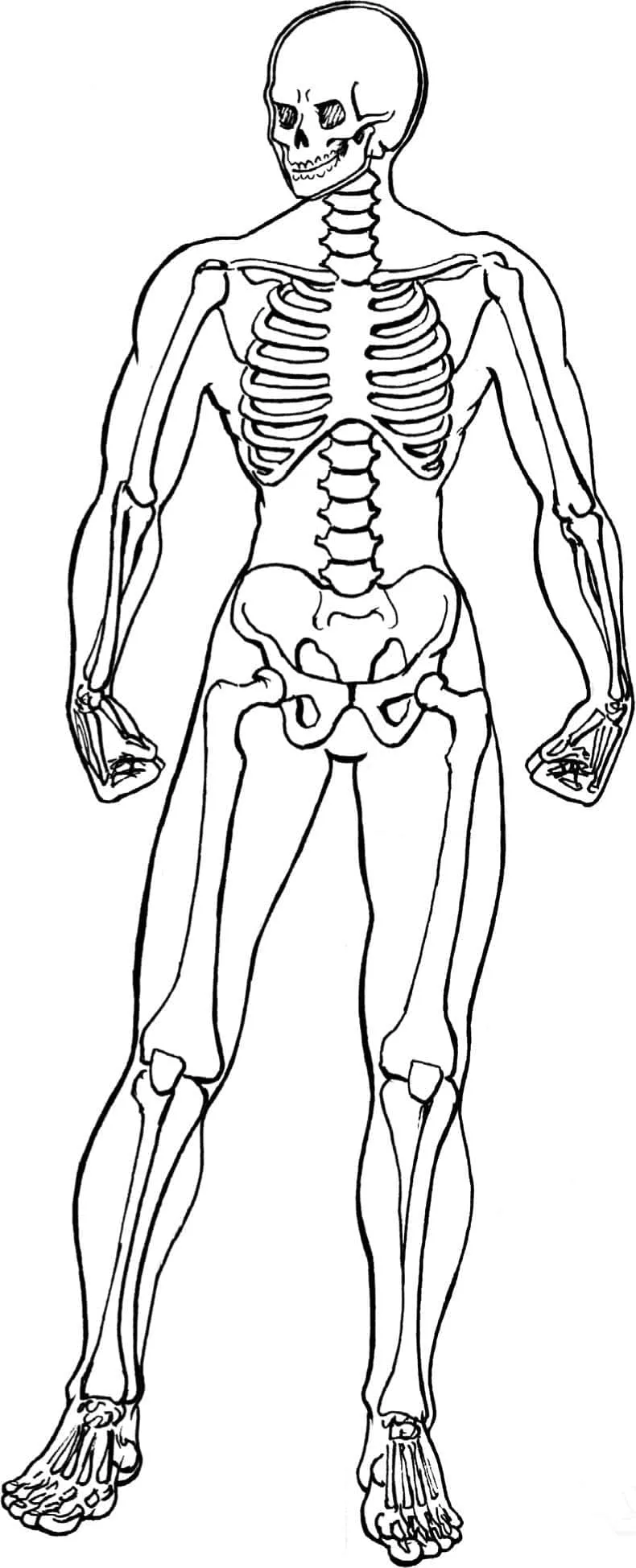
This diagram of an athletic figure shows the outline of the body around the skeleton. The musculature is distributed unevenly, being heavier around the shoulders, chest and limbs than it is around the hips and extremi...
Table of contents
- Title Page
- Dedication
- Contents
- Introduction
- The First Marks
- Objects & Observation
- Nature’s Landscape
- Going To Town
- Making Faces
- The Human Figure
- Creating Characters
- The Animal Kingdom
- Copyright
Trusted by 375,005 students
Access to over 1.5 million titles for a fair monthly price.
Study more efficiently using our study tools.
Frequently asked questions
Yes, you can cancel anytime from the Subscription tab in your account settings on the Perlego website. Your subscription will stay active until the end of your current billing period. Learn how to cancel your subscription
No, books cannot be downloaded as external files, such as PDFs, for use outside of Perlego. However, you can download books within the Perlego app for offline reading on mobile or tablet. Learn how to download books offline
Perlego offers two plans: Essential and Complete
- Essential is ideal for learners and professionals who enjoy exploring a wide range of subjects. Access the Essential Library with 800,000+ trusted titles and best-sellers across business, personal growth, and the humanities. Includes unlimited reading time and Standard Read Aloud voice.
- Complete: Perfect for advanced learners and researchers needing full, unrestricted access. Unlock 1.5M+ books across hundreds of subjects, including academic and specialized titles. The Complete Plan also includes advanced features like Premium Read Aloud and Research Assistant.
We are an online textbook subscription service, where you can get access to an entire online library for less than the price of a single book per month. With over 1.5 million books across 990+ topics, we’ve got you covered! Learn about our mission
Look out for the read-aloud symbol on your next book to see if you can listen to it. The read-aloud tool reads text aloud for you, highlighting the text as it is being read. You can pause it, speed it up and slow it down. Learn more about Read Aloud
Yes! You can use the Perlego app on both iOS and Android devices to read anytime, anywhere — even offline. Perfect for commutes or when you’re on the go.
Please note we cannot support devices running on iOS 13 and Android 7 or earlier. Learn more about using the app
Please note we cannot support devices running on iOS 13 and Android 7 or earlier. Learn more about using the app
Yes, you can access The Complete Guide to Drawing & Illustration by Peter Gray in PDF and/or ePUB format, as well as other popular books in Art & Art General. We have over 1.5 million books available in our catalogue for you to explore.