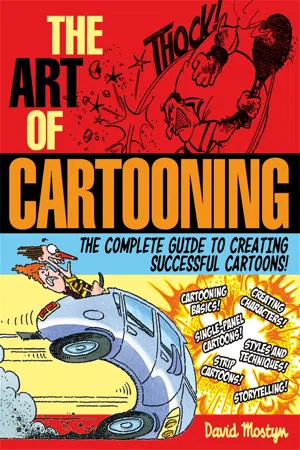
If you've always wanted to doodle your way to cartoon greatness, this eye-catching book is the place to start. Professional cartoonist David Mostyn explores the art of creating humorous drawings, from coming up with comical ideas to assembling cartoon strips in several frames. With clear visual examples, step-by-step exercises and inspirational artworks, this enjoyable guide will appeal to cartoonists of all levels of ability. Learn how to:
• Set up your workspace
• Come up with gags
• Create cartoon characters
• Get political
• Put together a strip cartoon
- English
- ePUB (mobile friendly)
- Available on iOS & Android
eBook - ePub
About this book
Information
Topic
ArtSubtopic
Art Techniques
CARTOONING THE HEAD AND BODY
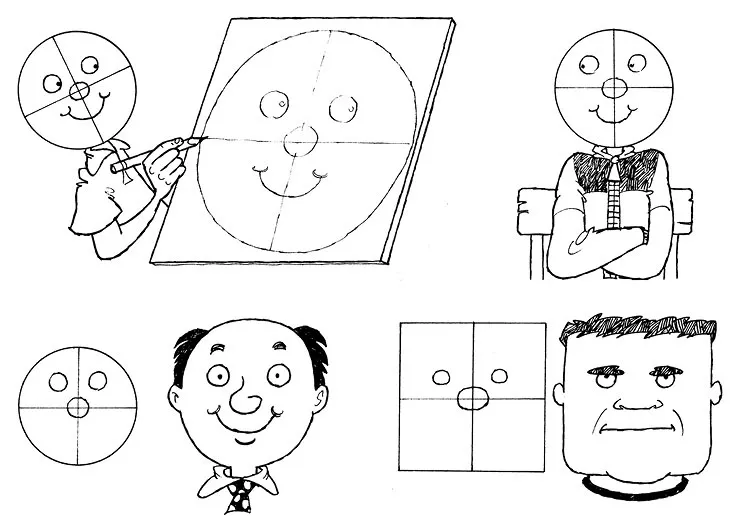
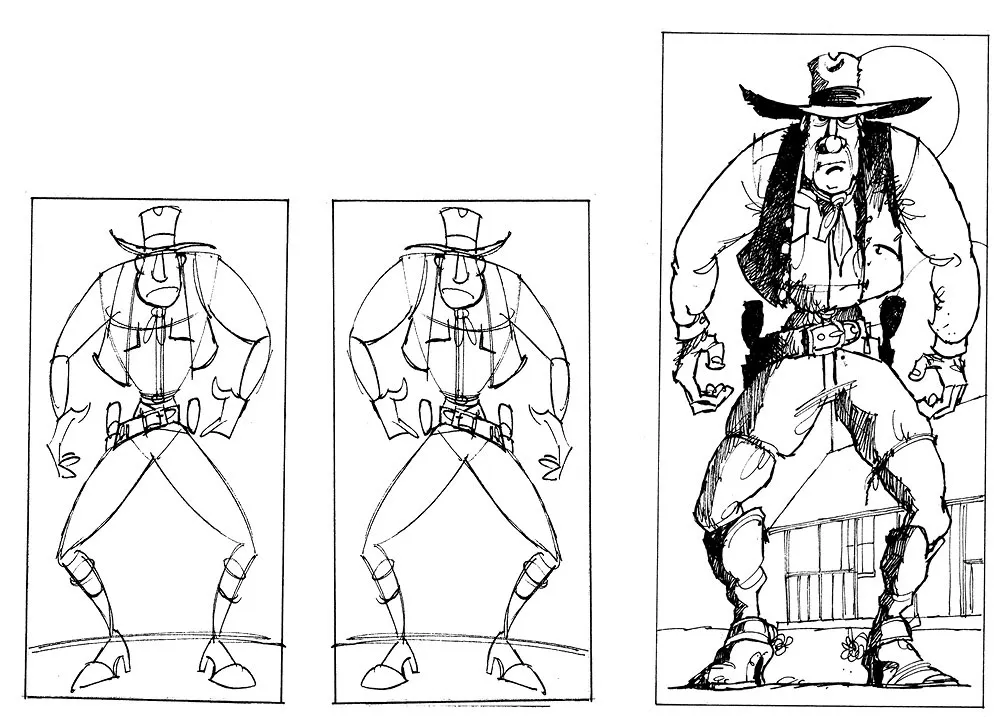
Whatever you want to draw, always start your cartoons using the same method. Whether your subject is small, tall, plump, skinny, an alien or a ghost, the preliminary steps always hold good. If you were building a house and tried to skip the foundations you wouldn’t get very far! The same applies to drawing cartoons, or indeed anything else.
First, make a basic construction before you start putting in the detail. Failing to do this is a common fault – nearly every novice cartoonist sets off by drawing an outline and hoping for the best. The simple construction method shown here helps you to make a proper start.
THE HEAD
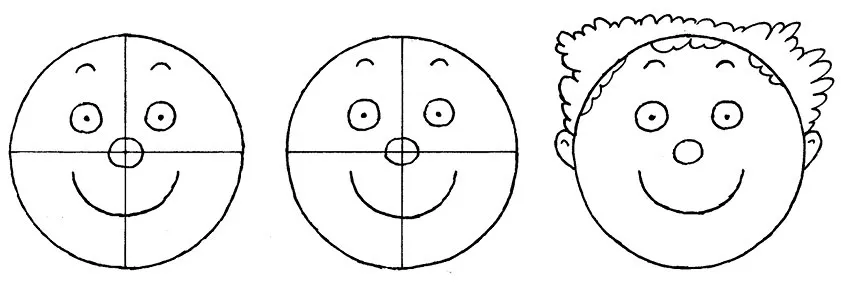
The head is obviously important because it shows the expression of your character and dictates the type of body you put in. Draw a simple circle with a rough indication of the eyes and nose. This is the basic construction which you should use in all the drawings you make.
Now imagine the kind of face you want and start building it up. Begin with the expression of the eyes and mouth (see pages 36–7) and add hair, wrinkles, warts and so forth later.
different Head shapes
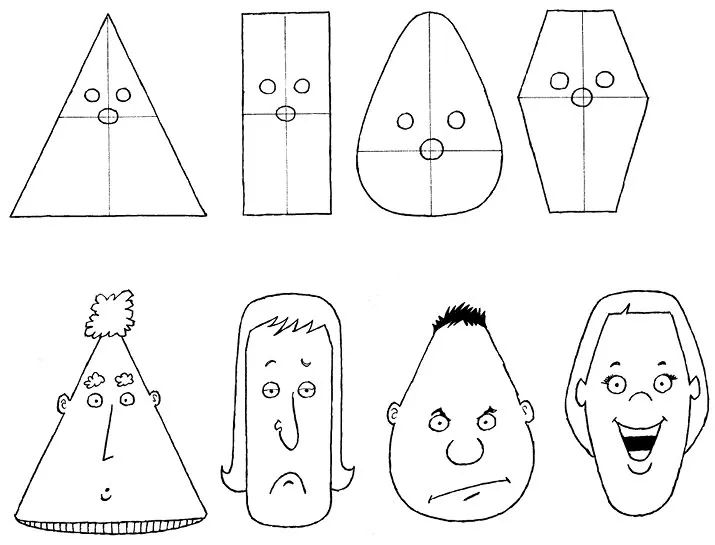
Of course not all heads are football-shaped, but fortunately you can adapt the simple construction method to draw all types of cartoon heads. Different shapes can be used for particular character types, for example a long face for a character who is often grumpy or disapproving, a square one for a macho or dumb character, and so on.
To turn or tilt the head, just go back to the basic construction, but this time move the guidelines depending on which way you want the head to go.
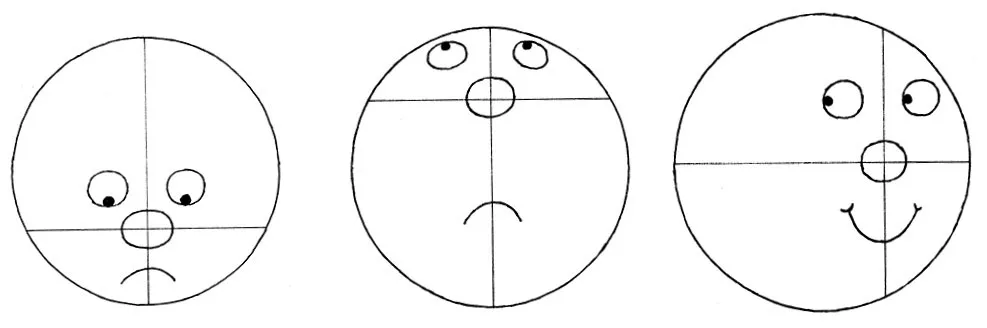
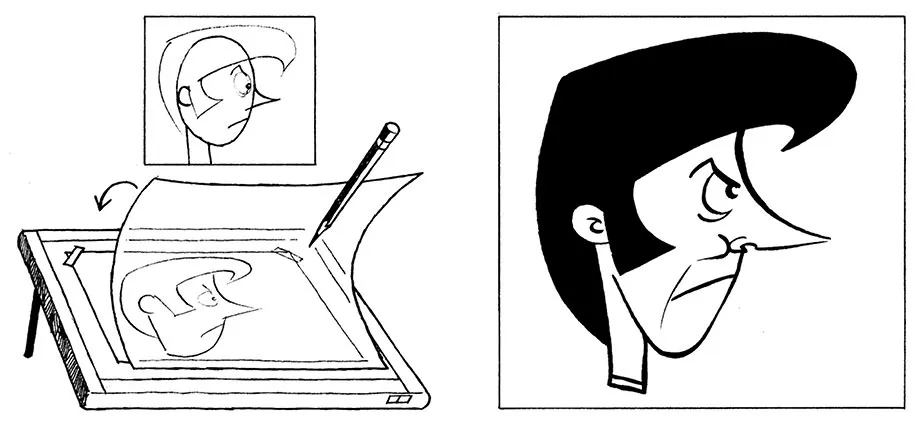
Throughout all this, keep the drawing simple. If you have a lightbox, this is where it comes in useful. When you’ve drawn the basic face and you want to produce a finished piece of artwork, tape the rough on to the lightbox, put your piece of artwork paper over the top and trace the rough. This is a good time to make small adjustments as you go along.
SYMMETRY
One trick I use to improve the drawing is to turn it over and see if it’s symmetrical, since I have a tendency to produce cartoons that lean to the right. Asymmetry isn’t necessarily going to spoil what you draw, but sometimes it helps to make the action more balanced. Once you’ve got the pencil drawing correct, ink it in with whatever medium you have chosen. (To see how to check symmetry using Photoshop, see page 121.)
facial expressions
When you come to draw facial expressions, begin with the same basic construction once more. This will give you a good template for just about any type of expression you want to draw.
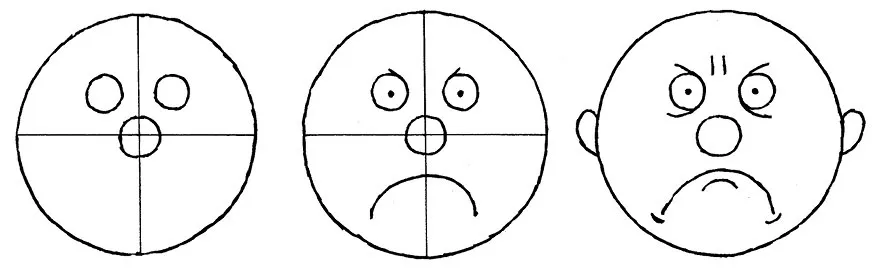
Let’s take the example of two contrasting expressions – very angry and very cheerful. Bear in mind the whole time that this is a cartoon you’re drawing, so you can be as extreme as you like.
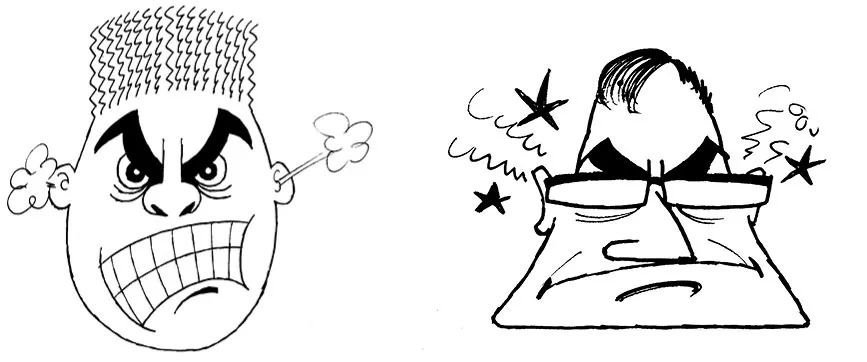
With an angry subject, every feature must show anger – even the hair. Make the eyebrows huge and thick and the eyes tiny, or perhaps put in glasses but no visible eyes at all. For added effect, you could draw steam coming out of his ears. One of the best ways to see what a face looks like with an exaggerated expression is to pull faces in a mirror – but not in public!
With a cheerful face, everything you have drawn before goes into reverse. The eyebrows go up, the eyes are well and truly open, and the mouth grins from ear to ear. Try to make even the hair look cheerful.
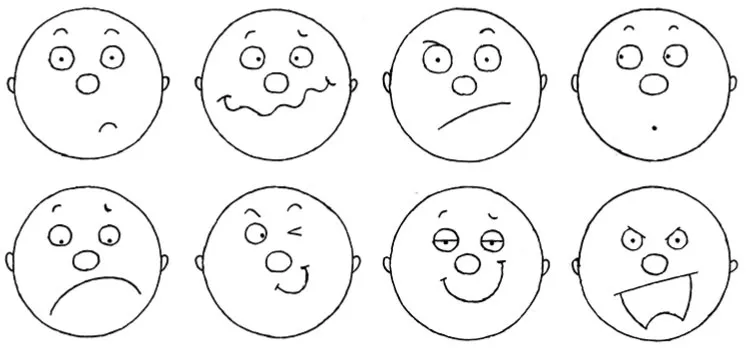
The most important point to remember when you’re creating these expressions is not to confuse the drawing by putting in too much. Look at the examples here: the expressions have been put in using the minimum of line.
Expressive Features: Eyes
Eyes are perhaps the most expressive of all the features, and cartoon eyes are no exception. Experiment with eyes of different shapes and pupils of varying sizes,...
Table of contents
- Title Page
- Dedication
- Contents
- Introduction
- Basics and Getting Started
- Cartoon Characters: People and Animals
- The Elements of Your Cartoon
- Different Types of Cartoon
- Computer Technology
- Conclusion
- Copyright
Trusted by 375,005 students
Access to over 1.5 million titles for a fair monthly price.
Study more efficiently using our study tools.
Frequently asked questions
Yes, you can cancel anytime from the Subscription tab in your account settings on the Perlego website. Your subscription will stay active until the end of your current billing period. Learn how to cancel your subscription
No, books cannot be downloaded as external files, such as PDFs, for use outside of Perlego. However, you can download books within the Perlego app for offline reading on mobile or tablet. Learn how to download books offline
Perlego offers two plans: Essential and Complete
- Essential is ideal for learners and professionals who enjoy exploring a wide range of subjects. Access the Essential Library with 800,000+ trusted titles and best-sellers across business, personal growth, and the humanities. Includes unlimited reading time and Standard Read Aloud voice.
- Complete: Perfect for advanced learners and researchers needing full, unrestricted access. Unlock 1.5M+ books across hundreds of subjects, including academic and specialized titles. The Complete Plan also includes advanced features like Premium Read Aloud and Research Assistant.
We are an online textbook subscription service, where you can get access to an entire online library for less than the price of a single book per month. With over 1.5 million books across 990+ topics, we’ve got you covered! Learn about our mission
Look out for the read-aloud symbol on your next book to see if you can listen to it. The read-aloud tool reads text aloud for you, highlighting the text as it is being read. You can pause it, speed it up and slow it down. Learn more about Read Aloud
Yes! You can use the Perlego app on both iOS and Android devices to read anytime, anywhere — even offline. Perfect for commutes or when you’re on the go.
Please note we cannot support devices running on iOS 13 and Android 7 or earlier. Learn more about using the app
Please note we cannot support devices running on iOS 13 and Android 7 or earlier. Learn more about using the app
Yes, you can access The Art of Cartooning by David Mostyn in PDF and/or ePUB format, as well as other popular books in Art & Art Techniques. We have over 1.5 million books available in our catalogue for you to explore.