For centuries, landscapes have captivated the imaginations of artists. For the amateur artist, the sheer scope of the landscape may seem daunting - whether it's a stunning view of unspoilt countryside, a city street, or the view outside your window. So where do you start?
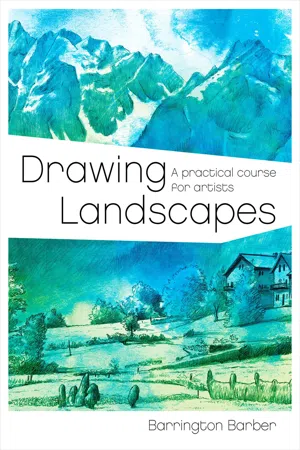
In Drawing Landscapes, artist and teacher Barrington Barber outlines the key areas to master and guides you through the skills you need to become an accomplished landscape artist.
• Includes information on materials, techniques, and styles
• Explains the core fundamentals of perspective, foreground, middleground, and background
• Looks at the basic elements of a landscape such as sky, water, mountains, and vegetation
• Offers step-by-step drawings and exercises to practise
- English
- ePUB (mobile friendly)
- Available on iOS & Android
eBook - ePub
About this book
Information
Topic
KunstSubtopic
Kunst AllgemeinBasic Elements of Landscape
When we begin to study landscape the sheer amount of material available can be confusing and it can be difficult to know where to start. The first step is to identify the components we are contemplating drawing starting with the vegetation and how it clothes the landscape. Next consider the underlying structure of a scene, which is evident from the formation of rocks, hills and mountains. Water provides a large part of many landscapes. Still or moving, it is extremely important, on account of the brightness and reflection it gives within the shape of the countryside. At the edge of the land you may be able to view the sea and this can be considered almost as a separate entity, so great can be its role. The sky is the backdrop to everything and is constantly changing to give a new look to the substance of the landscape.
Your awareness of the make-up of the landscape will become second nature and part of the enjoyment you get from drawing. Keep looking and allow your view to both differentiate and harmonize all the various parts you are drawing.
Trees in the landscape
When tackling a landscape with trees, beginning artists often make the mistake of thinking they must draw on every leaf. Survey such a scene with your naked eye and you will discover that you can’t see the foliage well enough to do this. You need to be bold and simplify and observe the general appearance of different trees. The following series of drawings is intended to help capture the shapes of a range of common trees seen in full foliage and from a distance. You can see that differences in leaf type are indicated by marking the general texture and shape.
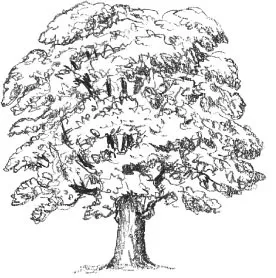
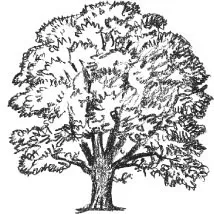
Oak
The Oak makes a compact, chunky cloud-like shape, with leaves closely grouped on the mass of the tree.
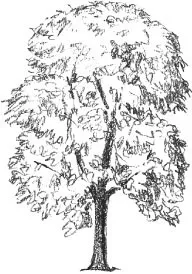
Ash
By contrast the Ash is much more feathery in appearance.
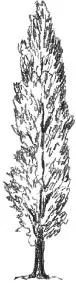
Lombardy poplar
The Poplar is indicated by long, flowing marks in an upwards direction.
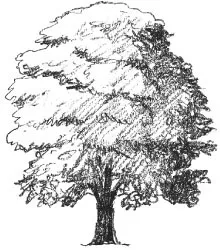
Horse chestnut
Some trees, such as the Horse Chestnut, can be blocked in very simply, just needing a certain amount of shading to indicate the masses.
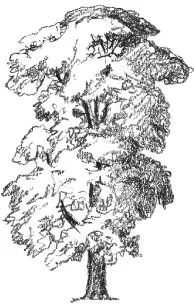
Elm
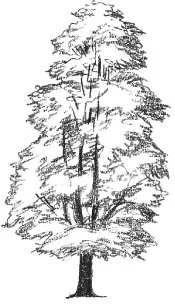
Lime
The Elm and Lime are very similar in structure. The way to tell them apart is to note the differences in the way their leaves layer and form clumps.
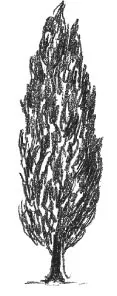
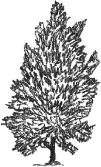
Cypress
The Cypress holds itself tightly together in a flowing, flame-like shape; very controlled and with a sharp outline.
Walnut
The Walnut requires scrawling, tight lines to give an effect of its leaf texture.
Holly
The Holly tree is shaped like an explosion, its dark, spiky leaves all outward movement in an expressive organic thrust.
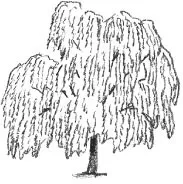
Weeping willow
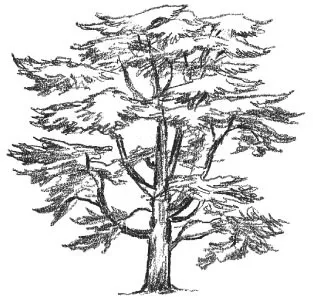
Cedar of Lebanon
You will also have to take note of where a darker or lighter weight of line or tone is required. Compare, for example, the weight of line needed for trees with dense dark leaves, such as the Cypress and Holly, with the light tone appropriate to the Willow and Cedar.
Foliage: the classical approach
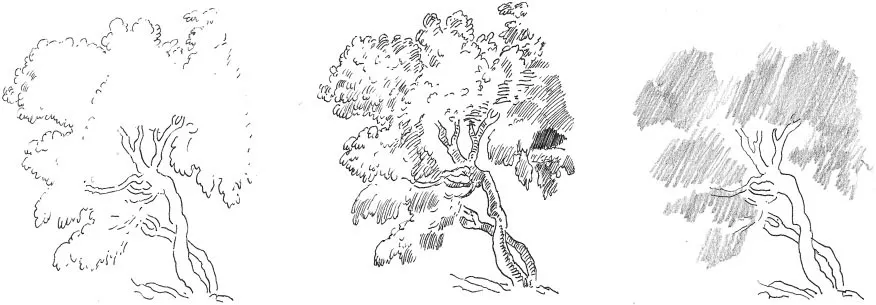
Drawing trees can be quite daunting when first attempted. It is a common misconception that every leaf has to be drawn. This is not the case. In the next few examples you will find depictions by Italian, French and Dutch masters which demonstrate how to solve the problem of showing masses of small shapes that build up to make larger, more generalized outlines.
In these examples a lively effect of plant growth is achieved by the use of vigorous smudges, brushed lines and washes, and finely detailed penlines, often in combination.
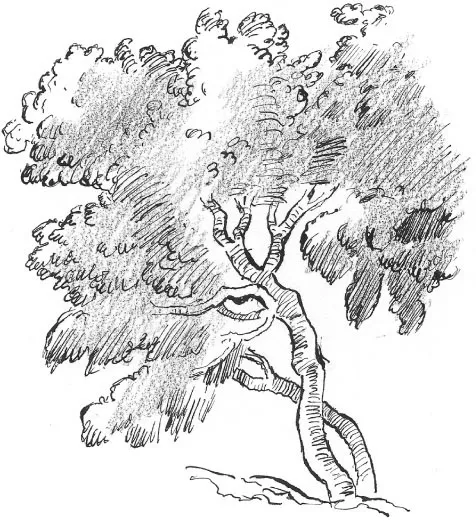
Notice the soft, almost cloud-like outline given to the groups of foliage in this example after Titian (drawn in pen, ink and chalk). No individual leaves are actually shown. Smudges and lines of tone make patches of light which give an impression of thick bunches of leaves. The branches disappear into the bulging form, stopping where the foliage looks most dense.
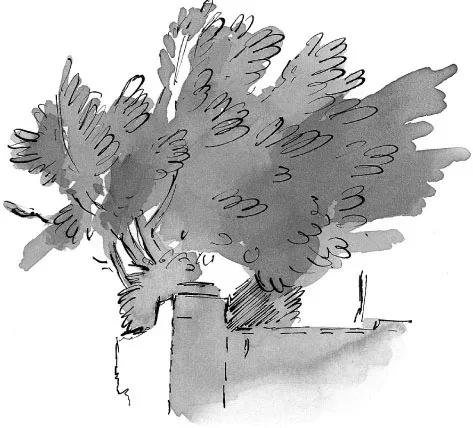
Despite the minimal drawing, this example after Giovanni Battista Tiepolo (in pen and ink) is very effective. The solidity of the wall has been achieved...
Table of contents
- Cover
- Title Page
- Contents
- Introduction
- Starting Points
- Structure and Anatomy of Landscape
- Materials and Their Uses
- Basic Elements of Landscape
- Manipulating Space
- Special Places
- Imaginary and Symbolic Landscapes
- Creating a Landscape
- Copyright
Trusted by 375,005 students
Access to over 1.5 million titles for a fair monthly price.
Study more efficiently using our study tools.
Frequently asked questions
Yes, you can cancel anytime from the Subscription tab in your account settings on the Perlego website. Your subscription will stay active until the end of your current billing period. Learn how to cancel your subscription
No, books cannot be downloaded as external files, such as PDFs, for use outside of Perlego. However, you can download books within the Perlego app for offline reading on mobile or tablet. Learn how to download books offline
Perlego offers two plans: Essential and Complete
- Essential is ideal for learners and professionals who enjoy exploring a wide range of subjects. Access the Essential Library with 800,000+ trusted titles and best-sellers across business, personal growth, and the humanities. Includes unlimited reading time and Standard Read Aloud voice.
- Complete: Perfect for advanced learners and researchers needing full, unrestricted access. Unlock 1.5M+ books across hundreds of subjects, including academic and specialized titles. The Complete Plan also includes advanced features like Premium Read Aloud and Research Assistant.
We are an online textbook subscription service, where you can get access to an entire online library for less than the price of a single book per month. With over 1.5 million books across 990+ topics, we’ve got you covered! Learn about our mission
Look out for the read-aloud symbol on your next book to see if you can listen to it. The read-aloud tool reads text aloud for you, highlighting the text as it is being read. You can pause it, speed it up and slow it down. Learn more about Read Aloud
Yes! You can use the Perlego app on both iOS and Android devices to read anytime, anywhere — even offline. Perfect for commutes or when you’re on the go.
Please note we cannot support devices running on iOS 13 and Android 7 or earlier. Learn more about using the app
Please note we cannot support devices running on iOS 13 and Android 7 or earlier. Learn more about using the app
Yes, you can access Drawing Landscapes by Barrington Barber in PDF and/or ePUB format, as well as other popular books in Kunst & Kunst Allgemein. We have over 1.5 million books available in our catalogue for you to explore.