As the Nazi advance across Europe stalled, Adolf Hitler repeatedly told his military advisers and inner circle that Germany possessed Wunderwaffen - miracle weapons - that would turn the tide and bring the Germans ultimate victory. But was he simply boasting out of desperation, or were the 'miracle weapons' real?
Ideas that other governments considered too outrageous were funded by the Third Reich. At this time, German scientists and engineers led the world in the fields of aviation research, rocketry, and the quest for alternative sources of energy. They even came perilously close to beating the British and Americans in the search to build the first atomic bomb.
This book describes the Nazis' secret plans to produce weapons of mass destruction, and shows how they almost succeeded in defeating the Allies in World War II.
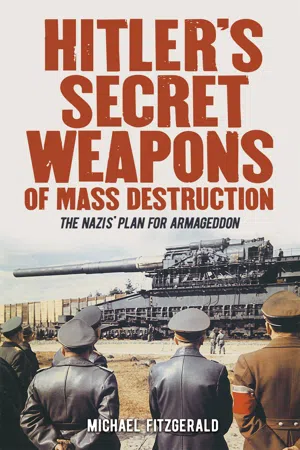
eBook - ePub
Hitler's Secret Weapons of Mass Destruction
The Nazi Plan for Final Victory
- English
- ePUB (mobile friendly)
- Available on iOS & Android
eBook - ePub
About this book
Information
Chapter One
Scientific Research and Development
Self-sufficiency drive
When the Nazis came to power in 1933, the German economy was in recession, with high unemployment and a shortage of raw materials. The currency was weak and, although the regime had promised to bring down unemployment and make the economy strong once more, most observers thought it would be impossible to achieve these aims quickly.
The poverty of the previous four years was one of the main reasons why the German people turned away from the traditional parties and towards the Nazis and the Communists. Cold and hunger were affecting millions of Germans when Hitler came to power and he recognized the need to address these issues urgently. Consequently, the Nazi regime quickly pursued new economic measures and public works programmes to improve the situation and, more importantly for them, their own standing.
Hitler’s ‘economic miracle’ appeared to be working. In 1933, when Hitler became Chancellor, there were six million unemployed and three years later there was full employment. At that point, many Germans regarded ‘work and bread’ as being a fair exchange for the loss of civil liberties.
In spite of Hitler’s lack of knowledge and understanding of science, he grasped the need for scientists and engineers to develop technologically advanced projects to help in his goal of making Germany powerful again. As a result, the Nazis tried many unconventional ideas, some of which proved strikingly successful. Nazi policy was to encourage the development of science and technology as rapidly as possible, primarily with military purposes in mind.
In 1933 Germany had few raw materials and was economically dependent on imports for most of its produce and resources, so the desire for ‘autarky’ – economic self-sufficiency – was a key policy of the Nazi government. These constraints were at least partly responsible for the willingness of the Nazis to fund the quest for ‘alternative’ sources of fuel and energy, no matter how bizarre they might appear. The relative shortage of fuel and most other raw materials also encouraged research and development into forms of propulsion that were less reliant upon petrol. As a result, German science began to evolve in an entirely different way from the rest of the world.
The increasing isolation of German scientists and the difficulties of producing raw materials within Germany led to the development of ersatz – substitute – products. Wilhelm Keppler, an industrialist and engineer, was directly appointed by Hitler to identify or create as many alternative or synthetic forms of raw materials such as oils, fats, metals and rubber as possible. Buna (the ersatz rubber) was particularly successful.4 Synthetic textiles and metals were also developed.
The hope was not only to make Germany self-sufficient in raw materials but also to make the production of military weapons and the manufacturing infrastructure needed to support it as cheap as possible. This objective, combined with the willingness to explore unorthodox scientific ideas, led to numerous experiments that were not even considered worth investigating by the Western powers. Before the war, these experiments were carried out by paid workers and with primarily civilian applications, but once hostilities commenced the focus shifted to largely military purposes and a heavier reliance on slave labour.
Chemists were called upon to create and improve techniques for manufacturing synthetic versions of coffee, petrol and rubber and factories were built to produce these new ersatz products. IG Farben, the chemical and pharmaceutical industry conglomerate, was called upon to lend its expertise, making fundamental contributions to this field.
Synthetic rubber
Germany was the first nation to begin developing synthetic rubber. The team at the Bayer laboratory in Elberfeld, led by award-winning chemist Fritz Hofmann, succeeded in creating isoprene in 1909, the first synthetic rubber.5 The growing popularity of motor cars led to considerable research being devoted to this field and the First World War acted as a catalyst for its application in other fields. Russia, short of natural rubber resources, invested considerably in developing synthetic alternatives during the war and Germany, faced with a similar problem, also began to develop synthetic rubber for military purposes.
In 1915, German chemists studied the researches of Hofmann and his factory and tried to apply them to armoured vehicles and tanks. They were faced with several difficulties which were never satisfactorily overcome.
The first was that the raw materials necessary for producing methyl isoprene – acetone and aluminium – were more essential in other areas of the war. Acetone was needed to make explosives and aluminium was used to build aircraft motors and airships. The supply of acetone from wood or acetate of lime was limited and synthesizing it from acetic acid was also problematic, because the acetic acid was derived from fermenting grain and grain served as an essential food supply for the troops. After a series of failed trials with rotten potatoes a method involving coal and lime was developed. Three different systems were employed, depending on the intended use of the isoprene. One involved leaving it to stand in tin drums at a temperature of 30 degrees Celsius for between six and 19 weeks. This resulted in the formation of ‘H-rubber’ – hard rubber. The rubber produced by this process was used in cases for electrical equipment or battery boxes for submarines.
A second method was to place the isoprene in iron drums at 70 degrees Celsius for between three and six months. This led to the production of ‘W-rubber’ – ‘weich’ (soft) – which was used for tyres, hoses, belts and any other products where flexibility was needed. A third method was to allow the isoprene to stand in an atmosphere of carbon dioxide while in contact with sodium wire. This resulted in ‘B-rubber’, which was used to coat balloon fabric or to insulate wires.
None of these synthetic forms of rubber was adequate but the Germans had little alternative. They managed to produce 150 tons (136 tonnes) of methyl rubber every month by the end of the war and a total of 2,500 tons (2,268 tonnes) in all. Several factories were built to produce the synthetic material but when the war ended production ceased abruptly. Both the military and the factories knew that the quality of rubber obtained by these processes was inadequate and they returned to the natural product as soon as hostilities were over.6
That was the end of the synthetic rubber quest for some years, at least in Germany. Then in 1930 Hermann Staudinger published a paper on developing synthetic rubber. His work was seized upon by the American company Du Pont and on the basis of Staudinger’s findings they developed a new material, neoprene.7
The Nazis then began to encourage new methods of developing and processing synthetic rubber and by April 1936 the Buna company was set up in Schkopau. The Schkopau factory was part of the Leuna chemical group, yet another subsidiary of the IG Farben industrial complex, and by 1937 it was producing synthetic rubber as well as PVC, THF, acetic acid, acetone, acetic anhydride and trichloroethylene.
During the Second World War the Schkopau plant became the principal producer of synthetic rubber. It also ran the Monowitz-Buna factory section of Auschwitz, where slave workers were forced to produce synthetic oil and rubber. The conditions under which they worked were so extreme that their life expectancy was only a few months.8
When the Allies launched the Operation Pointblank series of bombing raids on Germany, the Schkopau factory and other synthetic rubber plants were heavily targeted. Much of the infrastructure was destroyed by the bombing and what remained of the Schkopau plant was captured by the Soviets.9
Fuel from coal
The earliest example of the direct conversion of coal into synthetic fuel was developed in Germany by future Nobel Prize winner Friedrich Bergius, who took out a patent for the process in 1913. In 1914 the chemist and entrepreneur Karl Goldschmidt recruited Bergius to build a plant at his factory and by 1919 the production of synthetic fuel from coal had begun.10 Before long the factories were developing and refining the process and an increasing percentage of German energy needs began to be met by converting coal into synthetic fuel.
The attempt to produce petrol from coal was one key area in which large factories sought to convert one of Germany’s few natural resources – coal – into one it lacked – petroleum. Two different techniques were used. One was the Bergius process, which was the method used by IG Farben, and the other was known as the Fischer process. This method of deriving petrol from coal was developed by Dr Franz Fischer of the Kaiser-Wilhelm-Institut für Kohleforschung. Fischer and fellow chemist Hans Tropsch devised their process as early as 1923, turning coal into gas which was then used as a synthetic fuel.
From 1936, the Braunkohle Benzin AG (BRABAG) group of companies also turned out petrol from coal. These processes were carried out at the Leuna works and other factories and the synthetic fuel was sold through the Leuna petrol pumps. By 1937 enough had been manufactured to enable German cars to run on a mixture that was 40 per cent home-produced petrol. The Leuna plant alone produced a third of a million tons a year and by 1938 five new plants had opened to produce petrol from coal.11 The drive for autarky in fuel and raw materials accelerated as the likelihood of war drew nearer.
During the Second World War the Bergius and Fischer processes were extensively used to produce ersatz oil from coal or water gas. The Bergius plants became the leading source of aviation fuel and other synthetic raw materials or fuels and by 1944 synthetic fuel production resulted in 124,000 barrels of fuel each day from the 25 processing plants. During the war 18 million tons of fuel (16.3m tonnes) were produced from coal or tar sources and a further four million from the Fischer–Tropsch synthesis.12
Another way of turning coal into fuel was the Schichau process, in which coal was reduced to a powder. By 1937, it was claimed that this had been successfully achieved. The idea was that by reducing coal to as fine a density as face powder it would be possible for it to behave nearly as effectively as a natural gas. Pieces of coal were crushed between balls or rollers and the raw coal was fed into the pulverizer, together with air heated to an extremely high temperature. The hot air dried the crushed coal and blew the powder out in the form of usable coal fuel, which was then mixed with pre-heated air and expelled via a nozzle to create a kind of ‘fuel injection’ system. This produced enough heat to ignite the fuel.13
In July 1944, because of the extensive destruction of facilities by Allied bombing, the Germans began to develop the ‘Cuckoo’ project, an underground plant to produce synthetic oil. Construction began north of the Mittelwerk factory (which was built into a hill called the Kohnstein, near Nordhausen) but it was still unfinished when the war ended.14
Synthetic fuel was never able to play the dominant role in generating energy that the Nazis hoped. Before the war, they remained hugely dependent on imported oil from Romania and other countries and during the war they ruthlessly stripped the conquered nations of their natural resources to ameliorate the situation in Germany. None of these policies could overcome the fundamental problem of lack of natural resources within Germany, however. In spite of systematic plunder and scientific ingenuity, Germany remained handicapped by the shortage of the raw materials necessary for it to conduct war effectively.
Wood was also processed as a substitute for petrol. The results of these developments were described as ‘satisfactory’ and in 1937 a German mo...
Table of contents
- Title Page
- Contents
- Introduction
- Chapter Two • Aviation Development
- Chapter Three • Rocket Development
- Chapter Four • Rockets at War
- Chapter Five • The Mystery of the Foo Fighters
- Chapter Six • Flying Discs
- Chapter Seven • The Nazi Nuclear Programme
- Chapter Eight • The Bell
- Chapter Nine • Experimental Science
- Chapter Ten • The Human Cost
- Conclusion
- References
- Picture Credits
Trusted by 375,005 students
Access to over 1.5 million titles for a fair monthly price.
Study more efficiently using our study tools.
Frequently asked questions
Yes, you can cancel anytime from the Subscription tab in your account settings on the Perlego website. Your subscription will stay active until the end of your current billing period. Learn how to cancel your subscription
No, books cannot be downloaded as external files, such as PDFs, for use outside of Perlego. However, you can download books within the Perlego app for offline reading on mobile or tablet. Learn how to download books offline
Perlego offers two plans: Essential and Complete
- Essential is ideal for learners and professionals who enjoy exploring a wide range of subjects. Access the Essential Library with 800,000+ trusted titles and best-sellers across business, personal growth, and the humanities. Includes unlimited reading time and Standard Read Aloud voice.
- Complete: Perfect for advanced learners and researchers needing full, unrestricted access. Unlock 1.5M+ books across hundreds of subjects, including academic and specialized titles. The Complete Plan also includes advanced features like Premium Read Aloud and Research Assistant.
We are an online textbook subscription service, where you can get access to an entire online library for less than the price of a single book per month. With over 1.5 million books across 990+ topics, we’ve got you covered! Learn about our mission
Look out for the read-aloud symbol on your next book to see if you can listen to it. The read-aloud tool reads text aloud for you, highlighting the text as it is being read. You can pause it, speed it up and slow it down. Learn more about Read Aloud
Yes! You can use the Perlego app on both iOS and Android devices to read anytime, anywhere — even offline. Perfect for commutes or when you’re on the go.
Please note we cannot support devices running on iOS 13 and Android 7 or earlier. Learn more about using the app
Please note we cannot support devices running on iOS 13 and Android 7 or earlier. Learn more about using the app
Yes, you can access Hitler's Secret Weapons of Mass Destruction by Michael FitzGerald in PDF and/or ePUB format, as well as other popular books in History & Military & Maritime History. We have over 1.5 million books available in our catalogue for you to explore.