Sketching is a wonderful pastime and a great way to build up your drawing skills. You can use it to record your experiences and subjects that interest you, just by jotting down an impression in your sketchbook.
In this inspiring manual, artist Vivienne Coleman guides you through a variety of subjects in easy, confidence-building steps. She shows you how to do complete drawings in just a few minutes, so that you can make sketching part of your daily life. She also demonstrates how sketches can be developed into more detailed work. From pets and people to landscape and urban scenes, this book reveals how versatile and exciting sketching can be. It features:
• ten-minute sketch ideas
• essential drawing techniques
• sketching at home and on the move
• step-by-step instruction
- English
- ePUB (mobile friendly)
- Available on iOS & Android
eBook - ePub
About this book
Information
Topic
ArteSubtopic
Arte generalChapter 1
Getting Started
In this chapter we shall look at the basic things you’ll need to start sketching and how you’ll make those first marks on paper. The aim is to keep things easy and simple. Don’t worry if you’re a complete beginner, for the exercises will take you from first steps to competent sketching in easy stages with plenty of examples to try along the way.
To start with, we’ll look at sketching materials such as pencil, charcoal, graphite and pen and how you can use these to create various effects on the page. As you learn different techniques you’ll be given the opportunity to experiment so that you can discover your favourite ways of working and develop your own style.
We’ll look at lines and shapes and how to bring these to life with light and dark tones to create volume and realism, and you’ll also begin to look at things in a new way.
Many exercises are designed to be completed in only a few minutes, so you can practise only a little while every day if that suits you.

Basic materials
You may be surprised to learn how few materials you really need to begin sketching – in fact, just a pencil or pen and some paper! Of course, these are available in different forms, so we’ll look at a range of these basic sketching materials which are lightweight, relatively inexpensive and easy to obtain so it’s easy for you to sketch wherever you happen to be.
Pencils and pens
The first step is to choose something to make marks with. Shown here is a selection of sketching tools along with the different marks they make on the page.
If you’re inspired to do a quick sketch but don’t have your usual sketching tools with you, don’t worry! Just have a look around and see what’s nearby – perhaps something from your bag or desk such as a biro or pencil, or even a marker pen.
Notice the differences and similarities between the marks, which vary from thick to thin (marker pen vs biro) and from dark to light (charcoal vs pencil). In the following pages you’ll discover how to use these tools to create different effects, for example, a pencil for finer detail but a thick permanent marker pen for large, bold and expressive marks.
Graphite pencils are available in different grades, ranging from very hard and fine (9H) to very black and soft (9B). ‘H’ stands for ‘Hard’ and ‘B’ for ‘Black’. Throughout this book, for simplicity, we’ll use a mid-range pencil grade (HB: Hard and Black) because it’s commonly available, versatile and perfect for sketching.

Different sketching tools and the marks they make Left to right: graphite pencil; revolving/mechanical pencil; clutch pencil; woodless graphite pencil; biro; felt-tip pen (grey); brush pen; calligraphy fountain pen; fineliner or drawing pen; permanent marker pen (medium); permanent marker pen (thick); charcoal pencil; charcoal sticks.
There are advantages and disadvantages with any sketching tool. For example, fineliner and permanent marker pens make crisp, mono-tonal but permanent marks, so you cannot correct mistakes; whereas pencils and graphite pencils make multi-tonal marks that can be easily erased. The best thing to do is experiment to find your favourites.
Paper
Paper is available in all shapes and sizes, from flat sheets, sketch pads and bound sketchbooks to large rolls. Smaller sketchbooks are ideal for sketching when you’re out and about, particularly spiral-bound ones that allow you to fold the book back on itself, thus avoiding the pages trying to close as you sketch. Loose, flat sheets and larger sketchbooks are better suited to sketching large-scale work indoors.
Paper is available in different thicknesses (or weights). You’ll usually find this information on the sketchbook cover or the packaging of loose paper, written as grams per square metre (gsm) or pounds (lb) per ream (500 sheets). Papers range from thin 80gsm (50lb) to better quality, thicker 200gsm (120lb). Boards tend to be heavier (thickness measured in microns, 1,000 of a millimetre) and the higher the value, the thicker the board. Thicker paper tends to be more expensive and is not necessary for most sketching; cartridge paper (120–130gsm/75–80lb) is generally fine for the purpose.
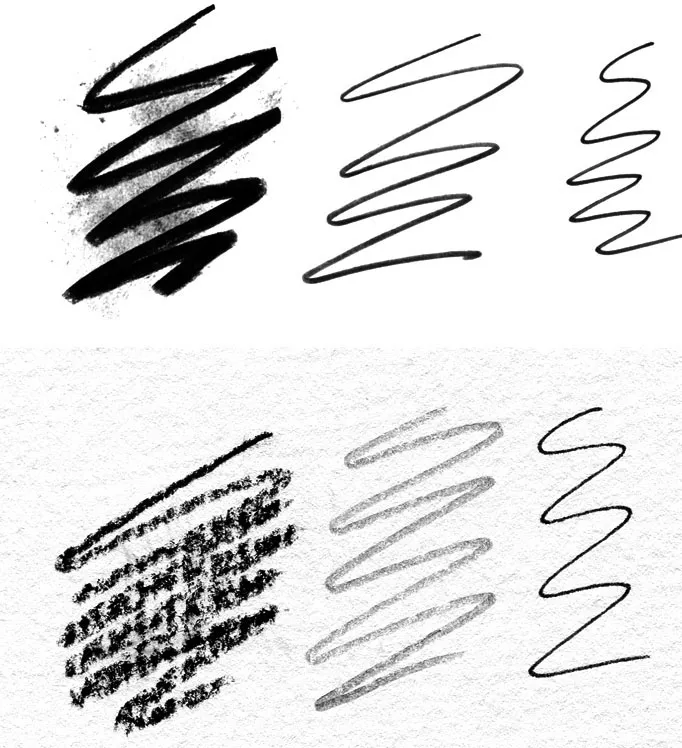
Smooth (top) and rough (bottom) surface texture with three sketching tools: charcoal, HB pencil and ink pen.
Paper may have a smooth surface (such as Bristol board) or a rough one (for example, the rough grade of watercolour paper). Smooth paper is great for ink and graphite but it’s harder to create different tones than on a rougher surface; charcoal can easily become smudged as it doesn’t really adhere to the paper surface (see how it’s smudged in the figure above). Rough-textured paper has more surface ‘grip’ (or ‘tooth’), is better for charcoal, and can result in interesting textures from both pencil and ink.
Of course, you can sketch on anything. Years ago and with time to kill, I sketched my surroundings on the only available paper – the inside of a thin paper bag. It was not ideal as it had images of hardware goods printed all over the other side!
Scrap paper is very useful for trying out ideas. If you’re feeling adventurous, why not try sketching on coloured, patterned or graph paper?
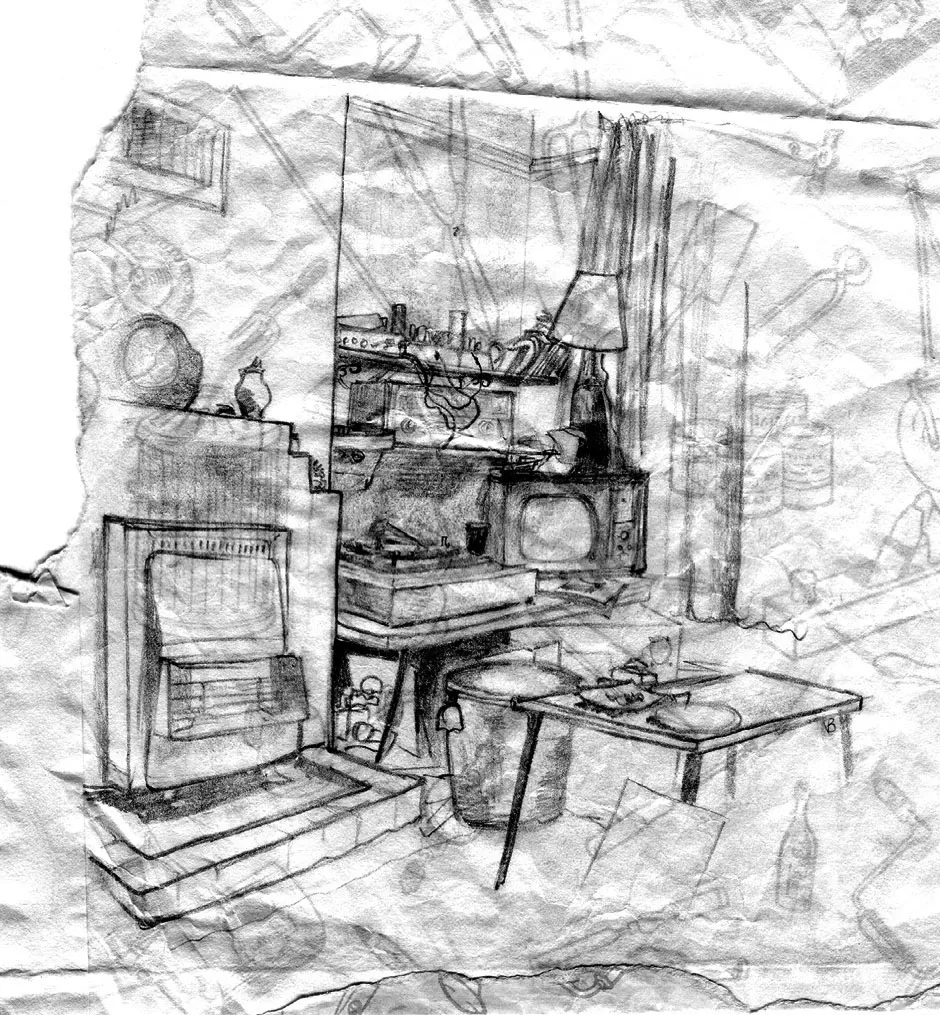
Sketch on a paper bag.
Erasers and sharpeners
When sketching you probably won’t need (or have time) to use an eraser, but it’s good to have one handy. A plastic or vinyl eraser may be a block, pencil, or end-of-pencil eraser; in each form it will remove most unwanted marks cleanly and completely. These erasers can be cut into smaller pieces for precisio...
Table of contents
- Title Page
- Dedication
- Contents
- Introduction
- Chapter 1: Getting Started
- Chapter 2: First Sketches
- Chapter 3: Sketching the Outdoors
- Chapter 4: Animals
- Chapter 5: People
- Chapter 6: Urban Sketching
- Summary
- Copyright
Trusted by 375,005 students
Access to over 1.5 million titles for a fair monthly price.
Study more efficiently using our study tools.
Frequently asked questions
Yes, you can cancel anytime from the Subscription tab in your account settings on the Perlego website. Your subscription will stay active until the end of your current billing period. Learn how to cancel your subscription
No, books cannot be downloaded as external files, such as PDFs, for use outside of Perlego. However, you can download books within the Perlego app for offline reading on mobile or tablet. Learn how to download books offline
Perlego offers two plans: Essential and Complete
- Essential is ideal for learners and professionals who enjoy exploring a wide range of subjects. Access the Essential Library with 800,000+ trusted titles and best-sellers across business, personal growth, and the humanities. Includes unlimited reading time and Standard Read Aloud voice.
- Complete: Perfect for advanced learners and researchers needing full, unrestricted access. Unlock 1.5M+ books across hundreds of subjects, including academic and specialized titles. The Complete Plan also includes advanced features like Premium Read Aloud and Research Assistant.
We are an online textbook subscription service, where you can get access to an entire online library for less than the price of a single book per month. With over 1.5 million books across 990+ topics, we’ve got you covered! Learn about our mission
Look out for the read-aloud symbol on your next book to see if you can listen to it. The read-aloud tool reads text aloud for you, highlighting the text as it is being read. You can pause it, speed it up and slow it down. Learn more about Read Aloud
Yes! You can use the Perlego app on both iOS and Android devices to read anytime, anywhere — even offline. Perfect for commutes or when you’re on the go.
Please note we cannot support devices running on iOS 13 and Android 7 or earlier. Learn more about using the app
Please note we cannot support devices running on iOS 13 and Android 7 or earlier. Learn more about using the app
Yes, you can access The Art of Sketching by Vivienne Coleman in PDF and/or ePUB format, as well as other popular books in Arte & Arte general. We have over 1.5 million books available in our catalogue for you to explore.