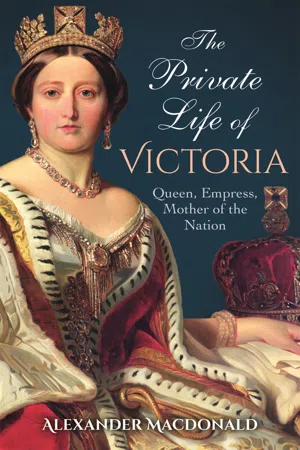
- English
- ePUB (mobile friendly)
- Available on iOS & Android
eBook - ePub
About this book
Now the second-longest-reigning monarch after Elizabeth II, Queen Victoria ruled at the height of Britain's power on the world stage and was a symbol of stability at home and abroad. Against this background of pomp and power, she was a passionate woman who led an often turbulent private life. Victoria was just eight months old when her father died and his paternal role was taken by her uncle Leopold of Saxe-Coburg and Sir John Conroy, an ally of her mother. The two of them sought to control Victoria and isolate her from others. This is the story of the Queen of England who had to fight to forge her own way in the world, and who found true romance with Prince Albert only to have happiness snatched from her when he died of typhoid at the age of 42.
Information
Chapter One Born to be Queen
Victoria was the last of the Hanoverian dynasty that had begun in 1714 when George I, the Elector of Hanover in Germany, was selected to succeed his second cousin Queen Anne, who died with no living offspring. Although there were others with greater claims to the British throne by primogeniture, he was the first Protestant in line. The others, all Roman Catholics, were prohibited from inheriting the throne by the Act of Settlement, which was passed in 1701. George left his wife behind in Germany, incarcerated in Ahlden Castle, Lower Saxony, after she was suspected of having an affair with a Swedish count, who was then murdered. George arrived in England with two mistresses, one tall and thin, the other short and fat and mocked respectively as ‘the maypole and the elephant’.
His son, George II, didn’t do much better. Although very much in love with his wife, he felt it was his royal duty to take mistresses. His frequent trips back to Hanover to indulge himself with the local prostitutes made him unpopular in Britain. George II’s son Frederick was similarly debauched, but died before he could succeed his father.
In 1760, the throne passed to George III, who lived a more virtuous life. He and his wife, Charlotte of Mecklenburg-Strelitz, had 15 children, but he suffered from periodic bouts of madness, now thought to be the result of the blood disease porphyria. In an attempt to clean up the royal family’s reputation, he signed the Royal Marriages Act of 1772. This stipulated that his descendants could not marry, legally, without the consent of the monarch and the approval of parliament. In practice, its effect was to give the princes a convenient excuse to wriggle out of any commitment to their lovers. As a result, they produced plenty of illegitimate children – 56 in all – none of whom were eligible to ascend the throne.
Separate lives
George III’s eldest son George IV, who served as Prince Regent when his father was incapacitated, briefly abandoned his twice-widowed mistress Maria Fitzherbert, who he had married illegally, to wed Caroline of Brunswick in 1795. The marriage, forced on him by his father who agreed to pay off the Prince’s mounting debts in return, was a disaster. The two were ill suited and soon hated each other, living completely separate lives. In 1814 Caroline left England to live in continental Europe. However, she chose to return for her husband’s coronation in 1821, hoping to assert her rights as Queen Consort. But George IV refused to recognize her as queen and sought a divorce, a move that was unpopular with the public and soon abandoned. Despite this, he publicly banned her from attending his coronation on 19 July.
Caroline fell ill that day and died on 7 August. He was blamed. The only issue from their marriage was a daughter, Charlotte, born in 1796. Continued hostility between her parents plagued Charlotte’s youth and adolescence. She was torn between a father she could respect but not love and a mother she could love but not respect. She once wrote: ‘My mother was wicked, but she would not have turned so wicked had not my father been much more wicked still.’
Charlotte would have been queen if she had not died in 1817, aged 21, along with her stillborn child. At the insistence of parliament, George III’s other sons quickly married in the hope that at least one of them would produce an heir.
Great expectations
The Prince Regent’s younger brother William, Duke of Clarence, who later became William IV, had already had ten children with the actress Dorothea Jordan. On 11 July 1818, he married Princess Adelaide of Saxe-Meiningen, who at 25 was half his age. They had two daughters, who quickly died, and a number of stillborn children. Frederick, Duke of York, was estranged from his wife, Princess Frederica Charlotte of Prussia, who was already in her fifties and well past the age she could conceive.
The youngest son, Prince Adolphus, Duke of Cambridge, who served as Viceroy of Hanover, married Princess Augusta of Hesse-Cassel on 1 June 1818. One of their four children, Mary of Teck, became Queen Mary as the wife of George V. Then there was the notoriously louche and unpopular Ernest, Duke of Cumberland, who was even said to have had an incestuous relationship with his sister Princess Sophia, later the mother of an illegitimate child sired by her father’s chief equerry. In 1815, Prince Ernest had married Princess Frederica of Mecklenburg-Strelitz, a divorcee. His mother, Queen Charlotte, disapproved and insisted that they live outside England. They had a son, who succeeded him as King of Hanover.
The fourth son, after George, Frederick and William, was Edward, the Duke of Kent, often regarded as the most intelligent of them all. Despite that, he had his weaknesses. A soldier, he had sired at least two illegitimate children by two different mothers. In response to his dalliances with the fairer sex, his father, George III, sent him to Gibraltar in February 1790 in disgrace. However, there he was joined by his mistress, Julie de Sainte-Laurent, who he had met several years earlier in Geneva. Due to health problems caused by the hot Mediterranean weather, Edward only stayed in Gibraltar for six months. In a letter to his father, written in December 1790, he said: ‘I petition that if it does not interfere with your commands for other Regiments in your service, you will allow me to be sent in the Spring with mine to any part of North America which you may chuse [sic] to appoint; allowing me, if it means with your approbation, to prefer Canada.’
Permission was granted and Edward travelled to Canada. Julie went with him. They were together for 28 years. Although they were thought to have no children, families in Canada claim descent from the couple. Returning to Gibraltar as Governor, this time Edward’s severity provoked a mutiny. Three of the ringleaders were shot dead, a fourth flogged to death.
Like most of the sons of George III, Edward was profligate with money. The way to clear his debts was to give in to the urging of parliament and marry. When Edward proposed to the widowed Princess Victoria of Saxe-Coburg-Saalfeld, Julie only learned of his forthcoming nuptials from the newspapers. Princess Victoria had first married at the age of 17. With her husband Emich Carl, Prince of Leiningen, she had a son Carl and a daughter Feodora. Prince Emich died in 1814 and her brother Prince Leopold, the widower of George IV’s daughter Charlotte, persuaded her to marry Prince Edward to secure the British succession.
The couple married in Coburg on 29 May 1818 and, again, at Kew Palace on 13 July. He was 52, she 32. They lived mainly in the moated castle at Amorbach near Frankfurt, Victoria’s dower house, and raced back to England by coach when she was heavily pregnant, as Edward was convinced that, if his child was to succeed, it would be much more popular if it was born on British soil. The race for the succession was now going full tilt. Adelaide, the wife of his elder brother William, had just given birth to a daughter, who died after a few hours, while Augusta, the wife of younger brother Adolphus, had given birth to a healthy boy.
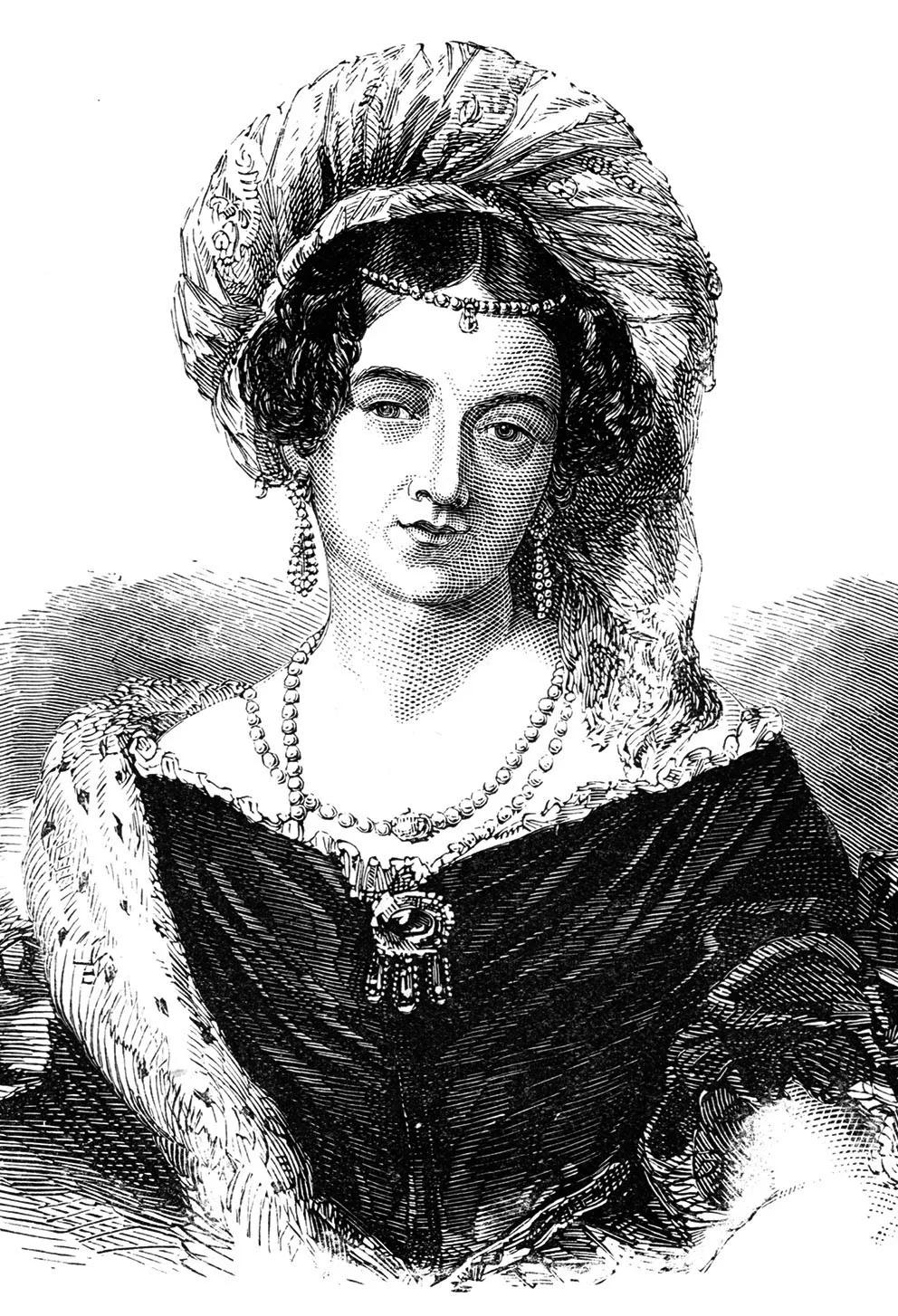
Princess Victoria Mary Louisa von Saxe-Coburg-Saalfeld was the mother of Queen Victoria. She was given the title Duchess of Kent.
Fourth in line
Crossing the Channel in a gale, on the royal yacht reluctantly provided by the Prince Regent, Victoria was violently ill. Landing at Dover, she was taken to Kensington Palace, which had fallen into disrepair since the death of Queen Caroline, wife of George II, in 1737. There the recently honoured Duchess of Kent gave birth to a healthy girl on 24 May 1819.
At birth, the child was only fourth in line to the throne – behind the Prince Regent, the future George IV, the Duke of Clarence, the future William IV and her own father. And her succession was far from certain. It was not impossible that George or William would produce a legitimate heir, or that her own parents would have a boy that would displace her.
Nevertheless, the new-born girl almost immediately became a bone of contention between the Duke and Duchess of Kent and members of the Royal Court, a number of whom had children with a potential claim on the throne. At the last moment before the child’s baptism, a low-key affair on 24 June 1819, the Prince Regent, a godfather, refused to allow her to be named Victoria Georgiana Alexandrina Charlotte Augusta, after her mother and godparents, as he would not have a derivative of his name being put before the Tsar’s. But he eventually agreed to Alexandrina Victoria, after her godfather the Tsar – who had paid for her parents’ marriage – and her mother. Both names were unpopular as they were deemed to be foreign. Until she was four, the child was known as ‘Drina’. Later, attempts were made in parliament to change her name to Elizabeth or Charlotte, which were seen to be more English. They failed.
Starved of funds, Edward took his family to live in Sidmouth, Devon, where he died unexpectedly of pneumonia on 23 January 1820, after a long walk along the cliffs in a gale with his equerry John Conroy. Edward’s only legitimate offspring, Victoria, was just eight months old. His father, George III, died six days later on 29 January, bringing the child two steps closer to the throne. Although Victoria was too young to know her father, her first prime minister Lord Melbourne told her that he was as agreeable as George IV and more ‘posé’ [a Regency term meaning ‘sedate’] than William IV, without being as talkative. Plainly Victoria was swayed by this. She wrote in her journal on 1 August 1838: ‘From all what I heard [sic] he was the best of all.’ And although she had a difficult time with her mother, reading her diaries after she had died, Victoria wrote: ‘All these notes show how very much She & my beloved Father loved each other!’
Although she could barely speak English, Victoria’s mother now had the task of bringing up a child who was second in line to the throne. From the beginning, Victoria was headstrong, defying her teachers and those who looked after her. Even her beloved governess Louise Lehzen – a pastor’s daughter from Coburg created baroness by George IV, so the future queen would not be nurtured by commoners – forced her to record her outbursts in a Conduct Book.
Country retreat
At the time of Victoria’s birth, Kensington Palace was a venerable old building. Originally called Nottingham House, the structure was bought by William III in 1689 and enlarged by the architects Christopher Wren and William Kent. Close to the hustle and bustle of the city surrounding it though set in ‘intensely rural’ gardens, the house functioned almost as a quiet country retreat. The family lived on two floors of a somewhat draughty, insect-ridden and partly derelict apartment. However, the slightly plump, promising and lively baby was indulged by compliant servants and fawned over by the great and the good who came to visit her. She flaunted her superiority over other youngsters and lacked true friends. But, despite being indulged with toys, clothes, pets, pony rides and trips to the seaside, she was unhappy, complaining later that she ‘had no scope for my very violent feelings of affection – had no brothers and sisters to live with – never had a father – from my unfortunate circumstances was not on a comfortable or at all intimate or confidential footing with my mother… and did not know what a happy domestic life was.’
Indeed, apart from Baroness Lehzen, her only true companion was her half-sister Feodora; her half-brother Carl was at school in Switzerland at the time. But when Victoria was nine, Feodora married Ernst I, Prince of Hohenlohe-Langenburg, and left to live in Germany. Otherwise, she was always under the eye of adults – even at night when she slept in her mother’s bedroom. She was not to walk up and down the stairs without holding someone’s hand. And there were constant admonitions to sit up straight. A sprig of holly was pinned to the front of her dress to make her keep her chin up.
She was not yet 11 when she was leafing through a book on the kings and queens of England, where she discovered she was second in line to the throne. It is said that she burst into tears, later telling Prince Albert that she was ‘very unhappy’ at the discovery. However, it must already have been clear to her that she was in a unique position. From the age of seven she had been invited to the Royal Lodge at Windsor, where George IV lived with his mistress, Lady Elizabeth Conyngham. It was clear that the corpulent and dissolute king did not like her, but recognized her as the future of the monarchy.
George IV died on 26 June 1830 of ‘obesity of the heart’ – though alcoholism, gluttony and addiction to laudanum cannot have helped. ‘There never was an individual less regretted by his fellow-creatures than this deceased king,’ said The Times. And Victoria found herself first in line after William IV. She was dismayed and anxious.
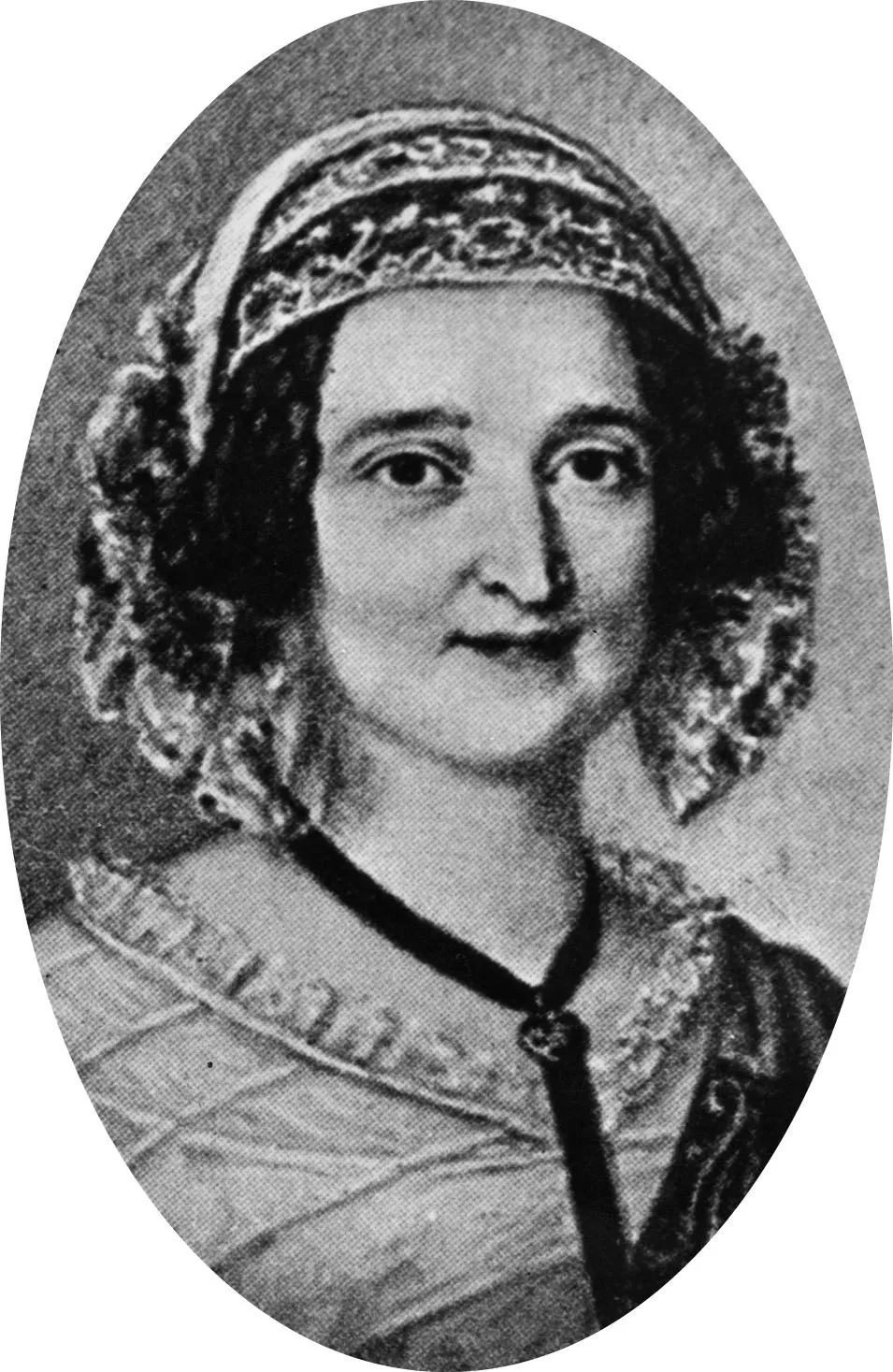
Baroness Louise Lehzen (1784–1870), governess and tutor to Victoria.
Leading role
Lehzen claimed that, despite her distress at the prospect of becoming queen, Victoria was determined to rise to the role. While her education was all important, she would not let the thought crush her innate grit. Though she was diligent with her books, she also enjoyed tending flowers and dressing up. Otherwise she lavished affection on her dogs and played with her dolls, making over a hundred out of wood. With Lehzen, she painted and made clothes for them, so they resembled characters from the Court, ballet or opera, which she loved, and painstakingly listed each creation in a book. On 1 August 1832, she began keeping a diary, which she wrote in daily – apart from when she had just given birth – until the end of her life.
Occasionally, her loneliness was relieved by family visits. In June 1833, Feodora came to stay with her husband and two children. They had not seen each other for six years. When Feodora left seven weeks later, Victoria wrote: ‘The separation was indeed dreadful. I clasped her in my arms, and kissed her and cried as if my heart would break, so did she, dearest sister. We then tore ourselves from each other in the deepest grief… When I came home I was in such a state of grief that I knew not what to do with myself. I sobbed and cried most violently the whole morning… My dearest best sister friend, sister, companion all to me, we agreed so well together in all our feelings and amusements… I love no one better than her.’
Her other consolation was a surprisingly grown-up relationship and correspondence with her mother’s brother, Uncle Leopold. Born in Coburg in 1790, Leopold was a German prince and member of the House of Saxe-Coburg and Gotha, a dynasty with influential connections to royal families all over Europe. After a career in the Ru...
Table of contents
- Title Page
- Contents
- Introduction: Victoria’s Secrets
- Chapter One: Born to be Queen
- Chapter Two: The Kensington System
- Chapter Three: Ascending the Throne
- Chapter Four: Reginamania
- Chapter Five: The Bedchamber Crisis
- Chapter Six: The Adoration of Albert
- Chapter Seven: Married Life
- Chapter Eight: Albert Ascendant
- Chapter Nine: The Model Family
- Chapter Ten: Under Threat
- Chapter Eleven: My Duty… As a Woman
- Chapter Twelve: Widowhood
- Chapter Thirteen: Final Favourites
- Chapter Fourteen: The Grandmother of Europe
- List of Illustrations
- Copyright
Trusted by 375,005 students
Access to over 1.5 million titles for a fair monthly price.
Study more efficiently using our study tools.
Frequently asked questions
Yes, you can cancel anytime from the Subscription tab in your account settings on the Perlego website. Your subscription will stay active until the end of your current billing period. Learn how to cancel your subscription
No, books cannot be downloaded as external files, such as PDFs, for use outside of Perlego. However, you can download books within the Perlego app for offline reading on mobile or tablet. Learn how to download books offline
Perlego offers two plans: Essential and Complete
- Essential is ideal for learners and professionals who enjoy exploring a wide range of subjects. Access the Essential Library with 800,000+ trusted titles and best-sellers across business, personal growth, and the humanities. Includes unlimited reading time and Standard Read Aloud voice.
- Complete: Perfect for advanced learners and researchers needing full, unrestricted access. Unlock 1.5M+ books across hundreds of subjects, including academic and specialized titles. The Complete Plan also includes advanced features like Premium Read Aloud and Research Assistant.
We are an online textbook subscription service, where you can get access to an entire online library for less than the price of a single book per month. With over 1.5 million books across 990+ topics, we’ve got you covered! Learn about our mission
Look out for the read-aloud symbol on your next book to see if you can listen to it. The read-aloud tool reads text aloud for you, highlighting the text as it is being read. You can pause it, speed it up and slow it down. Learn more about Read Aloud
Yes! You can use the Perlego app on both iOS and Android devices to read anytime, anywhere — even offline. Perfect for commutes or when you’re on the go.
Please note we cannot support devices running on iOS 13 and Android 7 or earlier. Learn more about using the app
Please note we cannot support devices running on iOS 13 and Android 7 or earlier. Learn more about using the app
Yes, you can access The Private Life of Victoria by Alexander Macdonald in PDF and/or ePUB format, as well as other popular books in History & Historical Biographies. We have over 1.5 million books available in our catalogue for you to explore.