Graceful, beautiful and subtle, flowers are among the most delightful of subjects for artists to draw. This fresh, accessible book is aimed at those who want to translate their love of the natural world into vivid, accurate illustrations. Drawing Flowers is packed with examples and exercises across the full floral range, from simple structures, such as tulips, to more complex configurations, such as sunflowers, and compositions involving groups of flowers.
Illustrated throughout by award-winning botanical artist Jill Winch, the book offers clear, concise instruction in the techniques of flower drawing. It also gives advice on practical considerations such as how best to position flowers for drawing, how to prevent them wilting and how to use a microscope to understand their structure.

- English
- ePUB (mobile friendly)
- Available on iOS & Android
eBook - ePub
About this book
Information
Topic
ArtSubtopic
Art GeneralChapter 1
Getting started
In this chapter, we look at the equipment you need in order to embark on your flower drawing. Most of us, when we’re learning a new skill, will often buy too many materials at the outset through sheer enthusiasm, but this is often a waste of money. All that’s necessary to make a start here is a pencil, a sharpener, an eraser and some paper.
With any materials, I strongly advise trying products from several manufacturers, since one brand’s 2H pencil will certainly be different from another, for example. I have discovered my own preferences over the years mainly by exploring what’s available from art supplies stockists rather than by following recommendations from other artists.
Pencils and accessories
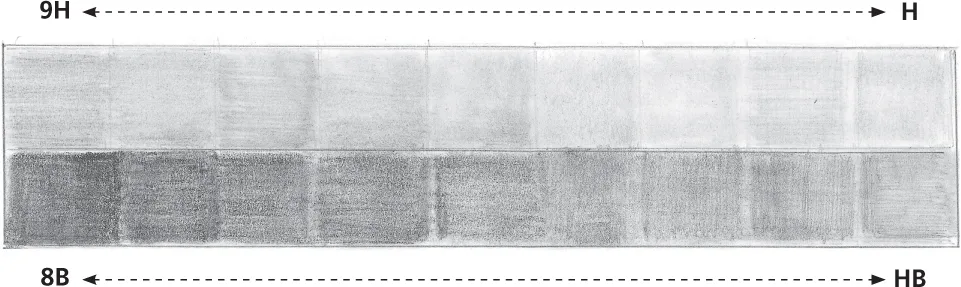
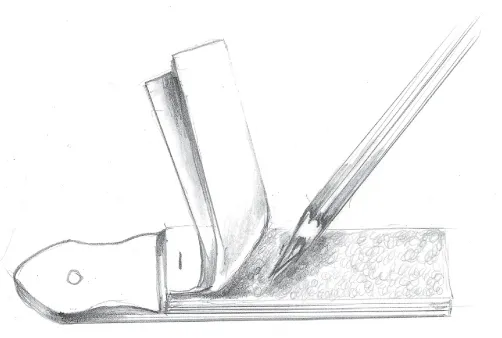
While brands differ slightly in the range they offer, pencils are graded from 9H through to 9B, 9H being the hardest and 9B the softest, with HB and F in between. The H pencils can produce lovely light tones; for the darker shadow areas, I often use the softer B grades. The addition of small, intense areas of dark shading, made with a B pencil sharpened to a fine point with an emery board, can create instant drama in your drawing. Derwent, Faber-Castell and Staedtler are excellent manufacturers and you can buy a box with a good range of hard and soft leads. You can give the pencil lead an angled edge by using an emery board, which will enable you to produce both tone and very fine line.
Clutch pencils are versatile and useful as you can expose the lead to the required length and grind it to a fine point, again with an emery board. These pencils sometimes have a removable sharpener at the end. Use this with caution, as the fine graphite dust can sometimes remain in the sharpener and spill out on to your paper. The leads are quite thick – usually 2–5mm. When you want a harder or a softer lead, change it by inserting it into the clutch mechanism at the tip.

A propelling pencil differs from a clutch pencil in that the leads used are usually finer at 0.3mm, 0.5mm and 0.7mm, and you simply push the end of the casing to propel the lead forwards. These pencils can be used for fine, detailed work, but the lead is susceptible to snapping if you exert much pressure. There’s no need to sharpen it, as movement on the paper will produce the smooth edge that is required.

Sharpeners
Desk sharpeners can be clamped to the table surface, which makes them look sturdy and capable. However, they can sometimes make the lead in the pencil unstable, so the simple hand-held pencil sharpeners are not only a cheaper alternative but better, too.

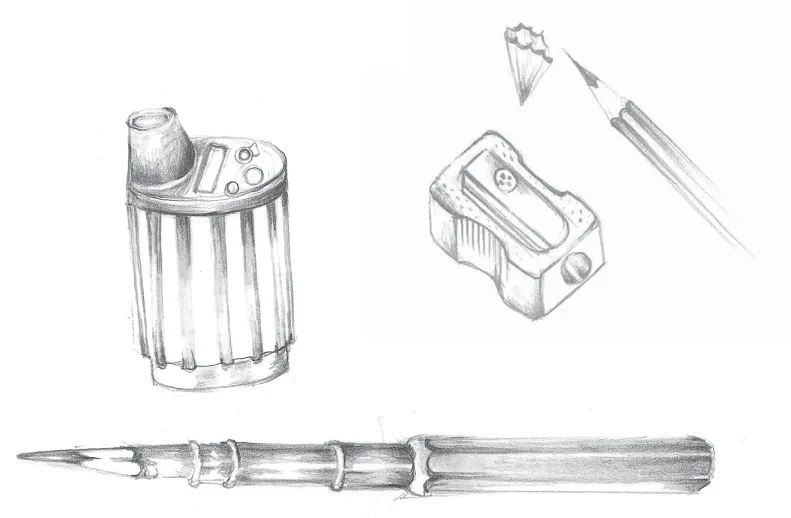
With repeated sharpening your pencils will become shorter, of course. A pencil extender is a handy tool which lengthens the barrel to give you extra grip and so prolongs the life of the pencil.
Erasers
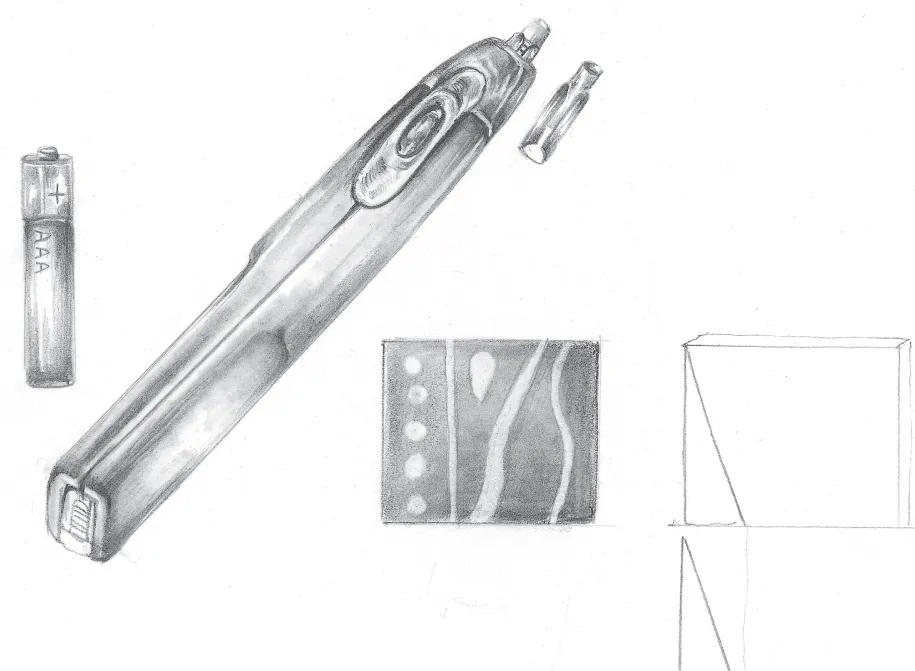
A battery-operated eraser is a useful tool for taking out specific marks, as it revolves at quite a high speed and is firm and small.
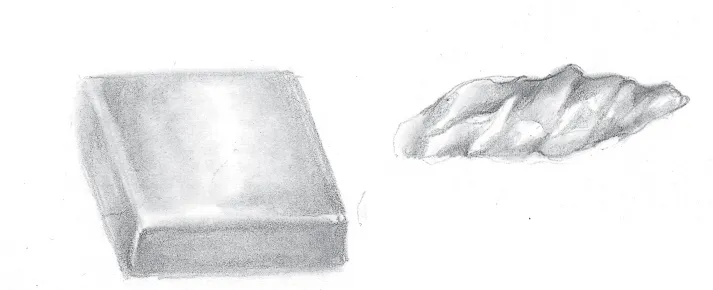
A putty rubber is very pliable and ideal for lifting out highlights and overworked parts. You can break off bits with which to lift out specific small areas – this is a more gentle approach than using a battery-operated eraser, but it is less effective for restoring the white of the paper. It’s also possible to roll a piece of putty rubber into a sausage shape and glide it over the paper – this avoids disturbing the surface by rubbing. Alternatively, to lift out finer lines, use a scalpel to cut angled slices from a plastic eraser.
Tortillons and paper stumps
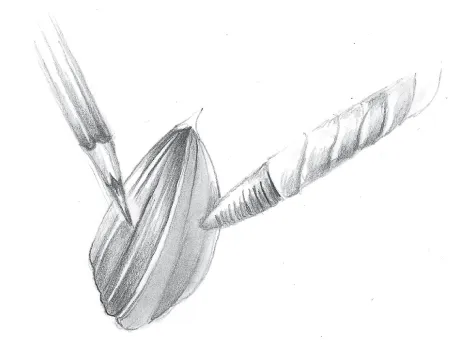
Made from tightly rolled paper, tortillons and paper stumps are designed for smoothing areas of graphite to give a smudged look, or spreading the graphite to give an area of overall tone. There is little difference between them, though you have a choice between one pointed end or points at both ends. They can be cleaned by rubbing the end with some fine sandpaper, which also restores a fine point. Tortillons and paper stumps are available in a variety of sizes from quite small to large.
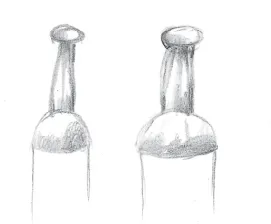
Stylus
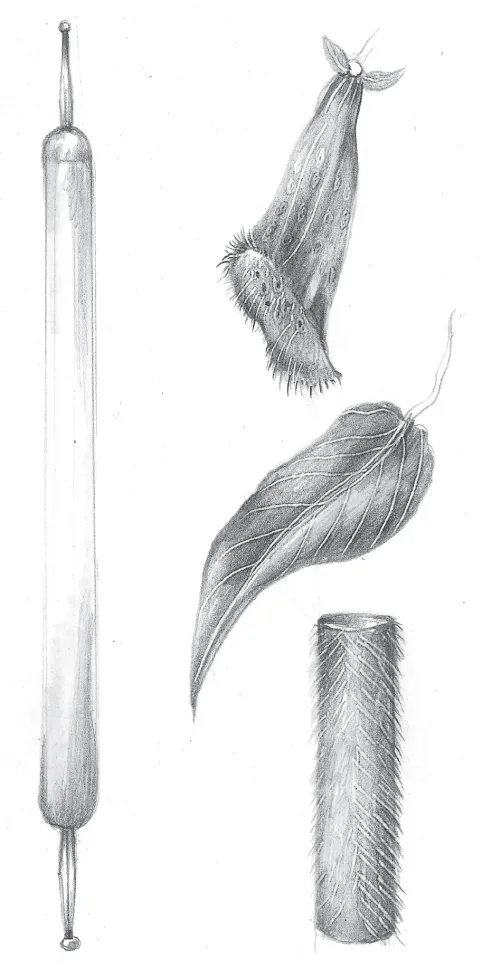
I use this tool for indenting the paper, which is a good way of creating hairs on stems, leaves and petals (see pages 98–99). Styluses have wooden stems, with different-sized metal ends in the shape of a ball. For a much finer line, you could use a darning needle or any metal implement with a blunt end.
Pen and ink
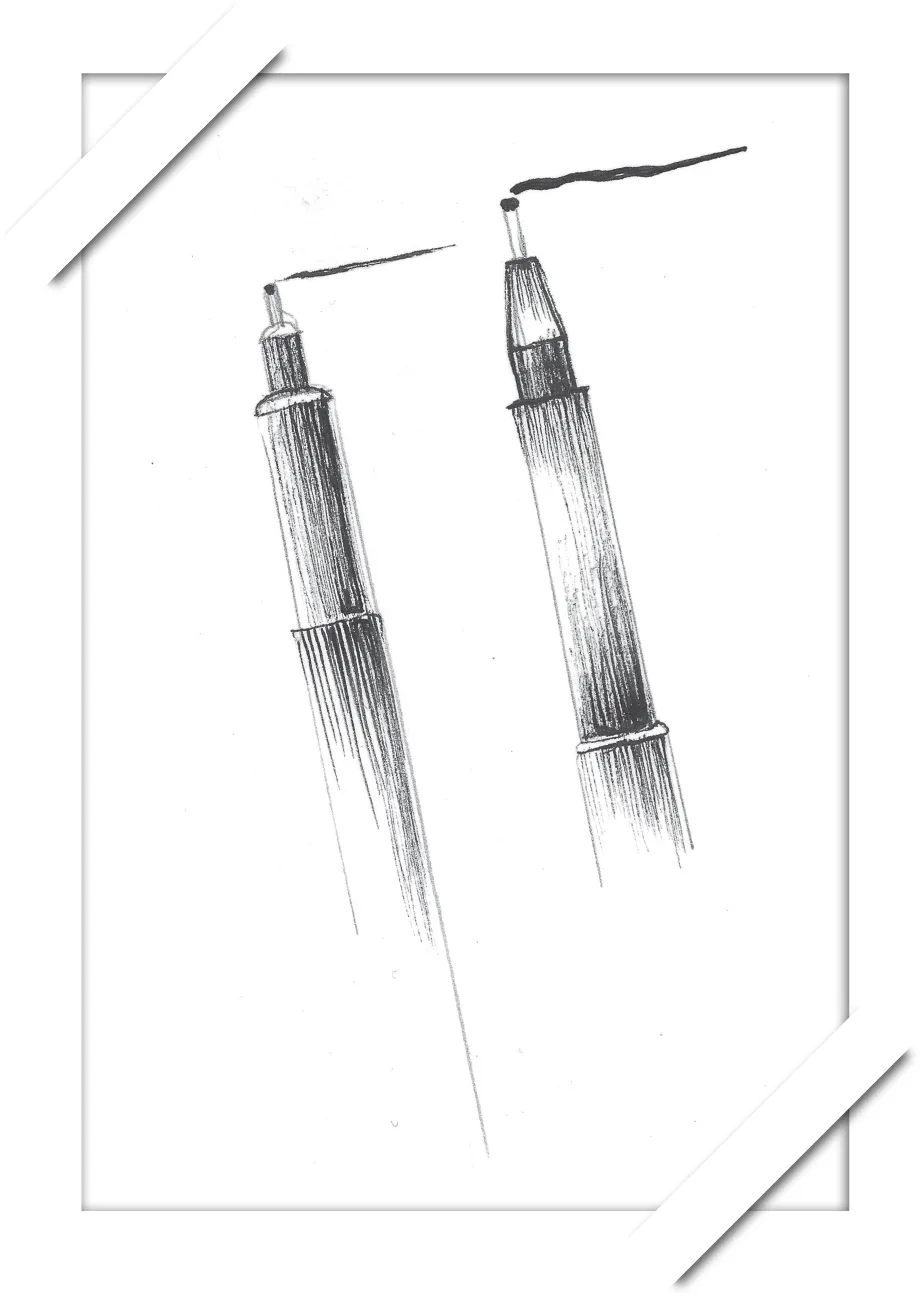
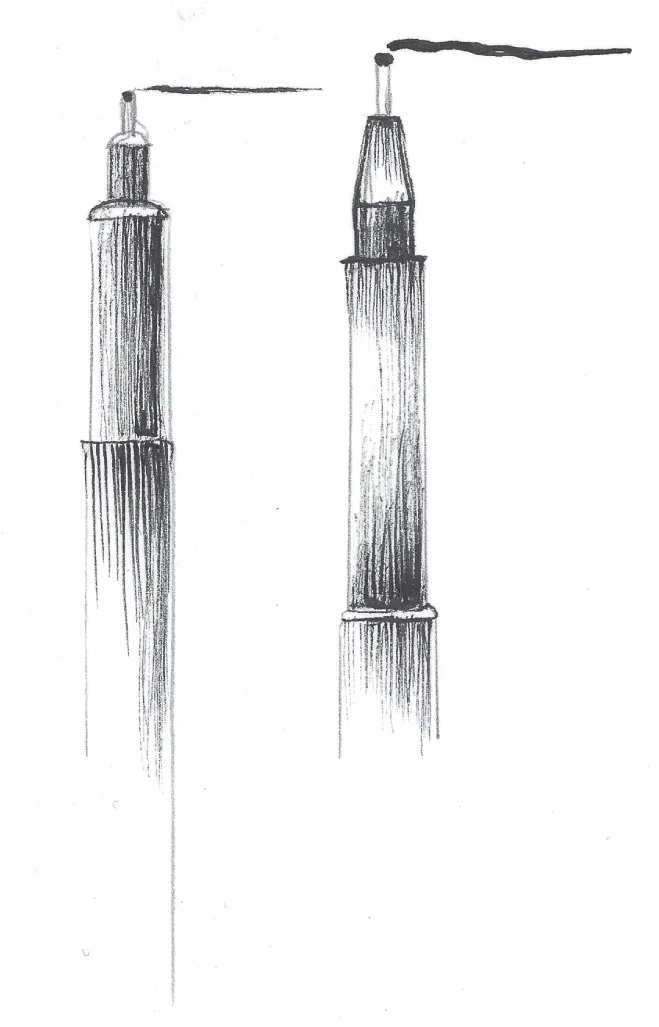
For pen-and-ink work, the most useful and easily available tools are fibre-tip pens. Often described as throwaway pens, they are an economical purchase. Depending on the manufacturer, they can be bought in various sizes. For the finer line shown here, I used a Staedtler 0.05, a pen with lightfast, waterproof ink. For the thicker line, I used a Staedtler 0.3 pen. I would generally not use a nib bigger than 0.3 for flower drawing. It is worth experimenting with different makes, such as Pilot, Edding and Faber-Castell.
Another useful t...
Table of contents
- Cover
- Title
- Contents
- Introduction
- Chapter 1: Getting Started
- Chapter 2: First Stages
- Chapter 3: Flowers step-by-step
- Chapter 4: Leaves
- Chapter 5: Composition
- Index
- Copyright
Trusted by 375,005 students
Access to over 1.5 million titles for a fair monthly price.
Study more efficiently using our study tools.
Frequently asked questions
Yes, you can cancel anytime from the Subscription tab in your account settings on the Perlego website. Your subscription will stay active until the end of your current billing period. Learn how to cancel your subscription
No, books cannot be downloaded as external files, such as PDFs, for use outside of Perlego. However, you can download books within the Perlego app for offline reading on mobile or tablet. Learn how to download books offline
Perlego offers two plans: Essential and Complete
- Essential is ideal for learners and professionals who enjoy exploring a wide range of subjects. Access the Essential Library with 800,000+ trusted titles and best-sellers across business, personal growth, and the humanities. Includes unlimited reading time and Standard Read Aloud voice.
- Complete: Perfect for advanced learners and researchers needing full, unrestricted access. Unlock 1.5M+ books across hundreds of subjects, including academic and specialized titles. The Complete Plan also includes advanced features like Premium Read Aloud and Research Assistant.
We are an online textbook subscription service, where you can get access to an entire online library for less than the price of a single book per month. With over 1.5 million books across 990+ topics, we’ve got you covered! Learn about our mission
Look out for the read-aloud symbol on your next book to see if you can listen to it. The read-aloud tool reads text aloud for you, highlighting the text as it is being read. You can pause it, speed it up and slow it down. Learn more about Read Aloud
Yes! You can use the Perlego app on both iOS and Android devices to read anytime, anywhere — even offline. Perfect for commutes or when you’re on the go.
Please note we cannot support devices running on iOS 13 and Android 7 or earlier. Learn more about using the app
Please note we cannot support devices running on iOS 13 and Android 7 or earlier. Learn more about using the app
Yes, you can access Drawing Flowers by Jill Winch in PDF and/or ePUB format, as well as other popular books in Art & Art General. We have over 1.5 million books available in our catalogue for you to explore.