- English
- ePUB (mobile friendly)
- Available on iOS & Android
eBook - ePub
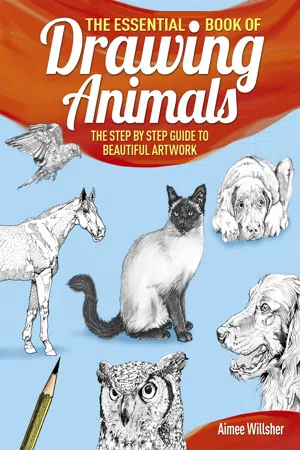
The Essential Book of Drawing Animals
About this book
From domestic pets to majestic wildlife, the huge variety of the animal kingdom is a constant source of inspiration for artists. In this book, artist and dog-lover Aimee Willsher shows how to create successful drawings of a wide range of animals. You will learn how to put simple shapes together to create recognizable forms, before adding tone and texture to bring your drawings to life. From cats, dogs and horses to dolphins and birds, there are many inspiring examples for you to follow.
Information
Topic
ArteSubtopic
Arte generale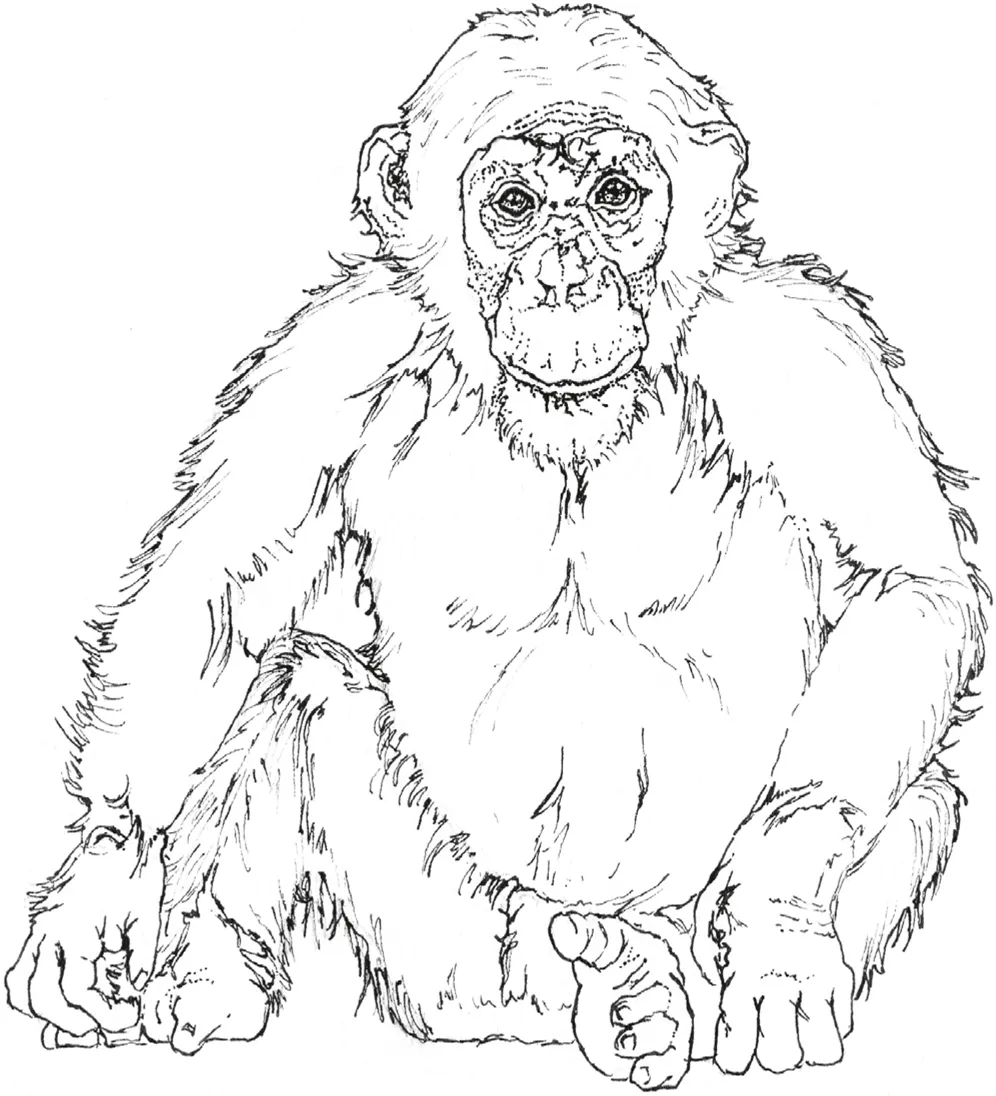
Chapter 1
CREATING FORM
Here’s the good news: the primary shapes that you learned to draw in early childhood can be used to help you draw any object you can imagine, no matter how complicated. It’s learning how to look at form in a new way that takes some practice. When you gaze at a field full of sheep, for example, you need to engage your mind like an artist with a potential drawing in mind. Those animals are made up of a body, head and four legs; what simple shapes best describe these individual body parts? Once you start to simplify complex forms into their components you will soon be able to draw all creatures, large or small, feathered or furred.
In this chapter we shall start from the very beginning, looking at the primary building blocks of form. We shall then examine how these shapes can be amalgamated to create recognizable outlines. Once you are familiar with drawing the outline of a particular animal you will no longer need the safety net of simple shapes; you can then focus on how to turn your two-dimensional outline into a living, breathing physical presence.
Primary Shapes
I have made a series of very quick sketches of a variety of creatures to show how simple shapes can rationalize a more complicated entity in your mind, making the subject a less daunting project to tackle.
These simple flat shapes are easy to draw and can be used in combination to create an endless variety of animal forms. You can see how a few simple circles connected with some lines can very quickly be used to form the outline of a horse.

The Illusion of Three Dimensions
One of the biggest feats when you are learning to draw is starting to make your pictures appear three-dimensional. This, of course, is about learning the tricks of creating an illusion, since the piece of paper will always be flat; it is a matter of making your marks so that your drawn image imitates what our eyes see in the world around us. This drawing sequence shows how easy it is to turn a flat two-dimensional shape into a solid form using a few simple linear additions and shading.

There are a few simple techniques which will help you to improve your powers of perception and allow you to translate solidity into your drawings.
SHADING
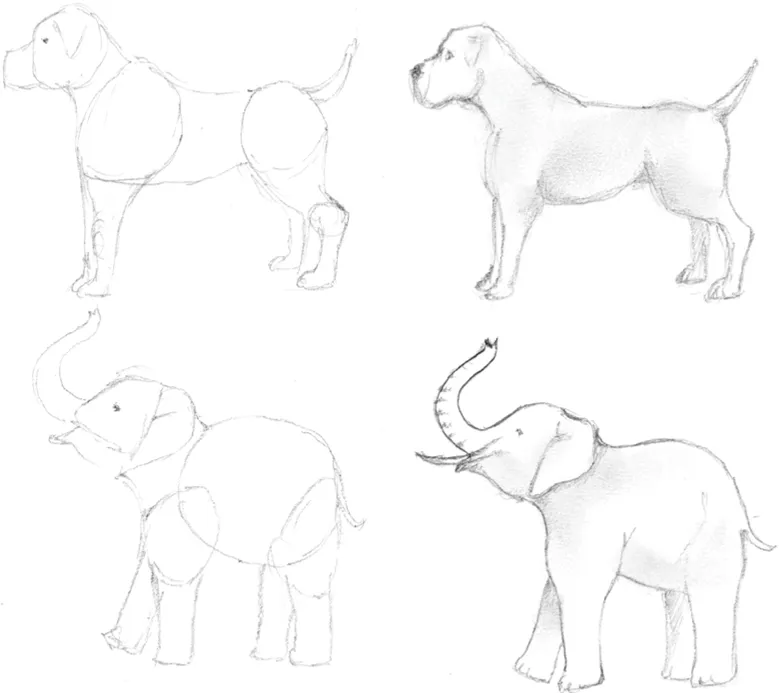
We have already seen how adding strategically placed shading on a simple shape like a circle can turn that circle into a sphere – a solid three-dimensional form. This shading technique can be applied to more complicated animal forms to enhance the feeling of their real shape. Adding a cast shadow beneath the form you are trying to represent also adds to its feeling of presence and solidity.

The drawings of the dog and elephant come to life with a few strategically placed smudges of shading. Make sure that when you are embarking upon a drawing in the early stages you keep your pencil work very light so that it is easily erasable and won’t show in the finished work.
CROSS-CONTOUR DRAWING
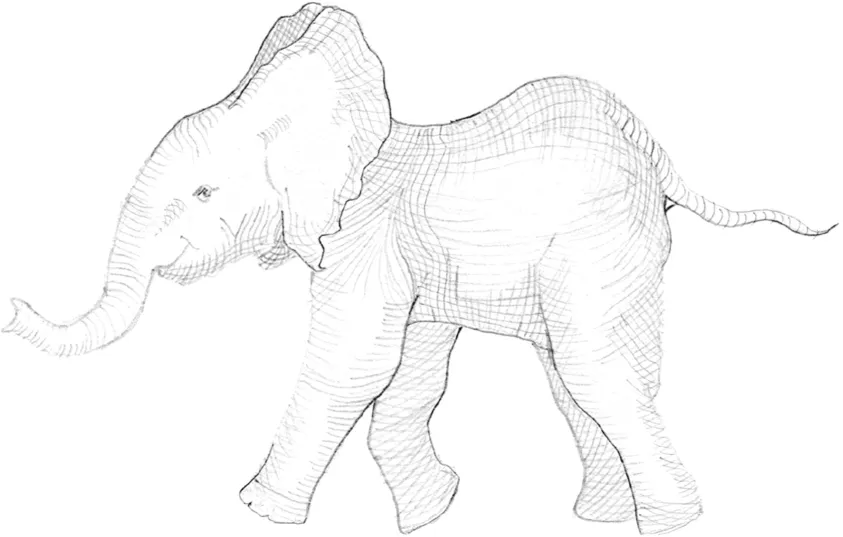
With this technique the illusion of three dimensions is created entirely with lines. It involves drawing a series of parallel or radiating lines across the surface of your form to describe its surface. It is a technique that is used to make topographical maps (maps that show where mountains and valleys are located). The closer the lines, the darker the tone. This technique is great for drawing complex curved forms. I have used cross-contour lines to emphasize the curves that make up the form of this baby elephant.
CONTOUR DRAWING
This technique focuses on the outline of a form and conjures the three-dimensionality of a subject by focusing on shape and proportion. It relies heavily on understanding the rules of perspective – so areas that are closer to the observer appear bigger. With this technique you must let the outlines speak for themselves and you need not worry about tone to make your drawings solid. The clear mass of the form speaks for itself, uncomplicated by detail.
You can see the effectiveness of this technique in my drawing of a dog. It is drawn from above and so is subject to extreme foreshortening. The head is the largest form in the drawing while the feet are merely little stumps projecting from the bottom of the form. The shape is not what we would automatically imagine when we think ‘dog’, but it is a two-dimensional interpretation of what we actually see.
Although this technique appears to be the simplest, it is in fact quite difficult to master – one wrong line and the image loses its power and visual...
Table of contents
- Cover
- Title
- Contents
- Introduction
- Chapter 1: Creating Form
- Chapter 2: Tone and Texture with New Materials
- Chapter 3: Animal Portraits
- Chapter 4: Capturing Movement
- Chapter 5: Animal Interaction
- Chapter 6: Elements of Composition
- Index
- Copyright
Trusted by 375,005 students
Access to over 1.5 million titles for a fair monthly price.
Study more efficiently using our study tools.
Frequently asked questions
Yes, you can cancel anytime from the Subscription tab in your account settings on the Perlego website. Your subscription will stay active until the end of your current billing period. Learn how to cancel your subscription
No, books cannot be downloaded as external files, such as PDFs, for use outside of Perlego. However, you can download books within the Perlego app for offline reading on mobile or tablet. Learn how to download books offline
Perlego offers two plans: Essential and Complete
- Essential is ideal for learners and professionals who enjoy exploring a wide range of subjects. Access the Essential Library with 800,000+ trusted titles and best-sellers across business, personal growth, and the humanities. Includes unlimited reading time and Standard Read Aloud voice.
- Complete: Perfect for advanced learners and researchers needing full, unrestricted access. Unlock 1.5M+ books across hundreds of subjects, including academic and specialized titles. The Complete Plan also includes advanced features like Premium Read Aloud and Research Assistant.
We are an online textbook subscription service, where you can get access to an entire online library for less than the price of a single book per month. With over 1.5 million books across 990+ topics, we’ve got you covered! Learn about our mission
Look out for the read-aloud symbol on your next book to see if you can listen to it. The read-aloud tool reads text aloud for you, highlighting the text as it is being read. You can pause it, speed it up and slow it down. Learn more about Read Aloud
Yes! You can use the Perlego app on both iOS and Android devices to read anytime, anywhere — even offline. Perfect for commutes or when you’re on the go.
Please note we cannot support devices running on iOS 13 and Android 7 or earlier. Learn more about using the app
Please note we cannot support devices running on iOS 13 and Android 7 or earlier. Learn more about using the app
Yes, you can access The Essential Book of Drawing Animals by Aimee Willsher in PDF and/or ePUB format, as well as other popular books in Arte & Arte generale. We have over 1.5 million books available in our catalogue for you to explore.