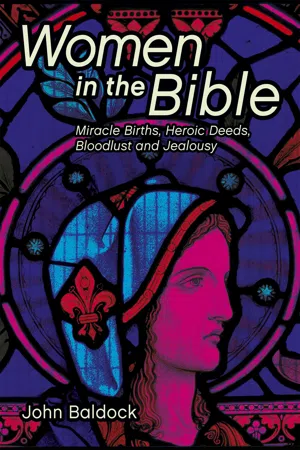
There are few women in the Bible that are treated with as much reverence as their more famous male counterparts. This dismal state of affairs mirrors the position of women generally in Western society over the last two thousand years. And yet closer study of the Bible reveals that women were once regarded as equals of men rather than subject to them. John Baldock is at pains to rescue the reputation of women in the Bible, exploring the ancient priestesses, prophets and heroines who used their courage and spiritual strength to lead the people. Working chronologically through the Old and New Testaments, Woman in the Bible includes fascinating stories of true love, incest, adultery, polygamy, exploitation and abuse by men. This accessible and well-argued book is essential reading for anyone interested in the role of women in religion and society.
eBook - ePub
Women in the Bible
About this book
Information
Part 1
The Old Testament
The Hebrew Bible, known to Christians as the Old Testament, opens with the story of God’s creation of the world and of the primordial couple, Adam and Eve, who initially lived at ease with their Creator in his garden. But when they failed to follow God’s instruction not to eat the fruit of the tree of knowledge, they set in motion a pattern that was to be repeated by subsequent generations. For whenever human beings chose to follow their own will rather than that of their Creator, they were afflicted with one kind of disaster or another.
However, what may appear to be a disaster to human eyes is often presented as a God-given opportunity to begin life anew by attempting to follow the will of God. This was the case with Noah and his family, who were spared from the flood that wiped out the rest of humanity, and with Lot and his daughters, who escaped the destruction of Sodom and Gomorrah. A similar theme recurs throughout the historical books that cover the period from the Israelites’ occupation of the land of Canaan to the fall of the kingdoms of Judah and Israel. Whenever the Israelites turned their backs on God they were overcome by their enemies, only for a new leader to emerge – a judge, king or prophet – who would urge them once more to follow the Way of God.
The theme continues in those books of the Old Testament written after the fall of the kingdom of Judah and the exile in Babylon. It is fair to say that women are given a bad press in all this: from Eve to Jezebel and beyond, they are often portrayed as the cause of the misfortunes that befell the people of Israel and their ancestors. In this regard, the role assigned to women in the Old Testament reflects the changing attitude towards women, as both society and religion become increasingly patriarchal. For example, when God created Eve we are told that she was Adam’s equal. In the early history of the Israelites, women were the equals of men in that they held important positions as prophets and judges, and occasionally officiated as priests. Certain women – e.g. Deborah, Esther and Judith – also acquired the stature of national heroes. At the other extreme, women were considered to be the property of their ‘father’s house’, a term that embraces the immediate family, the clan and the tribe.
The Christian view of the Old Testament was summarized by St Augustine, who said, ‘The Old Testament is nothing but the New covered with a veil, and the New is nothing but the Old unveiled.’ From the earliest times, Christians have understood many of the people and events described in the Old Testament as prefiguring prominent figures and events in the New.
The correspondence between events in the Old Testament and events in the New – known as ‘typology’, from the Greek tupos, meaning ‘stamp’ or ‘mould’ – had a profound influence on Christian art during the European Middle Ages, leading to the complex decorative schemes to be found in many medieval churches and cathedrals. Indeed, the representation in art of figures and events from the Old Testament is largely confined to Christian art since such representation was generally proscribed by the Jewish religion.
1 The Pentateuch
From Eden to the wilderness years
The first women
Also known as the Law (the Torah) or the Five Books of Moses, the Pentateuch attained its definitive form in the fifth century BC, during or shortly after the Jewish exile in Babylon, but it contains material from much older traditions said to predate this by at least another 500 years. Its five books are Genesis, Exodus, Leviticus, Numbers and Deuteronomy. Genesis and Exodus together take us from the creation of the world to the Israelites’ escape from Egypt and their journey through the wilderness to the land of Canaan. Leviticus is essentially a book of religious and social law, while Numbers and Deuteronomy combine further accounts of the Israelites’ journey with additional religious and social legislation. The Pentateuch concludes with the death of Moses on the threshold of the Promised Land.
EVE
MEANING: MOTHER OF ALL LIVING, OR LIFE
The first woman in the Bible.
† BIBLICAL REFERENCE: Genesis 1:27; 2:21–4:2; 4:25
In weaving together two accounts of the creation of the universe from different traditions, the opening chapters of Genesis offer us contrasting images of the nature of the relationship between man and woman. In the first account, which dates from c.400BC and is the more recent of the two, the relationship is seen as one of equals for we are told that God ‘created humankind [adam] in his own image, in the image of God he created them; male and female he created them’. (1:27) For their food, he gave them all the seed-bearing plants and all the trees with seed-bearing fruit. However, in the second account, which is dated to 1000–900BC, we are told that God first created ‘the man’, then the plants, animals and birds. He then caused the man to fall into a deep sleep, and while he was asleep he removed one of his ribs and made it into a woman. When the man saw her, he said, ‘she shall be called Woman [Hebrew ishshah] because she was taken out of Man [ish]’. (2:23) Once he had created them, God told the man and woman that they could freely eat the fruit from every tree in the garden, except for the ‘tree of the knowledge of good and evil, for in the day that you eat of it you shall die.’ Initially the primordial couple lived in a state of paradisal innocence, for we are told that they ‘were both naked, and were not ashamed’. (2:25) But then the serpent appeared on the scene and asked the woman whether God had forbidden them from eating the fruit of any tree in the garden. She replied that God had told them not to eat the fruit of the tree ‘in the midst of the garden, neither shall you touch it, lest you die.’ The serpent contradicted her, saying that they would not die. Rather, God knew that if they ate the fruit their eyes would be opened and they would be like God, knowing good and evil. At this the woman looked at the tree with fresh eyes, and saw that the fruit was to be desired because it was a source of wisdom. She took the fruit, ate it and gave some to her husband. Their eyes were opened, and becoming aware of their nakedness they covered themselves with garments made by sewing leaves together.
Later, when the man and woman heard God walking in the garden, they hid themselves from his presence. But God called out to the man, ‘Where are you?’
‘I heard you in the garden, and was afraid, because I was naked, and hid myself,’ replied the man.
‘Who told you that you were naked? Did you eat the forbidden fruit?’
‘The woman gave me the fruit, and I ate it.’
‘What have you done,’ God asked the woman.
‘The serpent beguiled me, and I ate.’
Then God said to the woman, ‘I will give you great pain in childbearing, and yet you will yearn for your husband and he shall have dominion over you.’ And to the man he said, ‘Because you listened to the voice of your wife and ate the forbidden fruit, the ground is cursed because of you. You will labour to produce food from it all the days of your life, until you return to the ground from which you were taken. For you are dust, and to dust you shall return.’ God then banished the man and woman from the garden and placed a guard over the tree of life. Following their banishment into the world outside the garden, Eve bore Adam three named sons – Cain, Abel and Seth – as well as other sons and daughters, thus paving the way for the generations that are described in the subsequent chapters of Genesis and the other books of the Pentateuch.
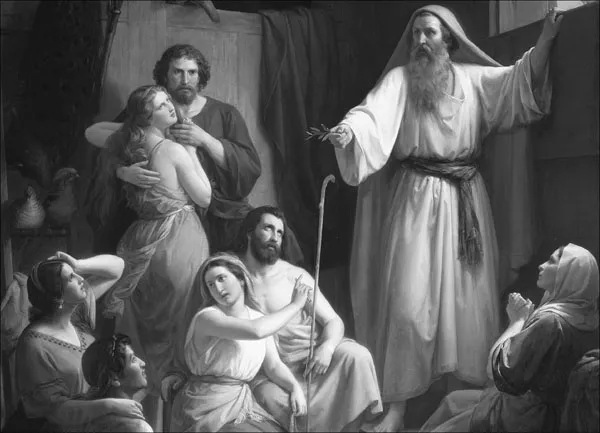
The waters are rising: Noah and his family were to be spared by God because he was a righteous man
According to the Jewish Talmud (books of extra-biblical commentary and interpretation), Eve was Adam’s second wife. His first wife was Lilith (‘Lily’), who demanded to be treated as his equal. When her demand was not met, she flew away into the night rather than submit to his authority. Adam’s refusal to treat her as his equal and her subsequent replacement by Eve may be due to Lilith’s association with death, whereas the name Eve means ‘Life’. The name Lilith, which is derived from the old Semitic word lel or lelath, meaning ‘night’ (Knappert, 189), appears in the Jerusalem Bible (Isaiah 34:14), but the same verse in the King James Version employs ‘screech-owl’ while the Revised Standard Version uses ‘night hag’. Lilith may have evolved from the ancient Sumerian goddess or demoness of the same name who is depicted in a Sumerian relief (c.2000BC) with wings and clawed feet and accompanied by owls.
The story of Adam and Eve has been retold so many times that it has taken on a surprising degree of reality in our human consciousness. It is also open to many interpretations. For some people, Genesis provides a literal account of the creation of the human race, according to which we are all descended from Adam (the first man) and Eve (the first woman). For others, it is an ancient myth concerning our human predicament and the apparent discord between our human and spiritual natures. Exponents of the latter interpretation have suggested that Eve represents both our spiritual essence, which lies concealed within the individual human being (Adam), and our quest for spiritual wisdom (the ‘forbidden fruit’). The relationship between the man and the woman in the story is thus more about the relationship between different aspects of the human psyche than about matters of gender.
Eve in art
Because the Fall of humankind is an essential part of Christian teaching, the story of Adam and Eve has long featured prominently in Christian art. The conventions governing images of the primordial couple were well established in European art by the early twelfth century. The most common scenes featuring Eve include the creation of Eve from Adam’s rib; Adam and Eve living harmoniously with God in the Garden of Eden; Eve plucking an apple from the tree and handing it to Adam, the serpent watching on from nearby; and the expulsion of Adam and Eve from the Garden of Eden. The popular perception of Eve has been influenced as much by works of art as by religious teaching. For example, Michelangelo’s Creation of Eve (from Adam’s rib) on the ceiling of the Sistine Chapel is dwarfed by its neighbour, the evocative Creation of Adam, thus giving powerful visual expression to the patriarchal teaching that woman is subordinate to man, a theme that seems to be underlined by the fact that Eve is shown being created from Adam’s rib. Moreover, artists of the medieval and Renaissance periods perpetuated the idea that Eve was the indirect cause of humankind’s fallen state through their depiction ...
Table of contents
- Title Page
- Contents
- Introduction
- Part 1: The Old Testament
- Part 2: The New Testament
- Bibliography
- Copyright
Trusted by 375,005 students
Access to over 1.5 million titles for a fair monthly price.
Study more efficiently using our study tools.
Frequently asked questions
Yes, you can cancel anytime from the Subscription tab in your account settings on the Perlego website. Your subscription will stay active until the end of your current billing period. Learn how to cancel your subscription
No, books cannot be downloaded as external files, such as PDFs, for use outside of Perlego. However, you can download books within the Perlego app for offline reading on mobile or tablet. Learn how to download books offline
Perlego offers two plans: Essential and Complete
- Essential is ideal for learners and professionals who enjoy exploring a wide range of subjects. Access the Essential Library with 800,000+ trusted titles and best-sellers across business, personal growth, and the humanities. Includes unlimited reading time and Standard Read Aloud voice.
- Complete: Perfect for advanced learners and researchers needing full, unrestricted access. Unlock 1.5M+ books across hundreds of subjects, including academic and specialized titles. The Complete Plan also includes advanced features like Premium Read Aloud and Research Assistant.
We are an online textbook subscription service, where you can get access to an entire online library for less than the price of a single book per month. With over 1.5 million books across 990+ topics, we’ve got you covered! Learn about our mission
Look out for the read-aloud symbol on your next book to see if you can listen to it. The read-aloud tool reads text aloud for you, highlighting the text as it is being read. You can pause it, speed it up and slow it down. Learn more about Read Aloud
Yes! You can use the Perlego app on both iOS and Android devices to read anytime, anywhere — even offline. Perfect for commutes or when you’re on the go.
Please note we cannot support devices running on iOS 13 and Android 7 or earlier. Learn more about using the app
Please note we cannot support devices running on iOS 13 and Android 7 or earlier. Learn more about using the app
Yes, you can access Women in the Bible by John Baldock in PDF and/or ePUB format, as well as other popular books in Theology & Religion & Biblical Criticism & Interpretation. We have over 1.5 million books available in our catalogue for you to explore.