![]()
Lesson 1
This lesson is primarily designed for people who haven’t done very much drawing, but even if you are already quite practised you may find that carrying out the exercises shown here is a good way to loosen yourself up for what follows. The main point of them is to work on the basic skills necessary to draw anything with some degree of verisimilitude. The practice of making marks, which after all is what drawing consists of, never loses its usefulness however accomplished you become.
So included in this section are exercises in drawing lines, tones, textures, and then simple shapes. All of the latter need a certain amount of control of the pencil, and practising this is never time wasted. You will also find lessons in simple perspective to introduce you to the practicalities of drawing shapes that appear to have some dimension.
These are followed by drawing the outlines of objects you have in front of you in order to familiarize yourself with working from life. This is where the real skill of an artist is honed, and it is something that you will never stop practising if you want to draw well. Finally, you will find exercises that give you some practice in adding texture to the objects that you draw in order to make them look more realistic.
Mark Making
These exercises are mainly for the benefit of complete beginners in drawing, but even if you are reasonably competent they will still be of great benefit. It is practising every day that produces manual dexterity, which is essentially what the artist needs. The more often you follow exercises such as these the more your hand and eye learn to work together, making your drawing more skilful.
Don’t ignore the aesthetic quality of making marks; try to make your group of exercises look good on the paper.
Exercise 1
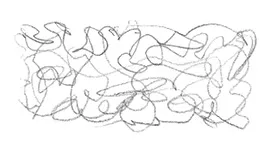
Start by making a scribbly line in all directions. Limit it to an area and try to produce a satisfying texture.
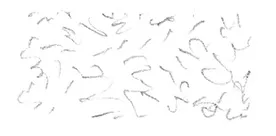
Next try short, staccato marks that fill the space. Notice how none of them overlap and the spaces in between remain similar.
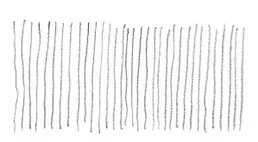
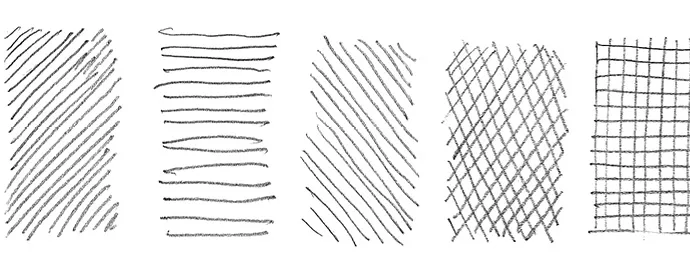
When you are drawing these more controlled uniform lines, make them all the same length and the same distance apart, keeping them as straight as possible. Repeat these three exercises.
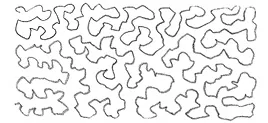
Now take a line for a walk, but don’t cross over it anywhere. This may seem rather obsessive, but it is a step on the way to teaching your hand to draw recognizable forms.
Next try a variety of straight lines, again trying to get them straight and the same distance apart, fitting into...