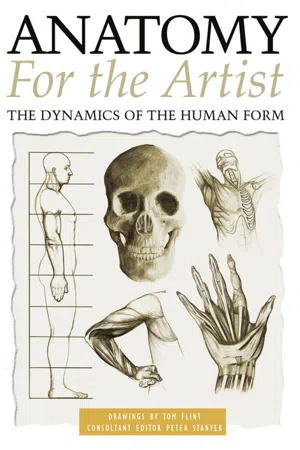
Anatomy for the Artist is a book by artists for artists, and presents a dynamic visual record of the fundamental characteristics and creative possibilities of the human form.
For hundreds of years' artists have developed their skills by drawing the human body. Bones and muscles, although largely hidden from view, reveal a great deal about us and are key components of expression. All artists need to understand how these structures affect movement and posture, creating character and making what are general physical attributes entirely personal.
No unnecessary medical jargon is included, only visually stunning yet accurate artworks, showing the artist what he needs to know in order to bring the human form to life.
- English
- ePUB (mobile friendly)
- Available on iOS & Android
eBook - ePub
Anatomy for the Artist
About this book
Information
Topic
ArtSubtopic
Art GeneralPOSTURE
Posture is the way we hold ourselves. It is controlled by the muscles, which in turn are programmed by the impulses they receive from the brain. Like the skin, posture can tell much about a subject. When we talk of ‘body language’, we mean the communication of fundamental information about an individual at a particular moment.
Posture can be used to express and symbolize any number of attitudes and attributes: generosity or meanness, hope or despair, bravery or cowardice; the list is endless. Before setting up a pose the artist must have a clear idea of what he wants to communicate or express. The position the model is then placed in must reflect the nature of the drawing. Rodin’s Thinker and Michelangelo’s David are famous examples of artists using posture and gesture to give conscious meaning to their work. In the David, for example, we read the virtues of nobility, leadership, youth and compassion. Goya’s The Nude Maja embodies passion and eroticism.
Thinking thr...
Table of contents
- INTRODUCTION
- THE SKELETON
- THE MUSCLES
- THE SKIN
- PROPORTION
- POSTURE
- FUNDAMENTAL FORM
- WORKING DRAWINGS
Trusted by 375,005 students
Access to over 1.5 million titles for a fair monthly price.
Study more efficiently using our study tools.
Frequently asked questions
Yes, you can cancel anytime from the Subscription tab in your account settings on the Perlego website. Your subscription will stay active until the end of your current billing period. Learn how to cancel your subscription
No, books cannot be downloaded as external files, such as PDFs, for use outside of Perlego. However, you can download books within the Perlego app for offline reading on mobile or tablet. Learn how to download books offline
Perlego offers two plans: Essential and Complete
- Essential is ideal for learners and professionals who enjoy exploring a wide range of subjects. Access the Essential Library with 800,000+ trusted titles and best-sellers across business, personal growth, and the humanities. Includes unlimited reading time and Standard Read Aloud voice.
- Complete: Perfect for advanced learners and researchers needing full, unrestricted access. Unlock 1.5M+ books across hundreds of subjects, including academic and specialized titles. The Complete Plan also includes advanced features like Premium Read Aloud and Research Assistant.
We are an online textbook subscription service, where you can get access to an entire online library for less than the price of a single book per month. With over 1.5 million books across 990+ topics, we’ve got you covered! Learn about our mission
Look out for the read-aloud symbol on your next book to see if you can listen to it. The read-aloud tool reads text aloud for you, highlighting the text as it is being read. You can pause it, speed it up and slow it down. Learn more about Read Aloud
Yes! You can use the Perlego app on both iOS and Android devices to read anytime, anywhere — even offline. Perfect for commutes or when you’re on the go.
Please note we cannot support devices running on iOS 13 and Android 7 or earlier. Learn more about using the app
Please note we cannot support devices running on iOS 13 and Android 7 or earlier. Learn more about using the app
Yes, you can access Anatomy for the Artist by Peter Stanyer,Tom Flint in PDF and/or ePUB format, as well as other popular books in Art & Art General. We have over 1.5 million books available in our catalogue for you to explore.