Few humans in history have been satirized as remorselessly as Adolf Hitler. It was easy to do. You could "Hitlerize" almost anything by adding a cow's lick hairstyle and a toothbrush mustache.
While his own side, the Nazis, portrayed him as a demigod, the perfect leader, and father of the nation, his enemies took it in the other direction, drawing him as a knock-kneed simpleton, a butcher with bloodied hands, an evil ghoul spewed up by the Abyss, and even an egg that had cracked.
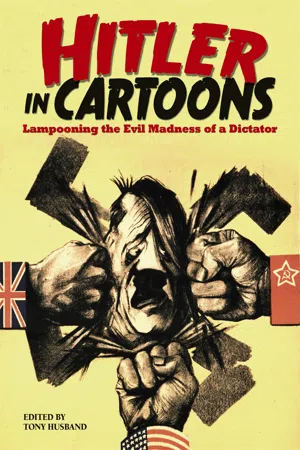
Hitler in Cartoons is the illustrated biography of a megalomaniac and control freak. Starting with his rise in the 1920s and ending with his fall in 1945, this book gives you Hitler in the raw as seen through the eyes of some of the world's greatest cartoonists, including Herb Block, D. R. Fitzpatrick, Ding Darling, E. H. Shepard, Bernard Partridge, Leslie Illingworth, and many others. The brilliant images they produced will haunt you as well as make you laugh.
- English
- ePUB (mobile friendly)
- Available on iOS & Android
eBook - ePub
About this book
Information
Subtopic
World HistoryIndex
HistoryChapter 1: On the way up
The central idea behind much German propaganda of the 1930s and 1940s was that Hitler was a godlike genius, who would lead the Master Race to a German Reich which would last a thousand years. Shaped by grievance at the Treaty of Versailles and tempered by Nazi terror, it was a collective national fantasy that came to grief against overwhelming odds in 1945 as Germany was invaded from all sides. In the early years, however, Hitler enjoyed a remarkable winning streak which carried him ever upward in the Nazi Party, and then to the summit of the German state. But who would finally win the battle for minds? The Nazis were masters of propaganda, but they were powerless against a well-timed joke.
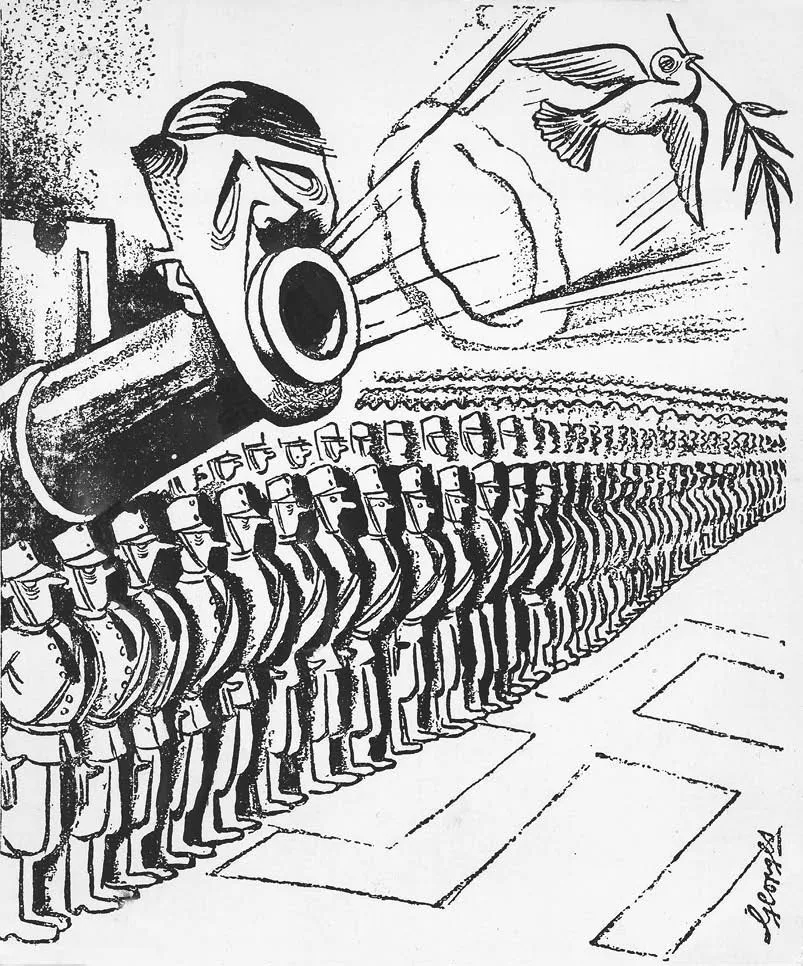
Hitler’s first major speech in the Reichstag, the German parliament, in 1933 was a plea for peace, equal rights and mutual understanding between nations. Some gullible people actually believed he meant what he said, but not Georges in The Nation, New York, 1933, who produced the powerful image above.
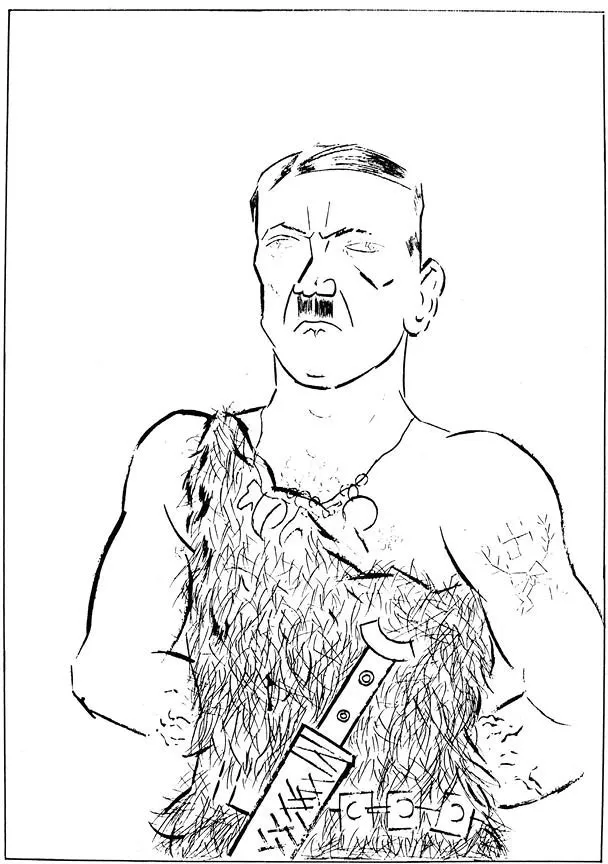
“Hitler the Saviour” by George Grosz (1923): This drawing mocks a popular postcard of the time by photographer Heinrich Hoffmann, which featured Hitler in a trenchcoat. Alluding to the Grimms’ fairytale about a man in a bearskin who made a pact with the devil as well as Wagner’s Ring Cycle, Grosz concludes that Hitler is a throwback to another age. This portrait was included in the Nazis’ Degenerate Art Exhibition, 1937.
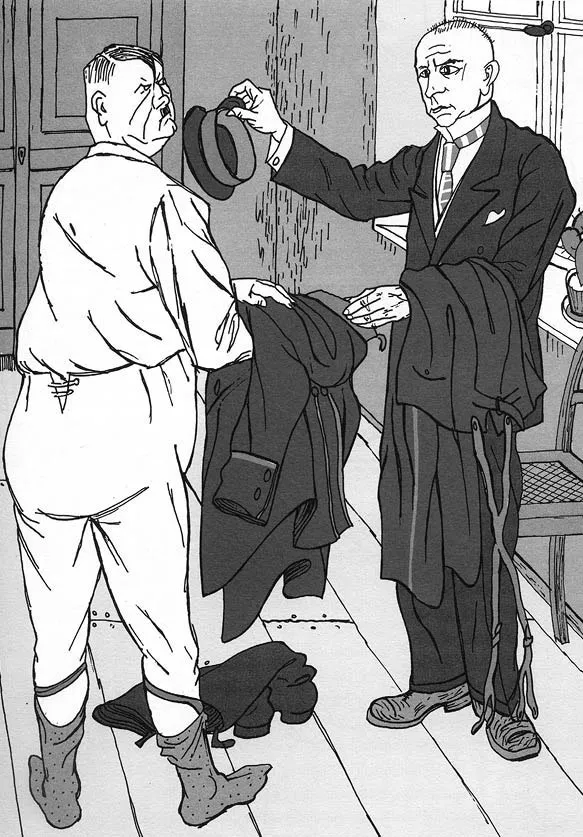
“Consolation” by Thomas Theodor Heine (1924): Hitler left Landsberg Prison in 1924, having written Mein Kampf while serving a prison sentence for his part in the Munich Putsch. Here, he is being handed his uniform by fellow fascist Hermann Kriebel who is saying: “Don’t worry about it, Adolf. In Germany making a fool of yourself isn’t fatal. If it didn’t work out for you as a sergeant, let’s try again as Reichspräsident.”
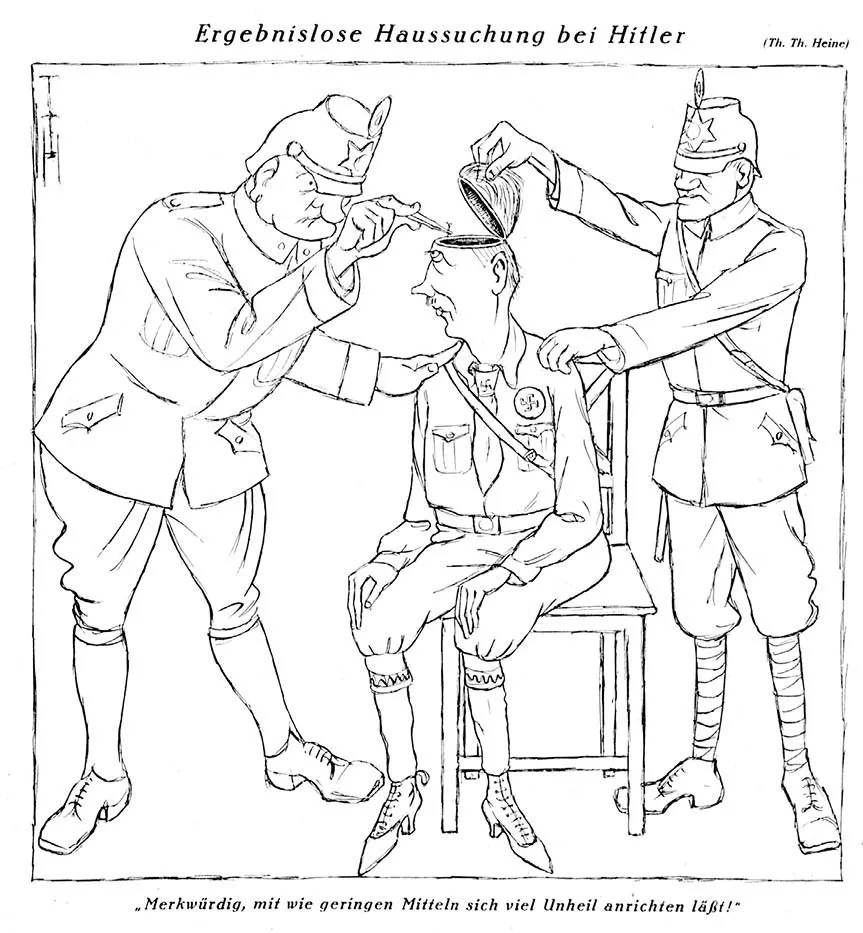
“Inconclusive Search at Hitler’s Place” by Thomas Theodor Heine (1930): As the economic crisis grew in Germany, the number of police searches of people’s homes increased. At the same time, the Nazis were seeking to become electable and even had Hitler kissing babies. Here, the police aren’t finding much. One says: “Remarkable how so much disaster has sprung from so small a seed.” Cartoonist Thomas Theodor Heine fled to Prague in 1933 when the Nazis came to power.

An image probably from the 1920s which is sarcastically dedicated to the Geman fans of Mussolini and Hitler: Hitler remains obedient to the overbearing Italian: “You’ve robbed me, insulted me, beaten me up and spat on me. Despite all the bullying, I worship you.” At this stage, Mussolini was still the model for Hitler, who tried to emulate his March on Rome with the Munich Putsch, but Hitler’s admiration was later to turn to scorn.
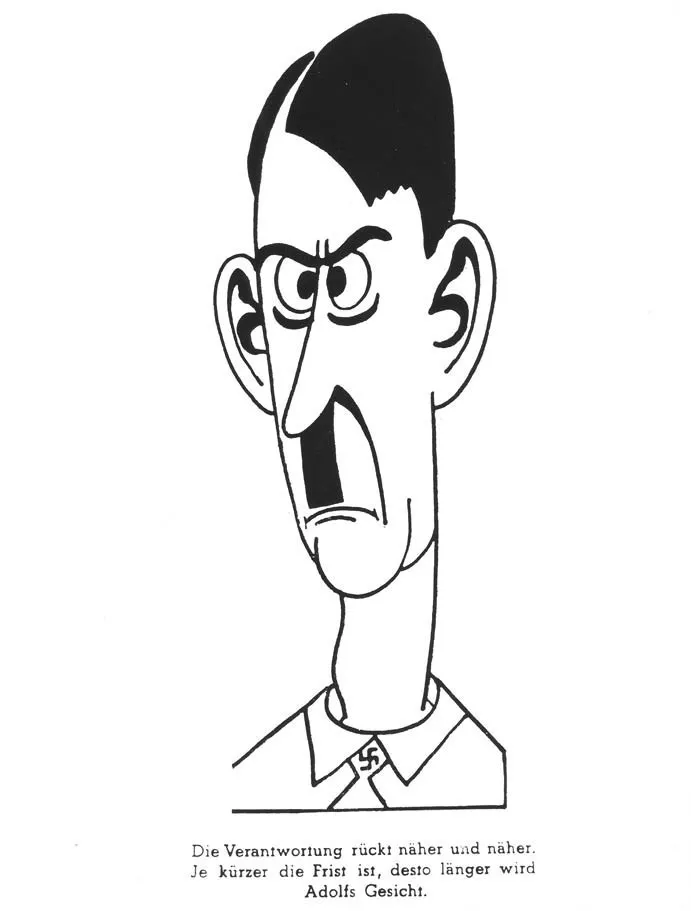
“Responsibility” (1931): This appeared in Social Democratic satire magazine Der Wahre Jacob in 1931. It says: “Responsibility is getting nearer and the closer it gets, the longer Adolf’s face becomes,” suggesting Hitler wasn’t up to the job of running Germany. The magazine was closed down by the Nazis in 1933.
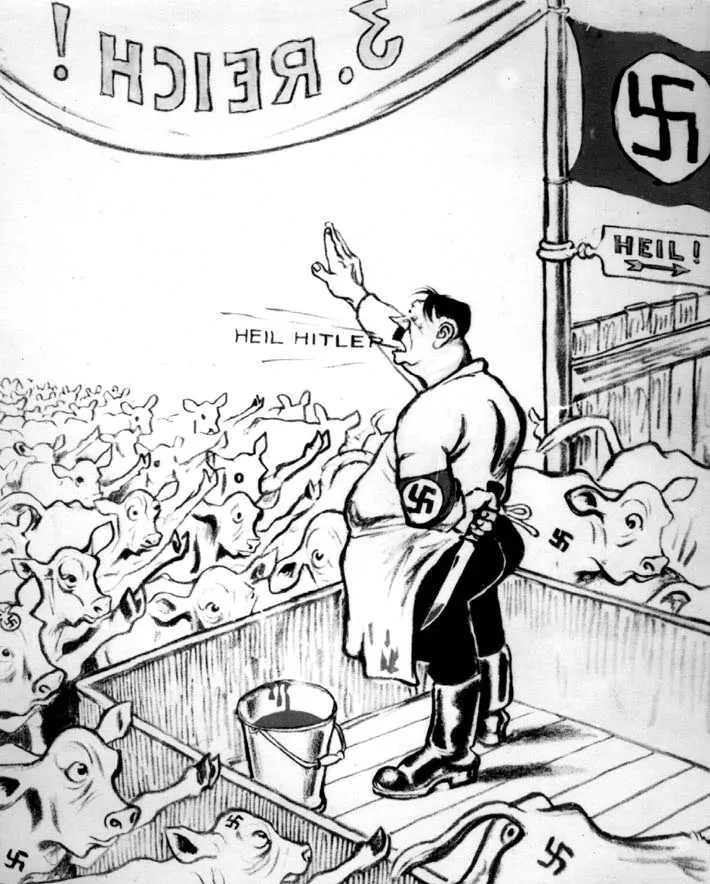
“Only the stupidest cows vote for their own butcher” by Rudolf Herrmann (1932): This image was chosen for the front cover of Roter Pfeffer (Red Pepper) magazine with the aim of averting the calamity of Hitler being elected. In 1932 there were 6 million unemployed in Germany and the NSDAP (the Nazis) won 37.4 percent of the vote in the July elections; the Nazis were inching closer to power on a diet of discontent.
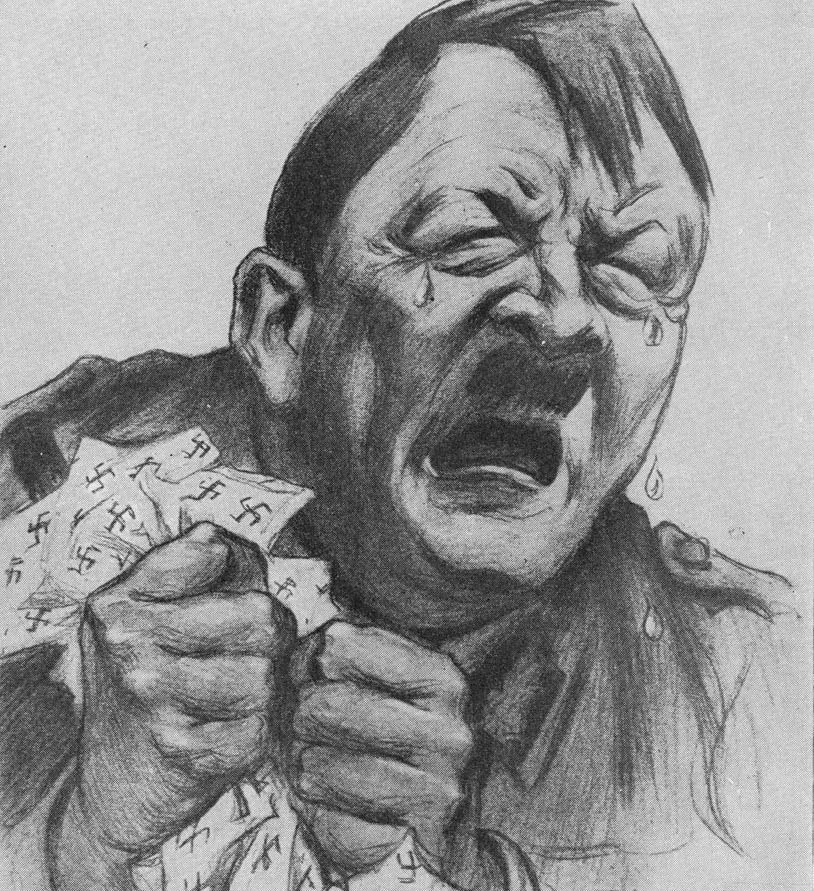
“The Führer’s Lament – ‘How can I become a dictator if no one helps me?’” (1932): This appeared in Der Wahre Jaccob in 1932 as well as Ernst Hanfstaengl’s book of cartoons in 1933—see page 11. The book sought to take the sting out of anti–Hitler cartoons, in this case by claiming that Hitler’s triumphs since taking power already answered the question. “Either Hitler’s successes belong to him alone, or he had help. If the first is true, he needs no help; and if the second is true, he had help.” But Hanfstaengl was wasting his time trying to outdo this image!
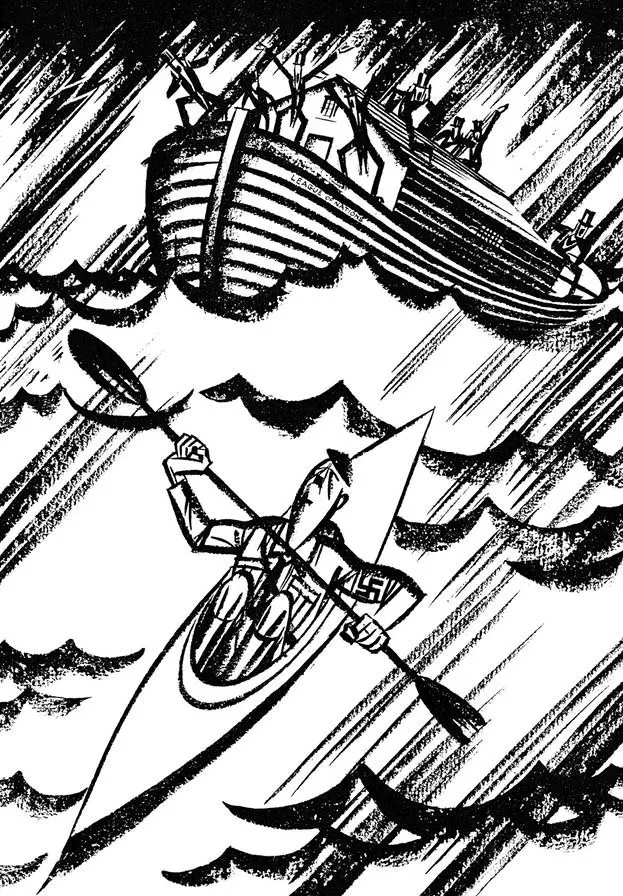
In this stylish cartoon by British artist Thomas Derrick from The Bookman magazine in 1933, Hitler abandons the ark carrying League of Nations diplomats during a deluge and makes off on his own in a canoe. Hitler had ordered his delegates to quit disarmament talks in Geneva and pulled Germany out of the League of Nations, forerunner of the U.N. Hitler claimed Germany had disarmed, but that other nations weren’t following suit.
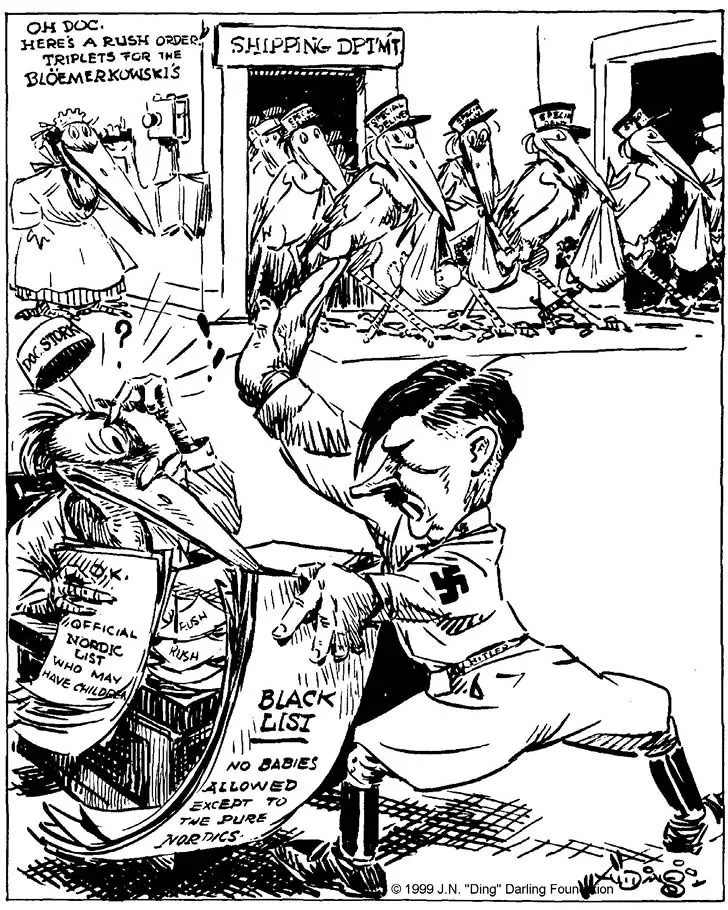
“Some Dictators Don’t Know Where to Stop” by Jay “Ding” Darling (1933): The racist policies of Nazi Germany sought to stimulate the “Aryan” birthrate through generous government loans, while limiting others. Jay Norwood Darling, better known as Ding Darling, worked for the New York Herald from 1917 to 1949 and won two Pulitzer Prizes.
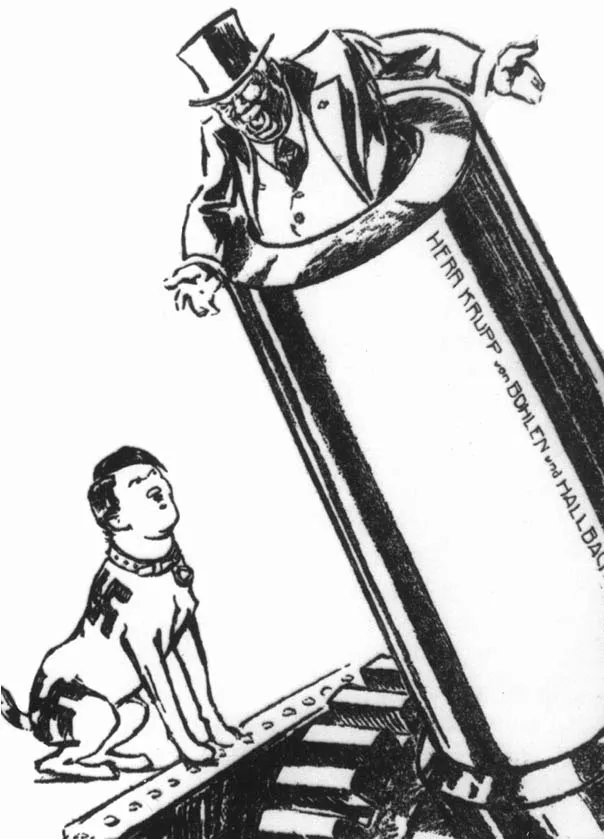
“Hitler and Krupp—His Master’s Voice” (1933): This fine drawing appeared in Brussels paper Le Soir. It features Adolf Hitler as a dog with swastika mar...
Table of contents
- Title Page
- Contents
- Introduction
- Chapter 1: On the way up
- Chapter 2: Jackboots on the march
- Chapter 3: Decline and fall
- Picture Credits
- Copyright
Trusted by 375,005 students
Access to over 1.5 million titles for a fair monthly price.
Study more efficiently using our study tools.
Frequently asked questions
Yes, you can cancel anytime from the Subscription tab in your account settings on the Perlego website. Your subscription will stay active until the end of your current billing period. Learn how to cancel your subscription
No, books cannot be downloaded as external files, such as PDFs, for use outside of Perlego. However, you can download books within the Perlego app for offline reading on mobile or tablet. Learn how to download books offline
Perlego offers two plans: Essential and Complete
- Essential is ideal for learners and professionals who enjoy exploring a wide range of subjects. Access the Essential Library with 800,000+ trusted titles and best-sellers across business, personal growth, and the humanities. Includes unlimited reading time and Standard Read Aloud voice.
- Complete: Perfect for advanced learners and researchers needing full, unrestricted access. Unlock 1.5M+ books across hundreds of subjects, including academic and specialized titles. The Complete Plan also includes advanced features like Premium Read Aloud and Research Assistant.
We are an online textbook subscription service, where you can get access to an entire online library for less than the price of a single book per month. With over 1.5 million books across 990+ topics, we’ve got you covered! Learn about our mission
Look out for the read-aloud symbol on your next book to see if you can listen to it. The read-aloud tool reads text aloud for you, highlighting the text as it is being read. You can pause it, speed it up and slow it down. Learn more about Read Aloud
Yes! You can use the Perlego app on both iOS and Android devices to read anytime, anywhere — even offline. Perfect for commutes or when you’re on the go.
Please note we cannot support devices running on iOS 13 and Android 7 or earlier. Learn more about using the app
Please note we cannot support devices running on iOS 13 and Android 7 or earlier. Learn more about using the app
Yes, you can access Hitler in Cartoons by Tony Husband in PDF and/or ePUB format, as well as other popular books in History & World History. We have over 1.5 million books available in our catalogue for you to explore.