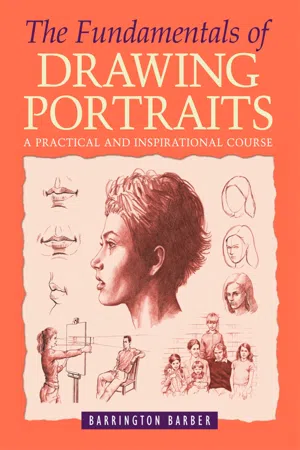
This book is essential for everyone who wants to improve their drawing skills. Written by teacher and established artist Barrington Barber, it contains a wealth of know-how and practical advice, supported by over 300 original illustrations. Guidance is given on how to overcome common difficulties without imposing a particular style or approach. The aim throughout is to help you discover your artistic purpose while giving you the technical skills necessary if you are to produce work you will be proud to call your own.
As a complement to the book's essentially skills based core, you will find feature spreads on artists who have been major influences on the development of portraiture, and plenty of scope for incorporating their innovative ideas in your own drawings.
The Fundamentals of Drawing Portraits presents an inspirational approach to all aspects of the subject, ensuring that you will remain enthused from beginning to end and regularly revisit its pages for advice and encouragement.
- English
- ePUB (mobile friendly)
- Available on iOS & Android
eBook - ePub
The Fundamentals of Drawing Portraits
About this book
Information
Topic
ArtSubtopic
Art GeneralFirst Steps
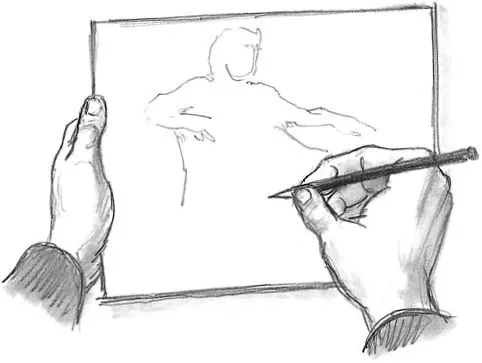
IN THIS FIRST SECTION we look at the most important aspects of drawing portraits. Themes are presented in the order in which you will tackle them, so that even if you have never done a portrait before you will know how to proceed. You will notice that much emphasis is placed on the structure of the head and the features. When you sit in front of a subject, you will carefully observe the particular image of a human being that this person represents. In order to be able to gauge the person accurately, you must have knowledge of what you are looking at. For example, the main shape of the head is vital because if you ignore this the resulting drawing will never really catch the qualities of the sitter. Basic anatomical and structural drawings have been provided to help you analyze this major basic shape. If you are very new to portrait drawing, you will find it beneficial to practise drawing just that shape accurately if loosely and lightly.
The particular arrangement of features is also very important. If you are keen to do so, you can measure everything, and this can help greatly in producing a good likeness. However, measurement by itself will only give the proportion, and you should aim to use your drawing practice as your guide to how the features relate and fit together.
The next important aspect to work on is the shape of each feature. Obviously each of us sees things slightly differently from the next person. Nevertheless there is an objective shape that a particular face will have which can be studied until correctly drawn. How each lump or bump in each feature is related to the whole shape and whether the curves are greater or smaller can make a lot of difference to the final result. There is no substitute for careful observation. If you practise looking at people’s faces it will enormously enhance your ability to recognize and draw the shapes in front of you. Changing light conditions and changing expressions give subtle variations to the features. You have to decide exactly which of these variations to include in your drawing.
Finally, we look at a range of materials, to give you a wide spectrum of options. What you discover for yourself through trial and error will stay with you and inform your work in the future.
The Angle of the Head
The most distinctive part of any portrait is the face, which is where the likeness and characteristics of the sitter can be shown most easily. This is your starting point. The head should be dealt with as a whole so that the face has a solid basis. Only so many views of the head are possible for a portrait to be recognizable.
The position you choose for the head will make a lot of difference to the end result, and whether people recognize your subject. We will start with the most common, and then assess the workable alternatives.
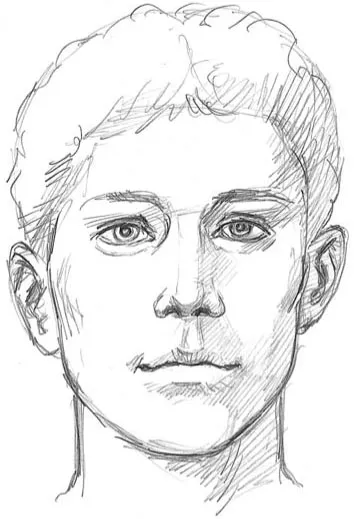
Full face, from the same eye level as the artist, is excellent for capturing the expression in the eyes, but the shape of the nose is less obvious.
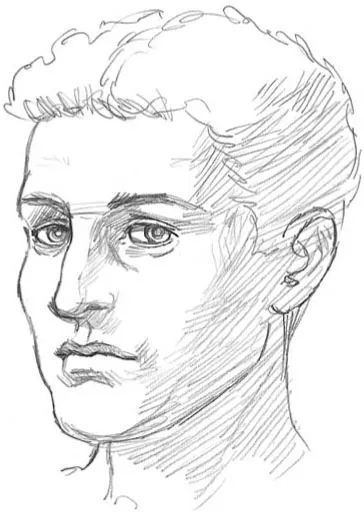
The three-quarter view is probably the most popular position. It gives a clear view of the eyes and enough of the shape of the nose to give a good likeness.
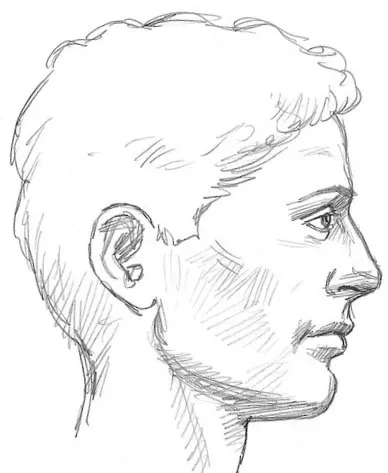
The head seen in profile allows clear definition of the features. Generally, though, portraits from this angle are less expressive, because the eyes are not clearly seen.
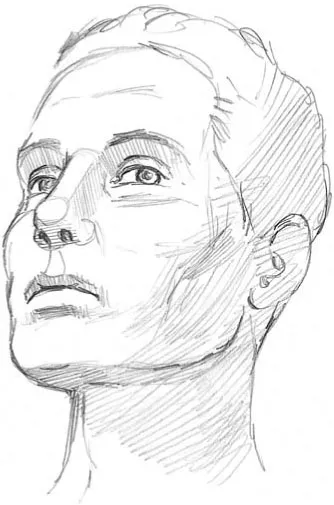
The head tilted back a little gives an air of coolness, even haughtiness, but it’s worth considering.

The head tilted forward can give a rather quizzical or defensive expression.
Drawing the Head: Basic Method
The basic shapes...
Table of contents
- Title
- Contents
- Introduction
- First Steps
- Styles and Techniques
- Composition
- Group and Family Portraits
- Life through the Ages
- Dress
- Animals in Portraits
- Furniture and Props
- Symbolism
- Self-portraits
- Caricature
- Last Word
- Index
- Copyright
Trusted by 375,005 students
Access to over 1.5 million titles for a fair monthly price.
Study more efficiently using our study tools.
Frequently asked questions
Yes, you can cancel anytime from the Subscription tab in your account settings on the Perlego website. Your subscription will stay active until the end of your current billing period. Learn how to cancel your subscription
No, books cannot be downloaded as external files, such as PDFs, for use outside of Perlego. However, you can download books within the Perlego app for offline reading on mobile or tablet. Learn how to download books offline
Perlego offers two plans: Essential and Complete
- Essential is ideal for learners and professionals who enjoy exploring a wide range of subjects. Access the Essential Library with 800,000+ trusted titles and best-sellers across business, personal growth, and the humanities. Includes unlimited reading time and Standard Read Aloud voice.
- Complete: Perfect for advanced learners and researchers needing full, unrestricted access. Unlock 1.5M+ books across hundreds of subjects, including academic and specialized titles. The Complete Plan also includes advanced features like Premium Read Aloud and Research Assistant.
We are an online textbook subscription service, where you can get access to an entire online library for less than the price of a single book per month. With over 1.5 million books across 990+ topics, we’ve got you covered! Learn about our mission
Look out for the read-aloud symbol on your next book to see if you can listen to it. The read-aloud tool reads text aloud for you, highlighting the text as it is being read. You can pause it, speed it up and slow it down. Learn more about Read Aloud
Yes! You can use the Perlego app on both iOS and Android devices to read anytime, anywhere — even offline. Perfect for commutes or when you’re on the go.
Please note we cannot support devices running on iOS 13 and Android 7 or earlier. Learn more about using the app
Please note we cannot support devices running on iOS 13 and Android 7 or earlier. Learn more about using the app
Yes, you can access The Fundamentals of Drawing Portraits by Barrington Barber in PDF and/or ePUB format, as well as other popular books in Art & Art General. We have over 1.5 million books available in our catalogue for you to explore.