- English
- ePUB (mobile friendly)
- Available on iOS & Android
eBook - ePub
About this book
In this groundbreaking book, Barrington Barber teaches two connected skills: drawing techniques and relaxation. He demonstrates, through a series of specially crafted exercises, how drawing is a calm, focused activity that can improve concentration and reduce stress, while teaching people to observe and enjoy their surroundings.
Information
Topic
ArtSubtopic
Art Techniques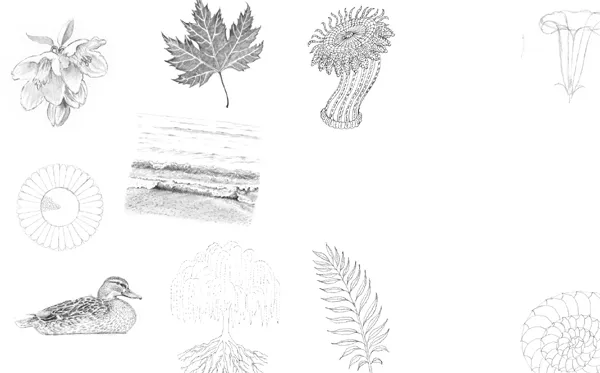
INSPIRATION FROM NATURE
In this chapter we shall explore how nature gives us a whole world of pattern and shape that we can turn to for our decorative drawing of meditational patterns and pictures. The variety and complexity of natural forms is astounding, and they can easily provide a lifetime of inspiration for an artist. I look to nature again and again for both figurative and abstract images, redrawing and stylizing objects to make an attractive patterned picture.
Water is one of the ideal natural forms that can be manipulated like this to make interesting formal patterns. Flowers are always decorative, with patterns of growth that range from a simple five-petalled open cup to the complexity of a chrysanthemum. They are also easily available, of course, for if you do not have a garden of your own you can take a sketching pad to a park or head for your local florist.
Birds and fish too are a good basis for many detailed formal patterns, since they are inherently attractive and require little alteration to produce attractive flat shapes.
SIMPLIFYING FLOWER FORMS
Here are a series of designs, mostly based on a circle shape, that you can adapt into effective flower-like forms. All blossoms have a relatively simple basic shape, with small differences that identify the particular type of flower. In these examples, start with a diagrammatic version and then make a drawing with more precision and flower-like textures.
1. Draw a circle. From the central point draw five large loops that touch the edge of the circle and finish back at the centre. The loops should overlap slightly. Draw a small circle around the central point.
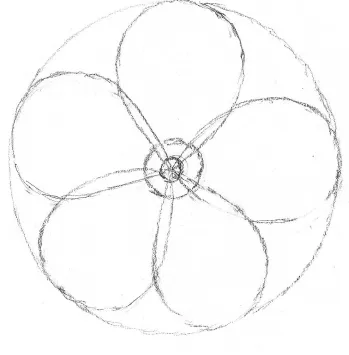
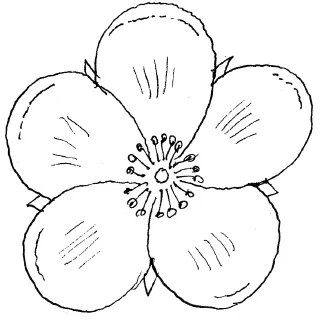
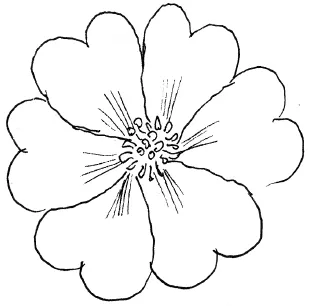
2. Now draw the outline of the overlapping petals with some simple marks to suggest texture. Draw some stamens radiating outwards from the centre and little points of leaf where the petals overlap.
1. Now draw a similar pattern with six overlapping heart-shaped petals.
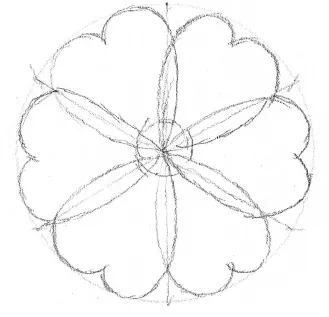
2. Firm up the outline, showing the overlap on one side only and put in some small circle-like shapes to denote the centre of the flower.
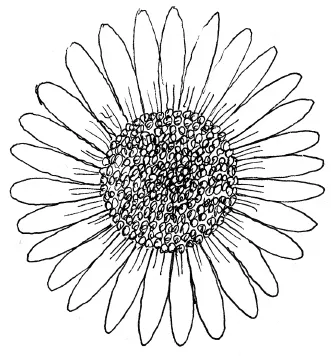
1. For this next pattern, draw two circles, one inside the other, as I have done. From the inner circle draw a number of narrow petals with curved ends, their tips touching the outer circle. Draw lots of small circles in the centre of your flower design.
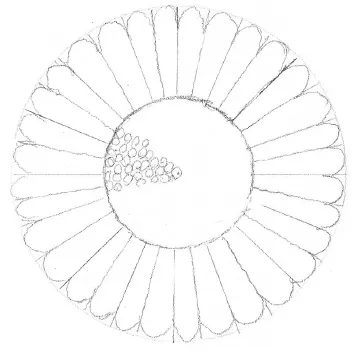
2. Now firm up your shapes, making the petal shapes more natural-looking and the flower centre quite dense with lots of small scribbly circles. The pattern resembles a sunflower.
1. Draw a set of four concentric circles. Around the central point and the three inner circles draw five curves to denote petals: the petals will be smaller towards the centre. Draw small pointed leaf shapes between the outermost petals.
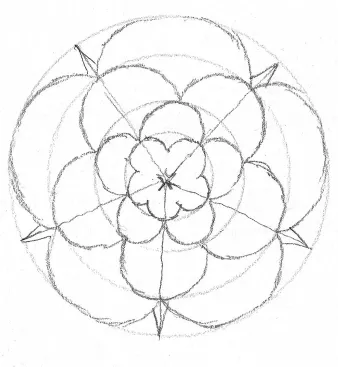
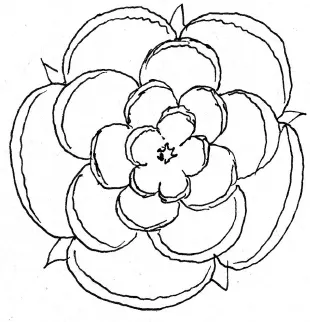
2. When you formalize the pattern, add extra edges to the petal shapes to suggest a curved edge. This pattern has the look of a Tudor rose.
1. From the centre of a circle draw seven overlapping petal shapes, this time tapering to a point where they touch the circle’s edge. Draw another set of petals behind and in between them.
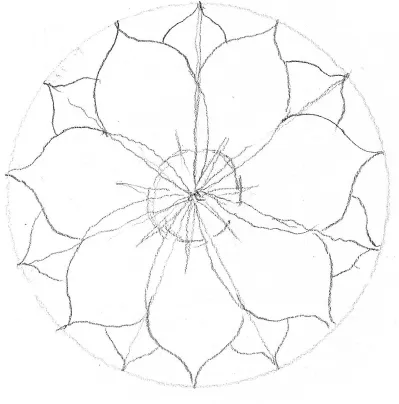
2. Firm up the lines and add some detail in the centre to resemble stamens...
Table of contents
- Cover Page
- Title Page
- Copyright
- Contents
- Introduction
- Making Mindful Marks
- Inspiration from Nature
- Mandalas: a Cosmic View
- The Creative Mind
Trusted by 375,005 students
Access to over 1.5 million titles for a fair monthly price.
Study more efficiently using our study tools.
Frequently asked questions
Yes, you can cancel anytime from the Subscription tab in your account settings on the Perlego website. Your subscription will stay active until the end of your current billing period. Learn how to cancel your subscription
No, books cannot be downloaded as external files, such as PDFs, for use outside of Perlego. However, you can download books within the Perlego app for offline reading on mobile or tablet. Learn how to download books offline
We are an online textbook subscription service, where you can get access to an entire online library for less than the price of a single book per month. With over 1.5 million books across 990+ topics, we’ve got you covered! Learn about our mission
Look out for the read-aloud symbol on your next book to see if you can listen to it. The read-aloud tool reads text aloud for you, highlighting the text as it is being read. You can pause it, speed it up and slow it down. Learn more about Read Aloud
Yes! You can use the Perlego app on both iOS and Android devices to read anytime, anywhere — even offline. Perfect for commutes or when you’re on the go.
Please note we cannot support devices running on iOS 13 and Android 7 or earlier. Learn more about using the app
Please note we cannot support devices running on iOS 13 and Android 7 or earlier. Learn more about using the app
Yes, you can access The Art of Mindful Drawing by Barrington Barber in PDF and/or ePUB format, as well as other popular books in Art & Art Techniques. We have over 1.5 million books available in our catalogue for you to explore.