Drawing the human figure with confidence and skill is perhaps the biggest challenge an artist can face, but it is the most rewarding when done successfully.
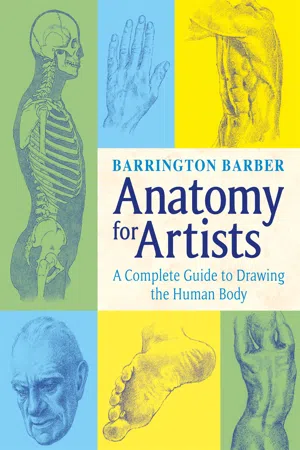
In Anatomy for Artists, best-selling author and artist Barrington Barber provides clear annotated diagrams of every part of the human body useful to the artist, showing bone structure, musculature and surface views.
Throughout the book he gives practical advice, gained from years of experience, on how to apply your newfound knowledge to the drawing of live models. This carefully researched, comprehensive book is an invaluable reference resource for the practising artist.
Learn how to:
• Recognize the differences between male and female bone structure
• Identify facial muscles used in different expressions
• Name the bones that show at the surface of the body
• Accurately portray the body in movement
• Improve your life drawing technique
- English
- ePUB (mobile friendly)
- Available on iOS & Android
eBook - ePub
About this book
Information
Subtopic
Art TechniquesIndex
Biological SciencesTechnical Introduction
This section is intended to give you some initial detail about the human anatomy before starting to draw. I have described the properties of bones, muscles, tendons, cartilage, skin, fat and joints, and shown diagrams of the different types of joints and muscles. There is also an introduction to anatomical terminology: you will find this useful as certain terms are used throughout the book.
BONES
The skeleton is the solid framework of the body, partly supporting and partly protective. The shape of the skeleton can vary widely. It affects the build of a person and determines whether they have masses of muscle and fat or not.
Bones are living tissue supplied by blood and nerves. They can become weaker and thinner with malnutrition and lack of use or heavier and stronger when having to support more weight. They are soft and pliable in the embryo, and only become what we would consider hard and bone-like by the twenty-fifth year of life.
Humans have 206 bones, but it is possible to be born with some bones missing or even extra ones, and a few bones fuse together with age. We each have a skull, ribcage, pelvis and vertebral column, as well as arm, hand, leg and foot bones. Most bones are symmetrical. The bones of the limbs are cylindrical, thickening towards the ends. The projecting part of a bone is referred to as a process or an eminence.
Highly mobile areas of the body, such as the wrists, consist of numerous small bones. Other bones, like the scapula (shoulder blade) can move in all directions, controlled by the muscles around them.
The bones of the cranium (skull) differ from all others. They grow from separate plates into one fused vault to house the brain. The mandible (jawbone) is the only movable bone in the head.
The long bones of the arms and legs act like levers, while the flat bones of the skull, the cage-like bones of the ribs and the basin shape of the pelvis protect the more vulnerable organs such as the brain, heart, lungs, liver and the abdominal viscera.
MUSCLES
The combination of bones, muscles and tendons allows both strong, broad movements and delicate, precise ones. Muscles perform our actions by contracting or relaxing. There are long muscles on the limbs and broader muscles on the trunk. The more fixed end of the muscle is called the head or origin, and the other end – usually farthest from the spine – is the insertion. There are powerful, thick muscles, like the biceps and the ring-shaped muscles (sphincters) surrounding the openings of the body, such as the eye, mouth and anus. Certain muscles grow together and have two, three or four heads and insertions. Combined muscles also have parts originating in different places. The fleshy part of a muscle is called t...
Table of contents
- Cover Page
- Title Page
- Copyright
- Contents
- Introduction
- Technical Introduction
- The Full Figure
- The Head
- The Torso
- The Arms & Hands
- The Legs & Feet
Trusted by 375,005 students
Access to over 1.5 million titles for a fair monthly price.
Study more efficiently using our study tools.
Frequently asked questions
Yes, you can cancel anytime from the Subscription tab in your account settings on the Perlego website. Your subscription will stay active until the end of your current billing period. Learn how to cancel your subscription
No, books cannot be downloaded as external files, such as PDFs, for use outside of Perlego. However, you can download books within the Perlego app for offline reading on mobile or tablet. Learn how to download books offline
Perlego offers two plans: Essential and Complete
- Essential is ideal for learners and professionals who enjoy exploring a wide range of subjects. Access the Essential Library with 800,000+ trusted titles and best-sellers across business, personal growth, and the humanities. Includes unlimited reading time and Standard Read Aloud voice.
- Complete: Perfect for advanced learners and researchers needing full, unrestricted access. Unlock 1.5M+ books across hundreds of subjects, including academic and specialized titles. The Complete Plan also includes advanced features like Premium Read Aloud and Research Assistant.
We are an online textbook subscription service, where you can get access to an entire online library for less than the price of a single book per month. With over 1.5 million books across 990+ topics, we’ve got you covered! Learn about our mission
Look out for the read-aloud symbol on your next book to see if you can listen to it. The read-aloud tool reads text aloud for you, highlighting the text as it is being read. You can pause it, speed it up and slow it down. Learn more about Read Aloud
Yes! You can use the Perlego app on both iOS and Android devices to read anytime, anywhere — even offline. Perfect for commutes or when you’re on the go.
Please note we cannot support devices running on iOS 13 and Android 7 or earlier. Learn more about using the app
Please note we cannot support devices running on iOS 13 and Android 7 or earlier. Learn more about using the app
Yes, you can access Anatomy for Artists by Barrington Barber in PDF and/or ePUB format, as well as other popular books in Biological Sciences & Art Techniques. We have over 1.5 million books available in our catalogue for you to explore.