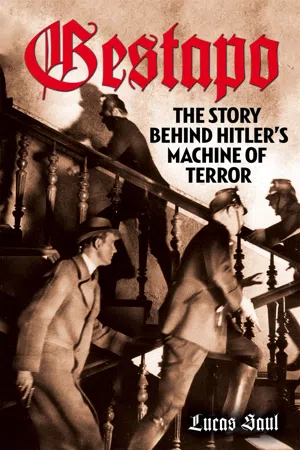
Formed in 1933, the Gestapo became one of the most feared state forces of the Third Reich before and during World War II.
Chronicling the history of the organization, from its origins to the brutal and horrific offences that it perpetrated on hundreds of thousands of people, to its eventual downfall, Gestapo is a compelling tale of power and destruction taken to their most terrifying extremes.
Familiar in films as the ominous men wearing black leather trench coats seen arresting people on the flimsiest of pretexts, the true story of the Geheime Staatspolizei (or Gestapo for short) is even more frightening.
Drawing on numerous sources, Gestapo explores how this secret state police force was born on 26 April 1933, the creation of Hermann Göring. Together with the Kriminalpolizei and the Sicherheitsdienst, the Gestapo would enforce a reign of terror on Germany and across much of Europe.
Containing profiles of key figures and chilling tales of its death squads' sadistic efficiency - from the torture of Resistance members to mass murder in collaboration with the Einsatzgruppen - Gestapo shows how the organization thrived on Hitler's insecurity until, as the Allies triumphed, its members were eventually rounded up and, as far as possible, brought to justice.
- English
- ePUB (mobile friendly)
- Available on iOS & Android
eBook - ePub
About this book
Information
Breaking The Chain
The chain of command from the RSHA down to the provincial Gestapo offices rapidly fell apart as the Allies overran occupied territories and finally Germany itself. Relentless Allied bombing shattered the Nazi command and control structure. Prior to the war, the regional offices had always had far greater autonomy, but in the years since they had come to rely on orders from above. When that culture changed, the Gestapo struggled to adapt. Confusion rapidly turned to panic in the areas farthest from Berlin, and in regions where adherence to the Nazi philosophy was less fanatical than in the capital. Information often arrived too late to be of use to officers, or could not be acted upon even if it did arrive in time due to increasing shortages of staff. The ruthless efficiency that had characterized the Gestapo ebbed away, and with it its air of invincibility.
When Germany surrendered, the key figures of the reviled Gestapo were hunted down remorselessly by the Allies, and many of their stories are included here. The ‘rank and file’ members of the organization were rarely punished harshly, however. Thousands of former SS and Gestapo men found employment in the intelligence services and the civil services of both West and East Germany. A law passed in 1948 in West Germany granted amnesty for all crimes committed before 15 September 1949 for which the punishment was less than six months. As many as 700,000 convicts and suspects benefited as a result.
The Demise of Roland Freisler
The Allies had forced the Luftwaffe onto the back foot and begun to take control of the skies over Western Europe. By 1945, even the German capital was no longer safe from attack. One particular raid on 3 February was to have a major impact on the Gestapo, killing one of its best-known and most flamboyant associates, Judge Roland Freisler.
It was ‘Raving Roland’ Freisler who routinely handed down death sentences to the defendants brought before him by the Gestapo, often without any evidence of guilt being offered. A fanatical Nazi, Freisler was known for his angry outbursts at those in the dock, and for ruthlessly punishing anyone who dared to show disloyalty to Hitler. In one especially memorable instance, a young woman named Marianne Elise Kürchner was arrested by the Gestapo for making a joke about the Führer. She reportedly said, ‘Hitler and Göring are standing atop the Berlin radio tower. Hitler says he wants to do something to put a smile on Berliners’ faces. So Göring says, “Why don’t you jump?”.’
Freisler’s judgement upon her? ‘Her honour has been permanently destroyed,’ he said in his adjudication, ‘and therefore she shall be punished with death.’ As far as Freisler was concerned, the war was no laughing matter.
It is perhaps fitting that the Gestapo’s chief judge lost his life while in the process of sitting in judgement on one of those arrested in the wake of the 20 July plot to assassinate Hitler. The wave of arrests that followed the attempted coup was one of the most notorious Gestapo operations. One of those interrogated and tortured was Fabian von Schlabrendorff, who had been a member of the German Resistance for several years and had unsuccessfully tried to assassinate Hitler in March 1943. A primed bomb he passed to one of Hitler’s associates was supposed to blow his plane out of the sky, but it was left in the drawer of his desk, where in any case it failed to detonate.
Schlabrendorff was facing a certain death sentence from Freisler when an Allied air raid caused the trial to be halted. The unsentenced defendant was hurried away to a cell and spent the rest of the war being shuffled between detention camps, before being liberated by the Allies. Judge Freisler, however, deemed that he had time enough to pick up his paperwork before evacuating the court building after the suspension of Schlabrendorff’s trial. It was a fatal mistake.
A direct hit on the building caused a roof beam to fall on Freisler, who subsequently died of his injuries. The bombing raid was led by US Air Force pilot Robert Rosenthal, a Jew who later worked as an assistant to a prosecutor at the Nuremberg trials. A hospital worker who received Freisler’s body was reported to have remarked, ‘It is God’s verdict.’ It was certainly a verdict that Freisler himself had handed down to others on thousands of occasions during the war.
Operation Carthage
The Danish Resistance movement (Modstandsbevægelsen) had long requested that the Allies target the Gestapo headquarters in the ‘Shell House’ (Shellhus) building in Copenhagen. By March 1945 the British had both the means and the will to carry out such a raid, having perfected the art of high-speed, low-level bombing runs with Mosquito aircraft. Even so, it was an incredibly audacious and high-risk attack, involving a flight in broad daylight right into the heart of a major city that was heavily defended with anti-aircraft guns.
The Gestapo, however, was holding dozens of high-level Danish Resistance fighters and the building was packed with dossiers that could lead to the execution of hundreds more. The Shell House was notorious as a centre of torture and depravity, and as a symbol of Nazi oppression in Denmark. The plan was to badly disrupt the Gestapo’s operation in the country while freeing the Resistance prisoners. The Gestapo held the majority of the prisoners on the top floor of the building, as ‘human shields’ against bombers, so the RAF decided to precision-bomb only the lower floors.
Three waves of six RAF Mosquitoes took part in the raid, supported by 30 American-supplied Mustang fighters. The latter’s role was not only to provide cover against enemy aircraft but also to attack and draw fire from the anti-aircraft guns positioned all across the city. Given the Shell House’s location in the centre of a densely populated area, the bombers would have to fly as low as possible. Indeed, as testament to this, one of the Mosquitoes crashed after its wing clipped a 30 m (100 ft)-high lamppost. Tragically, it span out of control into the nearby Jeanne d'Arc School and burst into flames. Some of the following waves of bombers, seeing the flames, mistook the burning school for their target and dropped their bombs there. As a result, 86 schoolchildren and 18 adults (most of whom were nuns) were killed.
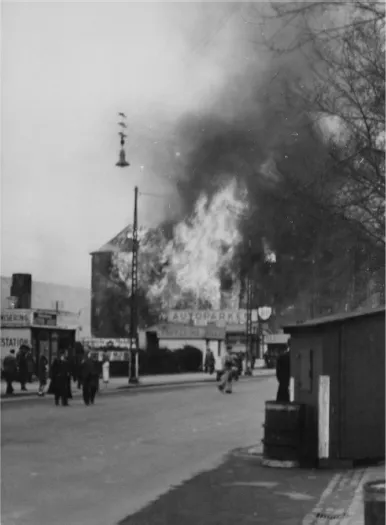
The Shellhus, Copenhagen headquarters of the Gestapo in Nazi-occupied Denmark, on fire in the aftermath of the Operation Carthage bombing raid by the RAF, 21 March 1945.
Many of the bombers, however, did score direct hits on the Gestapo HQ, and caused massive damage to the building. As it burnt, 18 Resistance prisoners took the opportunity to escape. A total of 55 Germans were killed, along with 47 Danish Gestapo employees and eight prisoners. One of the prisoners killed was Morgens Prior, who was being beaten by the Gestapo when the raid interrupted the torture. The badly wounded Prior died after jumping from the window of his fourth-floor interrogation room. The RAF lost four Mosquitoes and two Mustangs in the raid, which left nine airmen dead.
The role of the Danish Resistance has long been a source of historical debate, with many suggesting that Denmark did little to resist the Nazi occupation, while others point to the high quality of the information the Danes supplied to Britain. The most celebrated Danish Resistance fighter, Bent Faurschou Hviid (nicknamed ‘Flammen’ or ‘the Flame’ due to his bright red hair), was certainly a thorn in the side of the Gestapo. Widely believed to have personally executed 22 Nazi collaborators and double agents, Flammen was the most wanted man in Denmark until his death in October 1944. The bounty on his head led to his betrayal, and though he fled across a roof, he soon realized he was surrounded. Faurschou Hviid swallowed cyanide rather than face the Gestapo torture chambers. His lifeless body was dragged off the roof and down the stairs by its feet, with the arresting officers cheering each time his head struck a stair.
The remaining Danish Resistance fighters later succeeded in disrupting the Danish railway network in the days following D-Day, preventing German troops stationed in the country from reinforcing the Nazi defences in Western Europe.
The Case of Wernher Von Braun
The Gestapo’s arrest of Germany’s chief rocket scientist, Wernher von Braun, in March 1945, would arguably change the entire world. Throughout the war, von Braun was in charge of developing advanced rocket-based weapons that Hitler hoped would give the Reich a decisive military edge. Von Braun’s brilliance resulted in the V-2 rocket, the world’s first long-range guided ballistic missile. As the tide of war turned, the V-2 rockets were increasingly viewed as the wonder-weapon that might force the Allies to make peace with Germany rather than force the country to unconditionally surrender. More than 3,000 of the rockets were launched between September 1944 and the spring of 1945, initially targeted at London but later also at Antwerp and Liège. The number of people killed by the weapons is estimated at between 5,000 and 9,000.
Though the V-2 was effective as a terror weapon, it was too inaccurate to bring the kind of devastation of which Hitler dreamed. In addition, the production of the V-2 was horribly expensive, both in terms of treasure and blood. The Reich spent the equivalent of around £3 billion ($4.6 billion) in today’s terms, and in excess of 10,000 forced labourers were killed while working on the project, from exhaustion, sickness, malnutrition and mistreatment.
Senior members of the Gestapo believed that von Braun was more interested in the potential for rockets to travel into space than he was in rocket-powered weaponry. Himmler had a burning personal desire to get his hands on the technology and pushed to be allowed to take control of the entire operation. When this route brought him no joy he planted the suggestion that von Braun was deliberately dragging his feet on the rocket project. A rumour was also spread that von Braun was in fact a British spy about to betray the secret technology to the British.
Hitler was unnerved enough to allow Himmler to arrest von Braun and interrogate him. The entire team behind the V-2 was raided at 2 am and hauled into Gestapo headquarters while their homes and workplaces were searched. Von Braun remained in ‘protective custody’ for over two weeks, but no evidence of the supposed plan to flee to England was discovered by the Gestapo investigation. Eventually Hitler ordered his release, and von Braun returned to work. He was still involved in the V-2 project when he surrendered to Allied forces in 1945, along with his brother Magnus and the rest of his team.
Because of Himmler’s accusations and von Braun’s imprisonment by the Gestapo, the German scientist was treated favourably by the United States army. He and his team were flown to America, where he eventually became technical director of the US army Ordnance Guided Missile Project in Alabama. Von Braun designed the Saturn V booster that in 1969 sent Apollo 11 to the moon. By then he was a US citizen, and his past close association with the Nazi regime was a distant memory. His rehabilitation after the war was undoubtedly helped by Himmler, whose paranoid accusations provided von Braun with an anti-Nazi cover story that he never really had. As a result, the Gestapo inadvertently helped the United States win the space race, 25 years after they raided their chief rocket scientist’s home.
Justice for Hermann Fegelein
Hermann Fegelein was a career opportunist who took advantage of his close links to those in power in order to rise up through the ranks of the Nazi military machine. He was the brother-in-law of Hitler’s partner (and future wife) Eva Braun, and thus part of Hitler’s inner circle. In addition, he cultivated a close friendship with Heinrich Himmler, who ensured that he received the positions he most coveted in the Reich.
When Fegelein faced court-martial charges in 1940 after stealing food and luxury goods, Himmler stepped in to ensure all charges against his friend were dropped. Gestapo head Reinhard Heydrich tried on several occasions to have Fegelein brought to justice for a variety of crimes, including ‘murder motivated by greed’. That charge related to Fegelein ordering the execution of several prisoners held in a Gestapo prison so that he could take possession of their valuables. Fegelein was too well connected for any of the charges to stick, however.
Fegelein’s SS Totenkopf Reiterstandarte (‘Death’s-Head Horse Regiment’) worked closely with the German state police forces, including the Gestapo. While his unit was deployed in Poland it took part in the Kampinos Forest massacre that saw 1,700 Polish intellectuals shot dead. When the unit later moved to the Eastern Front, it assisted the Gestapo in rounding up partisans, Jews and suspected communists and executed them without trial. In offensive action he was daring to the point of recklessness, and was wounded by a Red Army sniper before being more severely wounded on 30 September 1944 during defensive actions against the Soviets.
After his convalescence, Fegelein was moved from frontline duties and Himmler made him liaison officer and chief representative of the SS at Hitler’s headquarters. He was one of those sat around Hitler’s table during the failed assassination attempt on 20 July. Fegelein, like Hitler himself, escaped with only minor wounds. For the rest of his life he kept photographs of those rounded up by the Gestapo and hanged in the wake of the failed coup. As the Allied and Soviet forces encircled Berlin in April 1945, Fegelein was at Hitler’s side in the Führerbunker, but ever the opportunist, he saw the writing on the wall and was determined not to go down with the sinking ship.
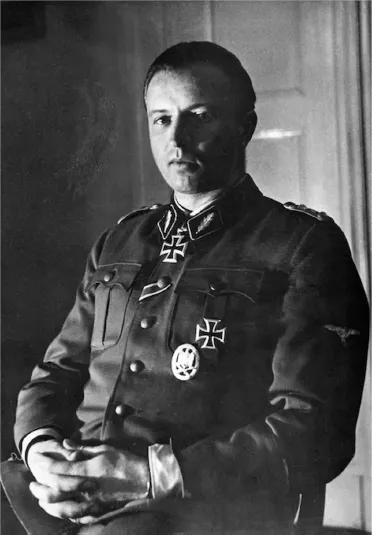
Hermann Fegelein, who benefited from his acquaintance with Hitler through Eva Braun, Hitler’s partner and, subsequently, his wife.
On 27 April 1945, it was noticed that Fegelein was not in the Führerbunker as was usual. One of Hitler’s bodyguards, Peter Högl, was sent out to see what had happened to him. Upon arriving at Fegelein’s Berlin apartment, Högl found him dressed in civilian clothes and apparently preparing to flee the country. Fegelein had been drinking heavily and was apparently planning to flee to Switzerland or Sweden. His packed bags were found to contain large amounts of cash and jewellery – some of which belonged to his wife. Even worse, a briefcase in Fegelein’s possession revealed evidence of Himmler’s attempts to negotiate peace with the Western Allies.
Himmler’s relationship with Hitler had been strained ever since the Führer had placed the Gestapo chief in charge of halting the Red Army’s advance into Pomerania, a region today split between Poland and Germany. Himmler proved to be a disastrous military commander and was easily defeated by his opposing number, Marshal Georgy Zhukov. As the German forces desperately tried to flee across the Baltic Sea, Himmler began to send increasingly incoherent reports back to Hitler. He eventually suffered a nervous breakdown and fled to a sanatorium, further eroding Hitler’s confidence in him.
The two men met for the last tim...
Table of contents
- Title Page
- Contents
- Introduction: Birth of a Monster
- The Early Years
- Expansion and Purge – At All Costs
- The Outbreak of War
- Policing Far and Wide
- Battling The Red Army
- Resistance, Resistance, Resistance
- The Growing Challenge
- Plots and Subplots
- Breaking The Chain
- Picture Credits
- Copyright
Trusted by 375,005 students
Access to over 1.5 million titles for a fair monthly price.
Study more efficiently using our study tools.
Frequently asked questions
Yes, you can cancel anytime from the Subscription tab in your account settings on the Perlego website. Your subscription will stay active until the end of your current billing period. Learn how to cancel your subscription
No, books cannot be downloaded as external files, such as PDFs, for use outside of Perlego. However, you can download books within the Perlego app for offline reading on mobile or tablet. Learn how to download books offline
Perlego offers two plans: Essential and Complete
- Essential is ideal for learners and professionals who enjoy exploring a wide range of subjects. Access the Essential Library with 800,000+ trusted titles and best-sellers across business, personal growth, and the humanities. Includes unlimited reading time and Standard Read Aloud voice.
- Complete: Perfect for advanced learners and researchers needing full, unrestricted access. Unlock 1.5M+ books across hundreds of subjects, including academic and specialized titles. The Complete Plan also includes advanced features like Premium Read Aloud and Research Assistant.
We are an online textbook subscription service, where you can get access to an entire online library for less than the price of a single book per month. With over 1.5 million books across 990+ topics, we’ve got you covered! Learn about our mission
Look out for the read-aloud symbol on your next book to see if you can listen to it. The read-aloud tool reads text aloud for you, highlighting the text as it is being read. You can pause it, speed it up and slow it down. Learn more about Read Aloud
Yes! You can use the Perlego app on both iOS and Android devices to read anytime, anywhere — even offline. Perfect for commutes or when you’re on the go.
Please note we cannot support devices running on iOS 13 and Android 7 or earlier. Learn more about using the app
Please note we cannot support devices running on iOS 13 and Android 7 or earlier. Learn more about using the app
Yes, you can access Gestapo by Lucas Saul in PDF and/or ePUB format, as well as other popular books in History & German History. We have over 1.5 million books available in our catalogue for you to explore.