The distinctive manga style is popular the world over for its glamorous, dynamic characters and stylish artwork. In this book, author and illustrator Peter Gray guides you through the process of drawing manga, from basic facial features to full-figure heroes and robots in action. Whether you are an experienced draughtsman or a complete beginner, tailored step-by-step exercises and handy hints will help you achieve stunning results.This is another title in Arcturus' successful range of Artist's Workbooks, which also includes titles on: Portraits, Figures, Manga, Techniques, Landscape, Animals and Still Life.
- English
- ePUB (mobile friendly)
- Available on iOS & Android
eBook - ePub
The Practical Guide to Drawing Manga
About this book
Information
Topic
ArteSubtopic
Tecniche artisticheHEADS FROM DIFFERENT ANGLES
As people move around, we see their heads from all different angles. If you can draw your manga characters from different angles you will be able to show them in various activities, emotions and interactions. It can seem quite complicated, but once again some rough guidelines will make the process much easier.
¾ VIEW
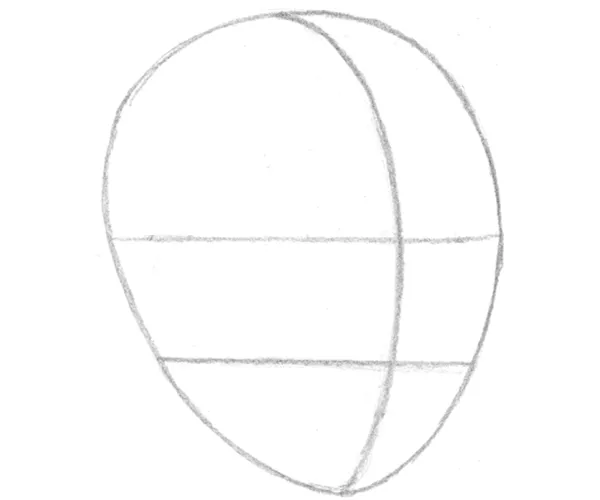
Step 1
To draw a three-quarter view (where the head is turned to one side), start with the egg shape, but make it broader towards the top and back. Place your horizontal guides as before. The essential difference here is that the vertical guideline must sit to one side of centre and curve.
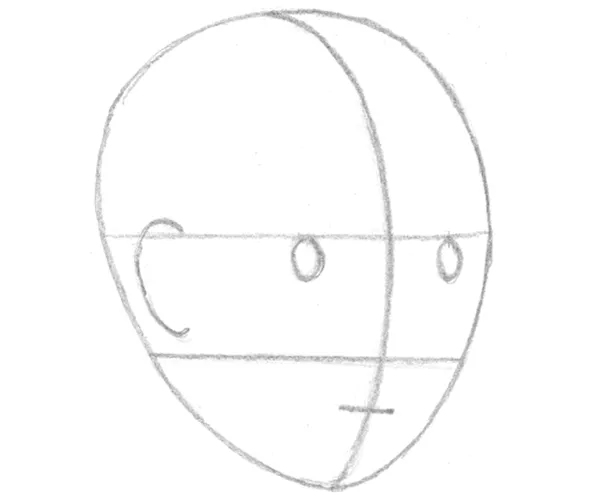
Step 2
Positioning the eyes, ears and mouth should now be quite easy.
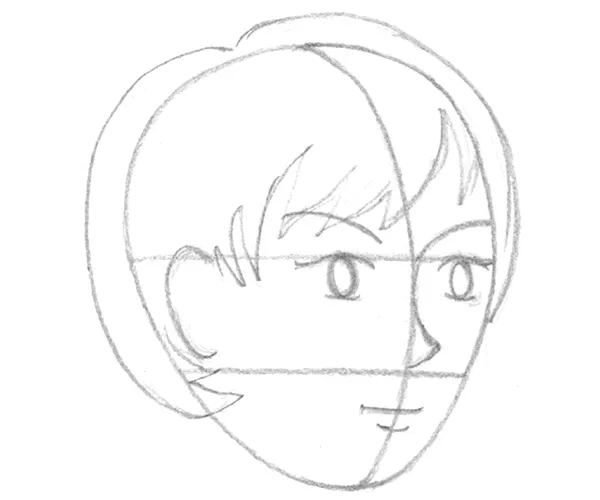
Step 3
Now the rest of the features can be drawn in position.
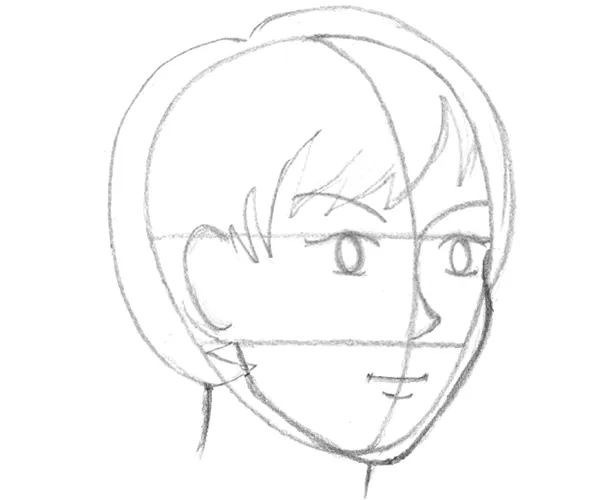
Step 4
For manga, it’s important to define the outline of the cheek and jaw. The line comes in at the eye socket, out to form a cheekbone, then down to the characteristic triangular chin. Note how the neck slopes forward.
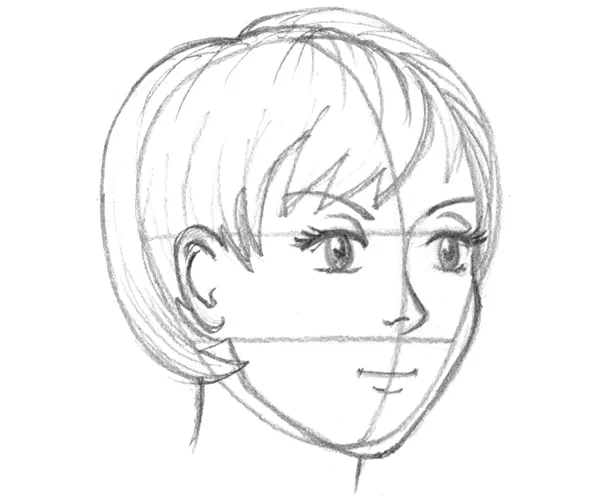
Step 5
Then it’s just a case of refining the features and adding the detail, before erasing unwanted guidelines.
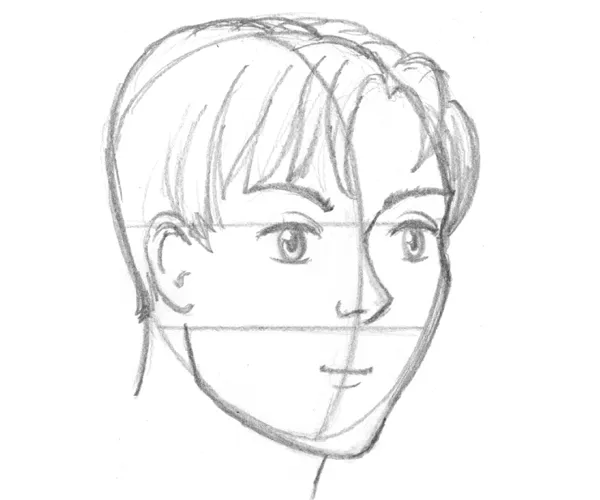
This male character was drawn from the same guidelines. The main differences to note are his fuller jaw line and broader neck.
PROFILE
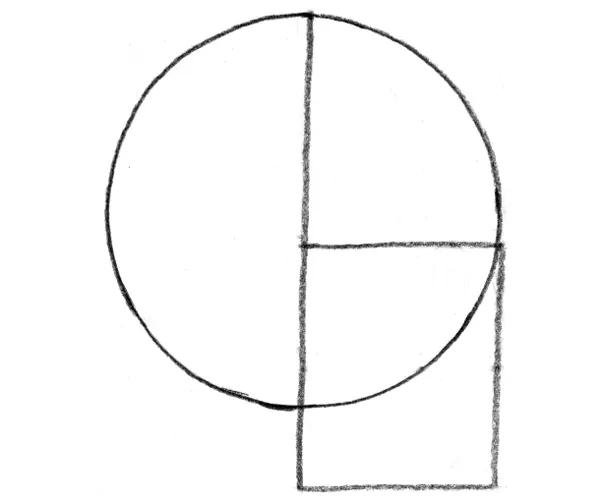
Step 1
Viewed from the side, the head is much wider than when seen from the front. To get used to the dimensions, try to think of the profile as a circle for the curve of the skull and a rectangle for the lower face and jaw. The central horizontal is halfway down the entire head.
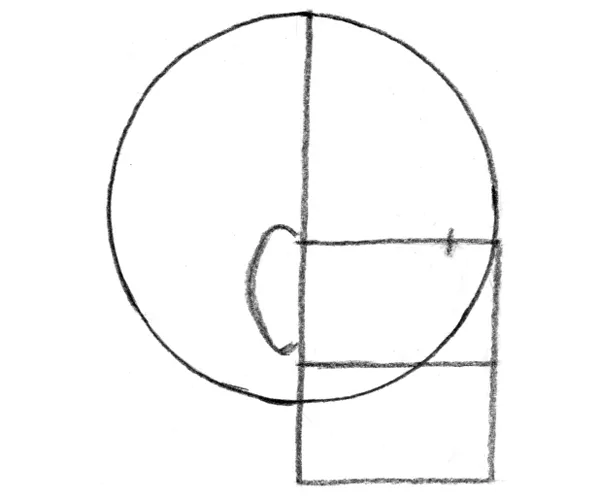
Step 2
The ear sits behind the centre vertical and the eye should be placed right near the front of the face.
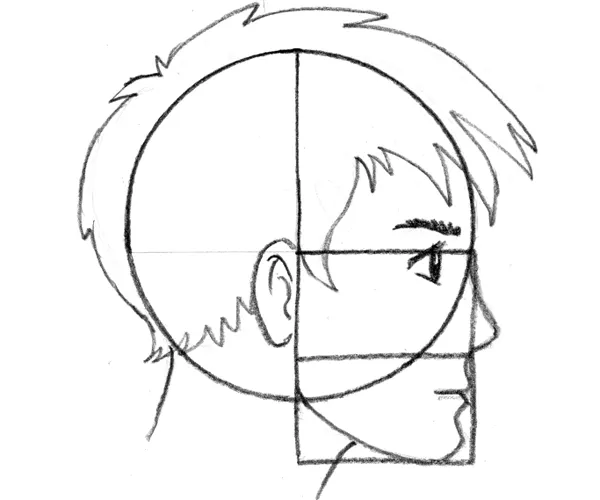
Step 3
The nose sticks out from the front and the mouth and jaw will fit neatly into the lower box. From this angle, the eye forms a triangle shape and the iris is reduced to a flattened disc.
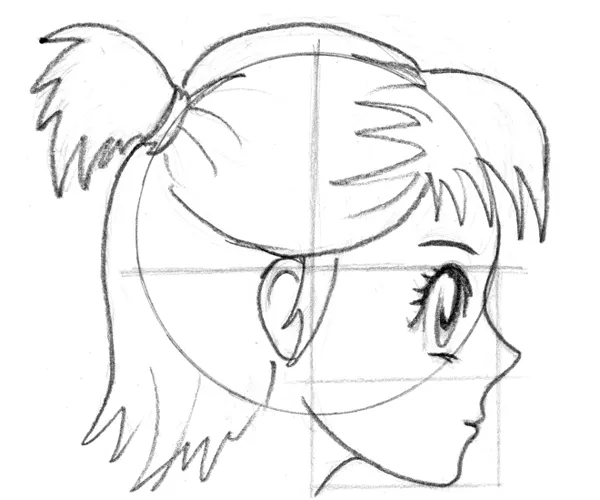
This female character follows the same framework, but the line of her chin slopes back.
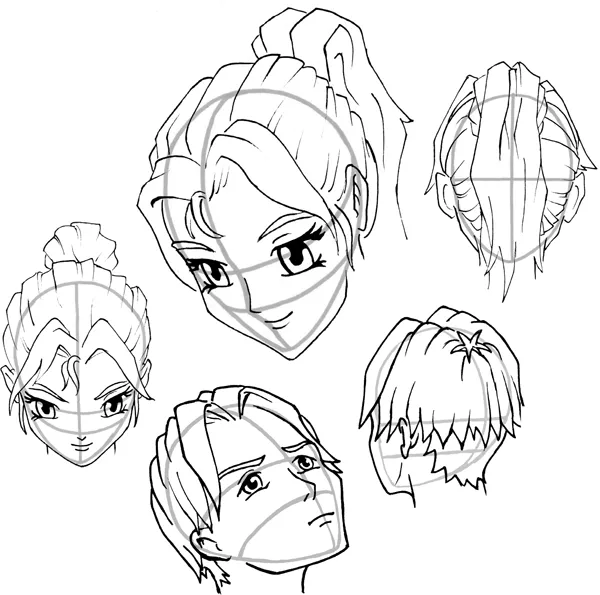
Once you get used to the proportions of profiles, you’ll probably find it easier to start from a broadened egg shape. Using the egg shape, you should be able to draw the head from any angle, as long as you put the guidelines in the right places. Study these diagrams and note how the guidelines follow the curve of the head, up, down and from side to side.
CHARACTER AND EXPRESSION – MALE
There’s much to be learned from copying characters from books, but the real fun begins when you can create new characters and bring them to life with expressions and interesting angles of view. Here are just a few examples of characters drawn from my imagination, showing a range of personalities and emotions. To begin designing characters of your own you could use these examples as starting points.
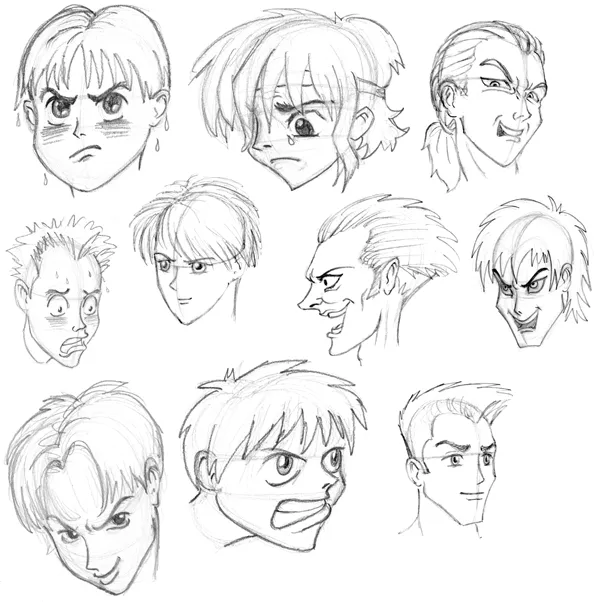
CHARACTER DESIGN 1
Taking elements from the examples shown, here’s a simple method for creating a new character.
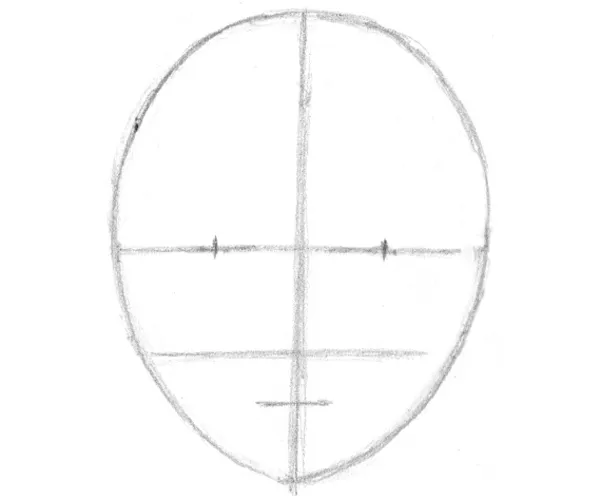
Step 1
A front view is perhaps the easiest start for a new character. I decided on a young face, so started with quite a squat egg-shape.
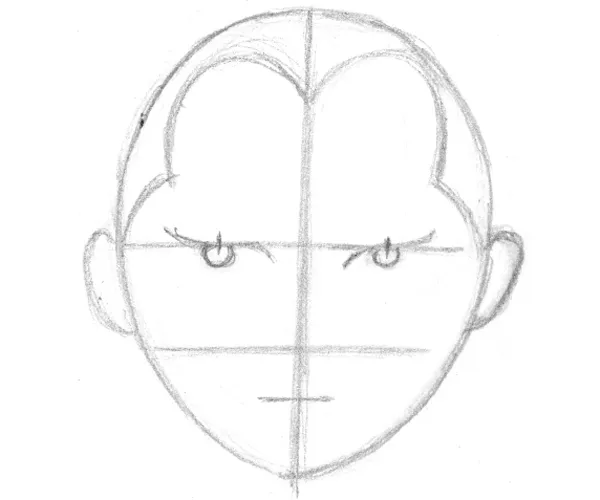
Step 2
Next I added more details to my guidelines.
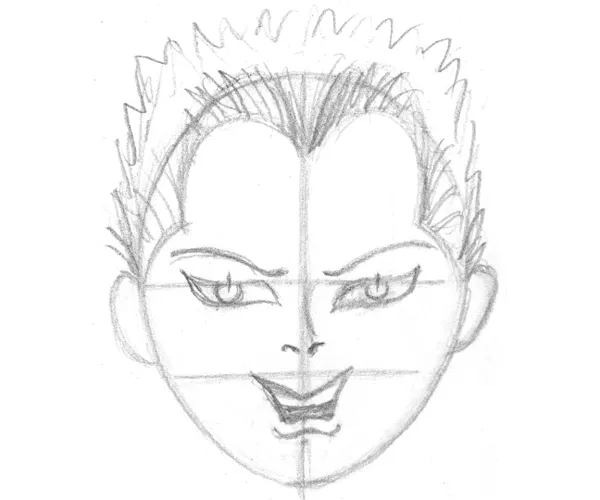
Step 3
Copying features on to the guidelines, a character very quickly started to emerge.
Step 4
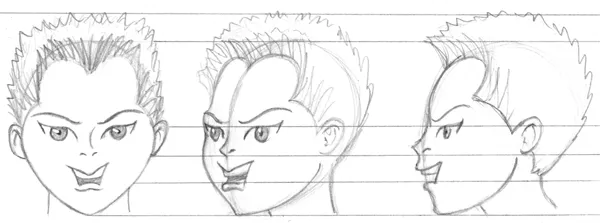
Refining the features and face shape, I completed the front view. But this is only a first stage in the design. Drawing the nasty little fellow from other angles will help me to see how he works three-dimensionally. Ruling some horizontal lines from the main features is a great way to keep a face’s proportions consistent.
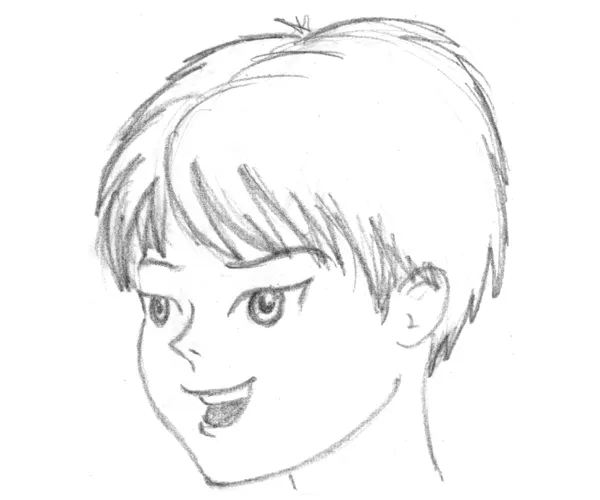
Table of contents
- Cover
- Title
- Copyright
- Contents
- Introduction
- Basic Materials and Equipment
- A Head Start
- Manga Features
- Heads from Different Angles
- Character and Expression – Male
- Character and Expression – Female
- Inking
- Light and Shade
- Rendering
- The Body
- Proportion
- Drawing the Figure
- Dynamism and Motion
- A Heroic Figure
- Clothing and Costume
- A Clothed Figure in Motion
- Developing a Character
- Machine Characters
- Designing a Robot
- Animal Characters
Trusted by 375,005 students
Access to over 1.5 million titles for a fair monthly price.
Study more efficiently using our study tools.
Frequently asked questions
Yes, you can cancel anytime from the Subscription tab in your account settings on the Perlego website. Your subscription will stay active until the end of your current billing period. Learn how to cancel your subscription
No, books cannot be downloaded as external files, such as PDFs, for use outside of Perlego. However, you can download books within the Perlego app for offline reading on mobile or tablet. Learn how to download books offline
Perlego offers two plans: Essential and Complete
- Essential is ideal for learners and professionals who enjoy exploring a wide range of subjects. Access the Essential Library with 800,000+ trusted titles and best-sellers across business, personal growth, and the humanities. Includes unlimited reading time and Standard Read Aloud voice.
- Complete: Perfect for advanced learners and researchers needing full, unrestricted access. Unlock 1.5M+ books across hundreds of subjects, including academic and specialized titles. The Complete Plan also includes advanced features like Premium Read Aloud and Research Assistant.
We are an online textbook subscription service, where you can get access to an entire online library for less than the price of a single book per month. With over 1.5 million books across 990+ topics, we’ve got you covered! Learn about our mission
Look out for the read-aloud symbol on your next book to see if you can listen to it. The read-aloud tool reads text aloud for you, highlighting the text as it is being read. You can pause it, speed it up and slow it down. Learn more about Read Aloud
Yes! You can use the Perlego app on both iOS and Android devices to read anytime, anywhere — even offline. Perfect for commutes or when you’re on the go.
Please note we cannot support devices running on iOS 13 and Android 7 or earlier. Learn more about using the app
Please note we cannot support devices running on iOS 13 and Android 7 or earlier. Learn more about using the app
Yes, you can access The Practical Guide to Drawing Manga by Peter Gray in PDF and/or ePUB format, as well as other popular books in Arte & Tecniche artistiche. We have over 1.5 million books available in our catalogue for you to explore.