"I have committed many acts of cruelty and had an incalculable number of men killed, never knowing whether what I did was right. But I am indifferent to what people think of me."
- Genghis Khan
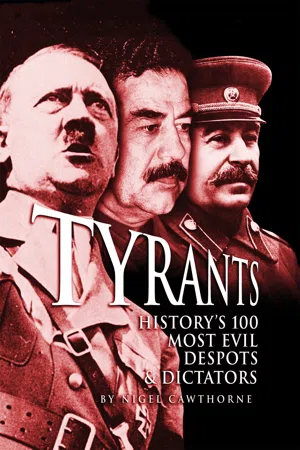
A spine-chilling chronicle of dictators and their crimes against humanity, Tyrants introduces the most bloodthirsty madmen - and women - ever to wield power over their unfortunate fellow human beings.
From Herod the Great, persecutor of the infant Jesus, to Adolf Hitler, mass murderer and instigator of the most devastating war the world has ever known, this book examines history's most infamous despots and tells in vivid detail the story of the lives they led, their ruthless climb to the top and the destruction and sorrow they left in their wake.
Unflinching in its coverage, Tyrants is a gripping and compelling portrait of the darker side of politics and power, revealing the strange and grisly stories behind the world's most infamous autocrats.
- English
- ePUB (mobile friendly)
- Available on iOS & Android
eBook - ePub
About this book
Information
Subtopic
European HistoryIndex
HistoryTHE MODERN WORLD
PORFIRIO DÍAZ
1830–1915
Dictator of Mexico
Like many tyrants, Porfirio Díaz came to power on the back of a democratic revolution, only to turn into a repressive dictator.
Born to a humble mestizo family in Mexico in 1830, Díaz studied to become a priest, but he abandoned the seminary to join the army at the outbreak of the war with the United States in 1846. He went on to distinguish himself in the War of the Reform – a civil war – from 1857 to 1860, and in 1861, he was elected the federal representative from the state of Oaxaca.
In the struggle against the French between 1861 and 1867, he backed the liberals under Benito Juárez. His contribution was key to the collapse of the French-backed regime, which installed the Emperor Maximilian, and the establishment of a republic under Juárez. But when Juárez stood for re-election in 1871, Díaz led a rebellion which failed. However, he defeated Juárez’s hand-picked successor Sebastian Lerdo de Tejada in the election of 1876. Falling from power in 1880, Díaz was re-elected in 1884 and held power until 1911.
Díaz believed in economic growth at any price. This meant marginalising the poor and expropriating the land of the Indians, who made up two-thirds of the population. The result was the rise of groups of bandits, who would later become a guerrilla force under Pancho Villa. To combat them, Díaz established the powerful state police force called the rurales. But rather than chase bandits, they preferred to terrorise Indian communities.
Díaz’s economic miracle did not work. In 1910, the aristocratic but democratically minded reformer Francisco Madero ran against him. When Díaz fixed the election, Madero organised a military coup. Díaz resigned on 25 May 1911 and went into exile in France, where he died on 2 July 1915.
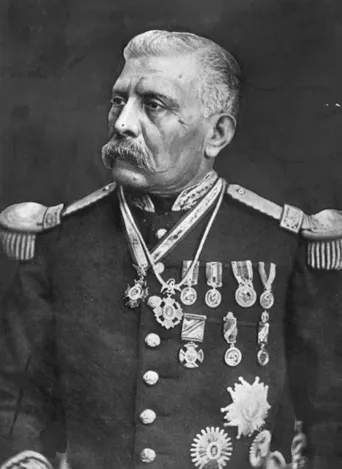
President Diaz, ex-soldier of the revolution and dictator of Mexico.
| Life and Crimes | ||
| 1830 | Born 15 September in Oaxaca. | |
| 1846 | Joins the army to fight the United States. | |
| 1857–1860 | Distinguishes himself in the War of the Reform. | |
| 1861–1867 | Helps overthrow the French-backed regime in Mexico. | |
| 1871 | Stages abortive coup against Benito Juárez. | |
| 1876 | Elected president. | |
| 1884–1910 | Dispossesses the poor and terrorises Indian communities. | |
| 1910 | Fixes election. | |
| 1911 | Overthrown by Francisco Madero in military coup. | |
| 1915 | Dies 2 July in exile in Paris. | |
TZU-HSI
1835–1908
Dowager Empress of China
Although Tzu-hsi started as a lowly concubine, she ended up ruling China for over 50 years, after her great beauty brought her to the attention of the Emperor Hsien-feng, and she bore his only son Tung-chih. When Hsien-feng died, Tung-chih was only 6 years old, so Tzu-hsi ruled as regent, brutally suppressing the Taiping Rebellion in 1864 and the Nien Rebellion in 1868.
When Tung-chih came of age in 1873, Tzuhsi refused to relinquish power. Two years later, he died – some say at his mother’s hand. In violation of all the laws of succession, Tzuhsi placed Tung-chih’s three-year-old cousin Kuang-hsü on the throne, with herself, once again, as regent. Although her full title was ‘Mother Auspicious Orthodox Heaven-Blessed Prosperous All-Nourishing Brightly-Manifest Calm Sedate Perfect Long-Lived Respectful Reverend Worshipful Illustrious Exalted Empress Dowager’, she was known in the Forbidden City as ‘The Old Buddha’.
When Kuang-hsü came of age in 1889, Tzu-hsi retired to a summer palace she had built with the money set aside to modernise the Chinese navy. But when Kuang-hsü began instituting radical reforms, Tzu-hsi staged a coup and had the emperor imprisoned in his palace, while she ruled in his stead.
In 1900, she encouraged the Boxer Rebellion which aimed to drive out all foreigners from China. When this was brutally put down by European troops, she fled Beijing and was eventually forced to sign a humiliating peace treaty in 1902.
The day before Tzu-hsi died on 15 November 1908, Kuang-hsü was killed in accordance with her deathbed wishes.
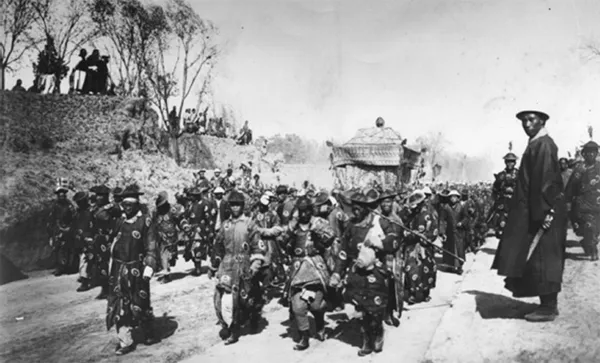
The funeral procession of the Empress Dowager of China, Empress Tzu-hsi.
| Life and Crimes | ||
| 1835 | Born in obscurity. | |
| 1861 | Becomes regent of China. | |
| 1875 | Son dies in suspicious circumstances; continues as regent for three-year-old cousin. | |
| 1889 | Retires to summer palace. | |
| 1895 | Imprisons emperor and seizes power again. | |
| 1900 | Encourages Boxer Rebellion: forced to flee when this fails. | |
| 1908 | Dies 15 November after ordering murder of the emperor. | |
KAISER WILHELM II
1859–1941
Emperor of Germany
Born with a withered left arm in Berlin in 1859, Wilhelm had a lifelong struggle to live up to the role of warrior king he believed the Prussian military state required of him.
The grandson of Queen Victoria, Wilhelm had a strict and authoritarian upbringing. He came to the throne on 15 June 1888 and quickly clashed with Otto von Bismarck, the ‘Iron Chancellor’ responsible for the unification of Germany, forcing him to resign in 1890. Wilhelm wanted the world to know that he had absolute power in Germany, though he was utterly inept at using it and he quickly alienated both Britain and Russia, even though both the King of England and the Tsar were his cousins.
A militarist by upbringing and inclination, he believed in developing the strength of Germany’s army and, encouraged by Admiral Alfred von Tirpitz, in 1900 he provided the money to build a German navy to rival the Royal Navy. During the Second Boer War (1899–1902), he supported the Boers against the British and later described Edward VII as ‘Satan’. He made so many enemies that Germany risked being surrounded by hostile nations, inspiring his generals to develop the ‘Schlieffen Plan’, a strategy that called for a lightning attack on France through Belgium, defeating any Western alliance before the Russians in the east could mobilise. However, a nervous breakdown in 1908 meant that Wilhelm had to relinquish some of the burdens of government.
When the Austrian Archduke Ferdinand was assassinated by a Serbian nationalist in Sarajevo in June 1914, Kaiser Wilhelm urged the Austro-Hungarian Empire to punish Serbia, failing to realise that a series of treaties amongst the European powers would mean that armed conflict between Austria and Serbia would engulf the whole of Europe in war. Even as the Kaiser tried to pull back from the consequences of his action, his army was putting the Schlieffen Plan into effect. The result was the First World War and four years of pitiless slaughter.
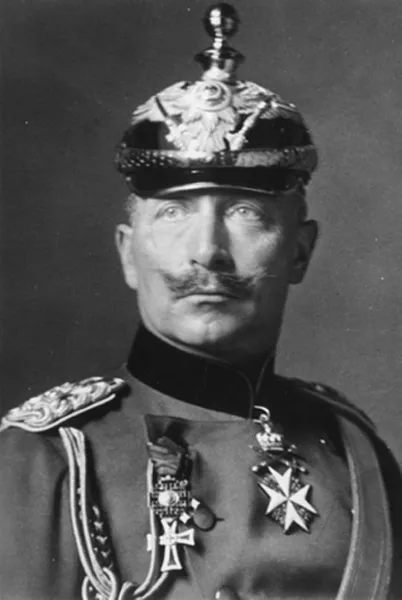
Kaiser Wilhelm II: the man, more than any other, responsible for World War I.
During the war Wilhelm was commander-in-chief of the German armed forces, though he was largely a figurehead. He opposed the sacking of Erich Falkenhayn from his position of commander of land forces in 1916, but Paul von Hindenburg took over anyway. Facing defeat in 1918 the army turned against him, and when revolution engulfed Berlin he was forced to abdicate. His abdication proclamation read: ‘I herewith renounce for all time claims to the throne of Prussia and to the German Imperial throne connected therewith. At the same time I release all officials of the German Empire and of Prussia, as well as all officers, non-commissioned officers and men of the navy and of the Prussian army,...
Table of contents
- Title Page
- Contents
- The Ancient World
- The Middle Ages
- The Napoleonic Era
- The Modern World
- Copyright
Trusted by 375,005 students
Access to over 1.5 million titles for a fair monthly price.
Study more efficiently using our study tools.
Frequently asked questions
Yes, you can cancel anytime from the Subscription tab in your account settings on the Perlego website. Your subscription will stay active until the end of your current billing period. Learn how to cancel your subscription
No, books cannot be downloaded as external files, such as PDFs, for use outside of Perlego. However, you can download books within the Perlego app for offline reading on mobile or tablet. Learn how to download books offline
Perlego offers two plans: Essential and Complete
- Essential is ideal for learners and professionals who enjoy exploring a wide range of subjects. Access the Essential Library with 800,000+ trusted titles and best-sellers across business, personal growth, and the humanities. Includes unlimited reading time and Standard Read Aloud voice.
- Complete: Perfect for advanced learners and researchers needing full, unrestricted access. Unlock 1.5M+ books across hundreds of subjects, including academic and specialized titles. The Complete Plan also includes advanced features like Premium Read Aloud and Research Assistant.
We are an online textbook subscription service, where you can get access to an entire online library for less than the price of a single book per month. With over 1.5 million books across 990+ topics, we’ve got you covered! Learn about our mission
Look out for the read-aloud symbol on your next book to see if you can listen to it. The read-aloud tool reads text aloud for you, highlighting the text as it is being read. You can pause it, speed it up and slow it down. Learn more about Read Aloud
Yes! You can use the Perlego app on both iOS and Android devices to read anytime, anywhere — even offline. Perfect for commutes or when you’re on the go.
Please note we cannot support devices running on iOS 13 and Android 7 or earlier. Learn more about using the app
Please note we cannot support devices running on iOS 13 and Android 7 or earlier. Learn more about using the app
Yes, you can access Tyrants by Nigel Cawthorne in PDF and/or ePUB format, as well as other popular books in History & European History. We have over 1.5 million books available in our catalogue for you to explore.