The Great Philosophers traces the biggest and most influential thoughts in philosophy's long stride through history, beginning with the Ancient Greeks and Early Romans, the first philosophical thinkers in the West, to whom much is owed.
How their concerns became the concerns of those who followed is clearly laid out, as is the way their answers shaped what we now recognize as philosophy. The medieval philosophers are also represented, combining their religious concerns with ancient thought and carrying it into the Renaissance. The modern era, the explosion of philosophy sparked by Descartes, is well represented here too. Founders and representatives of both rationalist and empiricist schools make an appearance, as do philosophy's sceptics, with their often-darker conclusions.
Philosophy's long walk continues, and you will find here the thoughts which make its contemporary form what it is, and perhaps what it is on the way to becoming. Philosophy is very much still under way, and The Great Philosophers pays regard to both the discipline as it is practised now, and to the history which made contemporary philosophy possible.
- English
- ePUB (mobile friendly)
- Available on iOS & Android
eBook - ePub
About this book
Information
Topic
PhilosophySubtopic
PhilosophersArthur Schopenhauer
1788–1860
Although outside the realm of academic philosophy, Arthur Schopenhauer (1788–1860) was nevertheless one of the most important philosophers of the nineteenth century, best known for his Eastern influence, and his philosophical pessimism.
SCHOPENHAUER’S PHILOSOPHY IS STUNNINGLY AND FAMOUSLY PESSIMISTIC. His work is certainly not the right sort of thing to read on a beach. It is hard to know whether the pessimism is the result of his philosophical discoveries or, rather, his philosophy is shaped by his pessimism. It might be that both simply follow from his own generally bleak temperament. His mother, Johanna, reports that from an early age her son ‘brooded on the misery of things’. Nevertheless, the broodings resulted in one of the nineteenth century’s philosophical masterpieces: The World as Will and Representation. We’ll consider it in a moment.
Schopenhauer was born in Danzig. His father, Heinrich, was a prosperous merchant, whose politics led him to move the family, at considerable cost, to Hamburg when Danzig was appropriated by Prussia in 1793. His parents encouraged his facility with languages – he was eventually fluent in six – and sent him to study in Paris and England. Although he would have preferred an academic life, he took a job as a clerk in Hamburg to satisfy his father. His father’s suicide left Schopenhauer with no incentive to stay in business and a reasonable income, so he turned to an academic life. Taking a place at the University of Göttingen, Schopenhauer initially studied medicine but switched to philosophy. At the suggestion of his tutors he focused on Plato and Kant. These two philosophers, combined with the unlikely influence of Hinduism and Buddhism, had an enduring effect on his thinking. He submitted his dissertation to the University of Jena, earned a doctorate, and returned to his mother’s home in Weimar.
His mother had an interest in culture, particularly literature, and published several novels. She also operated a literary salon and, quite possibly, had romantic liaisons with several representatives of Weimar’s intelligentsia. This probably disturbed Schopenhauer. No doubt Schopenhauer’s diatribes on the futility of existence, which led many guests of the salon to make excuses and leave a little early, disturbed his mother too. They fell out regularly, dramatically, and eventually comprehensively. Johanna demanded that he leave, and he departed for Dresden in 1814. Though his mother lived for another 24 years, they never spoke again.
Whether or not Schopenhauer would be willing to admit it, the episode skewed his thinking and probably had large effects on his personal life. You can hear the resentment when the otherwise clear-thinking Schopenhauer says that women are: ‘…an undersized, narrow-shouldered, broad-hipped and short-legged race … they have no proper knowledge of anything; and they have no genius.’
It almost goes without saying that despite a few romantic connections, Schopenhauer never married. He was the archetypal bachelor-philosopher, living and studying alone in Berlin and finally Frankfurt, with only his pet poodle for company. He died, seated at his breakfast table, in 1860.
The World as Will
The World as Will and Representation was published in 1818 and attracted virtually no interest. He attempted to drum up support by lecturing in Berlin, deliberately and disastrously timetabling his lectures to conflict with those of Hegel, whom he perhaps predictably regarded as ‘a commonplace, inane, loathsome, repulsive and ignorant charlatan’. His lecture hall remained empty, and he never repeated the experiment. He did, however, believe in the intrinsic value of his work – he thought it solved all philosophical problems worth the name – and had a second, expanded edition published. It was not until late in his life that the book and other writings finally earned him the fame he was after.
The book, says Schopenhauer, imparts a single thought, though he admits he is incapable of saying it in anything less than a large volume. Let us be a little reckless, and characterize this thought in a single sentence: the world as it is in itself is will. To get this single thought into clearer view, we’ll need to wave briefly at Kant, to whom Schopenhauer owes a large debt.
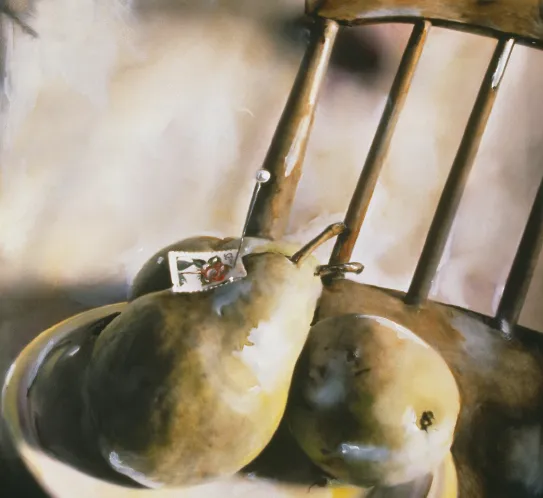
Pears on a chair. The experience of actual pears, says Schopenhauer, provokes the will; whereas an artistic representation of pears produces an aesthetic reaction.
Kant argues that the world we perceive is constituted by the mind. Objects appear to us in space and time, given the structuring activities of sensibility. Thanks to the understanding, we perceive a world of objects not just in space and time but standing in causal relations with one another as well. Schopenhauer follows Kant in all of this – although he ingeniously reduces Kant’s complex structure of categories to a single principle. Crucially, he adopts the Kantian distinction between the phenomenal world we experience (the world as representation) and the noumenal world of things-in-themselves, reality as it is apart from our experience (for Schopenhauer, the world as will). However, he rejects Kant’s claim that the noumenal world is forever beyond our ken. Schopenhauer claims nothing less than knowledge of the world as it is in itself.
Our sensory experience of the world is not our only access to the world, or at least not our only access to a part of the world. Schopenhauer argues that ‘a way from within stands open to us to [the] real inner nature of things’. We have perceptual experience of ourselves as bodies located in a world of objects in space and time, but we also have direct experience of ourselves as will – experience which does not conform to the usual activities of the mind which constitute the phenomenal world. I know my hand just reached for the coffee cup because I saw it, but I would have known anyway, because I willed it. When I looked at my hand, I viewed it as an object in the phenomenal world, but my other knowledge of it depended on nothing phenomenal. It is important to recognize that, for Schopenhauer, the willing and the bodily moving are not two different things: my body is objectified will, will as it appears or is represented in the phenomenal world.
Resolutely shunning solipsism, here the view that there is just one mind and everything else is a mere appearance, Schopenhauer argues that the whole world is a manifestation of will too. Once a person has realized that their own inner nature is will,
[h]e will recognize that same will not only in those phenomena that are quite similar to his own, in men and animals, as their innermost nature, but continued reflection will lead him to recognize the force that shoots and vegetates in the plant, indeed the force by which the crystal is formed, the force that turns the magnet…all these he will recognize as different only in the phenomenon, but the same according to their inner nature.
If you want to do better than agree with Schopenhauer on anti-solipsistic grounds, you can think along the following lines. If the will is the real inner nature of my body, and my body is lodged seamlessly into the rest of the phenomenal world, then the rest of the world’s real inner nature must also be will. For Schopenhauer, the phenomenal world is the appearance of will and the noumenal world is nothing but a world of will. Our own inner experience of willing, then, is Schopenhauer’s key to understanding the Kantian thing-in-itself, the world as it is apart from our experience.
The Philosophy of Pessimism
Considered in the abstract, the will is a kind of will-to-live or will-to-exist, but it manifests itself particularly as a constant throbbing of desire, striving and yearning, with no particular goal or object. It is merely undirected, blind, irrational want, which drives everything – better, which is everything. It is the blindness and irrationality of the will which leads to Schopenhauer’s famous pessimism. A human life is actuated by nothing but a constant craving, occasionally fleetingly satisfied but more often than not thwarted. When the will actually manages to satisfy itself, ‘life-benumbing boredom’ quickly sets in and the striving is reawakened. The will does nothing but vainly keep itself willing, until death. Life is something which ought not to be, and this is the very worst of all possible worlds. The uselessness of life emerges rather readily on Schopenhauer’s view of the inner nature of things:
…existence…is a constant hurrying of the present into the dead past, a constant dying…it is clear that, as our walking is admittedly merely a constantly prevented falling, the life of our body is only a constantly prevented dying, an ever postponed death: finally, in the same way, the activity of our mind is a constantly deferred ennui. Every breath we draw wards off the death that is constantly intruding upon us.
You would consider throwing him out of the salon too.
All is not entirely lost. Schopenhauer argues that there is a sense in which the will, if not tamed or fully sated, can be distracted from its cravings through aesthetic contemplation. If not exactly a kind of transcendence, there is a marked difference between our reactions to seeing a bowl of fruit, on the one hand, and admiring a well-executed still life depicting a bowl of fruit on the other. In the first case, the will might well become aroused, perhaps wanting to consume the fruit; but in the second, no such involvement is possible. Instead, one is led to something akin to reflection on Plato’s Forms, something approaching disinterested will-less contemplation, reflection for its own sake.
However, this sort of escape is only fleeting – one cannot stare at paintings forever. Our best hope for a lasting, though imperfect, release from the tyranny of the will is the saintly renunciation of life. It is possible, though a rarity, to become fully cognizant of the genuine nature of things. One can grasp the essential futility of all life, see life for what it is: the blind cravings of a single, unified Cosmic Will. The ascetic reaction, the renunciation of all gratification, the turning away from life, is the only genuine way one might deny the will and thereby diminish it, perhaps nearly extinguish it. The Buddhists have got it right or nearly right, according to Schopenhauer. The ultimate state is nothing like a heaven of pure satisfaction and eternal happiness, but the nothingness of Nirvana. For Schopenhauer, then, the closest to happiness we can come consists in the extinction of the self.
MAJOR WORKS
On the Fourfold Root of the Principle of Sufficient Reason (1813)
Originally Schopenhauer’s PhD dissertation. It is a critique of the assumption that the universe is explicable or amenable to rational reflection.
The World as Will and Representation (1819)
Schopenhauer’s masterpiece. He takes it that the underlying nature of the empirical world consists in blind willing. If one looks deeply enough into oneself, one discovers not only one’s true inner nature, but the essence of everything.
John Stuart Mill
1806–73
John Stuart Mill’s (1806–73) father, James Mill, was an outspoken advocate of utilitarianism and a friend of Jeremy Bentham, its founder. John Mill was born into a household steeped in utilitarian thinking, particularly Bentham’s views on education.
IT WAS THE AIM OF MILL’S FATHER TO EDUCATE THE BOY HIMSELF, in his own words, to turn him into ‘a mere calculating machine’. This James Mill more or less did, with alarming consequences.
John Mill could read Greek at the age of 3 and Latin at 8. According to his autobiography, by his early teens he had read all the major Greek and Latin works, made an extensive survey of history and become well versed in jurisprudence, psychology, economics, mathematics and logic. His father lectured to him on such subjects during long walks, requiring him to write up the lectures for the father’s consideration the next day. James Mill based a book, Elements of Political Economy, on a set of these papers. John Mill was just 14 at the time.
At 15, Mill read Theory of Legislation, the first published account of Bentham’s utilitarian views. The book changed him comprehensively: ‘I felt taken up to an eminence from which I could survey a vast mental domain, and see stretching out into the distance intellectual results beyond all computation.’ It gave Mill a standpoint, a philosophical position rich enough to underpin views across the philosophical spectrum, and, he hoped, the means to improve human life generally. His whole life really had prepared him for just this revelation. ‘When I laid down the last volume of the [Theory],’ he says with some reverence, ‘I had become a different being.’ In addition to pursuing the study of law, the new Mill spent the remainder of his teens editing many of Bentham’s unpublished manuscripts, contributing to several journals with papers on current events, political debates and law, all from the utilitarian point of view.
At 20, perhaps predictably, the calculating machine suffered the worst of a series of nervous breakdowns, or at least deep bouts of depression. Already in a ‘dull state of nerves’, Mill reflected critically on his own happiness. He asked himself if he actually would be happy if all his aims were realized, if all his planned improvements to institutions and law were affected. On discovering that not e...
Table of contents
- Title Page
- Contents
- Introduction
- Ancient & Medieval
- Renaissance
- 17th Century
- 18th Century
- 19th Century
- 20th Century
- Copyright
Trusted by 375,005 students
Access to over 1.5 million titles for a fair monthly price.
Study more efficiently using our study tools.
Frequently asked questions
Yes, you can cancel anytime from the Subscription tab in your account settings on the Perlego website. Your subscription will stay active until the end of your current billing period. Learn how to cancel your subscription
No, books cannot be downloaded as external files, such as PDFs, for use outside of Perlego. However, you can download books within the Perlego app for offline reading on mobile or tablet. Learn how to download books offline
Perlego offers two plans: Essential and Complete
- Essential is ideal for learners and professionals who enjoy exploring a wide range of subjects. Access the Essential Library with 800,000+ trusted titles and best-sellers across business, personal growth, and the humanities. Includes unlimited reading time and Standard Read Aloud voice.
- Complete: Perfect for advanced learners and researchers needing full, unrestricted access. Unlock 1.5M+ books across hundreds of subjects, including academic and specialized titles. The Complete Plan also includes advanced features like Premium Read Aloud and Research Assistant.
We are an online textbook subscription service, where you can get access to an entire online library for less than the price of a single book per month. With over 1.5 million books across 990+ topics, we’ve got you covered! Learn about our mission
Look out for the read-aloud symbol on your next book to see if you can listen to it. The read-aloud tool reads text aloud for you, highlighting the text as it is being read. You can pause it, speed it up and slow it down. Learn more about Read Aloud
Yes! You can use the Perlego app on both iOS and Android devices to read anytime, anywhere — even offline. Perfect for commutes or when you’re on the go.
Please note we cannot support devices running on iOS 13 and Android 7 or earlier. Learn more about using the app
Please note we cannot support devices running on iOS 13 and Android 7 or earlier. Learn more about using the app
Yes, you can access The Great Philosophers by James Garvey,Jeremy Stangroom in PDF and/or ePUB format, as well as other popular books in Philosophy & Philosophers. We have over 1.5 million books available in our catalogue for you to explore.