This internationally bestselling guide covers essential drawing techniques, written by expert practical art author Barrington Barber.
The Fundamentals of Drawing is a practical and comprehensive drawing course from beginner to advanced levels. Opportunities for practice and improvement are offered across a wide spectrum of subjects with step-by-step examples to guide you through.
Subjects include:
• Still life
• Plants, nature and animals
• Portraiture and life drawing
• Perspective and composition
The methods used in this book are time-honored and proven, having been practiced through the centuries by art students and professional artists. Barrington Barber brings his invaluable expertise as a working artist and teacher to the task of showing you how to use them effectively to create successful drawings.
No matter what your level of expertise, you will find his clear approach encouraging and his way of teaching inspirational.

- English
- ePUB (mobile friendly)
- Available on iOS & Android
eBook - ePub
About this book
Information
Topic
ArtSubtopic
Art TechniquesFigure Drawing and Portraiture
The human figure is the hardest and yet most satisfying subject to draw and no artist ever really exhausts its possibilities. Attendance of a life-drawing class is the best way to learn how to do this. However, if you are trying to teach yourself, discipline and an eye for detail will take you a long way. The best way to start is by observing people carefully: the way they move, sit and stand and how they look in different lights and from different angles. The great figurative artists studied the human form for their entire lives without reaching a limit with it, so there’s plenty of scope!
STARTING TO DRAW FIGURES
Before you begin, refer back to the diagrams of proportions in human beings to re-acquaint yourself with the basic lessons you learnt there (see pages 34–35). Now find pictures of people in various natural poses and try this exercise.
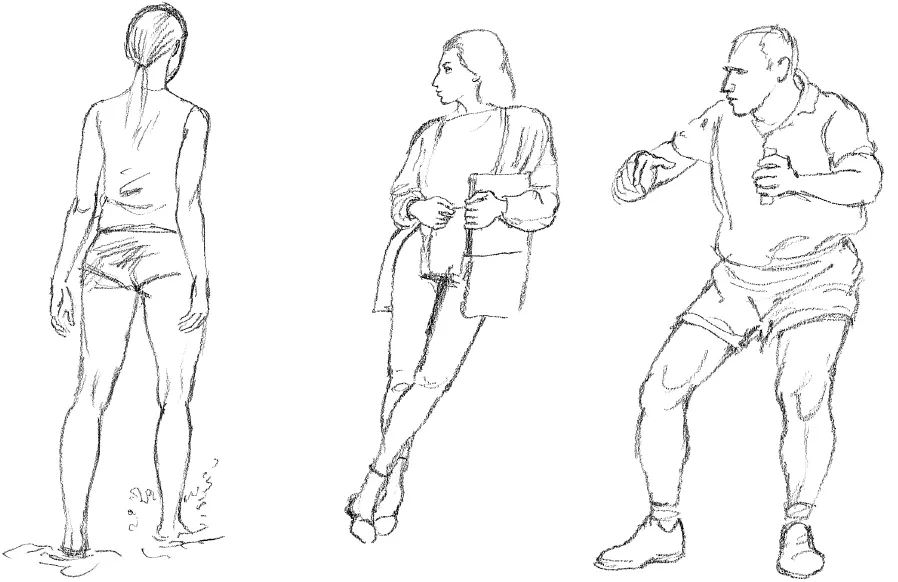
Carefully trace the outlines of your chosen figures.
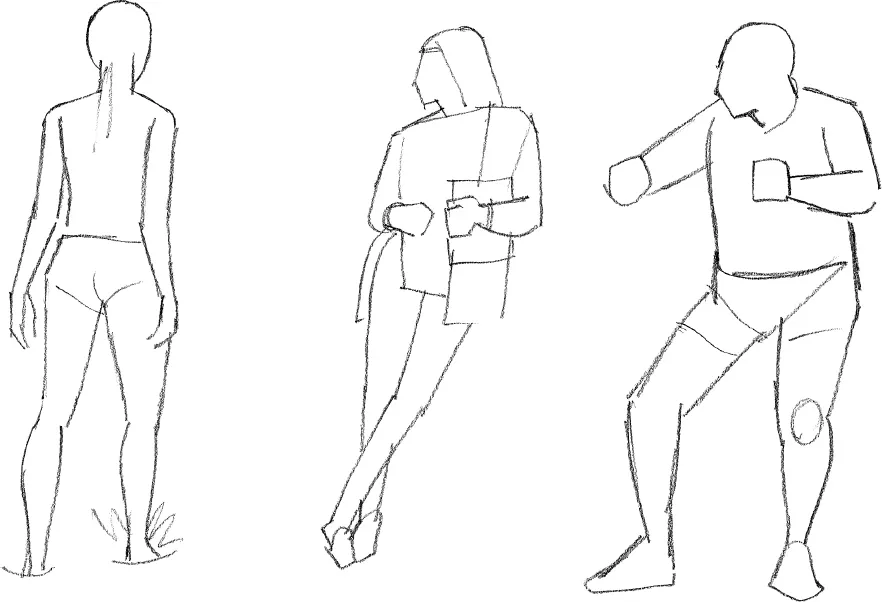
Now trace over your tracings, breaking down the figures to their simplest shapes.
This way of drawing shows you how to tackle figure drawing using very basic lines to describe the position of the figure and gradually build a more solid structure around these lines until you have got a complete figure.
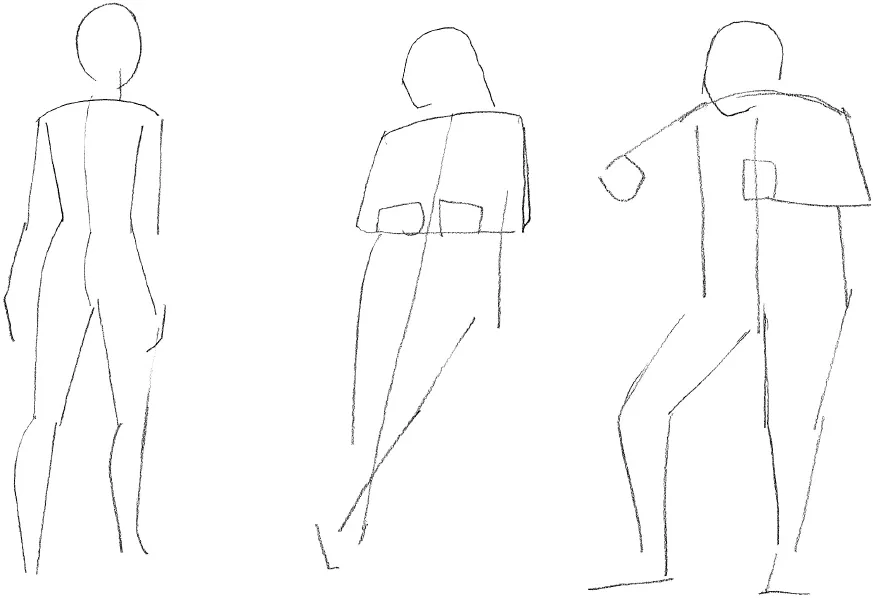
Now trace over your second tracings, putting in only the absolutely essential lines in order to show the movement of the figures. Take a central line through each figure, draw the main line of the shoulders, the main shape of the head and then make very simple lines to describe the arms and legs.
Don’t include any other details. In my examples you can see that for each figure the head is given simply as a rounded shap, and a line running through the torso and legs serves to give the feel of the pose. Pare down your drawings to absolute essentials, as I have done.
When you have reduced your figures to these simple shapes, build them up again until you have worked back to the shapes of your original tracings. The method is exactly the same as that shown here. You simply reverse the process. Begin by tracing over your last drawing.
DRAWING FROM LIFE
Once you have practised the previous exercise a number of times and gained in confidence, you should be ready to tackle drawing a real person. Get a couple of different people to pose for you for about twenty minutes. Approach your subjects exactly as you were shown in the previous exercise.
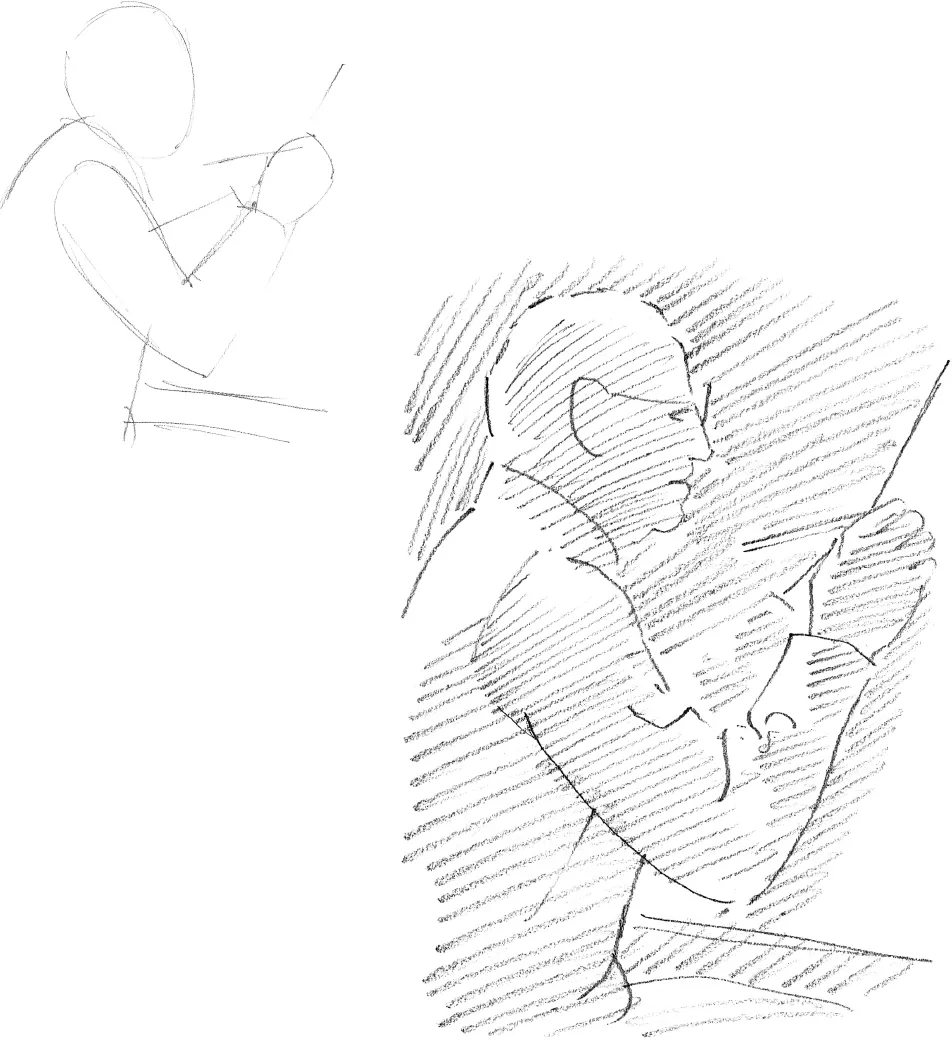
Draw the essential shape, movement or pose first and then try to fill it out a bit, but don’t worry about the detail.
As you take the figure through the stages – from simple shape to more detailed figure – you’ll begin to see how the drawing can be made to work. This does become easier with practice. Your aim at this point is to produce fairly good figures that resemble the models in a general way. Keep your drawings very, very simple, as I have done here.
Try to do this sort of drawing at least once a week.
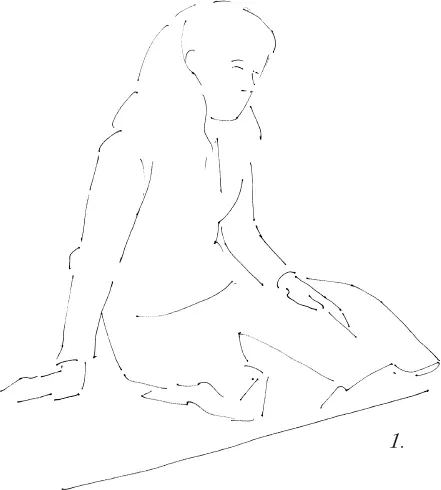
1. Block in the main shapes.
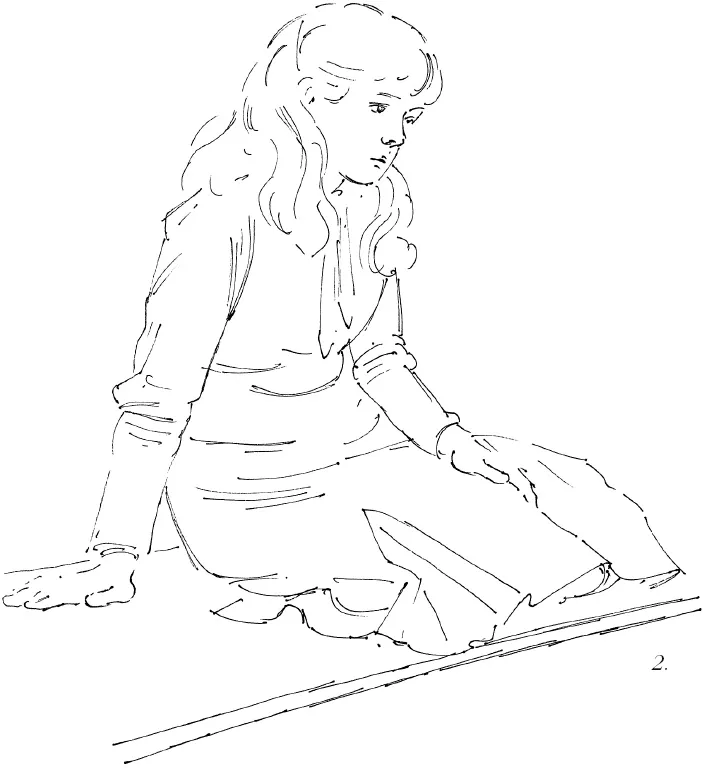
2. Add a little more detail to the main shapes of each part of the figure, but don’t draw too heavily. Experiment with different media for this: pencil, pen or charcoal.
Although you can be as thorough as you like, it is a good idea to stop before you have drawn every bump, wrinkle and indentation. The aim of simplifying is a very valuable part of learning to draw effectively.
STUDYING DIFFERENT POSES
Now try working from photographs or models with a view to giving yourself experience of capturing different kinds of poses. If you can find good ...
Table of contents
- Cover
- Title
- Contents
- Introduction
- First Stages
- Object Drawing and Still Life Composition
- More About Perspective
- The Natural World
- Figure Drawing and Portraiture
- Composition
- Techniques
- Aids to Better Drawing
- Copyright
Trusted by 375,005 students
Access to over 1.5 million titles for a fair monthly price.
Study more efficiently using our study tools.
Frequently asked questions
Yes, you can cancel anytime from the Subscription tab in your account settings on the Perlego website. Your subscription will stay active until the end of your current billing period. Learn how to cancel your subscription
No, books cannot be downloaded as external files, such as PDFs, for use outside of Perlego. However, you can download books within the Perlego app for offline reading on mobile or tablet. Learn how to download books offline
We are an online textbook subscription service, where you can get access to an entire online library for less than the price of a single book per month. With over 1.5 million books across 990+ topics, we’ve got you covered! Learn about our mission
Look out for the read-aloud symbol on your next book to see if you can listen to it. The read-aloud tool reads text aloud for you, highlighting the text as it is being read. You can pause it, speed it up and slow it down. Learn more about Read Aloud
Yes! You can use the Perlego app on both iOS and Android devices to read anytime, anywhere — even offline. Perfect for commutes or when you’re on the go.
Please note we cannot support devices running on iOS 13 and Android 7 or earlier. Learn more about using the app
Please note we cannot support devices running on iOS 13 and Android 7 or earlier. Learn more about using the app
Yes, you can access The Fundamentals of Drawing by Barrington Barber in PDF and/or ePUB format, as well as other popular books in Art & Art Techniques. We have over 1.5 million books available in our catalogue for you to explore.