1
Paleoethnobotanical Method and Theory in the Twenty-First Century
JOHN M. MARSTON, CHRISTINA WARINNER, AND JADE D’ALPOIM GUEDES
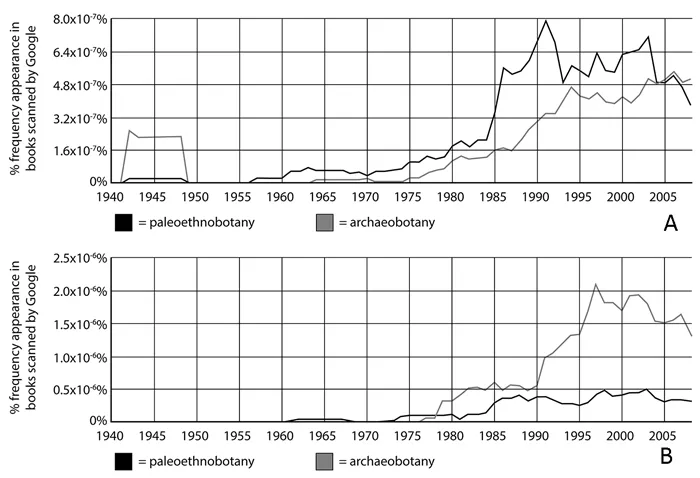
The origins of the study of relationships between people and plants in the past began as early as the nineteenth century with the identification of desiccated plant remains recovered from rockshelters in the American Southwest (Ford 2003:xii; 2004:x; Pearsall 2000:1) and waterlogged remains from Swiss lake-dwelling sites (Hastorf 1999:55). This field of study, first termed ethno-botany, today is termed either paleoethnobotany or archaeobotany, with the two synonymous terms generally preferred in North America and Europe, respectively (figure 1.1). Paleoethnobotany expanded tremendously as a field in the second half of the twentieth century, as reflected in the growing number of publications since the 1970s (see the extensive bibliographies in Hastorf 1999 and Pearsall 2000), and continues to make substantial contributions to archaeology today.
This volume is conceived as a reflection on the state of the field after the first decade of the twenty-first century. Paleoethnobotany has changed dramatically since its earliest days and since the publication of the first seminal volumes in the 1970s and 1980s (Hastorf and Popper 1988; Pearsall 1989; Renfrew 1973; van Zeist and Casparie 1984; van Zeist et al. 1991). It is time for a new and updated overview of the methods and theory of paleoethnobotany that addresses what we do and why we do it. This volume assembles a diverse group of authors to write about their areas of expertise in the practice and theory of paleoethnobotany. We cover topics from the formation processes of plant remains in the archaeological record to methods for their recovery and analysis to diverse modes of interpretation, both alone and in concert with other types of archaeological analyses.
This book differs from prior contributions to the field in three ways. First, this is the only comprehensive edited volume focusing on method and theory to appear since the 1988 publication of Current Paleoethnobotany (Hastorf and Popper 1988), still an influential and frequently cited volume but now dated in bibliography and without the benefit of technical advances in the field since the 1980s. Due to the high quality of the chapters in that volume, we aim to supplement (rather than replicate) the topics covered in 1988 with new areas of inquiry (e.g., starch grain analysis, stable isotope analysis, ancient DNA, digital data management, and ecological and postprocessual theory) that have become central to contemporary archaeological debates. Second, we aim for worldwide coverage in the literature referenced, in contrast to many excellent recent volumes that synthesize regional bodies of data and literatures in the Northeastern United States (Hart 1999, 2008), the Eastern United States (Gremillion 1997; Minnis 2003; Scarry 1993b), the Western United States (Minnis 2004), China (Zhao 2010), Africa (van der Veen 1999b), the tropics (Hather 1994), and Europe and the Near East (van Zeist and Casparie 1984; van Zeist et al. 1991). Finally, although Pearsall’s (2000) Paleoethnobotany: A Handbook of Procedures, currently in its second edition, is a critical reference for all paleoethnobotanists (as well as archaeologists of other specialties), its focus lies on providing a broad overview of methods in the discipline, rather than a critical examination of particular areas of study. This volume, in contrast, includes chapters that focus narrowly on individual topics and assesses the current state of theoretical, methodological, and empirical work in each area. We intend for this book to be used alongside the seminal works listed above, as well as myriad monographs and articles, and to serve as the next milestone along the path of paleoethnobotanical knowledge.
This chapter serves two purposes: it reviews briefly the state of the field to date and it suggests future directions in paleoethnobotany. Rather than list or summarize the other chapters in this volume, we reference them within this discussion to show how the questions addressed in subsequent chapters fit into the overall trajectory of both recent advances and predicted future trends in the field. Paleoethnobotany is poised at the intersection between study of the past and concerns of the present, including food security, biodiversity, and global environmental change, and has much to offer to archaeology, anthropology, and interdisciplinary studies of human relationships with the natural world. This volume, as a whole, illustrates many of these connections and highlights the increasing relevance of the study of past human-plant interactions for understanding the present and future (cf. van der Leeuw and Redman 2002).
The Development of Paleoethnobotany
The State of the Field in the 1980s
The state of the field of paleoethnobotany through the 1980s is well summarized by books published late in that decade (Hastorf and Popper 1988; Pearsall 1989; van Zeist et al. 1991) and need not be repeated here (see Ford 2003, 2004; Hastorf 1999:55–57; Pearsall 2000:1–10; Popper and Hastorf 1988; Renfrew 1973:1–6 for excellent summaries of this period). Early work in the field stemmed from chance finds of desiccated or waterlogged plant remains in archaeological contexts, the analysis of which first began in the late nineteenth century and continued through the 1960s (Pearsall 2000:4–6). The major tipping point for the study of paleoethnobotanical remains was the application of flotation to recover carbonized plant remains from archaeological sediments, a technique suitable for a wide variety of archaeological contexts. First publicized to the American archaeological community in 1968 (Struever 1968), flotation rapidly became adopted for use at an increasing number of sites across the Americas, Europe, and the Near East (Pearsall 2000:4–6). Coupled with the expansion of large salvage archaeology projects in the United States in the 1970s and 1980s (henceforth termed Cultural Resource Management, or CRM, projects), massive botanical data sets were recovered using flotation, studied, and published, driving the need for comprehensive methodological treatments of paleoethnobotany (i.e., Hastorf and Popper 1988; Pearsall 1989) that went beyond prior works that were more narrowly concerned with identification and interpretation of cultigens (e.g., Renfrew 1973; van Zeist and Casparie 1984).
Pearsall’s (1989) and Hastorf and Popper’s (1988) volumes had two far-reaching implications for paleoethnobotanical research in the 1990s and beyond. First, they popularized the study of plant remains as a theoretically grounded discipline that had the potential to address a variety of research questions. Chapters dealing with formation processes (Asch and Sidell 1988; Pearsall 1988), agricultural activities (Hastorf 1988), paleoenvironmental reconstruction (Smart and Hoffman 1988), and culture change (Johannessen 1988) highlight some of the applications of paleoethnobotanical data sets. Second, these books explained the recovery of plant remains in a way accessible to the general population of archaeologists (Toll 1988; Wagner 1988; and especially Pearsall 1989:chapter 2) and dealt with the basic quantitative methods employed in paleoethnobotanical analysis (Miller 1988; Pearsall 2000:chapter 3; Popper 1988). These referen...